if (Nicholas Bourbaki)

bourbaki“This author sent me a review copy of his CYOA novel.” I took the book out of its wrapper and held it up.

“Nicolas Bourbaki doesn’t exist,” my husband said. “He’s an invention.”

Someone had handwritten the enclosed note. I shrugged. “Maybe this guy really has that name.”

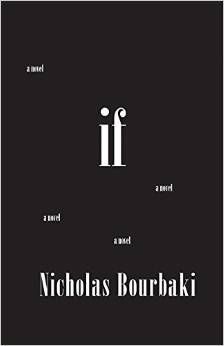
We were both wrong, as it happens; as this interview explains, Bourbaki-the-author assumed, with an extra h in the first name, a shadow of Nicolas Bourbaki the collective of pseudonymous mathematicians. His book, If, is a print choice-based novel — hefty, printed on thick paper, with “a novel” appearing multiple times on the cover as mark of both its multiplicity and its literary seriousness.

If sometimes embraces, sometimes rejects standard CYOA practice. It’s written in the second person, mostly, except when a first-person narrator crops up by surprise and many pages into the story: this first-person character is a bully, and for as long as we remember that he exists, the whole narration feels like a mean-spirited harangue against the protagonist. The main character also floats between characterization and Faceless Protagonism: he has a gender and passes through a specified series of ages, but some characteristics are intentionally withheld. On page 192, a character refers to him by name, though on page 194 we discover that this was a false identity anyway.

But having a name would probably pin the protagonist down in the wrong way. If belongs to that particular subgenre of IF whose overt hook is the opportunity to reach radically different life outcomes from the same starting point: works like Life’s Lottery, Pretty Little Mistakes (Sam Ashwell’s analysis), and Alter Ego (Jimmy Maher’s analysis).

Continue reading “if (Nicholas Bourbaki)”

Detective Grimoire (SFB Games)

Screen Shot 2014-11-19 at 1.19.03 PM

Detective Grimoire is a short (90-180 minutes, probably, depending how much you rush through the voiceover parts) point-and-click mystery adventure. It’s pretty easy — strong hints about what to do next and what you might have missed thus far, as well as a “sparkle” mode to draw attention to environmental object that you should really look at. (If you want a more classic pixel-hunting experience, you can turn the sparkles off.) The content is also reasonably kid-friendly; though you’re investigating a murder, the actual and hypothesized reasons for that murder are all kept fairly PG. Some other reviewers refer to these as “grisly” or “dark”, but I didn’t find them so; it seemed to me that the character motivations are either quite gentle or cartoonish or both. If you squint, there’s maybe a bit of an argument for preserving the wilderness, but even that is softly handled enough that it avoids any political bite.

Continue reading “Detective Grimoire (SFB Games)”

Weird City Interloper (CEJ Pacian)

weirdcitycover

Weird City Interloper is a parser-based conversation game by Pacian. Like some of Pacian’s previous work, especially Castle of the Red Prince, it largely does away with the traditional object and room hierarchy: here instead of navigating between places, you are moving from one interlocutor to another. As you go, you accumulate an inventory of characters you know about and topics you can discuss, and the point of the game is to discover the story by asking the right people about the right sequence of things. Because those options are always enumerated (and initially the list is pretty short), it feels as though the game could easily have been executed as a choice-based experience instead; this is an interesting one to look at if you’re studying the parser-choice borderlands.

The business of applying your topic inventory to different speakers sounds a bit mechanical, perhaps, and at some points it did seem as though I was just running around trying all my topics on all the characters. But at its best moments it felt much more organic than that, and several times it rewarded puzzle-solving leaps of intuition in a very satisfying way. The game also includes some well-timed help to give you hints if you seem to be lost, and this helped me past the couple of spots where I was feeling a bit stuck.

Continue reading “Weird City Interloper (CEJ Pacian)”

daddylabyrinth (Steven Wingate)

daddylabyrinth is an interactive memoir that showed in the Singapore ArtScience Museum exhibit of interactive stories (alongside Troy Chin’s Forgetting and Nick Montfort’s From the Tables of My Memorie). It explores the author’s relationship to his long-dead father, and it’s constructed of short writing passages, photographs, scanned documents, and speak-to-camera video bits. It’s a big piece of work, much bigger than you can explore fully in a setting like a museum exhibit, but because it is made up of many small accessible anecdotes, I nonetheless felt like it worked pretty well in that space.

Screen Shot 2014-11-17 at 10.37.26 AM

Like several of the interactive documentaries profiled at ICIDS, daddylabyrinth offers multiple curated paths through its assorted reflections. But it also tempts the reader with many diversions, many opportunities to go off and look at a document or a fuller explanation of a particular experience. Individual documents stand at the crossroads of different interpretive paths: dad’s army records can be part of an initial character sketch of Wingate’s father, or an element in a more thorough history of his army career, or part of a story about Wingate’s mother’s campaign to get those records altered. Many times a fresh path opens out of the middle of another, with the tempting “begin this path…” button offering a way in. Sometimes following links takes you through an unexpected loop, and over time certain pages repeat. Likewise, when you reach the end of a path, clicking the “end of path – continue” link lands you somewhere entirely unexpected and new (but thematically linked).

You may think you’re going to be able to go back to the path you first selected, but for me that didn’t happen: my curiosity always, always won out over my self-discipline and sense of order.

The effect is of course intentionally disorienting. The more information you amass about Wingate and his father, the less you have a sense of stability and direction. If you’re the kind of person who gets a little anxious about the prospect of being lost in an interactive story — if you dislike not knowing where the end is and how to get there and how far you’ve come already — then this is likely to awaken those discomforts.

Continue reading “daddylabyrinth (Steven Wingate)”

Coming Out Simulator 2014 (Nicky Case)

Screen Shot 2014-11-13 at 4.58.40 PM
Coming Out Simulator 2014 is a semi-autobiographical story about how the author came out to his parents. Interaction takes the form of menu-based conversation — conversation with the narrator in the framing story, and then a series of conversations with his past boyfriend and parents. The whole thing is illustrated in a streamlined, elegant way, and lightly animated, in a way that keeps you aware of the living breathing presence of your interlocutors even though most of what happens happens in text.

There are two things about this piece that particularly struck me. One is a piece of story content: when you’re discussing your sexuality with your mother, there’s a point at which she actually vomits from disgust. This sounds pretty extreme, and some of the subsequent references back to the moment are on the flippant side, but the moment itself did not strike me as totally unrealistic. Indeed, this captured something I have experienced myself in a different context: the sensation that it’s impossible to argue with someone because of the strength of their visceral reactions, together with guilt at making them feel that way (even when I felt that I was in the right). It also reminded me of Jonathan Haidt’s writing on conservative and liberal “moral foundations”, which argues that a strong sense of disgust tends to be associated with conservative values. Where one party feels disgust at something the other party does or thinks or wants, this is a very hard communication gap to bridge, because it is located somewhere other than the head.

Continue reading “Coming Out Simulator 2014 (Nicky Case)”