The Counterfeit Monkey puzzle chart was one of my major design aids when I was building the thing.
This is a chart of the puzzles in Counterfeit Monkey. It used to be linked from a blog post on the puzzle design, off-site, but it’s no longer at the endpoint of that link.
Instead, let’s put it here. I swear I have a good reason for doing this right now and it is genuinely not just because my blog gets the most traffic if I tweet a colorful diagram.
Don’t look too closely at the fine print if you’re planning to play and haven’t yet.
The Oxford/London IF Meetup next convenes January 29, when I will be talking about (and leading some workshoppy exercises around) storylet-based narrative design.
January 31–Feb 3, Ryan Veeder is running the first of three events in his Exposition for Good Interactive Fiction. This one is a short jam for Inform 7 games. There are a number of rules about how to participate, so please do check out the fine print.
February 15-16, Rob Sherman is running an interactive fiction masterclass at the British library. This is a paying event; tickets here.
March 20-22 in Toronto is Breakout Con, a conference on boardgames and tabletop RPGs. Some great narrative designers are scheduled in as guests.
NarraScope will be May 29-31, in Urbana-Champaign, Illinois.
Competitions
The Gaming Like It’s 1924 jam runs through the end of the month, and celebrates works that recently entered the public domain. There’s a whole list of possibilities in there that you might enjoy.
If you plan to enter Spring Thing 2020, you have until March 1, 2020 to declare your intent to enter. Spring Thing is a long-running competition for interactive fiction that welcomes longer games than IF Comp can accommodate, and features a “back garden” section for games that are unfinished, commercial, experimental, or where the author just wants to opt out of the competitive aspect of the competition. The games themselves will be due March 29.
The finalists for the Independent Games Festival were recently announced, with the awards scheduled to take place at GDC on March 18. Andrew Plotkin has been on the judging panel for a number of years, and shares his thoughts about some of the nominees here.
This video has some interesting design insight about Disco Elysium. I am told. I haven’t actually watched the video all the way through myself, because I haven’t played the game yet, because I need to borrow a Windows machine. That’s all being looked into and taken care of. I hear the video’s interesting, though.
Tools
YarnSpinner is a tool, in line with Twine or ink, that can be used to write and manage branching dialogue for games. It has now had a 1.0 release, and is available for free, though users are encouraged to support its Patreon.
Hi Emily, I appreciate the content you create to further the IF community.
I’m curious what games or platforms stand out to solve some of the issues you listed in your parser article 9 [years] ago.
I’d like to create a text heavy game with detailed world state and want to research the projects that handle these situations the best. Specifically UI driven interaction from the player.
[I then asked for confirmation that the writer would like to see this handled as a mailbag post.]:
I’d love to see a follow up on how you feel things have changed. From the perspective of a “traditional” game developer IF seems stuck in an award state [sic] of being too gamey for readers and not enough mechanics for gamers. It’s a hard problem to solve as most people aren’t writers, programmers and designers , that’s a lot of skill sets to tackle.
I’m not quite sure what “an award state” is, but maybe “an awkward state”? I disagree, though. “Not enough mechanics for gamers” or not, games from 80 Days to Choices and Episode to the works of Choice of Games to Failbetter’s entire oeuvre are making enough money and attracting enough attention to support quite a few small to medium studios. And that doesn’t touch on the audio IF, the visual novels, the interactive film, etc., etc., etc. Interactive fiction, broadly drawn, is doing fine. And I know quite a lot of traditional game developers who think so, too.
But okay, let’s set aside that part of the question. The question is about how to do UI for a game with a lot of world state and a lot of text, but without a parser.
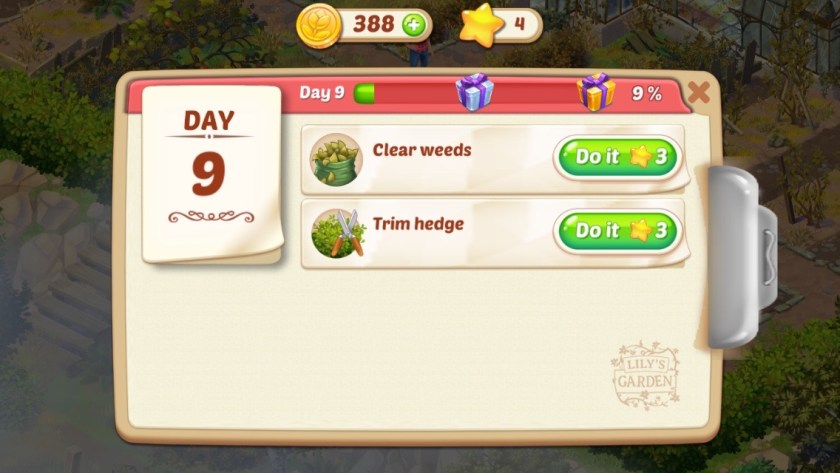
Lily’s Garden is here offering us two storylets: the story about clearing weeds and the story about trimming the hedge. Despite how it might appear, there’s actually some character and narrative advancement associated with each of these options.
A very simple implementation looks like this, interspersing every level with a little bit of story wrapper. This has been a standard method from the days of Diner Dash on:
Gating story with casual game levels
Lily’s Garden does something actually a little different, which is to let you gather “stars” by playing levels and then spend them to open more storylets. The “source” in the image below is the casual gameplay. Often, there are two or three storylets available at a time, which means you can choose which of them to play next, but you do have to finish all of the storylets assigned to a given day before moving on.
This is an effective design choice for mobile free-to-play, for several reasons.
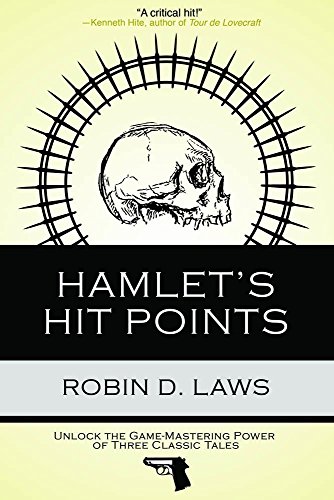
Hamlet’s Hit Points breaks down classic storylines into structures that can be deployed in tabletop (and sometimes digital) RPGs.
Hamlet’s Hit Points has been recommended to me a number of times by people with experience in RPGs, narrative, or systems design. Since I’ve recently been thinking and writing more about the stats-and-point-assignment aspects of narrative design, I came back to the recommendation this month. (It’s available as a physical book from various places including Amazon, but forvariousreasons I’m linking to Amazon less. You can get the book as downloadable content for $8 from DriveThruRPG, so that’s what I’ve linked.)
Hamlet’s Hit Points starts by acknowledging the influence of Hollywood writing guides of the kind I’ve sometimes covered here, and then offers its own kind of structural analysis of story beats, intended to cover both conventional narratives and RPGs. (The book is focused on tabletop RPGs with a human game master.)
Failbetter is a company very close to my heart: I’ve written for them many times as a freelancer over the past decade, and they provided key assistance when I was starting the Oxford/London IF Meetup. I have great respect for their focus on quality prose and storytelling, as well as their pioneering work exploring what storylet-driven narrative design can do.
I have a certain amount of freelance work ongoing from the past couple of months, with FBG’s blessing; and will have some pre-defined bandwidth to keep my hand in consulting. So if you see me out and around doing a few other things, that’s why.
I’m very excited to be on this team, and looking forward to what we build together!

 January 17 is the deadline for proposals for
  March 20-22

 The finalists for the Independent Games Festival were


 Emily Short's Interactive Storytelling