I’ve covered many books on game writing here over the years, and I’ve collected and linked a lot of online resources on narrative design and on the history of IF design in particular. I also recently did a post about blogs in this space; and here is one about podcasts.
Continue reading “Game Writing and Narrative Design Podcasts”Author: emshortif
Signs of the Sojourner (Alpha, Crowdfunding)
Signs of the Sojourner is an IF-friendly work with a beautifully expressive conversation mechanic that focuses on our resources and style of interaction rather than specifics of dialogue choice.
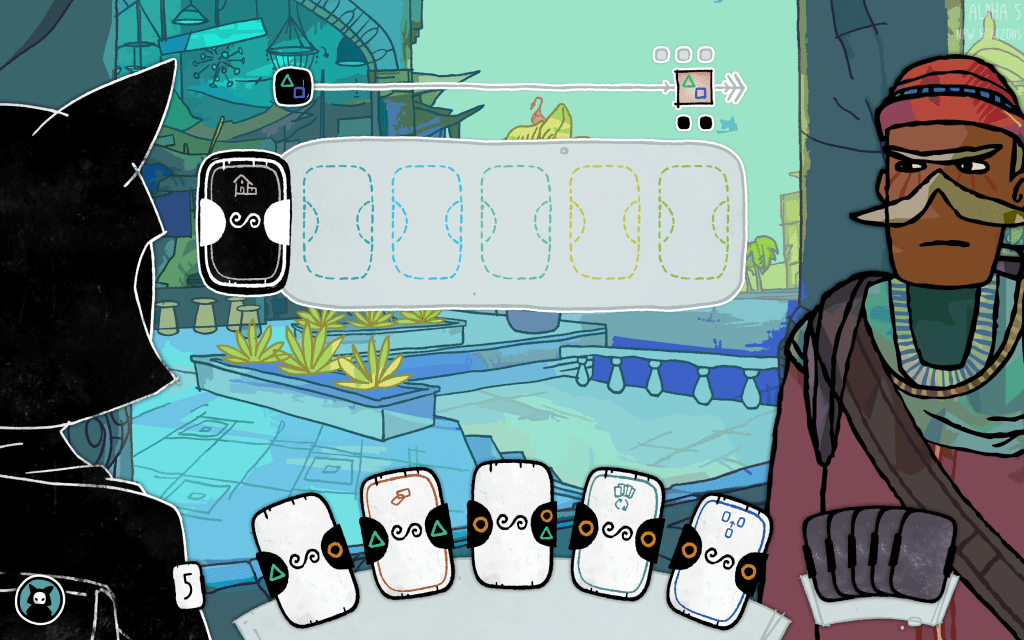
Signs of the Sojourner is a conversational deck-building game by the small indie studio Echodog, currently crowdfunding on Indiegogo and featuring writing by the excellent Kevin Snow. A polished, substantial demo is available on itch.io.
In short: I saw Kevin Snow’s pitch about this game and thought, neat, any game with Kevin’s writing is worth a look. Then I paid a couple dollars to download the demo from itch — you can of course get it for free, but it seemed polite. Then I played the demo through from start to finish, twice, getting significantly different experiences in the two playthroughs.
When I got to the end of the second play, I was having so much fun that I really felt quite sulky about the fact that this was just a demo and that I can’t play the full game until later.
Since I really want the full game to exist in maximum glory, I backed it and then came over here to tell you about why it’s cool. And as I wrote up this post, I needed a few more screenshots and wound up replaying almost all of the alpha for a third time because I was still having fun and discovering some new things about how the mechanics worked.
Continue reading “Signs of the Sojourner (Alpha, Crowdfunding)”Patchwork Girl (Shelley Jackson) and Spatial Hypertext
Reading Shelley Jackson’s classic 1995 hypertext, from the perspective of the present. Part of a series on literary hypertext.
This is part of an ongoing series of posts looking back at literary hypertext of the 90s and early 2000s, considering both example texts and contemporary scholarship and theory. Here we look at the concept of spatial hypertext.
The move from document-centered hypertext systems to map-based hypertext systems had some unforeseen but far-reaching implications: relationships between nodes could be expressed in more than one way. Maps showed interconnectedness explicitly, usually in the form of a directed graph. But also node proximity came into play; relationships among different nodes or documents could be indicated simply on the basis of their relative location. The use of these map-based hypertext systems to author new information spaces uncovered an interesting phenomenon. Users avoided the explicit linking mechanisms in favor of the more implicit expression of relationships through spatial proximity and visual attributes…
Spatial Hypertext: An Alternative to Navigational and Semantic Links, Frank M. Shipman, III and Catherine C. Marshall, ACM Computing Surveys 31(4), 1999.
“Spatial hypertext,” in this context, does not refer to pieces that map sections of text to a physical geography. There’s a fair amount of that in modern interactive fiction, perhaps because of the cross-pollination of ideas with parser IF. Reed Underwood even wrote an article for Killscreen about spatial hypertext that does use that phrase to mean “hypertext that represents a concrete physical space.”
Here, however, we’re using the older sense: hypertext where the connections between sections are visually represented to the reader in a kind of mindmap construction. Sometimes that mindmap might happen to resemble an object or physical location, but it might just as easily have some entirely different shape, conveying an entirely different kind of relationship between elements. Clicking on different nodes of the map navigates the reader to new contents.
On the screen, spatial hypertext can look a little like a shape poem, except that the blocks themselves contain significant amounts of text, or additional block arrangements of their own. Here is Shelley Jackson’s Patchwork Girl, published in 1995:

Mailbag: Pedagogical Uses of IF in the Classroom
Pardon, may I ask for some suggestions of resources (articles, short essays) about Interactive Fiction in classrooms? Thank you very much.
And then when I asked whether they were looking for IF taught as the subject or as a means to learning other things:
Surely I’m interested in IF used as a pedagogical tool, as broad as possible (in terms of grades, subjects, case history). An introductory (and inspiring!) blog post would be very useful. Thank you!
Interactive fiction has a long history of classroom use at most levels (a little bit of elementary-level use, but then more in middle school, high school, and university teaching). Several researchers have built syllabus materials that make extensive use of IF; have published about IF-related pedagogy; or have given talks and workshops about how to teach using interactive fiction. At NarraScope, for instance, there were some workshops on this topic as well as a panel on IF and education.
I haven’t done much hands-on work with this myself, but here are some links that may be useful in this area:
Continue reading “Mailbag: Pedagogical Uses of IF in the Classroom”The Cambridge Introduction to Narrative (H. Porter Abbott) – Chapters 10-14
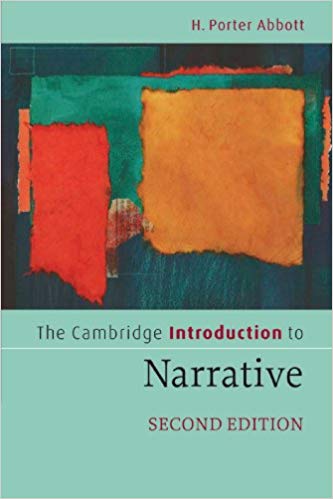
The Cambridge Introduction to Narrative is a book I’ve been chewing on now for several months, since it raises a number of issues about how to describe and think about narration but doesn’t (except occasionally and briefly) attempt to apply those terms or concepts to interactive literature. So this series has become less anything resembling a review than a set of responses and observations; although I am still trying to summarize the contents just enough that someone who might not want to read the whole book could come away with a clear sense of its subject matter and purpose.
Continue reading “The Cambridge Introduction to Narrative (H. Porter Abbott) – Chapters 10-14”IntroComp 2019
IntroComp is a recurring competition featuring game ideas that the creators are considering fleshing out into full games. This year’s crop includes a wide variety of styles.
IntroComp is an annual IF competition that invites authors to contribute partial and unfinished works for feedback. IntroComp 2019 is currently in progress, and if you’d like to check out the work here, you too can judge the entries.
Below the fold, some words on a few of the entries that I had time to play — but you may want to try them out yourself without spoilers.
Voting closes August 31.
Continue reading “IntroComp 2019”
 Emily Short's Interactive Storytelling