Interactive Narrative GDC Talks (Part 1)

Every year GDC talks are recorded and stored in the “GDC Vault”, which is accessible to people who have attended a recent GDC. There are also usually a few talks that are outside the paywall, though — and this year, there are quite a few non-paywall talks that might be of interest to IF and interactive narrative folks. There are also quite a few talks where the actual recording is behind a paywall, but the slides are available for free.

There are so many recommendable talks in this collection that I’m going to break them out over a couple of posts, starting with these fairly IF-specific talks:

Leading Players Astray: 80 Days and Unexpected Stories, Meg Jayanth, Freelance/inkle. (Slideshow, recorded talk.) An entertaining and watchable presentation about the tension between 80 Days’ boardgame mechanics and the story and the way the game tempts players into embracing bad strategy decisions. Meg also talks about the research that went into building 80 Days and the process of constructing the story as a whole.

Adventures in Text: Innovating in Interactive Fiction, Jon Ingold, inkle. (Slideshow, recorded talk.) Talks about narrative structure and tool implementation in inkle products, usable lengths of text, choice design, and a lot else. Well worth a look for anyone working in the choice-based game space.

Classic Game Post-mortem: Adventure, Warren Robinett. (Slideshow, recorded talk.) This is about the construction of the action-adventure game Adventure for the Atari 2600, but it talks about how that game was based on the Crowther and Woods game — and it also gets into a lot of delightfully sticky detail about the memory costs of a lot of the game elements. The latter is something that people working on interactive fiction now only have to worry about rarely, and usually only if they’re doing something either very large or targeted at a very restricted platform. A neat piece of game history with IF relevance.

Harvesting Interactive Fiction, Heather Albano, Choice of Games. (Slideshow only.) Intended to acquaint games narrative folks with recent developments in IF, this talk covers material that may already be familiar to IF veterans. Includes discussion of Hadean Lands, Codename Cygnus, Blood & Laurels, various Choice of Games titles, and much of the inkle collection, among other things. Edited to add: it’s a little hard to work out fully from just the slides, but I meant to mention that Heather did talk a lot about the use of ambiguity in text, and the storytelling leverage that you get from not overspecifying everything (which is sometimes easier when you’re working with words and not a full 3D model). This is an interesting area I’ve heard the Choice of Games folks talk about on various occasions but I’m not sure it’s gotten the discussion traction of some of the other concepts here (such as complicity).
Twine Shorts: Silver and Gold (Rosencrantz); Isis (Liz England)

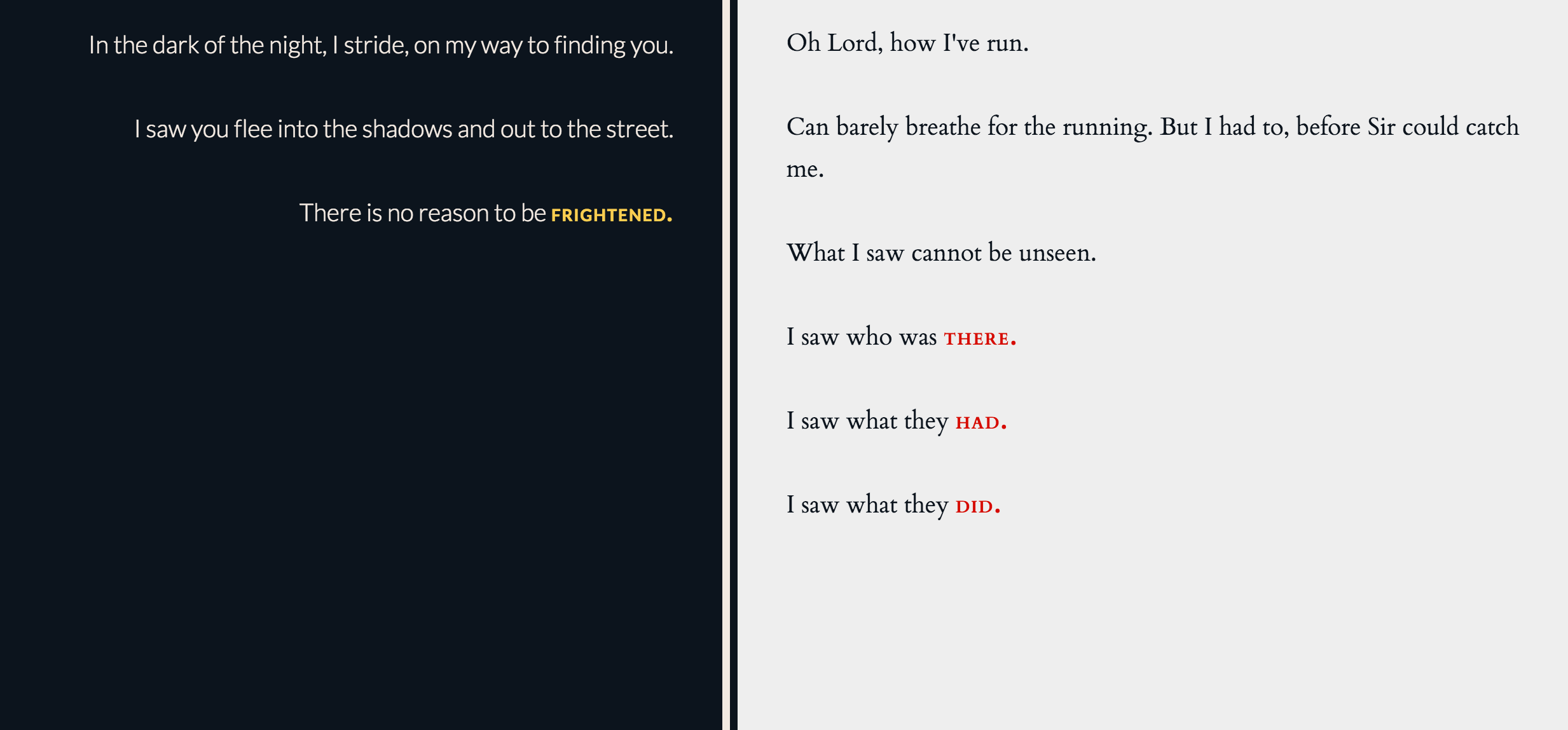
Silver and Gold is a Twine piece “in two voices” by Rosencrantz. It’s a bit similar to Origins from last year’s IFComp, in that it presents two competing views of what is going on side by side:

Screen Shot 2015-04-01 at 4.00.00 PM

Silver and Gold is more of a story and less of an experiment than Origins, though: there’s more at stake, and we get more of a sense of the two main characters and of the way the agency of one constrains the other. There are times when one character or the other is locked in a sort of reverie that doesn’t affect the other; there are also times when one character gets a chance to make a definitive move that alters the other’s state. At a couple of points, seeing the same effect from two viewpoints allows you to grasp what is happening more completely than would otherwise be possible (one character can hear something that is out of earshot for the other, for instance).

The two characters in question are locked in a dark horror/fantasy situation that can end in one of at least two ways (I played several times and found two endings and no obvious directions that might have led to more, but that doesn’t guarantee I didn’t miss something). The content of the story affected me less than the way the story was told — some of the backstory adheres to standard tropes, while other parts are a bit underexplained. Nonetheless, a piece with some cool formal aspects, and the most successful I’ve yet seen to make use of simultaneous dual-viewpoint narration.

*

Isis is a science fiction piece casting the player in the role of the AI life support system on a sentient space craft. It allows you to respond to your pilot in various ways, including trolling him with disobedient or subversive interpretations of his orders. If you don’t, and behave like a good little spacecraft, then the story nodes eventually start to loop and becomes boring: this creates a kind of meta-game motivation to perform the AI-spaceship-goes-mad trope. It’s not long, but I found it amusing.

The Toaster With Two Brains (Thrilling Tales of the Downright Unusual)

Screen Shot 2014-12-07 at 5.03.13 PM

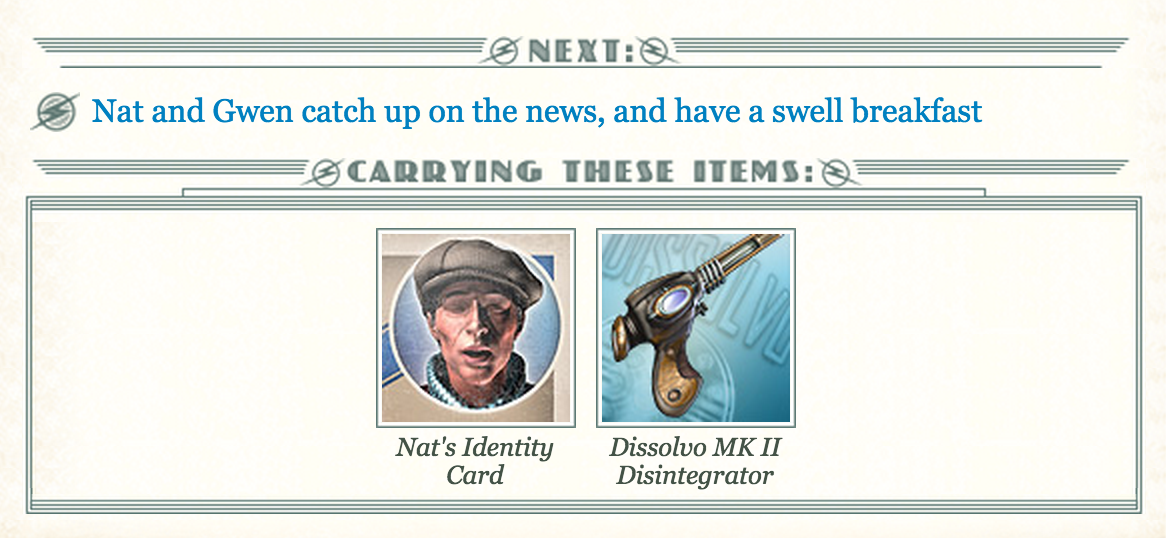
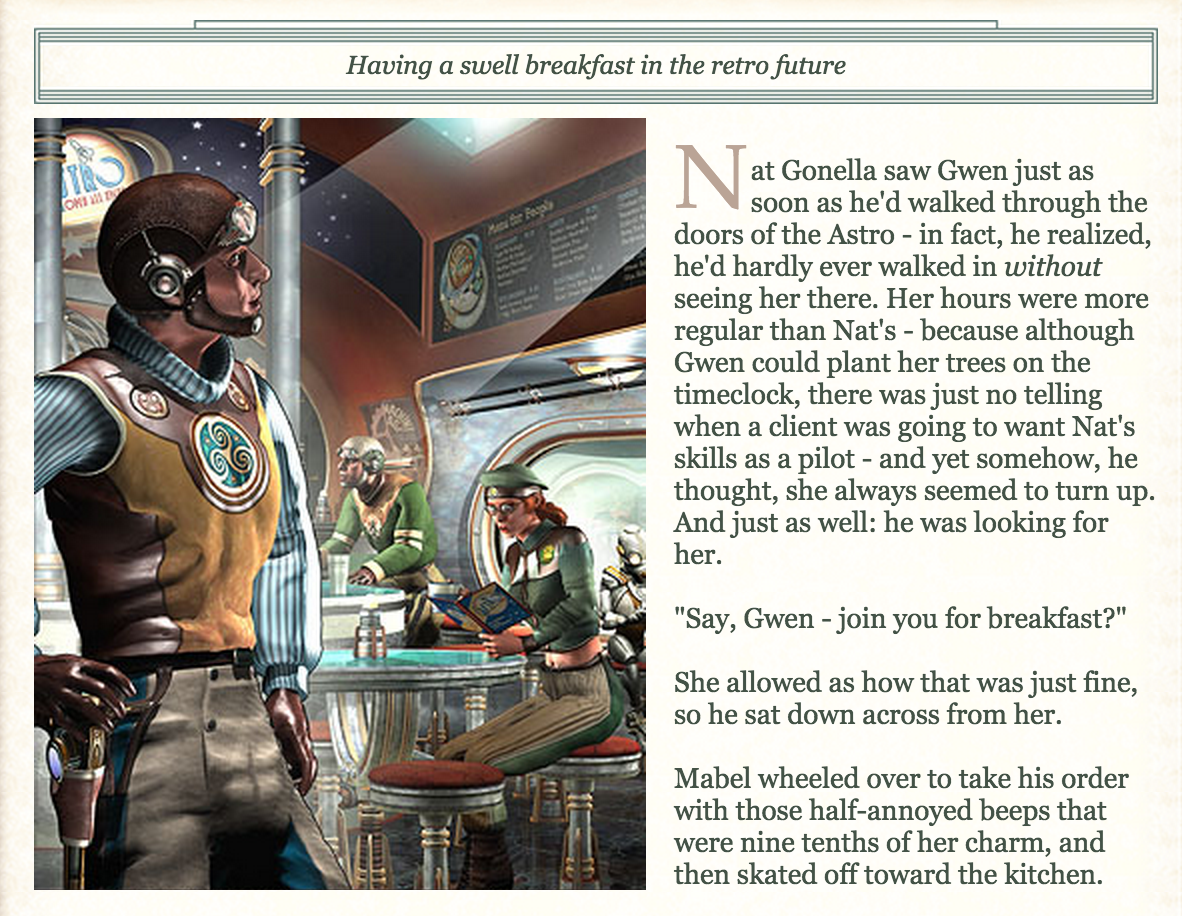
Thrilling Tales of the Downright Unusual is a website for retro-futuristic illustrated choice-based fiction, set in a shiny chrome and leather universe with lots of Deco machines and mad science. Choices often run to 1-3 options, and there’s an always-present inventory list, reminiscent of but significantly fancier than ChooseYourStory games:

Screen Shot 2014-12-07 at 5.06.24 PM

The majority of the choices are exploratory: you are choosing which objects to examine and which questions to ask of NPCs. Very occasionally you’re offered choices that seem like they might affect events, but the plot strands rejoin almost immediately, via standard sorts of agency-denial: you ask a character to come with you, but they refuse; you attempt to head the wrong direction, but it’s blocked. Even the inventory is a bit deceptive: games with inventory usually let you accumulate and drop things in ways that are likely to make a difference later in the story, but as far as I can tell, your inventory is very much determined for you, and it’s impossible to get to a particular story branch with any variation in your inventory list.

You also several times have the option of following the male or the female protagonist, getting a significant portion of the story from their perspective. Later, when the characters meet up again, you get filled in on what happened to the character you did not follow. The overall effect is that the story does contain significant branching, since you see different nodes if you’re playing as Gwen than if you’re playing as Nat, but that branching provides reader agency rather than player agency.

Continue reading “The Toaster With Two Brains (Thrilling Tales of the Downright Unusual)”

Coulda, Woulda, Shoulda (Tara Reed)

Screen Shot 2014-12-01 at 4.17.41 PMTara Reed’s Coulda, Woulda, Shoulda is a CYOA-style dating novel that initially appears to be a little in the vein of Night of a Thousand Boyfriends or the Date Him, Dump Him series. You’re a twenty-something San Francisco-dwelling PR flak (though we only occasionally see the slightest indication of what you do for a day job) with a couple of sassy gal pals and one obligatory gay friend. You go out for a night on the town and meet a wealthy, jaw-chiseled guy named Nick. What now?

The result is a story that runs fairly long for physical book CYOA — over 330 nodes, most of them at least a couple of pages of narration — and if your relationship runs a substantial course, it might include a hundred of those nodes.

ETA: Since my original post, the book’s title has been updated to “Love Him Not,” which hopefully does not cause too much confusion. As far as I can tell, the book’s contents are essentially the same.

Continue reading “Coulda, Woulda, Shoulda (Tara Reed)”

Choose Your Erotica

[Editor’s note, several years on: this article has been around for a while, and some of the works it talks about are no longer available to play. But the article is still getting regular hits, and I can see from outgoing links that people are trying to find and play those pieces.

Clearly there’s a lot of interest in this topic, and most of the time, when people are coming to my site for resources, I try to put together some kind of reliable resource list. However, I don’t want to maintain a main page on my website that will serve as a frequently-updated repository of interactive porn and erotica, since I feel like that might sort of give the wrong overall idea about what I usually discuss here. Not very on-brand.

SO. Compromise: I will occasionally add some links to the top of this post that seem to be currently functional.

Now, on to the actual article as originally posted.]

Parser-based AIF — “adult interactive fiction” — has been around for a long time, though it has generally had its own forums and meeting places; every once in a while someone would turn up on rec.arts.int-fiction with a coding question about layered clothing, or submit an adult game to a competition, but for the most part AIF didn’t overlap much with the main IF community. I did play a few pieces, but they were usually aimed unambiguously at heterosexual men. A common structure was to have a series of puzzles that would “unlock” sex scenes with assorted partners. (Here’s a review I did back in 2006 of Ron Weasley and the Quest for Hermione, for instance.) Sometimes these were cut-scenes, but sometimes you could use parser commands to do a play-by-play of which parts went where.

As choice-based IF has become more prevalent, so has choice-based, female-POV erotica. Here I take a look at several. I’m not going to be quoting long passages or posting images, but this may still not qualify as SFW depending on where you are.

Continue reading “Choose Your Erotica”

Slammed! (Paolo Chikiamco / Choice of Games)

Screen Shot 2015-02-05 at 6.29.58 PM

Paolo Chikiamco’s Choice of Games game Slammed! has been around for a while now, and has enjoyed a reputation as one of CoG’s better works. It just became available on Steam, and I took that occasion as an opportunity to check it out.

The premise is that you’re an aspiring wrestler who gets a chance to break into the pro circuit, developing your skills and playing out a bunch of matches in the ring. On the face of it, this doesn’t sound like my kind of thing — the only two wrestlers I can name are Hulk Hogan and Jesse Ventura, and I just had to double check on wikipedia to make sure I was remembering them right — which may be why I put off playing Slammed! despite the good reviews.

Chikiamco, on the other hand, clearly does know and care a lot about wrestling, and he writes about it in a way that feels both compelling and reasonably accessible to the non-fan, constructing a detailed world full of strong personalities. What’s more, the themes that come out of the premise are things that interest me: career vs personal loyalty, the cultivation of professional persona, the development of both skills and relationships, the fine line between being a team player and letting yourself be taken advantage of.

Continue reading “Slammed! (Paolo Chikiamco / Choice of Games)”