This is one of several design articles about the new interactive narrative platform Versu, which Richard Evans and I have been building with a team at Linden Lab.

The first several stories implemented for Versu are written for a generally Regency-period sensibility, influenced heavily by Jane Austen, and less-heavily by several of her contemporary authors, as well as more recent writers such as Georgette Heyer and Patrick O’Brian. We did not pull quotes from the more recent authors whose work is still in copyright, but we were aware of some of the tropes that those authors have brought into reader consciousness.
That wasn’t at all an inevitable choice. Versu as a platform is up to representing lots of possible periods, genres, and sub-cultures, and the next content we release will introduce material from another genre, so I’d like to talk a little about why we started where we did.
Why Austen?
We chose Austen’s world as a starting point for Versu because — though the system is up to all kinds of possible content and genres — Austen’s work takes place in a world of precisely defined manners that is nonetheless fairly familiar to contemporary readers.
The focus on manners, and the relatively large body of prose all referring to the same social milieu, meant that Austen gave us a lot of different examples of characters reacting to one another, speaking with subtext, and following (or failing to follow) implicit social rules. This made for terrific sample material on which to test and robustify Versu’s system. We reasoned that if we could make something strong enough to account for many Austen situations, we would be able to use that same system to describe the wide range of other socially focused stories we wanted eventually to be able to tell.
Other highly mannered societies would also have been great fun to model — Heian Japan came to mind. But it seemed like a dangerous idea to start with something where the average reader would have so very much to learn about the society in question just in order to anticipate the results of her actions. We wanted a reader’s first encounter with Versu to be one in which she experienced a sense of agency because she did know how to influence other characters. (For the same reason, the second Versu genre is a modern office setting — again, to establish accessibility.)
Down the line, we can imagine Versu being used educationally to do precisely this — introduce a particular historical period with its unique concerns, allow students to create models that represent the results of their research, or teach players about social expectations in specialized contexts. We can also imagine stories about alien worlds with vastly different manners that the reader needs to learn to navigate: socially focused speculative fiction.
How Austen?
From Austen, we drew a lot of particulars of what to model in a shared genre-specific library. We read through Austen’s novels, unfinished works, and letters, and extracted information to feed into Versu’s model.
In Austen, what do characters evaluate about one another? About themselves? Propriety, attractiveness, intelligence, and social status came up a lot.
What relationships are important? Various stages of romantic connection, from Frank Churchill and Emma’s light flirtation to Jane Fairfax and Frank Churchill’s serious (but secret) engagement came into play; family relationships were important, and so was the question of who was destined to inherit from whom.
Marking up Austen this way also turned our attention to some things that the Versu model didn’t originally include, or didn’t handle in a sufficiently flexible way. Austen characters spend quite a lot of time speaking explicitly about their values and beliefs, from Lady Catherine pontificating about the importance of musical accomplishment to Elizabeth talking about whether she thinks a man’s poverty would be enough to dissuade her from marrying him. From the outset, we had modeled the idea that different characters would care about different issues, so one character might be status-conscious while another was more susceptible to a pretty face. But we hadn’t modeled the ability for characters to explicitly discuss these values, argue about them, and change their minds. Drawing from Austen, we added dialogue elements that handled these types of conversations; and characters who, if persuaded to change their minds about a particular value, would then act slightly differently as a result. Characters in Versu who care strongly about propriety will have a different set of available reactions than ones who don’t care about it at all, for instance.
Several anecdotes from Austen’s letters became fodder for dialogue, such as her description of a storm that damaged several of the trees in the neighborhood. The letters also supplied a number of generalized moral and ethical statements that we pulled as dialogue when characters are talking about their beliefs.
From Austen and Austen-related research materials we also derived a lot of information about common contemporary entertainments and social scenarios, which set up the background for scenes in which characters are getting to know one another or resolving social states. There are a number of songs that characters can perform in the Regency Versu scenes, for instance, whose lyrics are drawn straight from Jane Austen’s songbook. Fordyce’s Sermons, mentioned in Pride and Prejudice, becomes a text from which characters may read aloud genuine snippets.
Sometimes these researched treatments surprised us a bit: for instance, the order of presenting dishes at a Regency dinner was quite a bit different from the course-by-course handling we’re used to. Far from starting with a soup or salad course and working through fish and meats, Regency tables often featured a wide selection of dishes simultaneously — so that’s what we described in “A Family Supper.”
How NOT Austen?
One of our early playtesters reacted with a pretty harsh “hey, I love Austen, and this IS NOT AUSTEN” response. And that’s a completely fair remark. There are a lot of things about Austen that we could not emulate or chose not to include.
Prose Cadence and Viewpoint
Perhaps the most obvious is the texture of Austenian prose. Austen writes a lot of very long paragraphs, and frequently summarizes the events of long periods of time, or overall impressions that characters take away from multiple encounters. Because we wanted to focus on moment-to-moment action, we deliberately moved away from Austen’s prose cadence. We were more invested in the idea that the player would be allowed to make large or small social moves: it was that Austenian sense of cumulative small details as well as grand gestures that we focused on most.
Similarly, Austen has a very distinctive style where she subverts the supposedly dispassionate third-person and uses it to reveal a character’s interiority. The very first sense of Pride and Prejudice (“It is a truth universally acknowledged…”) is not a truth universally acknowledged — it is from the perspective of a particular character: Mrs Bennett.
(Richard notes: This technique is not just a cheap stylistic trick, but is arguably [according to Bharat Tandon at least] at the heart of her vision: there is no dispassionate third-person external view from nowhere: we are always already seeing the situation from a particular, value-laden perspective, always already engaged, committed, etc.)
We don’t do this at all in Versu. Once we committed to the play-format, we couldn’t. Committing to the play format was the right decision for us for a ton of reasons, but it does mean we can’t do free indirect style.
Playability Concerns
Despite the research that came into play, history fans and Austen buffs will find many many ways in which we ignore or contravene period conventions. Versu’s Regency genre file doesn’t, for instance, rigorously enforce the different titles characters use for one another. Properly speaking, characters in Austen address one another in ways that are very much dependent on their relationship states, with the use of first names typically being acceptable only between intimates. In practice, what we found was that trying to use this system uniformly made gameplay confusing: now the reader was expected to track interactively not only all the characters in the scene, but also all the things they might call one another. So we dialed this back. It is possible to specify direct address methods between two characters, so that a lady might address her husband as “my dear,” but Versu doesn’t aggressively manage this.
Another point is that Austenian plots tend to focus heavily on character problems rather than on striking events. What will happen between Elizabeth and Darcy? Will Anne Elliot ever reconcile with Captain Wentworth? Can Fanny Price ever obtain happiness, when her horizons are so limited?
These are terrific stories, but a literal adaptation of them makes for directionless gameplay, especially in the opening moves. We found that just setting the reader down in a ballroom with some emotional malaise didn’t make for strong engagement. Instead, we needed something where the protagonist’s problem was more clearly defined, more immediate, more demanding.
That’s why we pulled in mystery and gothic plot elements for two of our longer stories, even though Austen herself engaged with the gothic primarily in order to make fun of and subvert it, in Northanger Abbey. We probably could have explored a more Austenian genre-subversion, but we felt that at the beginning of the project, genre expectations were positively helpful to us, because they give the player hints about what to expect to be able to accomplish in the story.
(And to be fair, even Austen sometimes made use of a strong precipitating incident — the unfinished Sanditon begins with an overturned carriage and a wounded protagonist.)
Another significant playability point is that Austen’s characters practice quite a bit of deception, from Frank Churchill’s fake flirtation with Emma to Edward Farrars’ silence about his engagement. This makes for fun reading, and to a limited extent Versu characters can also practice deception. But we had to tread a fine line here. Versu doesn’t (currently) implement very deeply the question of what characters believe about the knowledge states of other characters — this quickly becomes a very very complicated and recursive business — and that ruled out certain treatments of deception. We were also concerned that if characters did too much lying and other deceptive behavior, perfectly correct simulator output would look like a mistake to the player, because characters would be responding based on information the player didn’t have.
This question of character deception is one I’d love to come back to and address more systematically, but we felt that both from a modeling and a gameplay perspective, we first needed to nail the honest social interaction, reach a point where the player had a strong sense of social agency, and earn some reader trust. Only after that will we be ready to model complex secrets and lies.
Thematic Challenges
Austen’s world is rigorously heteronormative, and all her characters are presented as straight. We wanted to avoid building those assumptions into the engine. At the same time, we wanted to avoid startling readers who were trying to keep to canon by having an AI-driven NPC Mr Darcy unexpectedly hook up with an AI-driven NPC Mr Bingley, contrary to their canonical behavior.
So the compromise we settled on was this:
- characters can be defined to be interested in zero, one, or multiple genders (and the system is able to acknowledge genders besides male and female, though there are no Austen characters who embody this)
- a character driven by a player can ignore their character’s pre-defined sexual preference and make advances to others; so a player controlling Elizabeth may make advances to another woman
- a character driven by the AI will by default adhere to their specified preference, so an AI-driven Elizabeth will not make advances to another woman by default
- if a player character makes advances to an AI character, that will automatically make that AI character open to the player character’s gender
- any characters who can reach a state of strong romantic involvement may become engaged, though engagement and marriage are not acknowledged for non-straight couples in Regency England; the only way this can happen in the simulator is for a player character to take action in that direction
There are still a lot of situations this doesn’t cover: it’s obviously possible that an author will want to write a story about the protagonist’s fruitless crush on a person who isn’t interested in her gender, for instance. Some ways to address this are in the works.
A related point is that there’s a lot of gender-role policing inherent in the manners of the Regency. Men are expected to behave one way, women another, and characters tend both to talk about these differences in essentialist ways, but also to give strong feedback to those who stray beyond their “appropriate” gender presentation.
Here again we took a route of trying to constrain the AI characters but not necessarily the player. Non-player women can’t challenge one another to duels; player women can, if they choose.
Another 19th-century vs. 21st-century challenge came from the treatment of mental illness in “House on the Cliff.” The mad person is a staple of the gothic novels from which we were pulling tropes. On the other hand, 19th century treatments of mental illness don’t align very well with our 21st century knowledge of those conditions, and a growing desire not to stigmatize them or spread misinformation.
The compromise we made here — and I don’t know whether this was the right approach or not, honestly — was to try to make the story’s “madness” as obviously trope-madness as possible: a representation of a story feature from a particular period and genre, not a representation of the way mental illness works in the real world. “House on the Cliff”‘s “mad” people contract madness almost as a Lovecraftian disease.
In all of these cases, I’m very conscious that we’re walking an uncomfortable line, and it’s because there are so many different ways to engage with the mores of the past:
- represent accurately and uncritically (and even this raises some issues: Austen’s omission of gay characters obviously doesn’t mean that no one in the Regency was gay, so “Austen’s Regency” and “the actual Regency” are different creatures — which do we want to present “accurately”?)
- represent accurately but with criticism (e.g. by showing negative outcomes of historical expectations)
- represent inaccurately, treating the period as a fantasy dressing for some subset of modern mores (since “modern mores” doesn’t even refer to a single set of beliefs)
…and ideally I would like Versu to be a platform that allows people the full creative spectrum — to fantasize, to create escapist literature in which their Mary Sue self seduces Mr Darcy, to build crossovers and slashfic to their heart’s content; to create fun experiences for their friends, grounded in in-jokes and private connections; to write serious critiques of the past or the present; to put the player in a hard situation and use that to teach a particular, personal reality; to share what their own lives are like.
We’re a long, long way from handling all of those possible uses of the system — but that’s part of the reason that user content is so vitally important. And is why the next thing we’re working on is opening up the user tools.


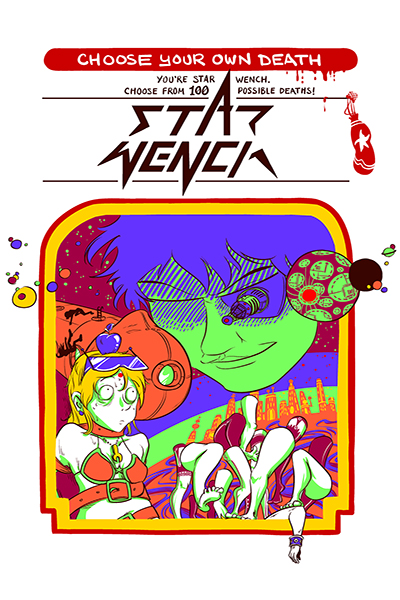
 is a Choose Your Own Death book by Anna Anthropy. Not Choose Your Own Adventure, because (aside from the whole trademark issue) you don’t get to pick what leads up to the death:



 Emily Short's Interactive Storytelling