Threaded Conversation Public Beta

“Threaded Conversation” is the extension I used to build Alabaster: a large and complex piece of work implementing a lot of my ideas about conversation modeling for use with Inform 7.

Threaded Conversation is capable of handling several styles of interaction: old-school ASK/TELL, something closer to menu conversation, or (the default) a prompted ASK/TELL similar to the default TADS 3 conversation system. It dovetails with some of Eric Eve’s conversation extensions to automatically handle greeting and saying goodbye to characters. Without implementing anything as rigid as a dialogue tree, it has a concept of conversation topics, recognizes when the player significantly changes the subject, allows for NPCs to direct conversation towards areas of their own interest, and is capable of tracking character knowledge separately from the way the character might choose to express that knowledge. I’ve successfully used it for both two-person and multiple-person conversation modeling.

It does not include any built-in features for artificial intelligence on the part of the NPCs, but because it has a concept of “things the NPC wants to say urgently/at some point in the future” that can be freely adjusted, it dovetails reasonably well with author-designed code to determine what the NPCs should want to say next.

The intention had always been to polish and revise this extension and its documentation, then release it for use by the rest of the community. In practice, what happened was that I got it a good way towards the finish line and had an extension that I myself was happy to use, but that was probably incomprehensible to other humans. Occasionally someone would ask me for a copy and I would send it off… and never hear anything more about it, presumably because the people receiving the code weren’t able to do much with it.

Then I changed careers and life paths into one that leaves me a lot less spare time (and where I’m doing enough coding in my day job that my energy when I’m done winds up in other places). The good news, however, is that Christopher Conley stepped forward and volunteered to do the work needed to adapt Threaded Conversation into something other people could use.

He’s revised the code and documentation, and is now looking for volunteers to beta-test the extension and its documentation. If you’re interested, check out his posting on the intfiction forum for contact details.
Bee out in Varytale Reader’s Beta

Varytale is a platform for interactive stories that fall somewhere on the spectrum between stateful CYOA (like Choice of Games) and quality-based narrative (like Echo Bazaar).

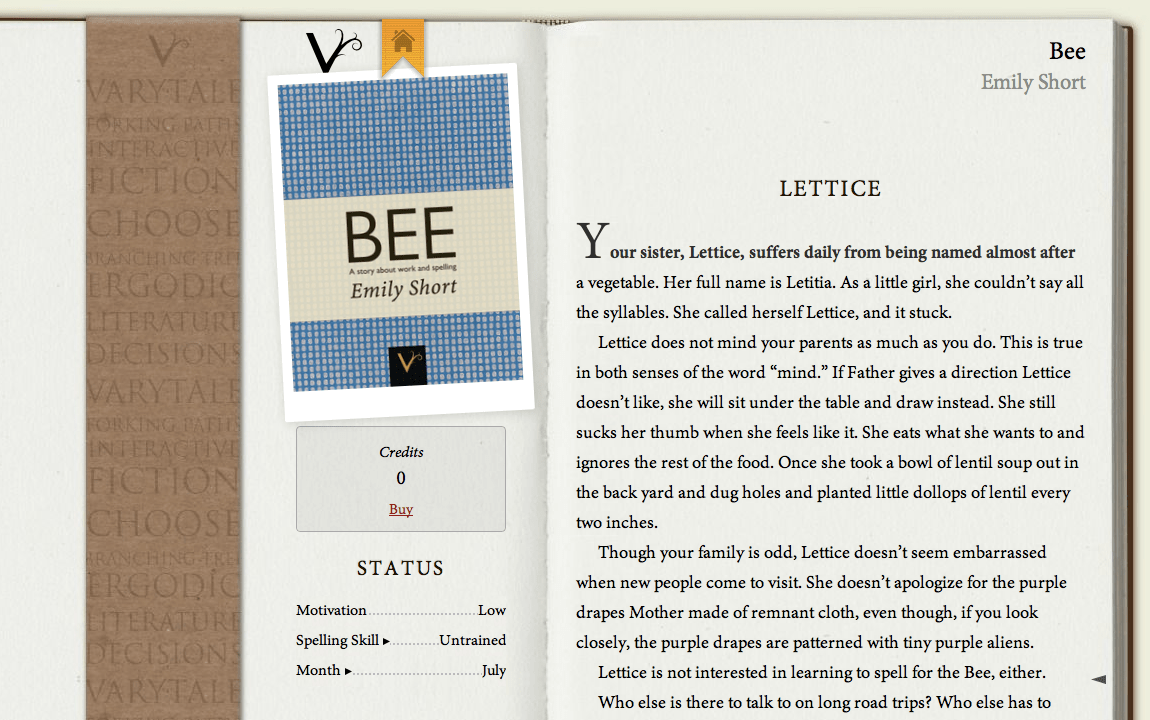
As you can see from the screenshot, the experience is intentionally booklike and lushly textured. Varytale borrows or improves on the attractive qualities of Undum. There are visible stats if the author wants them (or else not). Choices can appear as links embedded in the text or a list of options immediately following it. You can keep track of your place in a book with one or several bookmark ribbons, which grow longer over the cover of your book the more you’ve read.

Currently the reader’s beta offers access to four official books:

I haven’t gotten very deeply into Fighting yet, but How to Read is a tidy, brief introduction to how to use Varytale and is likely also to be interesting to anyone thinking of writing Varytale books in the future. Hymn and Shanty is more like interactive poetry, allowing the player to choose stanzas to add to a song. There’s also a growing collection of reader-submitted stories.

Bee is a new work of mine, written for Varytale: it’s the story of a home-schooled girl preparing to compete in the national spelling bee, dealing with various small crises with family and friends, and gradually coming to terms with the clash of subcultures involved in belonging to a family like hers.

Bee is not reviewed anywhere that I know of (unsurprising given it’s only just out), though one reader had this to say:

It’s fascinating to me, how the family dynamics and cultural dynamics–and the growth of the main character–weave in and out with the concentration on learning how to spell strange and unusual words. The protagonist has a distinct personality, but the choices she (well, you) make are constrained and opened both by earlier choices, and cultural indoctrination, and all sorts of other things. And it often comes back to spelling: as a concentration tool, a mode of defiance against parents, a meditation on spiritual matters.

If you heard about the Varytale beta before now and went to have a look, you may have encountered a version that was action-metered so that you could only play a few steps at a time. I don’t feel like that was perfect fit for the book. The platform has been revised so that it’s now possible to remove that requirement, and I’ve done so; if you want to read Bee in pieces, that’s still possible, but you can also go straight through if you want. (Though the screenshot includes a bit about “Credits”, Bee is currently free and requires no purchase.)

There’s quite a bit to say about the Varytale authoring tools as well: unlike its predecessor Undum, Varytale offers a fairly significant set of tools for putting a book together. But I’ll save that for another post.

Edited to add: some additional comments on Metafilter, Free Indie Games, IFDB review, Gamespite thread.

Bundle In A Box – Adventure Bundle

Out today at bundle-in-a-box.com is a very reasonably-priced bundle of adventure games, both graphical and text, including new work by Jonas Kyratzes (screenshot above). Konstantinos Dimopoulos explains:

We will exclusively debut the whimsical The Sea Will Claim Everything by Jonas Kyratzes and offer six more games: Gemini Rue, Metal Dead, The Shivah, Ben There, Dan That!, Time Gentlemen, Please! and – for the first time ever – the downloadable version of 1893: A World’s Fair Mystery text-adventure (previously only available as a physical product). Yes, we are indeed hoping to further fuel the current Adventure Game Renaissance!

While I haven’t played the graphical games in this collection, I’ve heard great things about The Shivah and Time Gentlemen, Please!. 1893 remains one of the most extensive settings ever offered in text adventure form, a meticulous historical recreation that is engaging to explore whether or not you choose to engage with the plot and puzzles.

Pricing for the Bundle In a Box follows the pay-what-you-want model with a low minimum; proceeds go to establishing an indie dev grant fund and to charity.

A Small Roundup of Interesting Things

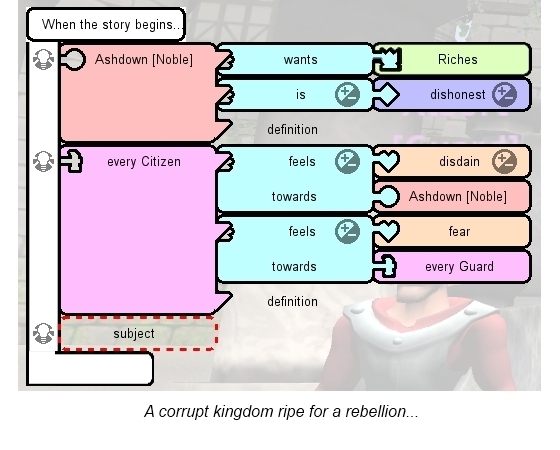
Storybricks, now fundraising on Kickstarter, is an AI project to allow users to create generated stories in an MMO environment. The project provides an authoring tool for establishing characters’ desires, relationships, moods, and basic conversation:

The engine then brings the results to life within a 3D fantasy kingdom. The Storybricks team has posted a public demo that you can try out for yourself.

Playfic, Andy Baio and Cooper McHatton’s website for playing and writing Inform games online, has had a successful three months, with hundreds of new games posted and (collectively) around 85,000 play sessions. Now Playfic has added the ability (crucial, in my opinion) for authors to include extensions from Inform’s extension site, meaning that supported games can be more complex and make use of a wide range of pre-existing tools.

Cover Stories is a minicomp pairing artists and authors of interactive fiction. The first phase (now over) collected dozens of pieces of cover art; during the second phase (now running), authors may select one of the submissions and write a short game suitable for that cover. There are still some cool images unclaimed. Rules and details may be found here.

Endless, Nameless by Adam Cadre

Endless, Nameless is Adam Cadre’s latest game. The surrounding text claims that it’s the relic of the bulletin board age, but anyone familiar with Adam’s oeuvre won’t be surprised to know there’s a bit more to it than a retro remake. There’s no way to write a substantive review without addressing the ways in which it takes a twist, though; it’s worth playing enough to find out just exactly how it’s going to be not what you think. So please consider giving it a try before reading on.

Continue reading “Endless, Nameless by Adam Cadre”