Hap Aziz and Colonial Williamsburg

Hap Aziz, a doctoral researcher in the use of interactive fiction for education, is creating an educational game about Colonial Williamsburg. The Historical Williamsburg Living Narrative is currently gathering funding through Kickstarter.

Hap was good enough to talk to me about his approach to the educational aspects of the project: why he chose this particular period, the teaching aims of the game, how it relates to other IF he’s encountered, and his wishlist of IF tools for educational gaming.

Continue reading “Hap Aziz and Colonial Williamsburg”

GDC 2012 Talk on Dynamic Dialogue

One of the more interesting GDC talks I saw was a Friday afternoon presentation by Elan Ruskin, talking about how dialogue snippets are matched to a continually changing world state in Left 4 Dead 2 and other Valve games.

It’s a neat rule-based system, designed to meet a couple of specific important requirements: easy for the writers to author a lot of content, responsive to a wide variety of different situations (what if we want a character to have a special quip if attacked while in the circus environment as opposed to elsewhere?), interruptible (characters should be able to exchange quips, but should sensibly break off if one of them comes under attack). Like Inform, it prioritizes rules and applies the most specific one it can find, using less-specific ones as fall-backs.

The resulting system is very well tuned to the specific case of having NPC dialogue that’s highly reactive. Characters aren’t planning or trying to achieve goals via dialogue, but they present a strong illusion of situational awareness, which is what those games require. (And there’s often a place for purely reactive NPC quips in IF, too.)

The talk also goes over a number of optimization strategies for speeding the lookup on these sorts of tasks, and argues for the importance of making tools that writers find comfortable to use. Solid stuff, both technically and in terms of project planning.

Elan has posted the slides and video here.

(Bonus: there’s a shout-out to Inform in the middle.)

Storydeck: Steampunk and Ella

Storydeck is a system by Ian Millington and Emily Bembeneck, using the concept of Doodle God as a mechanism for storytelling. You play by accumulating story elements and combining them to unlock new storylet events, which in turn give you new elements to combine. In Doodle God those elements were things like “fire” and “water” combining to make a “steam” element; in Storydeck elements are instead characters, locations, artifacts, and so on. There are two Storydecks in current release, a Steampunk deck about a clockwork Victorian mystery and an Ella deck that appears to be a recasting of Cinderella. They’re prettily-made things, too, with evocative, mysterious illustrations for each of the story element cards.

This sounds great. I enjoyed Doodle God. I’ve enjoyed other games that were to some extent about combining narrative elements in inventive ways, often using some kind of card mechanism: Once Upon A Time, Gloom, Daniel Benmergui’s recent Storyteller game (not to be confused with his earlier game of the same name).

But the Storydeck games aren’t really clicking for me as interactive experiences, and the reason is — paradoxically — that they’re not generic enough.

Continue reading “Storydeck: Steampunk and Ella”

Jon Ingold’s The Colder Light

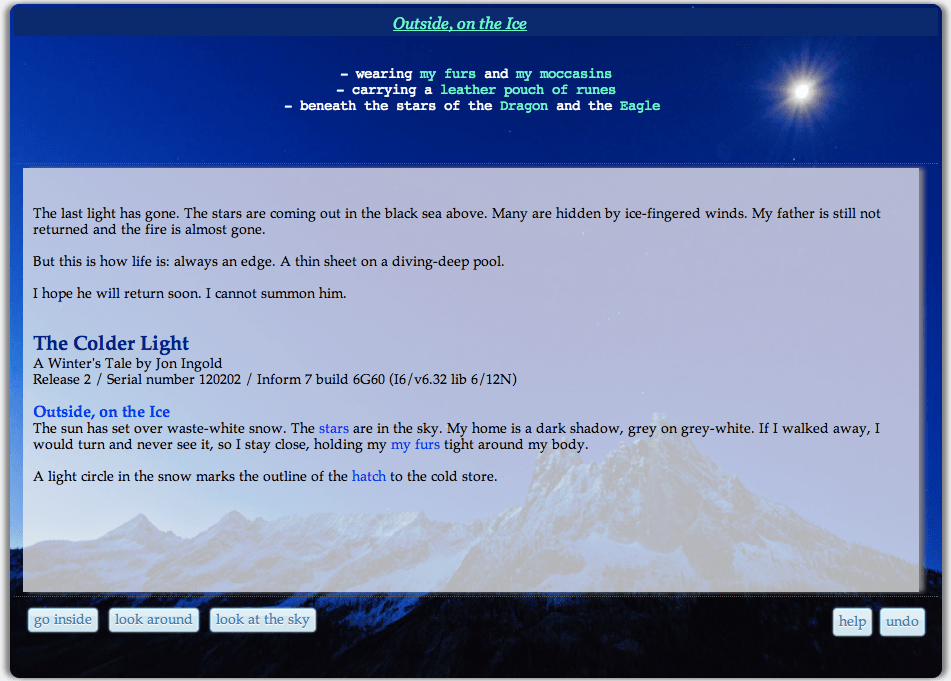
The Colder Light (online play, IFDB page) is the latest game from Jon Ingold: in this case, a spare, melancholy tale about life on the ice. It also uses an interface evolved from some work by Erik Temple (see for example Erik’s alternate interface to Sand Dancer).

This interface attempts to address some of the community’s long-standing concerns about the parser by presenting affordances explicitly. The player can click on hyperlinked objects in room descriptions and inventory and receive a list of plausible ways to interact with these. The result is a play experience with the noun-and-verb variety of classic parsed IF, a more consistent world model than the average CYOA, and enough diversity to make for genuine puzzles; but without any guess-the-verb issues. It also, I imagine, eased the authoring burden that Jon didn’t have to write the vast range of error messages that typically come with parsed interactive fiction.

There are some other possible novice-friendly features it doesn’t have: HELP only produces credits information, there are no hints to speak of, and mapping is also up to the player. But it’s still pretty accessible and I would be interested to see what new-to-IF players might make of it.

So that’s worth noting, and has already received some discussion. There have been a lot of user interface experiments over the past year and a half or so, but to my mind A Colder Light is one of the most successful in capturing the sense of possibility and setting immediacy that I like from parsed IF, while offering a significantly more accessible experience to the user and avoiding unnecessary screen clutter.

But the work also bears analysis on a couple of other levels.

First of all, it centralizes all its puzzles around a consistent mechanic — achieving this is a bit of an obsession of mine, I admit. To discuss that, I’ll need to be slightly spoilery, though I’ll try to avoid giving away specific puzzles.

Continue reading “Jon Ingold’s The Colder Light”