Two slightly unusual new pieces in the IF/conversational game space are out today:
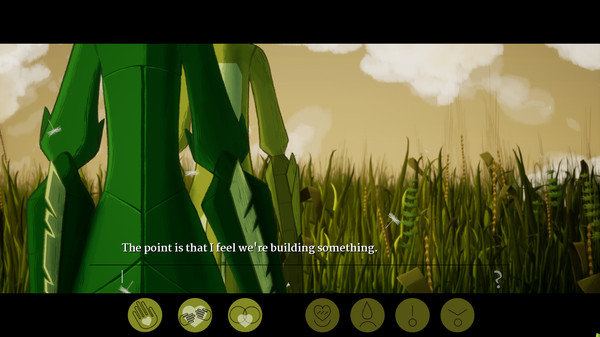
Don’t Make Love (Windows) is a natural-language-driven conversation between a praying mantis couple, trying to decide whether they should get together:
Assume the role of a praying mantis in a relationship. Constantly torn between their mutual love and the instinct to have sex – which could lead to the male mantis’s death – the couple are now on the verge of making a decision. Assume the role of either of the lovers, and try to keep their relationship in balance. Do your best to convey your feelings in a situation with no solution.
*
Bury Me, My Love (iOS, Android) is a Lifeline-style game of conversation with a Syrian refugee called Nour, featuring real-time conversational exchanges and the possibility of running out of resources or encountering border closures. Communication includes text, images, and emojis.
Or, as the developers write:
You and your virtual counterpart Majd will be able to communicate with Nour and follow her journey, just as if you were chatting with her via WhatsApp. You will text each other and exchange emojis, pics and selfies, relevant links…
You will also be asked to make important choices – as you are required to do in the Lifeline series and other interactive stories. Nour will regularly seek help and ask for your advice. The happy unfolding of her journey is in your hands. She won’t systematically do as you say though, and sometimes she might also hide things from you. You’ll have to deal with that, as she is the one risking her life.
The big thing at the moment (as covered yesterday) is IF Comp, currently running with 79 games to play and rate. You only need to rate five to have your vote count, though, so please don’t be daunted by the size of the pool if you’d like to judge. We need more judges this year, not fewer!
October 21, probably, the London IF meetup plays Comp games. I say “probably” because nailing down the venue has taken more running around than I hoped.
November 9, Hello Words meets in Nottingham to write IF.
AdventureX is coming November 11-12 at Goldsmiths in London. The event schedule is here.
Releases
If, somehow, the nearly 80 games released for IF Comp aren’t enough for you, you might also be interested in:
Thaumistry: In Charm’s Way. Bob Bates Kickstarted this classic-style parser game, and it’s now available:
Thaum: (noun). A unit of magical energy
Bodge: (verb). To hack or kludge
Eric Knight was a child prodigy who was featured on the cover of Invent! Magazine at the age of 13 for his invention of an anti-stain chemical treatment.
Unfortunately, he hasn’t invented anything since and now, at the age of 23, he has a strong case of imposter syndrome. He feels like a failure…
Andrew Plotkin has written up his impressions of this game as well.
*
Trackless is sort of a cross between graphical adventure and text parser experience: you move through a visually realized world, but sometimes to interact with things you have to click on those things and type an appropriate verb. Usually, only one verb is correct, and typing the wrong one gets you the terse discouragement “NOPE”.
I wasn’t sure what this was gaining. Why not just treat a click as USE if there’s only one thing you can do with this item? It’s not like guessing the verb was the fun part of parser IF back in the day, except in specialcases. (It does claim that you get more points for using more imaginative verbs or not repeating yourself, so flexing your synonyms may be a useful strategy. But at the same time, it doesn’t seem like it’s mostly a wordplay game, per se.) So it feels like Trackless keeps the least appealing thing about parser IF but dispenses with the richness of control, world model subtlety, and textual descriptions.
That said, I did not play the whole thing. It may be that the verb choice gets more interesting later.
IF Comp is on, and you have another month or so to play and rate the games. This year’s selection of games is properly enormous — a record-breaking 79 entries. (The ceiling used to be in the region of 50, so this is a big jump.) That collection includes a rich selection of parser and choice-based games in many different styles; reappearances by some established authors alongside plenty of new names; and three translations of Chinese interactive fiction, which I think may be a first for the Comp. I see lots of fantasy, horror, and SF as well as slice-of-life; not as much mystery as there are in some years.
If you want a look, here are some resources for you:
The Short Game podcast provides an introduction to the competition, including explaining what the competition is for people who aren’t familiar with it at all.
This post breaks down the games by genre and play style, while this subforum at the intfiction forum has discussion threads for many of the individual games.
Some blogs running reviews wind up on Planet-IF. This thread also allows people to link to their own reviews.
This year, the Comp allows judges not only to leave ratings but to add a few lines of feedback to the author. That’s a nice option if you have something private to say or don’t want to write a full review — authors very much value getting responses to their work — though please remember to be polite and constructive, and mind the guidelines for judges.
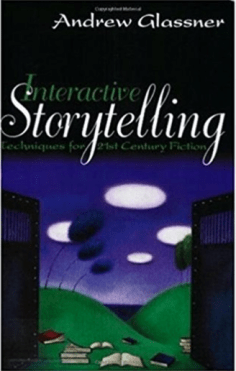
Interactive Storytelling: Techniques for 21st Century Fiction (Andrew Glassner, 2004). Glassner’s book is rather more effort to read than most of the other guides to interactive story I’ve covered so far: it’s hundreds of pages longer, and in a somewhat more pedantic style. It begins with two long chunks on the nature of story and the nature of games.
He begins the section on stories by introducing many standard concepts of writing from scratch: character, plot, scenes. Conflict and stakes. Three-act structures and inciting incidents. The monomyth, again (though mercifully he admits that it is not necessary to use and is not the guarantee of a good story). Maslow’s hierarchy of needs. Viewpoint and dialogue. At the end of this section — about a hundred pages, much of it consisting of example narrations from film and other sources — Glassner proposes a “Story Contract,” which he will use throughout the rest of the book to make value judgments. The contract contains the following clauses:
The author is responsible for the psychological integrity of the main characters.
The author is responsible for the sequencing and timing of major plot events.
The audience must allow itself to be emotionally involved.
Glassner later uses this contract to evaluate various works and forms of interactive story (about which more below), so baking in what the author is “responsible” for gives him a way to dismiss a lot of techniques in existing work. In many other respects, the story segment is largely a not very edited overview of basic writing advice.
In the section on games, Glassner also offers quite a bit of review. Like late 90s IF theory, he distinguishes puzzles from toys (this is something that we talked about quite a lot back then). Here, again, he offers a bunch of broad background: types of games, game loops, participation vs spectating, the nature of rules; the uses of scoring; the types of resources that can be included in game design, and the ways resources are deployed. He also gets into individual vs. team sports, competition and cooperation, applications of chance, some basic game theory chestnuts like the Prisoner’s Dilemma, and a section on terminology from Go.
All of this discussion is on the more abstract end and includes examples from sports and board games as well as computer games; it’s by no means focused purely on executing a AAA first-person shooter experience, and much of his game typology is not focused on the video game industry.
IF Comp goes live October 1. That’s tomorrow! It looks like there will be quite a few entries this year.
October 7, I am speaking in Buenos Aires about AI (more an artificial intelligence than a narrative talk per se, though I do get a bit into some recent AI-aided work).
AdventureX is still forthcoming in London Nov 11-12, and there will be a sizable contingent of IF folks there, including some from out of town.
New Releases
Bob Bates’ new kickstarted adventure Thaumistry is currently available to the backers of the original project, and will go on sale to the general public October 6. This is a parser-based game in TADS 3; I wrote up a preview version of the game some months ago for Rock Paper Shotgun.
Anya Johanna DeNiro has released A Bathroom Myth, a roughly 45-minute Twine story. All proceeds go to the Transgender Law Center.
From Adrao, Sashira, Cecilia Rosewood and Felicity Banks comes a Choice of Games Hosted Game called LOST IN THE PAGES. It is a book with a framing device surrounding seven very different short stories. Uncle Irwin has travelled through a portal into his book collection, and must be rescued from an ominous force.
Dialogue: A Writer’s Story is a heavily conversation-driven game from Tea-Powered Games, which tries on several different conversation mechanics:
Dialogue: A Writer’s Story is a game about conversations, writing and science. In Dialogue, you play as the writer Lucille Hawthorne, exploring characters and events through a year in her life via mostly ordinary, and occasionally fantastical, conversations.
The game consists of various types of conversations with different mechanics. Active conversations occur in real-time, and the effect of Lucille’s statements can be modified through her equipped Focus. Exploratory conversations map different subjects spatially, allowing for backtracking and finding new paths, while emails can be arranged and edited.
Be inspired alongside Lucille as you help her write her science fantasy novel, learning more about her neighbour Adrian’s biochemical research to see her book through to its conclusion!
Swipe Manager: Soccer is a ‘choose your own adventure’ football management game where (as in Reigns) you swipe left or right to make critical decisions about play. It’s available now via App Store and Google Play.
Crowdfunding
The Colossal Fund, gathering funds for the IFTF and for IF Comp prizes, has reached its goal of raising $6000.
Giada Zavarise is kickstarting Selling Sunlight, a narrative RPG:
In narrative RPG Selling Sunlight, you are a wandering merchant whose face got stolen by the Sun. To get your identity back, you’ll have to explore a strange, hand-painted world, befriend other travelers, trade goods and information and conspire against the Sun Himself. Will you ask for His pardon, or try to defy Him?
Articles and Resources
The Twine community has announced a new resource in the form of the Twine Cookbook, which is intended to bring together examples and resources for creating new materials in Twine. They are actively seeking new contributions in multiple Twine formats.
Earlier this month I spoke at the new conference Progression Mechanics at Northwestern, alongside Rami Ismail, Laine Nooney, Tarn Adams, and others. It was a very cool conference, and much of the program is available for viewing from the Progression Mechanics website. For various reasons, Laine’s talk is not available that way, which is a pity as it’s a fascinating view into the history of Sierra Online; however, much of the rest of the content is. Folks with a narrative interest may like (aside from my own talk) Tarn’s talk on emergent narrative and how to design interlocking systems that will produce good moments of play; and Ashlyn Sparrow‘s panel contribution about writing grant-supported games to support social purposes.
Recently I’ve been trying to figure out what to do about a bad situation. I don’t see a solution that doesn’t violate some value I consider important. There are many possible things to do or refrain from doing, and I am concerned about the consequences of almost all of them. The stakes are pretty high. Outcomes affect quite a few people. It is hard to calculate the risks. People I love disagree with me about what the priorities are, and about who has a right or responsibility to do anything.
This is the kind of thing that makes moral choices hard in real life, in my experience. It’s not “kill puppy or save puppy.” Nor a Fate-style escalation, “poke puppy / kick puppy / make puppy ill / kill puppy” — though I realize that was partly philosophical thought experiment.
It’s not “there’s a very very painful, possibly heart-breaking, thing that you morally have to do.” I’ve been there, too, but while that situation might be miserable, it’s at least clear. There’s no A vs B. There is only option A, and what you have to do to get through A, and what you can salvage when A is over. Not a choice mechanic but a challenge mechanic.
It’s not “I have so many feelings about this that I don’t trust my own motives.” I do have feelings. I’ve also had quite a bit of processing time.
It’s not “I habitually do not behave as well as I want to behave, and I need to do the slow work to improve those habits: keep my temper, drop an addiction, work out more often, stop saying yes to projects I don’t have time for.”
This is something else. It’s a decision, but it’s a slow, complicated, multipart decision in which the possibilities all seem at least somewhat sickening, and not all the possible solutions are visible at the outset.
And I keep thinking: have I ever played a moral choice that felt like this? What would that even look like?
 Bury Me, My Love (iOS, Android) is a Lifeline-style game of conversation with a Syrian refugee called Nour, featuring real-time conversational exchanges and the possibility of running out of resources or encountering border closures. Communication includes text, images, and emojis.


 Interactive Storytelling: Techniques for 21st Century Fiction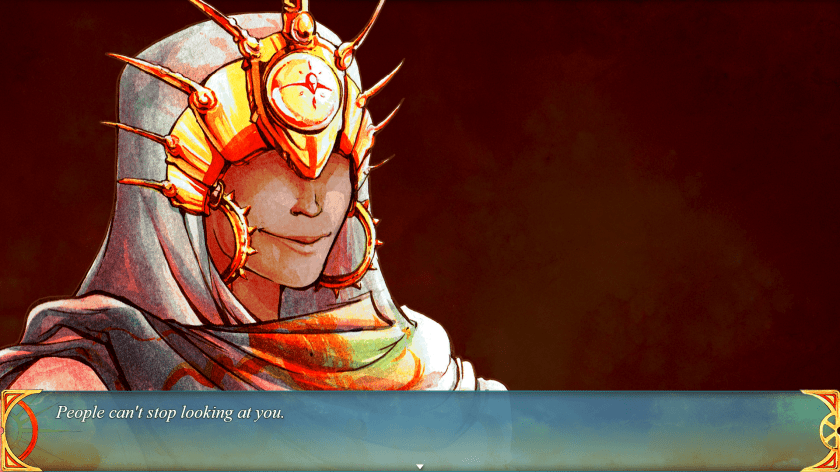
 Emily Short's Interactive Storytelling