Mid-July Link Assortment

IF Comp intents to enter are now open, so if you’d like to write for the comp this year, you can sign up.

The next London IF meetup is coming soon, July 19, and will focus on writing IF for money — or hiring those who do.

August 14-17, Cape Cod, MA is the Foundation of Digital Games conference, including a workshop in procedural content generation. The PCG workshop has a theme this year:

What do our generators say about the underlying systems we have designed and the designers who create them?  Our theme aims to explore the biases inherent in PCG and the potential with which to subvert it.

Articles and Research

This week James Ryan’s Twitter feed has been a treasure trove of interesting links and images: he’s researching the history of procedurally generated text and has found a wealth of material going back decades.

*

Sergei Mozhaisky has translated a couple of my articles into Russian. As I don’t read Russian at all, I can’t comment on the details, but they can be found here:

*

Lyle Skains has a presentation on how readers respond to different types of links in hypertext narratives, which is likely relevant to Twine; though one of the things that struck me about the example is that it wasn’t immediately easy to see (as a reader) which types of links were which. I found myself wondering how much the effects observed in this study were due to the absence of conventions around hyperlink labelling in the literary hypertext community, as opposed to using different colors and a clear schema to distinguish between links that explore and links that move forward as in some of Porpentine’s work. Also worth looking at in this regard: Alice Maz’ Colorado Red, which distinguishes forward-moving links from tooltips for showing the narrator’s feelings about things in the text.

*

Gillian Smith et al have published a report from the ICCC’s workshop on social justice and computational creativity, which looks at questions from implicit bias in machine learning to AI-assisted ways of interpreting the world around us to questions of access in related academic and technical fields. Her own paper for the workshop outlines some subjects for further thought in this area, including ethical deployment of machine learning in situations where the general public may not be aware they’re seeing the artifacts of AI. (And if you’re interested in this, see also Liza Daly’s essay Ethical Imperatives in AI and Generated Art.)

*

ZedKraze reviews Will O’Neill’s Little Red Lie. The game is not a new release, but I only ran across it recently. 

Edit: I think I got the wrong end of the stick about the release date on this, possibly. Sorry about that! It seems like perhaps it is in fact reasonably new.

*

IF Comp Prize Fund, and retrospectives

One of the new features of IF Comp this year is a cash prize fund. It’s still possible to donate other prizes, including books, games, toys, food, services in kind, and probably even (if you really want) separate prizes of money; but the intent of the fund is to make sure there are financial rewards distributed a bit more evenly than in the past and to more places.

Meanwhile, Chris Klimas has written an article looking back at the first ever edition of IF Comp, and Craig Locke is covering some games of IF Comp past as well.

AdventureX

AdventureX 2017 is currently on Kickstarter, raising funds to run November 11-12. It’s a two-day conference and demo floor that focuses on narrative games, including graphical adventures and various forms of IF. Last year I spoke; this year features a bunch of cool people including Jon Ingold. If you would like to speak or present, you can also find a presenter application here.

New Toys and Games

New on iOS is Silent Streets, which describes itself as “an augmented reality detective adventure,” with choose your own adventure elements, but also the opportunity to find important clues in your real-world environment, and unlock new events by walking using your GPS tracker. The game also provides voice acting, and writing from Richard Cobbett (of games journalism and Fallen London/Sunless Seas fame). About the design, Cobbett writes:

The nature of the game made for an interesting structural challenge, due to having to carefully balance the player’s likely mental bandwidth as they dipped in and out of the story, coming up with mysteries that allowed for lots of movement and interesting reveals that didn’t waste their valuable time, while still keeping the interactive element of being the one to solve the cases and complete bonus challenges to discover more than just the raw solution. Contacts for instance both allow the player to ask about the various things they’ve found, and act as touchpoints led by representatives of the different factions – the press, the police, the underworld.

Of things previously mentioned on this blog, this is probably closest to Jim Munroe’s Wonderland, which also features puzzles unlocked by walking. (And for the same reasons, I may not get around to playing, let alone finishing, this any time soon: while I walk around a fair amount, it’s often in contexts where I need a bit too much attention for my immediate surroundings to be immersed in a game. But your experience may be different, especially if your main walking context is not rush-hour London.) And of course there’s the well-established Zombies, Run!

Engadget also has a write-up of the experience.

*

StoryNexus and quality-based narrative fans who recall Rob Sherman’s highly creepy Black Crown Project may be interested in this message from the author:

[The Black Crown Project has] been offline for over two years now, but last year the copyright reverted to me from Random House… I’ve compiled all of the material I have (including the game assets, notes, sketches and prototypes) and placed it into a Github repository for anybody, anywhere to do anything they like with, as long as they don’t try and commercialise it.

The archive is found here: https://github.com/bonfiredog/blackcrownproject

*
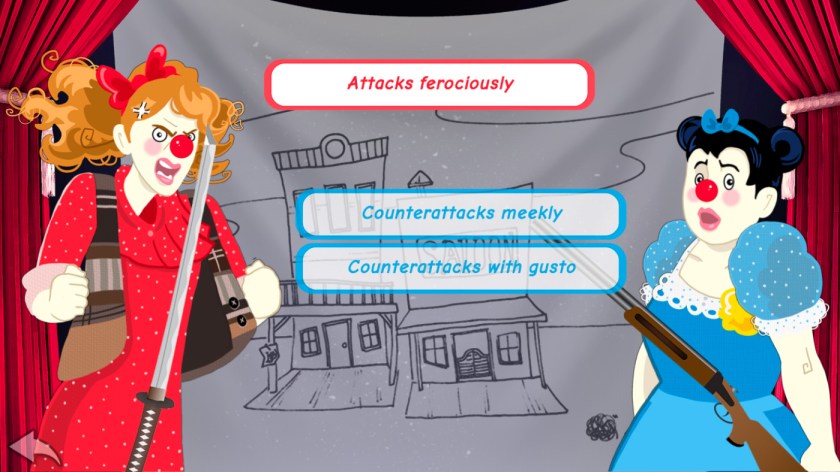
screenshot-10

Morro and Jasp is a two-player conversation game where both players are selecting what to say next (so none of the conversation responses are selected by the system). Or, as they put it:

Morro & Jasp: Unscripted is a 2 player conversation/performance simulator, where (practically) every line is chosen by a player. There are 28k words of dialogue (and about 100 different endings) for playthroughs that last only a few minutes — the idea is that every session is radically different. It’s also a collaboration with theatre artists (the titular clowns), so there are really unique influences in the writing of it (including clown theory!)

The concept distantly reminds me of Dietrich Squinkifer’s masterpiece of awkwardness, Coffee: A Misunderstanding. This doesn’t have the players actually speak the lines that they’ve chosen, though, and presumably the effect is rather different. I am curious about clown theory, too.

*

17776 Football is not exactly traditional IF, at least as far as I’ve played; it’s closer to dynamic fiction, with embedded images and video to help tell its story, and a few link-based elements.

*

Caleb Wilson’s excellent and influential Lime Ergot now has a Spanish translation, thanks to Ruber Eaglenest.

*

Wikitext: The Text Adventure is a parser style text adventure space that allows you to traverse locations defined by Wikipedia. I was able to make it start in Oxford and then wander the described space until I got to the street I live on, which was surreal. I doubt this works for every street — Oxford locations are probably a bit over-represented in Wikipedia — but still, a good time.

Ili.jpg

Ili is a narrative game now being kickstarted, mostly focusing on dialogue and negotiation rather than combat. The demo only works on Windows, so I haven’t had a chance to give it a shot, but the author writes:

Ili is an immortal being haunted by regret. Your aim is to guide Ili through her past and meet the ghosts from her past. While Ili is the game’s protagonist, you control most of her actions and act more like her spiritual guide. You are to help her say or do things that she would be too afraid to do by herself. The problems put in front of both you and Ili can be solved in different ways through talking. Do you intend to change the past? Or is it better to make peace with the past and to move on?

Ultimate Ending Books is a CYOA line I hadn’t heard of until just recently; don’t really know more about them than the website.

AlcoholIf you’re interested in procedural toys, you’ve probably already seen Inspirobot. If not, enjoy. I think it’s saying that I could live in a volcano if I had a couple cocktails first.

Hatred (Richard Goodness)

Screen Shot 2017-06-19 at 8.42.34 PM.pngHatred begins as a piece about hate crimes, and about attitudes towards our current president. The story (rated R, it helpfully informs us) casts the 45th president of the United States in the role of both victim and presidential commentator in the death of Matthew Shepard, and in the Columbine Massacre. At one point it ascribes to our current president some words spoken by William Jefferson Clinton; the complexity of the sentence structure alone suffices as evidence for the misattribution.

All of this is framed as evidence in a trial of God.

Continue reading “Hatred (Richard Goodness)”

The Ultimate Guide to Video Game Writing and Design (Dille/Platten)
Screen Shot 2017-06-04 at 1.02.03 PM.pngThe Ultimate Guide to Video Game Writing and Design (Flint Dille and John Zuur Platten). This one is a few years old — first printing 2007, it looks like — but it’s still selling healthily on Amazon. Dille and Platten are pragmatic about what they do: commercial work for which they’re hired and which require a number of soft skills beyond simply being able to write. In the introduction, they describe themselves as craftsmen rather than artists — a point about which I actually have some sympathy — and a good bit of the book consists of introducing the essential facts about how video games are made. (Or were made in 2007, at any rate. But there’s a lot here that’s still true.)

In contrast with Skolnick’s book, Dille and Platten dive right in to narrative structure questions in an early chapter: they talk about “limited branching” and “critical path” structures that would correspond with gauntlet or friendly-gauntlet structures; “funneling narrative” which is essentially branch-and-bottleneck; and “open-ended,” which seems to mean “a story in which the designer hasn’t really planned for CYOA structure at all and the result is a time cave or an unfinishable mess.” They also include “nodal” stories where short stories or quests are organized around in-game locations.

In other places, they’re (like Skolnick) providing standard writing advice you’d find in any how-to-write-a-novel guide, translated into game contexts: the need for (and types of) conflict, establishing and raising stakes; the gameplay version of “show don’t tell,” which is “play don’t show”. In fact it probably pairs pretty well with Skolnick’s book; each covers a slightly different part of this arena.

From there, much of the rest of the book is about process: processes that support concept development, processes of communication, processes of getting hired and getting paid.

Continue reading “The Ultimate Guide to Video Game Writing and Design (Dille/Platten)”

Nocked! True Tales of Robin Hood (Andrew Schneider)

title screen.jpgOut today for iOS is Nocked, a Robin Hood adventure story by Andrew Schneider, which ran a successful Kickstarter back in December. Here’s the blurb:

Rob from the rich and give to the poor, cross swords with the Sheriff of Nottingham, and above all, lead Sherwood through the turning of the seasons and into a new age.

By your actions, gain gold, renown, followers, and even a measure of grace. Then spend those resources to fortify your forest home, accomplish special missions, and change the course of Sherwood’s destiny. Will you save your plundered gold to rebuild the walls of your home, or send it to the poor and dispossessed to increase your renown and attract Merry Men to your cause? And what of the rising bounty on your head?

Consider your choices carefully, for the consequences of your actions are not always readily apparent. For better or ill, in ways both small and large, you will change the course of history.


In story terms, Nocked! shares some of the features of a Choice of Games piece: it starts at the beginning of Robin’s career as an outlaw and allows the player to build up his (or her) resources and personality, then play out subsequent adventures. And rather like a Choice of Games work, Nocked! advertises itself on the strength of its size and massively branching narrative: more than 400K words! Five distinct backstory options! Fifty possible endings!

iPhone Nocked Knight Screen
Note the “Remaining Daylight: Sunset” feature at the bottom of the screen.

The “true tales” subtitle or title extension might seem to suggest that this is going to be a particularly historically accurate rendition of Robin Hood. It’s… really not. Early in your adventures you may encounter a unicorn, a talking wolf, the Sheriff of Nottingham’s mystically enormous hounds, and/or a lesson in archery-related spell-casting. Likewise, the game lets you be the long-lost heir to the throne of England whether or not you’re male (and there are other male contenders; this isn’t a Queen Elizabeth kind of situation).

Gold, men, and renown accrue when you do useful or clever things (or, like, steal stuff); you can then spend these again to get out of problematic situations. Meanwhile, certain chapters of the story have their own special timing stats: for instance, you can be wandering in the woods and have an indicator at the bottom of the screen of how much daylight time you have remaining — a reminder of your current limits and constraints.

All this makes sense to a degree, though I found myself bothered by the use of Robin’s men as an expendable stat, especially given how freely the resource is given out in play. One of the very first actions I took gained me something like 55 men; another action took away 80 again. Maybe this makes sense as a representation of how frequently the player is expected to be deploying manpower, but it felt dissonant with the fiction when it happened — partly because it’s hard to imagine suddenly accruing 50-odd followers without significant effort, and partly because the protagonist’s easy-come, easy-go attitude to said followers made it hard to believe in him as a legendary leader.

The storytelling is packed with event — battles, fires, chases, magic lessons, unicorn sightings, ambushes in narrow ravines, misplaced royalty — and the writing is rather less concerned with developing a coherent personality for the protagonist. The prose style is sometimes actively clunky:

A horse with a sparkling horn that rises from its forehead grazes on a nearby hilltop.

It’s not mostly quite so awkward about its noun phrases, nor so Lisa Frank in its imagery — I’ve cherrypicked. But I did sometimes feel that the whole thing was creaking a bit under the strain of those 400,000 words, which perhaps did not have time to be thoroughly edited.

What you get in exchange is a huge amount of narrative consequence for your choices. I played a good bit, but I haven’t talked much about the plot because I can’t be sure that your plot experience will be anything like mine.

Nocked! is built in an engine that brings Twine to mobile (not, I should add, the only such engine — there are other commercial IF games that are Twine under the skin). This variant displays mostly text, but with a strip of illustration at the top to establish setting, and a menu / status bar area at the bottom. I thought this worked pretty well, while keeping the majority of the screen for the text.

Mailbag: Choice of Aesthetics

A while back, you alluded to the aesthetic preferences cultivated by Choice Of Games and their writers.  Is this written down or codified somewhere?  Is there a critical discussion?   Have you written about it?

There’s a lot of advice and material codified for people who are actually working for them, on their website. An obvious starting point would be their three-part series about how they judge good games: 1 2 3

It’s also probably worth looking at their ideas about structure, which covers branch-and-bottleneck (or what they call “stack of bushes”) design, delayed consequence, and stats deployment. Endgames specifically are covered in this post.

Sam Ashwell’s review of Cannonfire Concerto talks about how that work does/does not align with Choice of norms, and there are a few other (admittedly fairly offhand) observations in his review of Hollywood Visionary.

Overall, I’d characterize their preferences like this:

  • a highly customizable protagonist who at a bare minimum can be any gender and romance any gender, but who might also embody many other possible variations
  • a tendency towards bildungsroman, so that the protagonist’s definition can be incorporated into the storytelling, and because the whole brand was inspired by the game Alter Ego; many of their works start with an education and training period
  • less focus on prose style: their structure allows for more verbose writing between choices than inkle or Failbetter, and the undercharacterization of protagonists often precludes using a strong narrative viewpoint
  • an emphasis on plot consequence (you did this and as a result the company failed) over internal or emotional consequence
  • a tendency (though not an absolute rule) in favor of interchangeable characters
  • riffing on core conventions of existing genres (though this is something where they’ve matured over the years, I think — but early pieces sometimes felt focused on “what if we took this standard trope set and then explored the consequence trees possible within it”)

Video Game Storytelling (Evan Skolnick)

As part of my prep for the London IF Meetup July 19 (all about writing IF for money), and building on the earlier reviews of books about writing interactive fiction specifically, I thought I’d profile a couple of books that talk about game writing in an industry context — starting with this one:

Screen Shot 2017-06-04 at 12.14.03 PM.pngVideo Game Storytelling: What Every Developer Needs to Know About Narrative Techniques (Evan Skolnick). Skolnick is a veteran in this industry and frequently does narrative workshops at GDC to bring people up to speed. (Full disclosure: I’ve met the author a few times at GDC.)

The book is a fast, breezy read and assumes essentially no narrative experience. Using examples from popular games and movies, Skolnick starts with a chapter on “stories need conflict,” then moves on to three-act structure, the concept of the inciting incident, the monomyth, the need for villains to have coherent motives, how to avoid basing your plot on too many coincidences, and so on.

After introducing all of these ideas, he then shifts to his “In the Trenches” section, which is about how to actually work on a team with other game designers, translate story into level design, and so on.

The subtitle is telling; this book is not just (or perhaps even primarily) for writers, but for people who need to work with writers or have enough writerly craft to understand what’s going on with the story aspect of their game. And I confess I have a love-hate relationship with that whole project: it’s definitely useful to educate the industry about good writing practices and drum up support from other departments. At the same time, I’ve had a lot of conversations with game developers who have read just one or two books about narrative in their lives and have embraced some particular scheme to the point where they have a hard time with any other approach to craft or aesthetics. The monomyth has its points, but I admit I kind of groan inwardly at game parties when someone uses the phrase “hero’s journey.”

Continue reading “Video Game Storytelling (Evan Skolnick)”