Mid-July Link Assortment

Thanks

Sharp-eyed readers may have noticed that over the last year and a half, a lot of these posts have been signed “Mort Short” rather than “Emily.” This is because, for a lot of the pandemic, I haven’t had the time and energy to guarantee that the link assortment would happen on time twice a month.

But knowing how much it mattered to me to maintain the community support, my brother stepped up to help draft and schedule posts. He worked with me to keep the load as light as possible: often I’d forward him email or point him at items of interest online, and he’d pull together event dates, images, links, and summary text for me to review before it all went live.

He’s now stepped back again for the time being, but I wanted to acknowledge the kindness.

Events

July 28 is the next meetup of the People’s Republic of Interactive Fiction.

July 31 is the deadline to vote in ParserComp. There are a bunch of people currently writing reviews of these games.

August 7 is the next SF Bay interactive fiction meetup.

Programming Languages and Interactive Entertainment is a 2-day workshop running alongside the AIIDE conference. Paper submissions are due by August 12, and the event itself will be October 11-12. This workshop also has a “conversation starters” track, where people are encouraged to submit materials to spur discussion groups. Demos of languages are also welcome. If you’re working on a domain-specific language for interactive fiction development, this might be a place to share what you’re working on.

September 1 is the deadline to register as an author for IF Comp, and the games themselves will be due September 28. This year, unusually, there is a move so that authors participating in the competition may also act as judges: this rules change may not be permanent, but it’s an experiment this year to help accommodate the growing number of authors and make sure games are getting enough voters.

Articles

Here’s a fun interview with inkle about the development of Overboard!

*

I know I’m constantly linking these, but Aaron Reed’s series 50 Years of Text Games continues to be excellent, and is now up to 1996 with Andrew Plotkin’s So Far.

*

Mr Pages, from the Mask of the Rose art (Failbetter Games)

This month, I also published a blog post on Failbetter’s blog about character behaviour development for Mask of the Rose.

The game is built in ink, and doesn’t have the programmatic sophistication of something like Versu. But Mask does have its own notion of a social model, used to resolve how characters respond to the player and whether they’re willing to do as you ask.

That response-resolution plays out in the immediate performance as well as the long-term outcome. Even where the lines of dialogue don’t change, the system’s ability to distinguish between “hesitant cooperation” and “happy cooperation” may feed into character expressions and pacing of delivery (since we can do things like automate a brief pause).

These are nuances that could be scripted by hand, in theory, but in practice we just wouldn’t have time to do it.

Books and Games

Not new in general, but new to me: this week I came across A. M. Sartor’s illustrated interactive work, including a couple of hauntingly-depicted poems and storybooks.

End of June Link Assortment

Events

July 3 is the next SF Bay Area IF Meetup.

ParserComp closes for new entrants very very soon, and the games will be available to play and judge throughout July – so if you’d like to try some piping hot new text adventures, they’ll be available shortly. (If you’re curious about the how and why of voting, there’s an extended discussion of it on the intfiction forums.)

Recent Things

RockPaperShotgun has an article about Failbetter’s working process that also includes a bit about our forthcoming work and a few quotes of mine.

The Short Game podcast has recently covered a number of IF and IF-adjacent games – including inkle’s Overboard.

Aaron Reed’s excellent 50 Years of Text Games series continues, this time with an article on Patchwork Girl, a piece of classic hypertext. (If you’re curious about what I’ve written about it as well, that’s here.)

Mid-June Link Assortment

Events

June 30 is the last day to submit games to ParserComp.

July 3 is the next SF / Bay Area IF Meetup.

New Releases

Overboard! is a new interactive detective story from inkle – in which you are definitely the culprit, and the only question is who is going to take the fall for your misdeeds. It’s available for iOS and on Steam.

If you prefer your stories in interactive audio form instead, you may be interested in Wanderword’s audio horror story Escape from 63rd and Wallace, set in 1890s Chicago. Playable on the Amazon Echo, it features two modes, story-focused and puzzle-focused.

Books

Narrative Mechanics is a book of articles on games and the making of meaning through mechanics.

Articles

Aaron Reed’s 50 Years of Text Games series continues to deliver extraordinary stories about the history of the medium. I found myself particularly enthralled and fascinated with his telling of the games written by St. Bride’s – a chapter in game history I’d not heard of before Aaron brought it to my attention.

Talks

The London IF Meetup heard from Destina Connor about characterisation and identity in JRPGs. A recording can be found here.

Jeremiah McCall recently spoke about teaching history through video games, and that talk can be found on YouTube.

End of May Link Assortment

Events

June 5 is the next SF / Bay Area IF Meetup.

June 13 is the next Seattle Area IF Meetup.

June 21 I will be presenting to the VOLUPTAS summer school, which is working on playable experiences to teach architecture. Game designers interested in the crossover with architectural pedagogy might find this an interesting project.

June 30 is the ParserComp 2021 submission deadline.

Links & Articles

Sofia Kitromili at Bournemouth University is currently conducting a user experience study on improving mental resilience through the use of an interactive narrative application, and is looking for people over the age of 18 to participate.

The storytelling experience will prompt participants to engage in choice-based conversational storytelling and allow them to traverse a narrative as well as engage in optional reading and writing activities that are designed to strengthen mental resilience. Anyone interested to know more can send an email to Sofia at skitromili@bournemouth.ac.uk.

New Releases

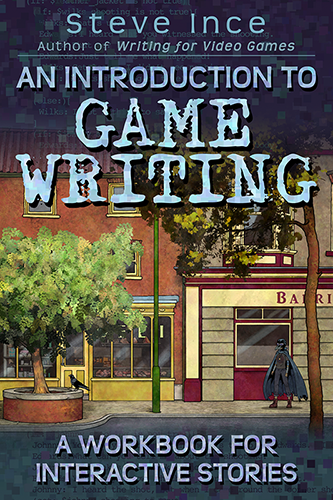
Steve Ince has a new book coming out, aimed at kids who want to learn the ropes of game writing. The book launch is scheduled for June 20, and will have a live streaming event on Facebook at 5pm BST. The book is primarily written for designers ages 10 and up.

Kickstarters

Tim Fowers is currently running a kickstarter for his latest game, Paperback Adventures. As of this post, the project is already backed, but you can still donate or secure a copy if you are so inclined.

“Conquer a menagerie of pulp novel characters in this solo deckbuilding word game.

Just like in the original game Paperback—and its follow up, Hardback—you will build your own deck of cards throughout the game, and those cards will have letters to help you spell words every turn. But in Paperback Adventures, instead of testing your wordsmithing wit against other players, you will use your words to defeat a series of AI enemies in “roguelike” fashion.

Paperback Adventures is a solo-focused game. It was designed from the ground up as a strategic, highly-replayable solo word game. There are also additional gameplay variants for cooperative play between two players.”

Mid-May Link Assortment

Events

May 16 is the next Seattle Area IF Meetup.

May 17 is the next Boston Area IF Meetup.

May 23 is a workshop-style meeting of the London/Oxford IF Meetup. The group will be offering feedback on open design problems (some tips and guidelines are included in the event description). You’re welcome whether or not you’ve got an open problem of your own to share.

June 5 is the next SF / Bay Area IF Meetup.

June 21 I will be presenting to the VOLUPTAS summer school, which is working on playable experiences to teach architecture. Game designers interested in the crossover with architectural pedagogy might find this an interesting project.

New Releases

The folks at Clockwork Bird have recently released Silicon Dreams on Steam.

It’s 2065, and you are an interrogator-model android tasked with rooting out deviants among your own kind. You must probe for lies, monitor and exploit emotional spikes, earn the trust of your subjects, and make the final call: release, or destroy?

More info is available here.

Filip Hráček has also finished the modern-day fantasy Knights of San Francisco for both iOS and Google Play.

What if goblins, ogres, and dragons weren’t imagined? What if our ancestors were, unwittingly, foretelling the future? Find yourself in that future, centuries from now, among the ruins of what was once the 21st century – where these terrifying creatures roam freely…

Links & Articles

Stella Wisdom, the Digital Curator for Contemporary British Collections at the British Library is running a tree-themed game jam for the Urban Tree Festival this month. The jam is accepting submissions until May 23.

The Association for Research in Digital Interactive Narratives has posted a call for papers for the ICIDS November 2021 Conference.

“The theme for the conference this year is Interconnectedness and Social Impact. We encourage authors to consider possible connections to this theme in their papers, but we emphasize that there is no requirement that papers reflect the theme, either implicitly or explicitly. The theme is meant as inspiration, and is not intended to act as a constraint.”

More information is available on the site; the main submission deadline is June 25.

End of April Link Assortment

Events

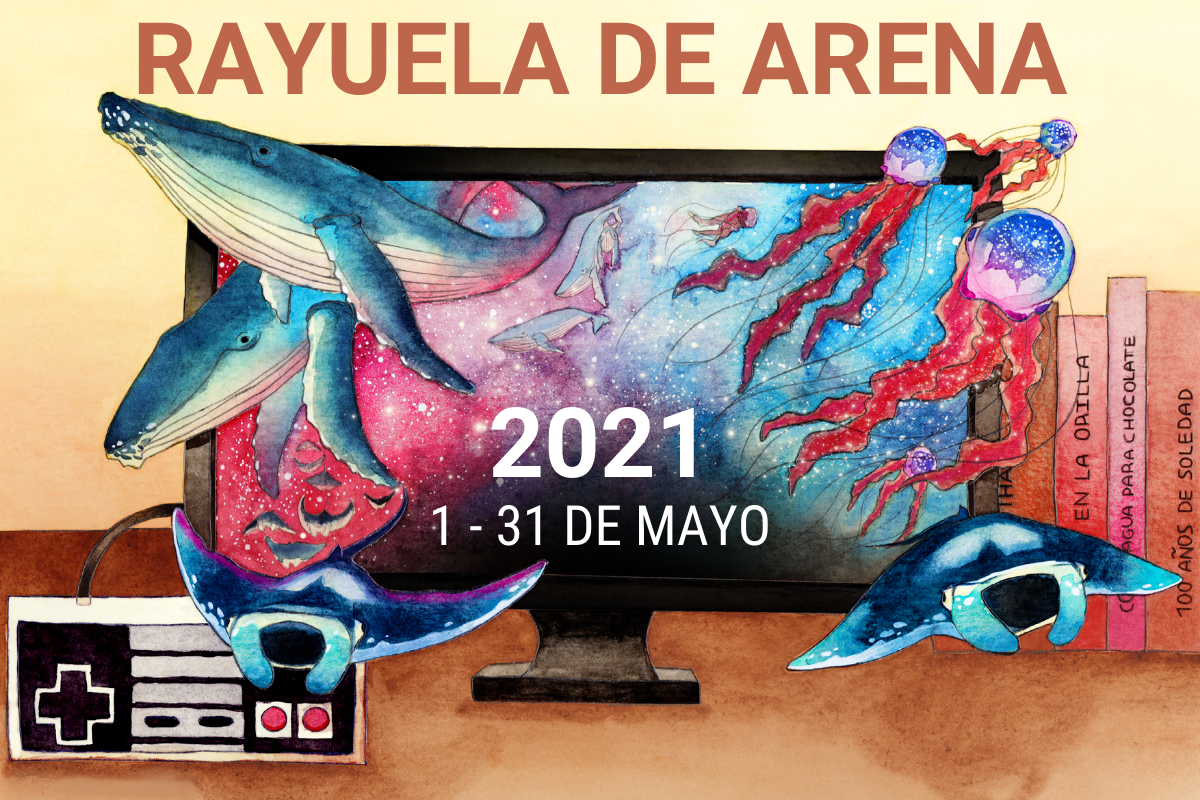
May 1 will be the beginning of the fourth annual Rayuela de Arena interactive fiction jam. Submissions will be open until May 30.

May 1 is also the opening of ParserComp 2021. Submissions can be sent in until June 30.

May 1 is also the next SF Bay Area Meetup.

May 7 is the Spring Thing voting deadline, when you can pick favourites from the more than 30 choice- and parser-based games submitted this year. If you’d like to nominate something for this competition, there’s still time – and if you’re hunting for people’s opinions on games, you can find a bunch of review threads on the intfiction forum.

May 16 is the next Seattle Area IF Meetup.

May 23 is a workshop-style meeting of the London/Oxford IF Meetup. The group will be offering feedback on open design problems (some tips and guidelines are included in the event description). You’re welcome whether or not you’ve got an open problem of your own to share.

June 21 I will be presenting to the VOLUPTAS summer school, which is working on playable experiences to teach architecture. Game designers interested in the crossover with architectural pedagogy might find this an interesting project.

Links & Articles

Last weekend I was a panelist at LudoNarraCon with Marta Fijak, Richard Rouse, and Thomas Grip on the topic of “Telling Dark Stories with Games.” The full panel is available on YouTube (as are other panels from the con, for those interested).

The Association for Research in Digital Interactive Narratives has posted a call for papers for the ICIDS November 2021 Conference.

“The theme for the conference this year is Interconnectedness and Social Impact. We encourage authors to consider possible connections to this theme in their papers, but we emphasize that there is no requirement that papers reflect the theme, either implicitly or explicitly. The theme is meant as inspiration, and is not intended to act as a constraint.”

More information is available on the site; the main submission deadline is June 25.

Aaron A. Reed’s 50 Years of Text Games series continues to be a great read, with recent articles on Plundered Hearts (1987), A Mind Forever Voyaging (1985), and Uncle Roger (1986). If the latter doesn’t ring a bell, you’re not alone: it’s a much less-known work by hypertext/digital literature creator Judy Malloy, whom I know mainly for her work Yellow Bowl. One of the great things about this series is that, alongside the background on familiar favourites, it also introduces some important developments in the history of interactive story that might not be so well known.