Long Live the Queen (Hanako Games)

Long-Live-The-Queen

I’m not exactly getting to this one in a timely fashion. Long Live the Queen is a visual novel/sim that has been out for a couple of years now, and people have been telling me to play it, and I’ve just been somewhat overwhelmed by how hard it is to get through. But now I have managed to win (once) and die (a lot of times), which is supposedly the correct proportion for this game.

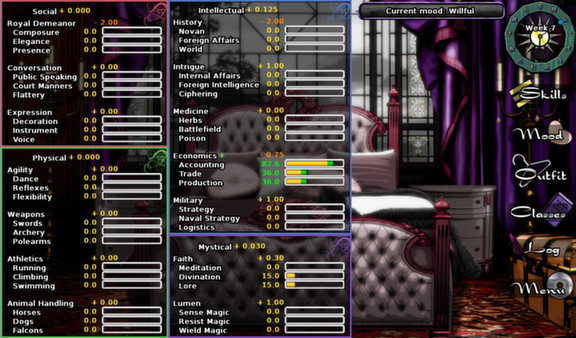
The premise is that you are 14-year-old Elodie, the princess of a kingdom faced with internal and external strife, and you have to live through the 40 weeks until you turn 15 and are crowned. Every week you choose two subjects to study from a bewildering array (everything from Accounting to Divination, Elegance to Archery). Every weekend, you pick a weekend activity that affects your mood, which in turn affects your aptitude for different subjects. And each weekend you also face certain specialized story choices, which follow a consistent schedule. Winning is largely about learning which challenges are going to come up when and which skills you’ll need to have in order to overcome them, and training accordingly.

LongLiveQueenStats

Quite a bit has already been written about LLtQ: about how hard it is, about how it compares with Princess Maker and Varicella. I want to talk about the cruelty stat.

This sounds like it’s going to be spoilery, but it’s really only mildly so: there are so many moving parts in this game that even a detailed analysis can leave a lot still to be uncovered.

Continue reading “Long Live the Queen (Hanako Games)”

Pry (Tender Claws)

pry_textExpand

PRY is an iOS story that combines video segments and text to explore the inner and outer worlds of a veteran who is still struggling to process his experiences in the war, who is suffering from vision impairment thanks to wounds sustained there, and who is now trying to hold down a job in demolitions.

The interaction consists entirely of swipes and touches of the text: not, as in a hypertext environment, selecting particular words and choices, but instead pinching portions of the screen together, pulling them apart, or sliding along a line of text. The hand is in contact with the screen almost all the time, and movement is almost always meaningful; operating PRY feels tactile and analog, like playing an instrument.

The conceit is that there are several layers of reality happening at a time. Though this is handled in different ways in different chapters, the general rule is that if we spread the page open, we’re opening the protagonist’s eyes, looking outwards, and seeing objective reality. Sometimes that objective reality takes the form of video about what is happening around us; sometimes it’s different text. Or, again, if we pinch the page closed on itself, we’re retreating into the subconscious, where flickering surreal images and rapidly cycling single words of text indicate our fears, our memories, our connections with the present. The subconscious recollection of childhood, or of an incident in war, might underlie our uncomfortable reaction to what is happening on the job site.

pry_brailleThemes of sight and the ability to see are crucial. In one chapter, we can read a braille passage about Jacob and Esau by swiping over the braille text; this functions as an audio scrub, moving the voiceover forwards and backwards. One can read tentatively, a single word at a time, or fast, fast enough to turn the words into semi-gibberish. This appealed to me on several levels: because it recapitulated the physical experience of the protagonist, and that is a level of involvement that iOS games are very rarely able to offer; because it put me in a position of temporary and uncomfortable illiteracy (I can’t read braille and the string of dots meant nothing to me on their own) that suggested helplessness; because I felt relieved when I was able to get the translation after all, via unconventional means.

(Ironically, I suspect that this would be a very difficult game to make accessible to visually impaired players, but I’m not sure.)

Elsewhere, PRY offers a text that opens and opens and opens. Initially there are just a few lines of text on the screen. Pinch them apart, and new sentences appear between old ones, expanding the narrative outward. Sometimes, in a virtuoso trick, the new sentences change the meaning of the sentences that come afterwards: a pronoun now refers to someone different, a description to something else. But the text has to work in both its closed and its open formats. There’s a lot of content here, too — you can keep expanding, keep reading more and more into the screen, for longer than seems plausible. And when there’s no more detail text to be read, sometimes peeking between the lines will instead reveal the subconscious response, flickering words that convey the protagonist’s ambivalence or fear. The lines that have been fully and wholly explored fade gently to a darker grey, guiding the reader to where new material remains to be seen.

It is, in short, an ergodic work that requires a reasonable amount of effort from the player, but the smoothness of the design means that that effort is low in friction and typically enjoyable. There are no choices available that will change what happens in the story, or even how the protagonist feels about them; our decisions are entirely about how deep we will go into the protagonist’s understanding, and what aspect of his experience we want to look at when.

PRY was released without all of its chapters, but even as it stands it is appealing and evocative, and very unlike most other interactive story interfaces I’ve encountered.

(Disclaimer: PRY came to my attention during IGF judging, but I played a copy that I purchased.)

Choose Your Own Autobiography (Neil Patrick Harris)

Screen Shot 2015-06-17 at 1.10.49 PM I’m not a big reader of celebrity memoirs, but this one came my way for Christmas: Neil Patrick Harris’ autobiography takes the form of a choose your own adventure book, in which Neil’s life story, together with some made up incidents clearly recognizable as fantasy, are narrated as happening to “you”.

This sounds like a gimmick, since the set of people who know of Neil Patrick Harris because of Dr. Horrible or How I Met Your Mother likely has a good overlap with the set of people who retain warm fuzzy nostalgia feelings about Choose Your Own Adventure books. But it turns out that it’s formally interesting as a CYOA piece, too.

Continue reading “Choose Your Own Autobiography (Neil Patrick Harris)”

Her Story (Sam Barlow)

Her-Story-Screenshot-Desktop-A

Last year I wrote about the way Gone Home is mostly backstory but doesn’t yield to thematically directed exploration. I talked then about wanting to see more games of research, pieces where the player could make guesses about where things were going and then test them out.

Sam Barlow’s Her Story accomplishes that nebulously-framed wish of mine, and brilliantly so.

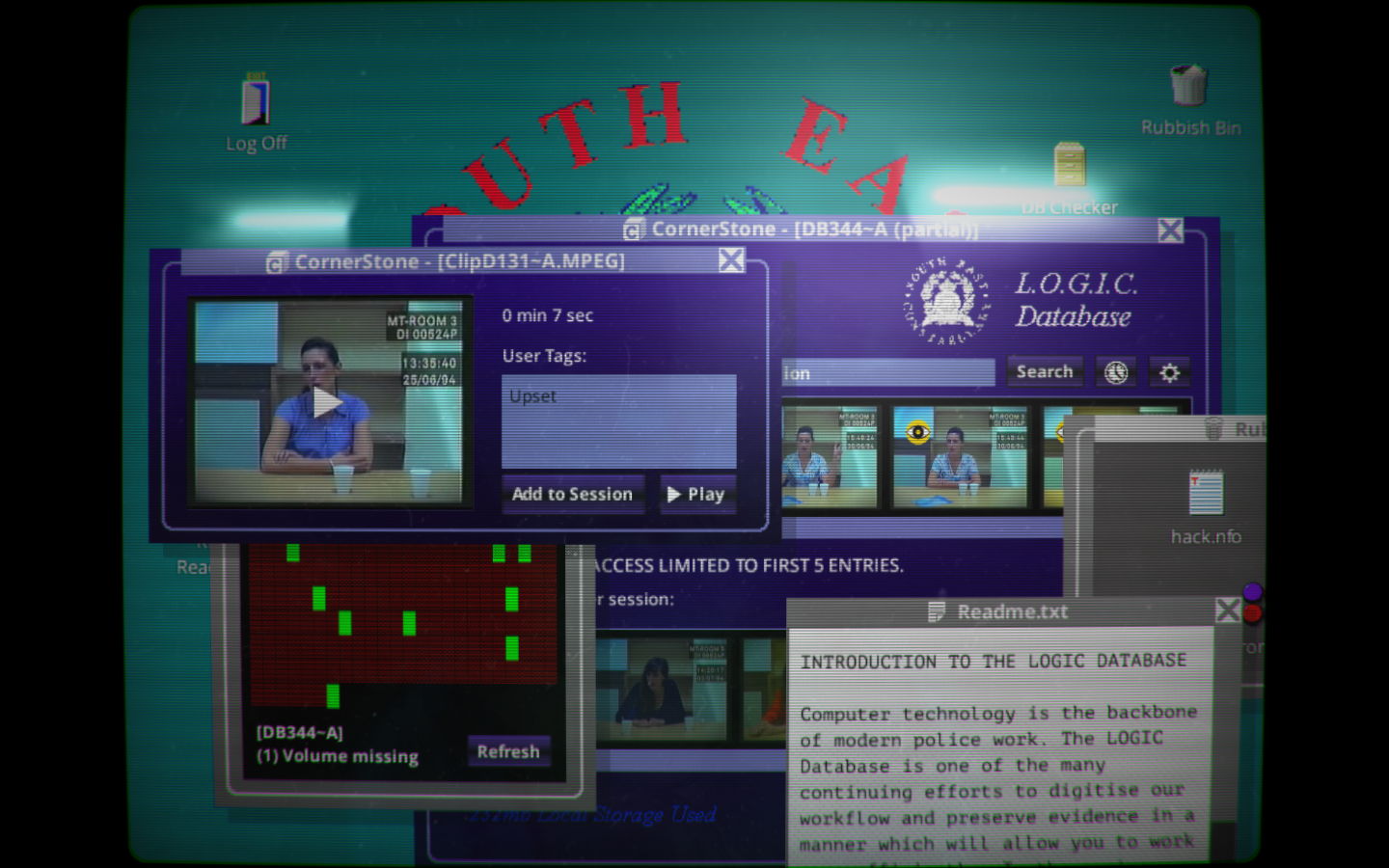
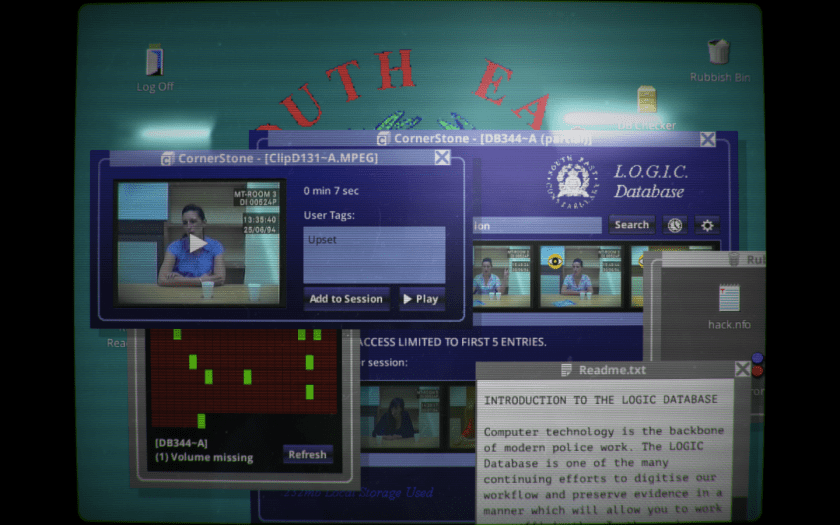
The idea is apparently straightforward: the protagonist has access to a database of video snippets taken from the interrogation of a woman involved with an apparent murder more than 20 years ago. The video snippets all have searchable subtitles, which means that if you look for a word that is spoken in one of these snippets, you can bring it up. What you can’t do is watch all the snippets in order; and if more than five snippets are associated with a particular keyword, then you can’t access those after 6. (This prevents the game from being too easily solved by someone who latches onto key names early on.)

As a police filing system this is perhaps not very practical, but it makes for a highly engaging game. One starts with a prompt, “murder”, which turns up several snippets with which to get started. From there, it’s a matter of thinking of new keywords to enter. Sometimes the keywords are names or places mentioned in one video that are obviously important. Sometimes I reached them by association or guesswork instead: if one hears about a death, it’s reasonable to want to know what happened at the funeral, for instance. And, of course, the same snippets of video may be reached by several different routes, so there’s less of a premium on exhaustiveness than in something like Toby’s Nose (but perhaps more than in the intentionally unmappable daddylabyrinth). It also feels less controlled and gated than Analogue: A Hate Story.

The game also has a second level of robustness, namely, it’s not necessary to see absolutely every snippet in order to work out what happened. 80-90% is probably sufficient. Personally I had a pretty good idea of what had happened by the end of a couple of hours, though I kept playing for a while longer in an increasingly quixotic mission to find the last remaining bits. I failed to get them all, but I reached a point where I felt pretty satisfied.

It’s massively daring to tell your story in whatever order the player happens to stumble upon — and yet my experience and the experience of every reviewer I’ve read so far was that the narrative order they experienced was compelling and memorable. After playing through this myself, I brought it along to an interactive fiction meetup and watched another group of people play: they saw the story unfold in a totally different way than I did, but it still worked. (They were also so fascinated with the game that we stayed on that for two hours and never moved on to other activities.)

There are a couple of features of the snippets themselves that make this scheme work. First, they’re telling a story that is very complicated (so there’s quite a lot to find) but differently shaped from what you might initially expect (so you’re not just filling in some sort of Motive/Opportunity/Method chart).

Second — and this is a reflection of both writing skill and the quality of the acting — they contain multiple kinds of information. In the earliest phases of the game, the player is just trying to get a sense of the key people and places in the story, scanning the snippets for names to build up a who’s-who. Then one starts comparing new snippets to old ones, looking for factual discrepancies and implications. Later, after the shape of the story has started to emerge from the mist, they start to be readable for emotional hints as well. There are details — visual details, verbal details, tones of voice and choices of imagery — that only take meaning after the player knows quite a lot about what is going on. And that is why the same snippet can still function well in the building of the narrative regardless of whether you see it as almost your first pick of the game or not until quite late.

I’d like to talk about the actual content a bit; however, any discussion of the story itself is of course massively spoilery, even more so for this work than for most games. So I’m going to put that behind a tag.

However, if you’re reading this review to find out whether I think it’s worth playing: yes, absolutely. If you’re a parser IF fan from the old days, you probably remember Sam Barlow from Aisle, a one-move game that is still one of my go-to pieces for introducing new players to parser IF despite the fact that it was written in 1999 — and you may find that the game has more in common with parser IF than you might have thought possible. If you’re a student of experimental narrative forms, this is a smashing example that people will be discussing for some time, and you should know about it. If you’re more of a mainstream indie game enthusiast, you’ve probably already seen the collection of positive reviews Her Story has racked up elsewhere, but in case you haven’t: this is not only a fascinating experiment, it’s also a solid, suspenseful gaming experience that kept me on the edge of my seat.

And the disclaimer: I bought this game in preorder, but Sam then sent me an advance key so that I could play early and review it.

Go play it before you read anything else I have to say. PLAY IT PLAY IT.

Continue reading “Her Story (Sam Barlow)”

And the Robot Horse You Rode In On (Anna Anthropy), with some thoughts about Spider and Web

robothorseWriting about Videogames for Humans, Robert Yang noted some ways in which he found it a useful but not comprehensive guide to the games it covers. His review includes this passage:

Or when Cat Fitzpatrick plays Anna Anthropy’s “And The Robot Horse You Rode In On” (merely one of TWO lesbian westerns featured in this book!) and Fitzpatrick does not know, or does not care, that this is probably a remake of Andrew Plotkin’s “Spider and Web” except with sexy lady fighting instead of overly intricate Cold War futurism. With that background, you can read Anthropy’s changes and simplifications to the original plot device as an admonishment of the hardline parser-based interactive fiction establishment and their historic ambivalence about accepting Twine as interactive fiction. It’s as if she’s saying, “look, Twine can do what the canon parser IF does, and with less bullshit and more style.”

[Edited to add: Anna says Robot Horse is not a remake; see the comments section. I’ve left the original discussion here, but it’s worth having that fact up front.]

I’d never played And the Robot Horse You Rode In On, and it had somehow escaped my awareness among Anna Anthropy’s games, so when I read this blog post, I immediately went to try it out. And —

Yes, this is the same story; also, it is not at all the same story. The contrast throws both Anna’s and zarf’s work into such high relief that it makes me grin. In addition to which, Robot Horse is possibly my favorite of Anna’s Twine work that I’ve played so far.

But to talk about this I will have to spoil both games a lot. If you haven’t played Spider and Web and you’re planning to do so one day, you don’t want it spoiled before you play, trust me; if you haven’t played And the Robot Horse…, it’s short and you should probably go try it now. (Subject to the usual warnings: like a lot of Anna’s other work, it contains references to sexual activity, and while its primary intent is not pornographic, it may not be suitable for workplace reading. However, this discussion will not itself be unsafe for work.)

Continue reading “And the Robot Horse You Rode In On (Anna Anthropy), with some thoughts about Spider and Web”

Sunset (Tale of Tales)

sunset1

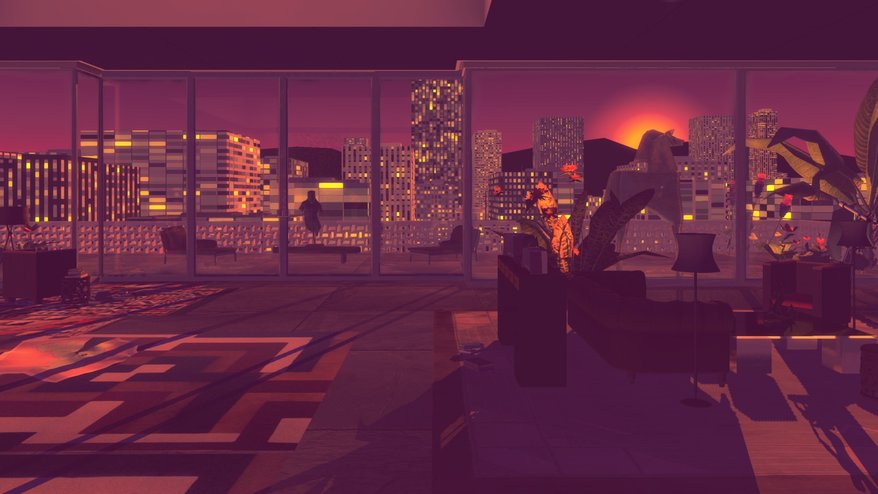
Sunset is the story of Angela Burnes, an African-American woman who has become the housekeeper of Ortega, a wealthy man in the fictional Latin American country of Anchuria. The time is 1972, in the middle of that country’s civil war. Every week Angela spends an hour before sunset tidying her employer’s house in the rose-orange half-light.

During that time the player can go through Ortega’s possessions, getting to know the man better, checking chores off the day’s list. Eventually, Ortega starts leaving notes around the house, which the player can answer. Many chore actions and note-answers offer two variants, a flirtatious one and a cold one, but Ortega also responds to any sign of human presence. Leave his lights on, leave his water running, and his love for you will grow.

The apartment changes from visit to visit. Sometimes there’s a mess, left over from Ortega’s activities. Sometimes there’s new mail or rearranged books. Ortega changes from week to week which doors of his apartment are locked, which means that the whole floor plan of the apartment is rarely available to us at once; the apartment retains some more private areas that we only get to visit once or twice.

The ability to section off parts of the floor plan helps direct the player each day, though it was (I found) an only middling solution: on several days Angela was assigned chores so vaguely described that I couldn’t figure out where I was supposed to go in order to perform them. Somewhere in the apartment, from some angle, there would be a hot spot that would complete the chore in question, and I’d wander around all the rooms over and over, curious, then confused, then bored.

I began to enjoy Sunset more when I decided to let myself skip chores that proved too hard to find.

Fortunately, Ortega’s a forgiving boss, so even if Angela leaves some tasks undone, he never fires her and the story never comes to a mid-game halt. And the system seems designed in part to push the player towards romance, towards the flourishing of a sense of intimacy with someone never seen or encountered.

Sometimes the interactive flirtation worked for me, though more when it took the form of physical gestures rather than words: I was happy enough to leave Ortega’s possessions attractively laid out, but some of Angela’s flirtatious messages to Ortega are more overtly sexy than I found… plausible? comfortable? …given that they’ve never even been in the same room together. This may partly be a reflection of the writing generally: Angela’s inner monologues were often a bit on the nose for me, too, though not so much so as to ruin the experience. Conversely, I was amused the time I took the black queen off the chess board, and returned to find that he’d removed the black king as well.

Eventually, as things break down in the city outside, the apartment becomes more and more cluttered with objects that Ortega has rescued: crates and boxes, maps, museum plans. Hallways that used to be useful become blocked with junk, forcing me to go the long way around. Angela’s inner voice was frustrated, though not as frustrated as my own.

The thing I like best about this gameplay is the way it allows for improvising small expressive moments. The way I’m drawn to the window by the sound of jet fighters outside, and watch the contrails nervously even though I know it’s just a parade demonstration. The way I turn on a record and sit in a chair to listen to it after my chores are done, reaching for some quiet. The way, on other days, that I rush through my chores and leave again as soon as possible, currently annoyed with Ortega and not willing to linger in his space. The pleasure I take in the sight of my shadow cast across the carpet. The nervousness when I look out the window and see the city burning right before the protagonist was supposed to head home — surely it would be safer for her to sleep overnight in Ortega’s apartment than to go out alone in that chaos? The shock of hearing a bomb go off and seeing its flash in the lighting change around me.

Late in the game I found myself updating the calendar to the current date, even though that seemed pointless and futile, just as a touchstone for the earlier times when I had been meticulous about that ritual.

Continue reading “Sunset (Tale of Tales)”