Bloom (Caelyn Sandel)

Screen Shot 2015-07-11 at 3.38.43 AM

Bloom is a substantial Twine story by Caelyn Sandel, being issued in episodes. (Because I’m writing some blog posts in advance of travel, there are only the prologue and two chapters available at writing time, but by the time you read this, the third chapter may well be available.) It tells the story of Andy Blumenthal as he discovers that he is rightly a woman called Cordy.

It’s a longer, less visceral piece than Caelyn’s previous Cis Gaze, playing out as a more substantial series of scenes — though there are still some passages with a gut-punch effect, as when the protagonist encounters some particularly unpleasant humor that hits her vulnerabilities.

The protagonist is not just her situation, though. She also has a family with its own interesting dynamics; a roommate and coworkers who are rounded enough not to be mere markers. Both Cordy and her sister Rachel have endearing styles of eating, making sure that textures and flavors are properly distributed. Cordy’s mother is active in domestic violence prevention, laudably, but it’s not at all clear how she’s going to react to Cordy’s gender identity. Cordy herself has a hard time explaining what’s happening to her, since she barely understands it herself at first, and it doesn’t match with the trans narratives she knows; she feels like she should have recognized herself as a woman back in childhood or puberty, not at the age of almost 30.

The structure is very linear. The player can explore a bit, and can sometimes pick a flavor choice of more or less significance, but the plot doesn’t appear to branch significantly (which, frankly, might be the only sensible way to do an episodic Twine piece).

Nonetheless, the interaction lends quite a lot to the experience, especially the sensation of being on the spot when Cordy feels overwhelmed and doesn’t know what she wants to do.

Long Live the Queen (Hanako Games)

Long-Live-The-Queen

I’m not exactly getting to this one in a timely fashion. Long Live the Queen is a visual novel/sim that has been out for a couple of years now, and people have been telling me to play it, and I’ve just been somewhat overwhelmed by how hard it is to get through. But now I have managed to win (once) and die (a lot of times), which is supposedly the correct proportion for this game.

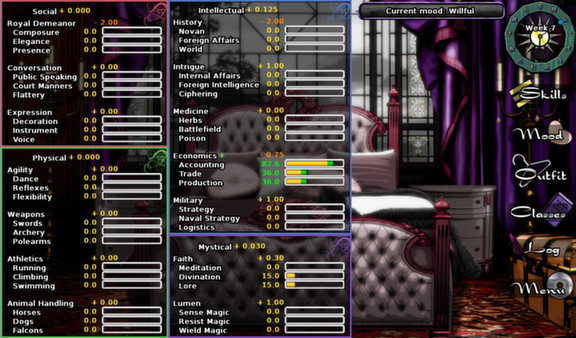
The premise is that you are 14-year-old Elodie, the princess of a kingdom faced with internal and external strife, and you have to live through the 40 weeks until you turn 15 and are crowned. Every week you choose two subjects to study from a bewildering array (everything from Accounting to Divination, Elegance to Archery). Every weekend, you pick a weekend activity that affects your mood, which in turn affects your aptitude for different subjects. And each weekend you also face certain specialized story choices, which follow a consistent schedule. Winning is largely about learning which challenges are going to come up when and which skills you’ll need to have in order to overcome them, and training accordingly.

LongLiveQueenStats

Quite a bit has already been written about LLtQ: about how hard it is, about how it compares with Princess Maker and Varicella. I want to talk about the cruelty stat.

This sounds like it’s going to be spoilery, but it’s really only mildly so: there are so many moving parts in this game that even a detailed analysis can leave a lot still to be uncovered.

Continue reading “Long Live the Queen (Hanako Games)”

The Secret Language of Desire (Megan Heyward)

SecretLanguageTrimmed

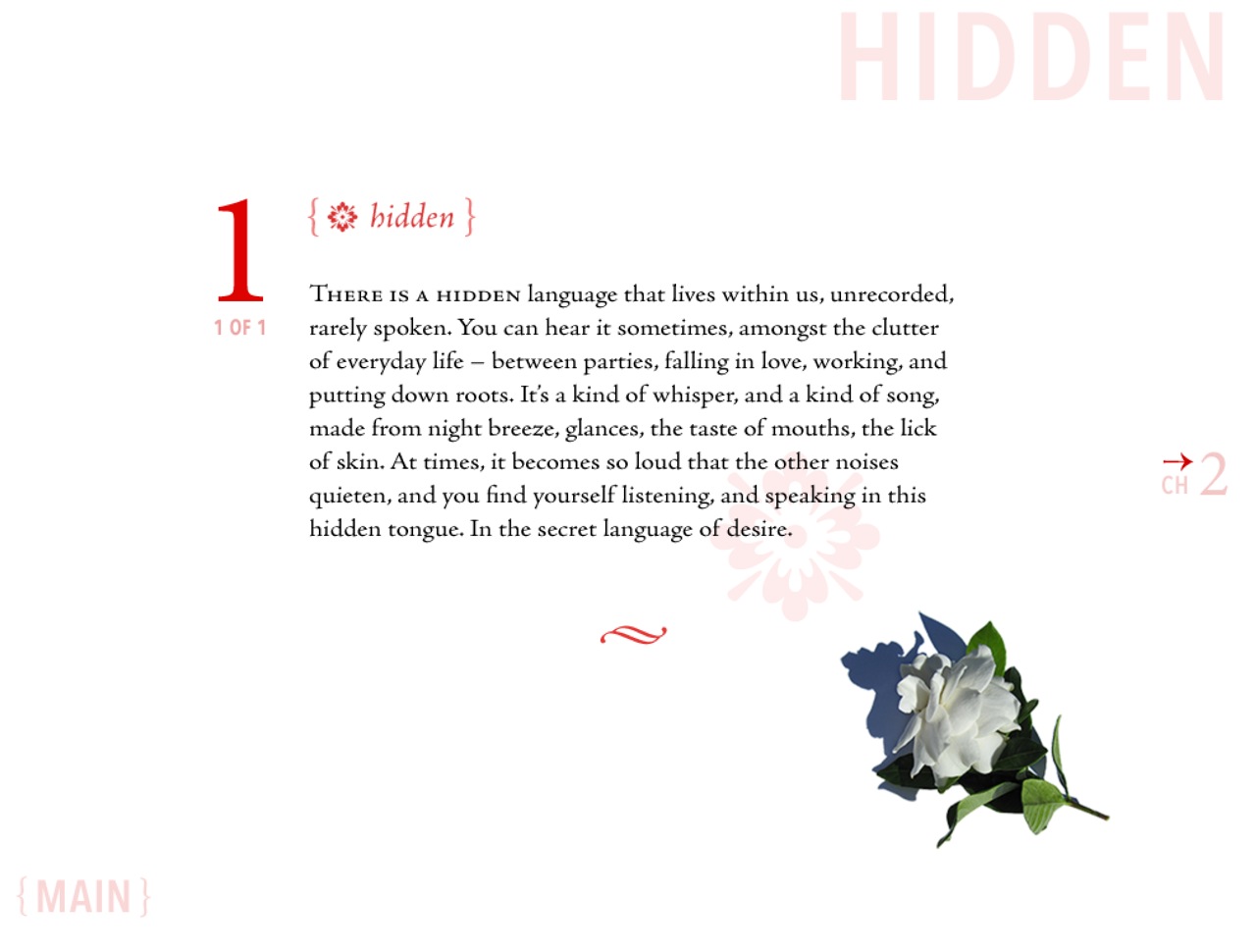
The Secret Language of Desire is an iPad app, enhanced with images and music and sound effects, which tells the story of a woman’s erotic awakening through a series of 27 short vignettes. It is available via iTunes, and will also be shown at the upcoming ELO conference in Bergen.

It’s fully linear: there are no branches in the story, no hypertext links to dig into. Unlike in PRY, there’s very little hidden information to tease out of the interactions, either. In one case, there’s something to uncover that explains the meaning of an intentionally vague and referential bit of text, though I was pretty sure what I was going to find there. This is the exception rather than the rule.

Continue reading “The Secret Language of Desire (Megan Heyward)”

Videogames for Humans (ed. Merritt Kopas)

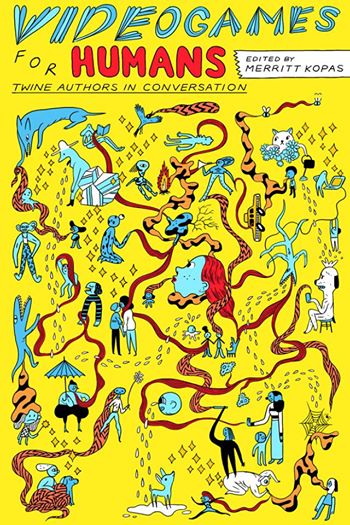
VFHcvrI’ve mentioned the existence of this book before, but only recently did I get my own contributor copies of Videogames for Humans, an anthology of Twine playthroughs annotated by their players. (Here’s Robert Yang talking about the anthology; here’s me talking about Robert Yang talking about the anthology.) It’s a big chunky paperback, devoted to the unexpected task of demonstrating an interactive art form on paper, through transcripts.

Here’s something excellent from this book: Naomi Clark’s playthrough of Horse Master. It takes much longer to read than the game takes to play for the first time, because it is digging into details of wording and implementation. It reveals the game’s innards and explains them. It is also both lovely and funny. You should absolutely play Horse Master yourself first: you’ll enjoy both the game and the analysis more if you experience them in that order.

Here’s another: Riley McLeod’s playthrough of Benji Bright’s Fuck That Guy, about the experience of being a queer trans man playing a game about cis gay sex, and the ways that that does and does not feel familiar, the things that are inviting and the things that are off-putting.

Or: Squinky on Jeremy Lonien and Dominik Johann’s The Message. “I don’t know what it is about pianos in slapstick comedy,” they write, and then go on to explain what it is, which is awesome.

Or: Patricia Hernandez on Elizabeth Sampat’s Nineteen, which is about a suicide attempt that failed, and if it hadn’t failed then, among many other more important losses, I would never have met Elizabeth and played Deadbolt with her.

Or: Anna Anthropy writes a charming response to Michael Brough’s Twine about losing a scarf, a story that sounds trivial but in fact carries considerable feeling, about the importance of things in our lives and the difference between the things that we work on and invest in personally and the things that are fabricated for us by the machines of industrialized capitalism. This resonated with me.

Continue reading “Videogames for Humans (ed. Merritt Kopas)”

Dialogue: A Writer’s Story Demo (Tea Powered Games)

Screen Shot 2015-07-07 at 2.01.44 PM

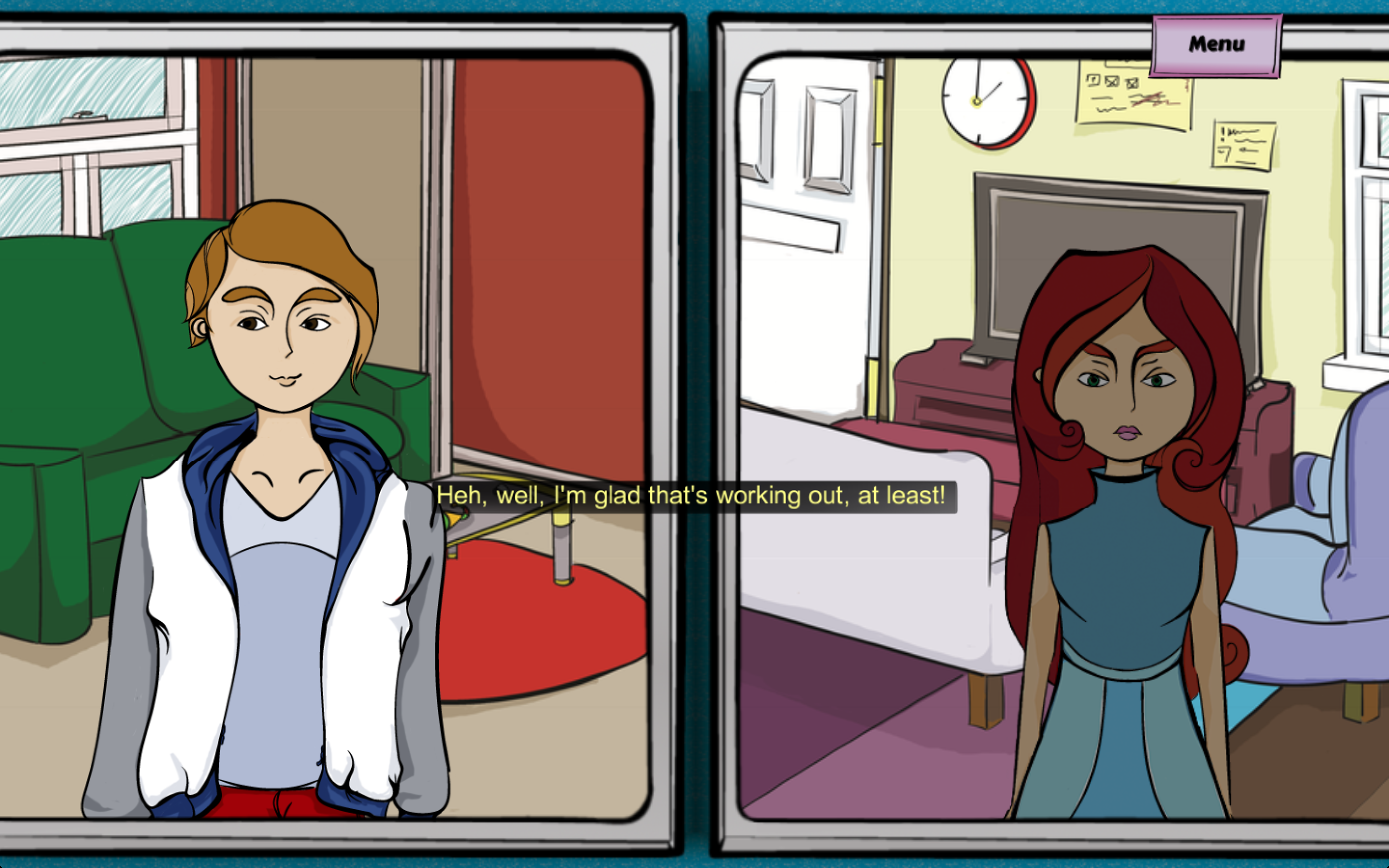
Dialogue: A Writer’s Story is the tale of Lucille, a woman who is stuck on a novel, and who goes to her friends and relatives to find inspiration and work past her difficulties. The full game is not yet available, but a demo is free to download. My remarks here are therefore necessarily based just on the two scenes provided in that demo.

Dialogue has some aspects of a visual novel — in the screenshot shown above, Lucille and her brother are talking, and Lucille periodically gets timed opportunities to choose dialogue responses. All of the text is fully voice acted. There is a bar that shrinks as you run out of time to answer, as in Telltale conversation sequences, though there are also some additional dialogue powers that come into play and allow you to gain alternate dialogue lines partway through the timed session.

At the end of your conversation with Lucille’s brother, you get a little summary of how the game thinks the conversation went: were you pushy? neutral? I have to admit that its understanding of what I was doing and why didn’t really match my own.

Continue reading “Dialogue: A Writer’s Story Demo (Tea Powered Games)”

The Magic Circle (Question)

Screen Shot 2015-07-10 at 7.41.06 PM

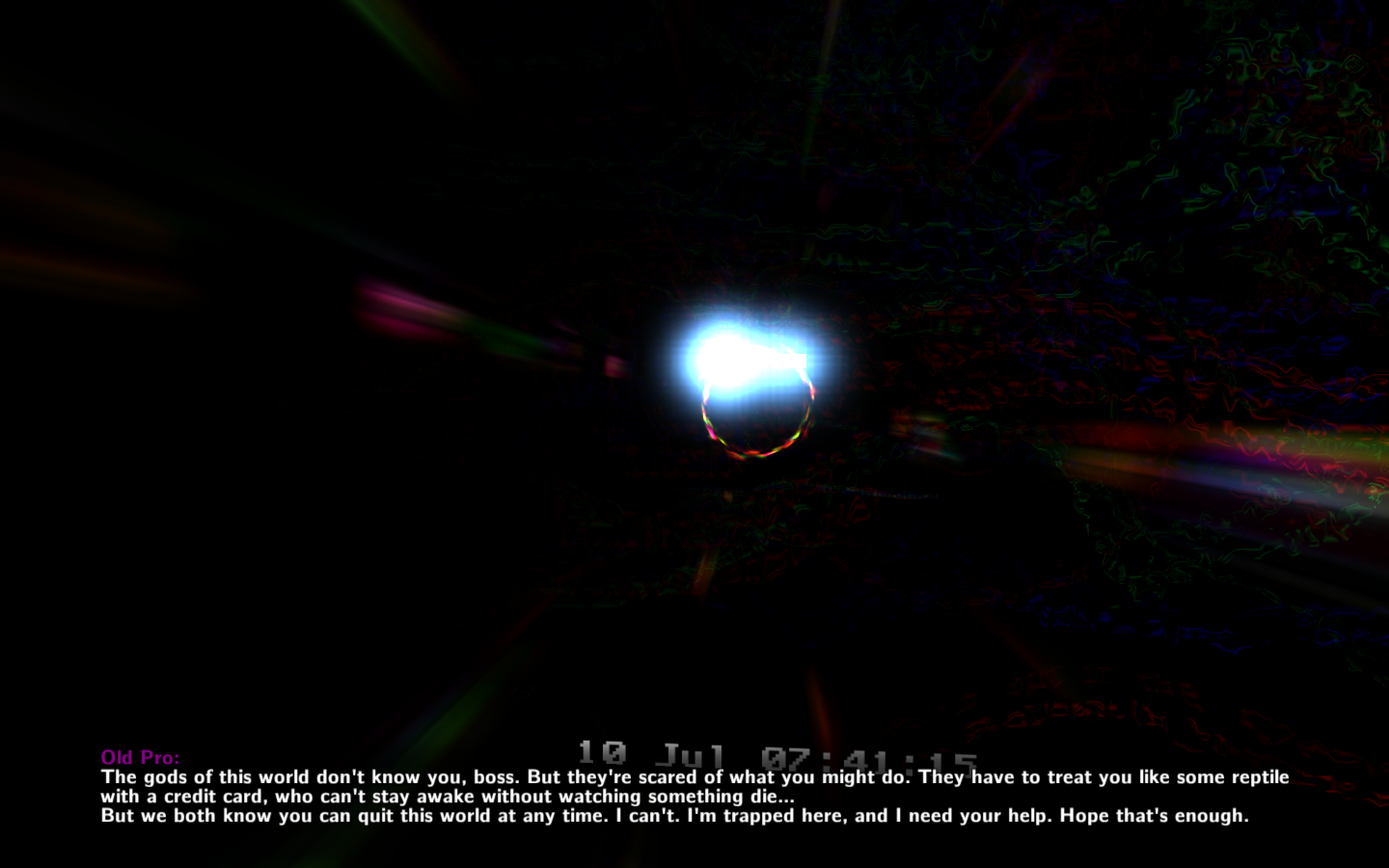
If that’s hard to read, here are the first couple of sentences:

The gods of this world don’t know you, boss. But they’re scared of what you might do. They have to treat you like some reptile with a credit card, who can’t stay awake without watching something die…

The Magic Circle is a first-person puzzle game that recently left Early Access for full release on Steam. The premise is that Ish Gilder, a game designer with a massive cult following, has been trying for decades to follow up on his early text adventure success. He’s been promising exotic features for the sequel with Molyneuxian abandon, and he’s held something like five separate crowdfunding campaigns, but the game never quite comes together. In fact, a nearly launch-ready version gets totally scrubbed at one point, a complete space-station setting buried in favor of something more fantasy-oriented.

There’s a whole website dedicated to documenting the sad history of the game development.

(Disclosure: I received a free review key for this game.)

You play as a tester who has gotten access to this desperately broken thing, and you’re trying to get it to function for you. Early on you meet the Old Pro, a self-aware AI of the protagonist who has been waiting all these years for his game to be released so that he can get out into the world. (How exactly he came to be a self-aware AI is not deeply explored and neither are the ethics of releasing him.) You don’t have a sword because Ish has decided late in the process to remove combat, but you do have access to debug tools that allow you to meddle with the flags controlling NPC behavior. When you’ve learned about a skill from one NPC, you can apply it to others.

You thus spend the bulk of the game play time — I’d estimate about four and a half hours for me — exploring both the space and the fantasy areas of the game, which are linked, and solving puzzles in order to get close enough to creatures to yank their skills out of their bodies.

This is an elegantly designed puzzle space: consistent and comprehensible mechanics, lots of fun bits where you can combine different character skills to produce useful or funny or horrifying results, and a non-linear design that lets you tackle problems in the order of your choosing. It is possible to find solutions the devs didn’t specifically anticipate. I did once waste a lot of time trying to solve an enemy, the Securitron, because I hadn’t yet picked up the skills that would have made it easy to kill, but eventually I remembered that I had other options and went off to try something else first. Most of the time I was challenged enough to have to give situations a bit of thought or experimentation, but not all the way to stuck, which is what you want.

Lots of nice work has also gone into making an easily navigable map with clear signs of where you will find new puzzles to solve, so you’re not wandering around this big space desperately looking for doors and triggers.

So that’s fun. And while you’re doing it, you get a bunch of diary-page style storytelling in the form of change log notes and director’s commentary and other scattered text and audio clips, messages from the Old Pro, and the occasional scene of avatars interacting in-world. This is how you learn about Maze, the expert player who has come on to work for Ish as a designer, who loves high-difficulty gameplay and hate hate hates cut scenes; Coda, the long-time fan who has grown up waiting for Ish’s next game; references to Ish’s ex-wife and to other QA testers and designers who came and went over the years. From time to time you hear music, overlaid with instructions from the composer about what it’s supposed to sound like in this context.

Eventually – but let’s have some spoiler space.

Continue reading “The Magic Circle (Question)”