Spoken IF: Codename Cygnus, Multi Path Audio, Mayday: Deep Space

cygnusCodename Cygnus is interactive radio drama: there are voice-acted scenes with music and sound effects. The premise is that you’re a secret agent, and you can download several missions; each mission is itself divided into smallish episodes, so when you start something, you’re not committed to a long session. It’s highly genre-determined, trope-y stuff, where you’re meeting bad guys with foreign accents across a gaming table, or slipping truth serum into someone’s drink.

Periodically the narrator asks you which of two options you’d like to pursue in order to continue your mission, with specific keywords for you to speak (“Athletic? Or Clever?”). You can either speak the next word or tap the option on-screen, but the system is designed so that you can play entirely hands-free, without holding or looking at your device. As with Choice of Games titles, your actions may determine character stats rather than causing immediate narrative branching; and in fact in Codename Cygnus a lot of your choices (“Athletic / Clever?” “Hostile / Charismatic?”) are explicitly asking which of your stats you want to use and enhance. Because you’re not viewing the text, the screen consists purely of a stats readout, plus controls to scrub or replay audio sections you’re currently listening to. It’s simple but attractive.

Continue reading “Spoken IF: Codename Cygnus, Multi Path Audio, Mayday: Deep Space”

The Feasts of Tre-mang (Eli Brown)

Screen Shot 2014-12-30 at 3.58.41 PMThe Feasts of Tre-mang is a fictional cookbook. That is, it contains recipes that you can actually cook, but they claim to be a variety of holiday dishes from an obscure Atlantic island called Tre-mang that was destroyed by volcanic eruption in 1914.

As you might expect in a cookbook, there are lists of ingredients, methods, and measurements; there are pictures of finished dishes, and editorial notes about safe substitutions. There are also explanatory articles about Tre-mang history and culture, the contexts in which these foods would be presented, and the life of Theodora Peterson, an anthropologist’s daughter whose diaries are the chief source of surviving information about Tremanner cuisine. Brown intersperses these with “old” photographs, maps, portraits, the Tre-mang flag and currency, and even Tre-mang-style erotic postcards. (It seems that Tremanners were very much aroused by ears.) It is narrative-of-objects stuff, though supported by lots of straight written text as well as well.

Continue reading “The Feasts of Tre-mang (Eli Brown)”

Choice of Robots (Choice of Games)

Robots

Choice of Robots is a recent large-scale Choice of Games piece: you take the role of a gifted young graduate student in robotics, about to make significant breakthroughs in your field, generating a line of robots that might become surgeons, soldiers, companions, factory workers. Your choices include design decisions for the robots and business decisions about how to manufacture and sell them, but also personal decisions about how to relate to your robot creations, and what you think it all means. The scope of your activities is such that you may find yourself flying to Shanghai to take meetings, or spending months in a military jail, or preventing the invasion of Taiwan — and along the way it’s pretty likely that you’ll also make a considerable personal fortune, which you can choose to spend on luxuries, philanthropy, or a mix of things.

Continue reading “Choice of Robots (Choice of Games)”

Games of Co-Authorship

Someone recently asked me about games in which the player is involved in the story as a co-author rather than as a protagonist, and this is the list I came up with (plus a few others that I thought of after answering the initial request):

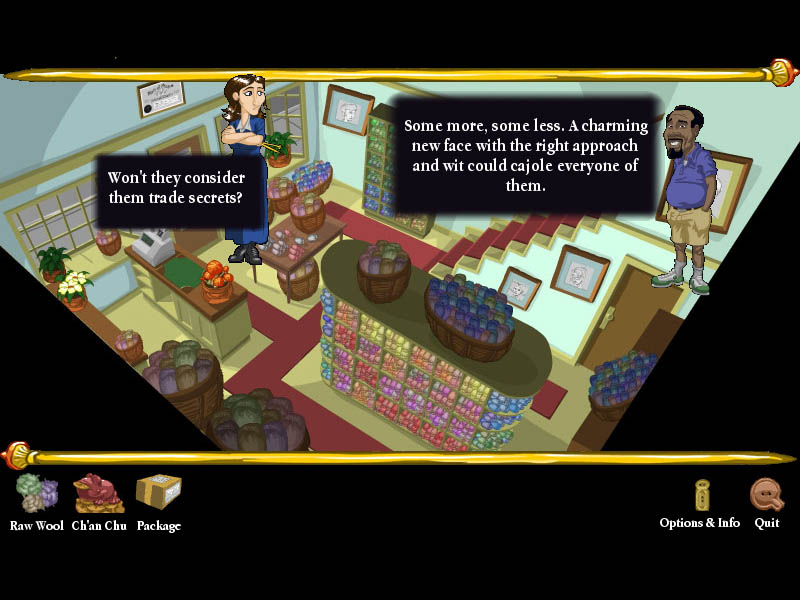
witchs

Witch’s Yarn — a graphical point-and-click rather than text-based, but you’re picking which props/characters you want to bring on stage next. Eons ago I did a review of it here. I think there are interesting procedural narrative things they could have done with this premise, but mostly in practice it came out as a series of puzzles instead. (Still interesting and unusual, though.)

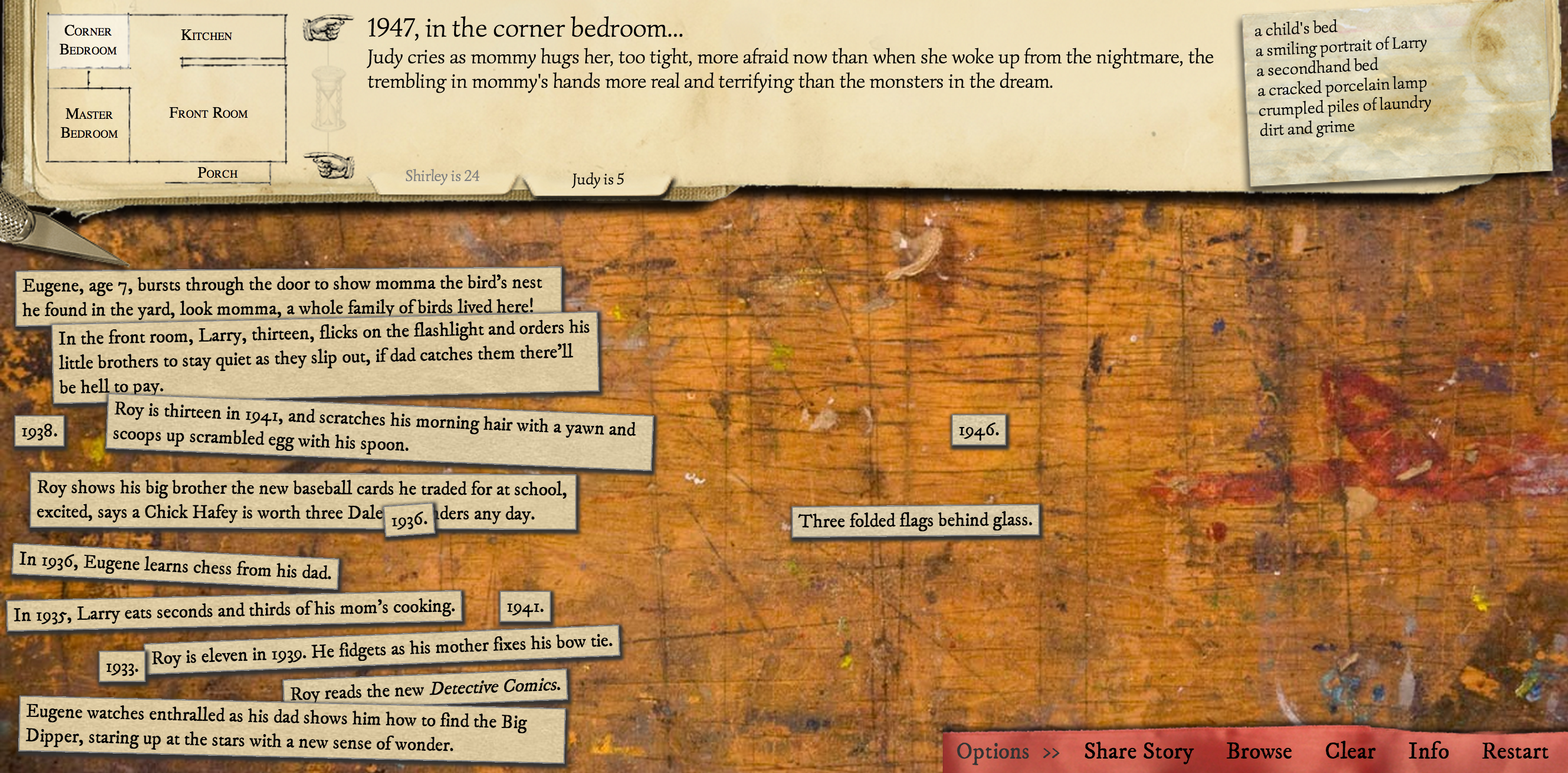
Screen Shot 2013-04-03 at 6.50.26 PM18 Cadence — players rearrange objects and narrative elements to construct their own stories. I talk about it more here.

Continue reading “Games of Co-Authorship”

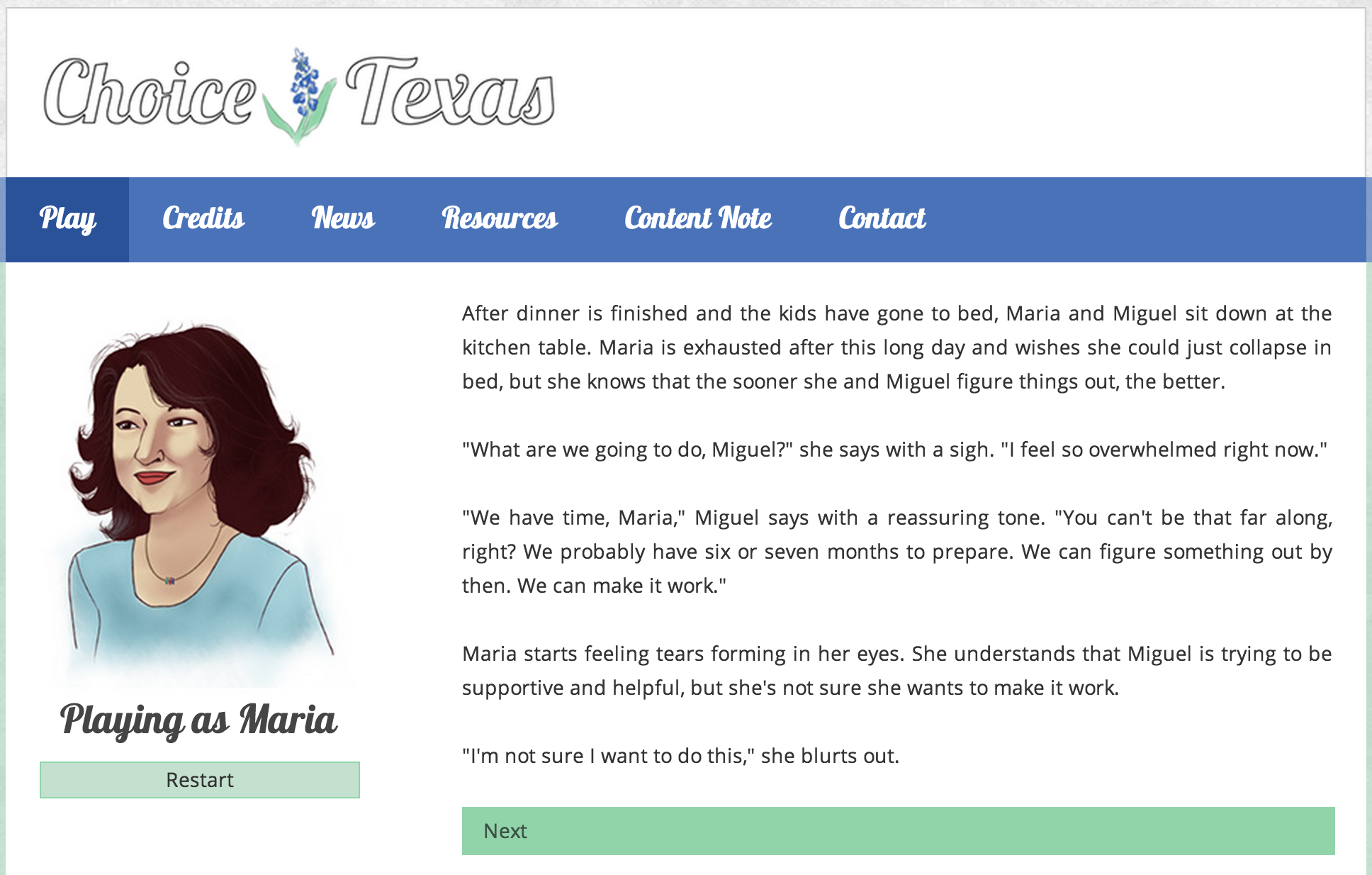
Choice: Texas (Carly Kocurek, Allyson Whipple, Grace Jennings); The Spare Set (Rob Sherman)

Screen Shot 2014-12-31 at 1.48.00 AM

Choice: Texas is a game about options for women in Texas who are facing unwanted or problematic pregnancies. It’s carefully researched and non-generic: there’s lots of information about costs, complications that apply to different situations, the rules for open and closed adoptions, the legal requirements that determine access to abortion, and quite a bit else.

There are five different protagonists, each with her own unique and branchy tale: a Hispanic mother who already has three children, a career-oriented black woman who faces a loss of opportunities at work if she stays pregnant, a teenager whose parents are anything but supportive, a victim of sexual assault, and a woman whose planned and longed-for pregnancy has turned up serious fetal abnormalities. Some of these characters have loving partners and good health care options. Some don’t, so much.

Continue reading “Choice: Texas (Carly Kocurek, Allyson Whipple, Grace Jennings); The Spare Set (Rob Sherman)”

Competitions, Anthologies, and Shows

IF Discussion Club this month is looking at the incentive systems and formal infrastructure in the IF community: competitions, anthologies, and shows. But as there’s a lot of material out there, I wanted to preface that discussion by providing a little bit of an overview to some of the things I’m aware of. (Edited to add: the transcript of that discussion is now available.)

Consequently, I contacted a number of people who have put together one of these events, and asked them to give me an overview of their thinking: what were they trying to do? Why? How did their goals change, and how well did it all work? I got a lot of response: many thanks to all those who took the time to write detailed responses.

I did not try to capture and describe things that were primarily about presenting a single IF work to the public (e.g., read-alouds of Lost Pig) or talks or demos of IF creation system (such as talks about how to use Inform 7 or intro-to-Twine workshops). I also didn’t attempt to cover sites that do/did on-going curation, such as IFDB, Baf’s Guide, freeindiegam.es, or Forest Ambassador, whether or not those were IF-exclusive.

Even without those restrictions, I’m sure there are a number of things that I left out. There are many general-purpose game jams that sometimes turn out to include IF entrants, which would be impossible to track down thoroughly. I didn’t try to cover all of the themed minicomps of the past decade and a half, because there have been so many. ifwiki lists 44 standalones of varying degrees of seriousness and specificity — including ToasterComp (12 entries) and BreadComp (0 entries). There are also people I wanted to contact but couldn’t reach, and there are also doubtless events I’m not aware of.

If you know of projects that are not discussed here but you have some insight into how they’re run, please feel free to add information in the comments.

Continue reading “Competitions, Anthologies, and Shows”