IntroComp 2014: The Cuckold’s Egg, Hornet’s Nest, Bridges and Balloons

Some thoughts follow on the IntroComp 2014 games I’ve tried so far. IntroComp is a long-running interactive fiction competition in which authors submit the beginnings of games and invite feedback and information about whether players would like to see more.

If you would also like to vote, you have through August 15 to try the entries and rate them.

Continue reading “IntroComp 2014: The Cuckold’s Egg, Hornet’s Nest, Bridges and Balloons”

80 Days (Meg Jayanth / inkle )

4_travelling-ferry

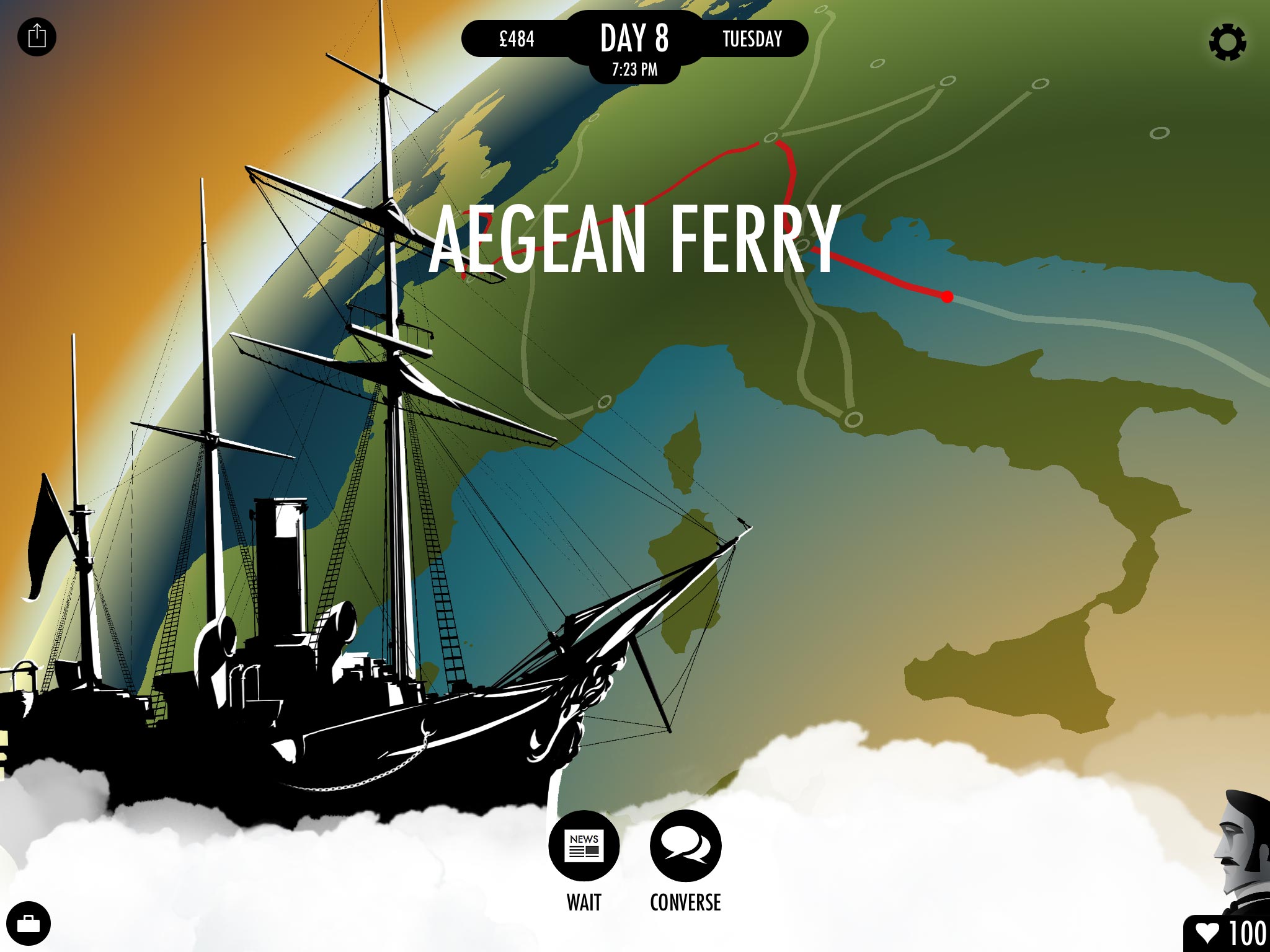
80 Days is a gorgeous iOS game from inkle studios and a script by Meg Jayanth, who (among other things) did the StoryNexus Samsara project. 80 Days takes off from the Jules Verne novel about Phileas Fogg’s round-the-world race; but it adds steampunk elements to the setting (I realize that some people feel about steampunk the way I feel about zombies) and allows the player to set the route, casting him in the role of Fogg’s valet Passepartout. Different routes take different amounts of time and have different costs associated with them; money and health are both resources that must be replenished periodically. The player can also buy (or more rarely acquire through narrative events) various inventory items that make the trip more comfortable, reveal new routes, or sell for fantastic profits in distant cities. It’s also slightly more constrained than the big open map might initially make it seem: you can’t really backtrack in some cases, even if there’s a nominally valid route in a particular direction and even if you the player think it would be a good idea.

Continue reading “80 Days (Meg Jayanth / inkle )”

Ultimate Quest

UltimateQuest

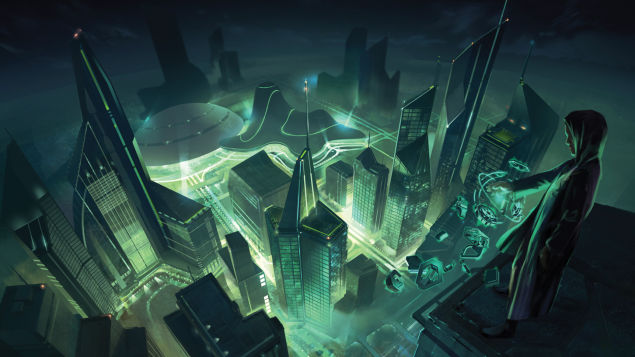
You’ve been kidnapped, confused, and trapped in a factory to do labor far beneath your true level. The friends you once knew think you’re dead, if they think about you at all. But you’re equipped with NV-level nanomite implants, meaning that you can disassemble and reassemble the world around you in surprising ways. It’s up to you to escape, confront the people who put you away, and complete the world-changing project you had begun.

Ultimate Quest is a new IF game — written by me, gorgeously illustrated by Silvio Aebischer — that opens today and runs in five episodes through the 22nd, as part of a new product launch by NVIDIA. The first players to complete the game will win actual prizes. If you’re reading this blog, you probably have a head start on the competition: this is classic parser IF with plenty of puzzles and exploration.

Note that this is a game with Twitter connections: you will need an account to sign in, and to tweet during play.

Blood & Laurels in The New York Times

Versu

Blood & Laurels is covered in the July 7 edition of The New York Times (page C1 in the print edition):

What Blood & Laurels offers is one of those quintessential video game moments, a first glimpse at something on the horizon.

The coverage is part of a larger article about developments in IF, which also mentions the growth of Twine, work by Porpentine, Christine Love, and Cara Ellison, and other text-based apps such as Device 6 and A Dark Room.

View original post

Heroes Rise on Steam

Choice of Games has brought their Heroes Rise series to Steam, making it the first all-text game distributed that way. (Steam also carries a few other things I would consider interactive fiction, such as Depression Quest, and IF’s relative Sunless Sea. But those games are somewhat more visual.)

CoG would like to bring more text games to Steam in the future, but the possibility of that will depend on sales, so they can use some support from Steam-using IF fans.

Latest Discussion Transcript

I’ve now posted last night’s transcript from the IF Discussion Club, this time on interactive nonfiction. It was a sparser session than some have been (people are busy on sunny summer afternoons!), but touched on a few different problems, including the question of how much “nonfiction” can be applied to anything interactive.

The proposed topic for next time, July 12, is testing. For perhaps obvious reasons, this doesn’t come with a reading list of games, but we’ll be interested to talk about testing methodologies and the various challenges that come with different forms of IF.

That said, if you want something provocative to read on the topic, may I recommend Mattie Brice on the Death of the Player?

Play- and player-centric design are usually interchangeable terms, but I’d like to make a stronger distinction between them. My main quibble with player-centric design is the fetishized iterative process, where you take a prototype and get players to playtest it. Sometimes, this is useful; if it’s very important to you that someone feels a certain way or does a certain thing, playtesting is a method to achieve that. When I made Mainichi, I released it without any playtesting and iteration. Because players have a tendency to want agency and a positive trajectory, their input would have been useless to me. As well, the game was made for a friend to understand something. I couldn’t playtest the game with them and then ‘release’ it after. It would be like asking your crush to read and edit the love note you want to pass to them one day. With games that use personal experience as a main part of their design, player input through playtesting washes out their voice. If your game leaves out traditional qualities and emphasizes voice, then player-centric design is a useless paradigm for you.

So perhaps it’s also worth talking about what testing does to a game — squeezes, squishes, alters, in ways that might be good or bad.