
Rome.
Rome.
Practice 2013 got off to an excellent start with a talk about breaking competitions. This is an area I know basically nothing about, so it was fascinating to hear about the issues involved: subjective vs (supposedly) objective methods of scoring bboy battles, cultural concerns around commercialization vs retaining a “raw” (and thus more authentic) battle experience, gender issues, and the degree to which bboy performances resist being made more accessible.
Several people in the audience compared bboy competitions to Street Fighter matches, but I’m not a very competitive player of video games.
I am, however, very interested both in playing and in attempting to create virtuosic games — pieces that inspire awe and surprise because they accomplish something that one would assume was impossible. I sometimes feel a bit guilty about this taste because skill is not the only criterion of quality, and because I do not want games culture to be as exclusionary as breaking culture appears to be. Talking only about high-end craft can make it seem like one is only interested in showing off or placing people in hierarchies of skill.
Still, watching the breaking battle after tonight’s talk reminded me of the human value of virtuosity. Because those dancers were amazing. Watching them was exciting and surprising and funny and joyous.
Admittedly I may be the only person on earth who yells “Holy shit!” when I see some really awesome parsing taking place.
We are fast approaching the talk Graham Nelson and I are giving at the Oxford Publishing Society Evening. Several other cool people are talking as well about games and ebooks. Drinks etc. start at 6:30 PM, talks at 7:15.
Normal price for non-OPuS members £10.00; there’s a special price for readers of this blog, £5.00. This is paid at the door (where presumably you just tell them that you read about the offer here).
Registration, directions and information about the other speakers is here.
I’ve moved to Oxford, and that means I’m no longer in range of the Seattle IF crowd or other local US meetups. I could see starting something in the UK, though, if there were interest. This could be something along the lines of PR-IF, the Seattle IF group, or the SF Bay IF meetup: a chance to get together and talk about craft, share tools and works in progress, possibly play games together, and whatever else seemed interesting to the members.
There are some indications of curiosity on Twitter, but I know not everyone follows there. So:

Fallen London has some new content for Halloween, and as I haven’t been back in a while, I headed over to check this out.
Fallen London has changed a good bit since I last spent significant amounts of time there. Some of the more grindy bits now let you just pay a larger number of actions all at once (5, often) in order to get an immediate effect. The Bazaar has new goodies in it that I haven’t seen before. The game of Knife and Candle has been completely redesigned.
What really excites me about “Hallowmas”, though, is that they’re trailing some of their end-of-story content, and also some in-game tie-ins to their forthcoming, much-anticipated Sunless Sea. I’ve been curious for a long time to see how they wrap up some of the strands of this story, especially since what I do know about it is pretty awesome.
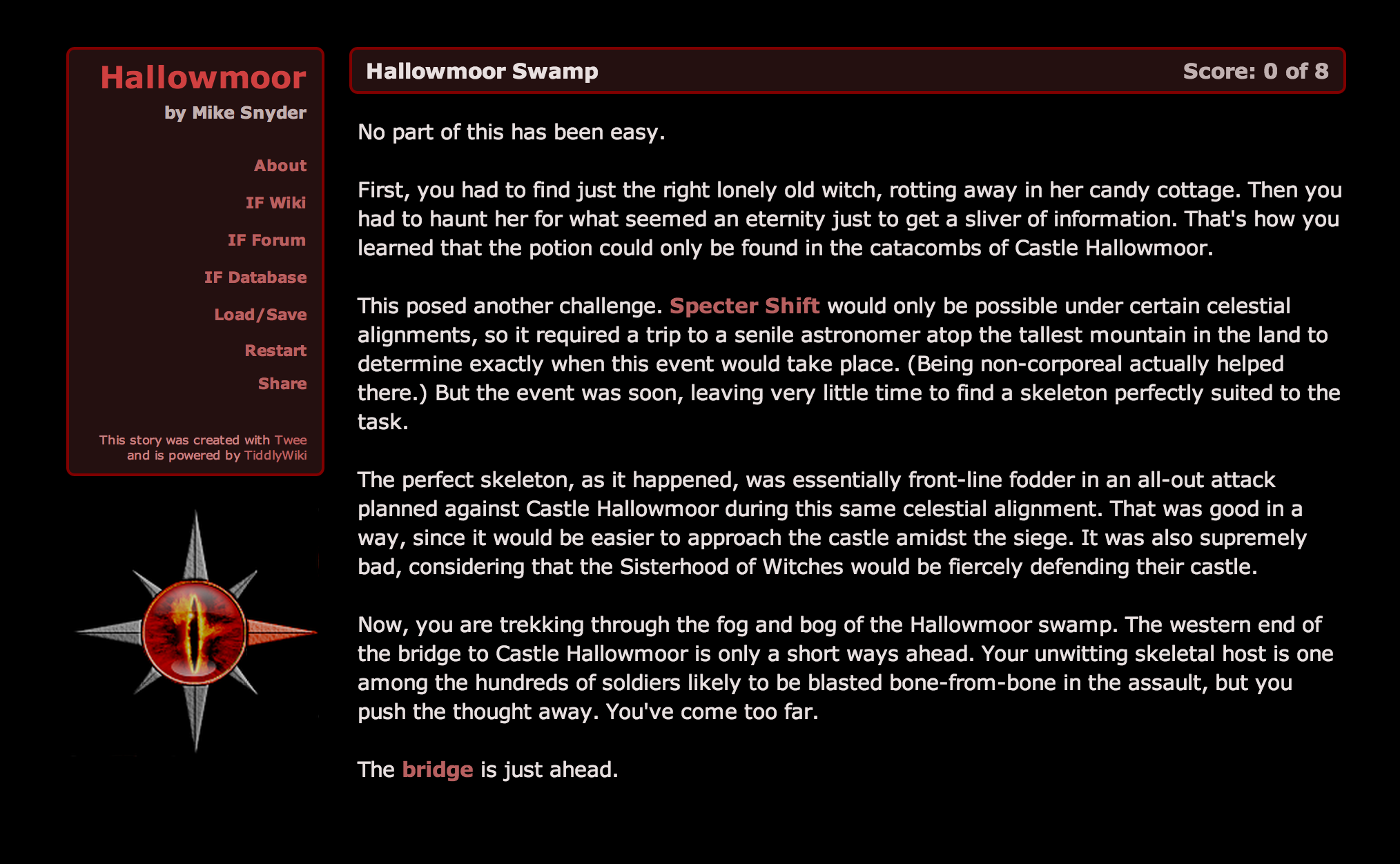
Mike Snyder released a Twine game for Halloween, Hallowmoor, about an epic battle between witches and skeletons in a fantasy kingdom. I haven’t finished it myself, but it’s substantial and highly polished. It’s also an interesting one for people who care about the formal relationship between Twine and parser games, since it’s got a bunch of features — a dynamic, updating map; a compass rose that shows exits; an inventory with usable objects; state that tracks the location of NPCs — that I associate more with parser pieces. There are also definitely puzzles, including a clever body-swapping mechanic.
(Full disclosure: I’m stuck about halfway in, at the moment.)
Ectocomp is a yearly IF competition with games written about a Halloween theme, with three hours or less allowed for development time. This year there are a startling twenty-four entries, many from authors you may already have heard of.
So far I’ve only had a chance to try a small handful of them, but there are some entertaining bits here, and most will only take a few minutes to play.
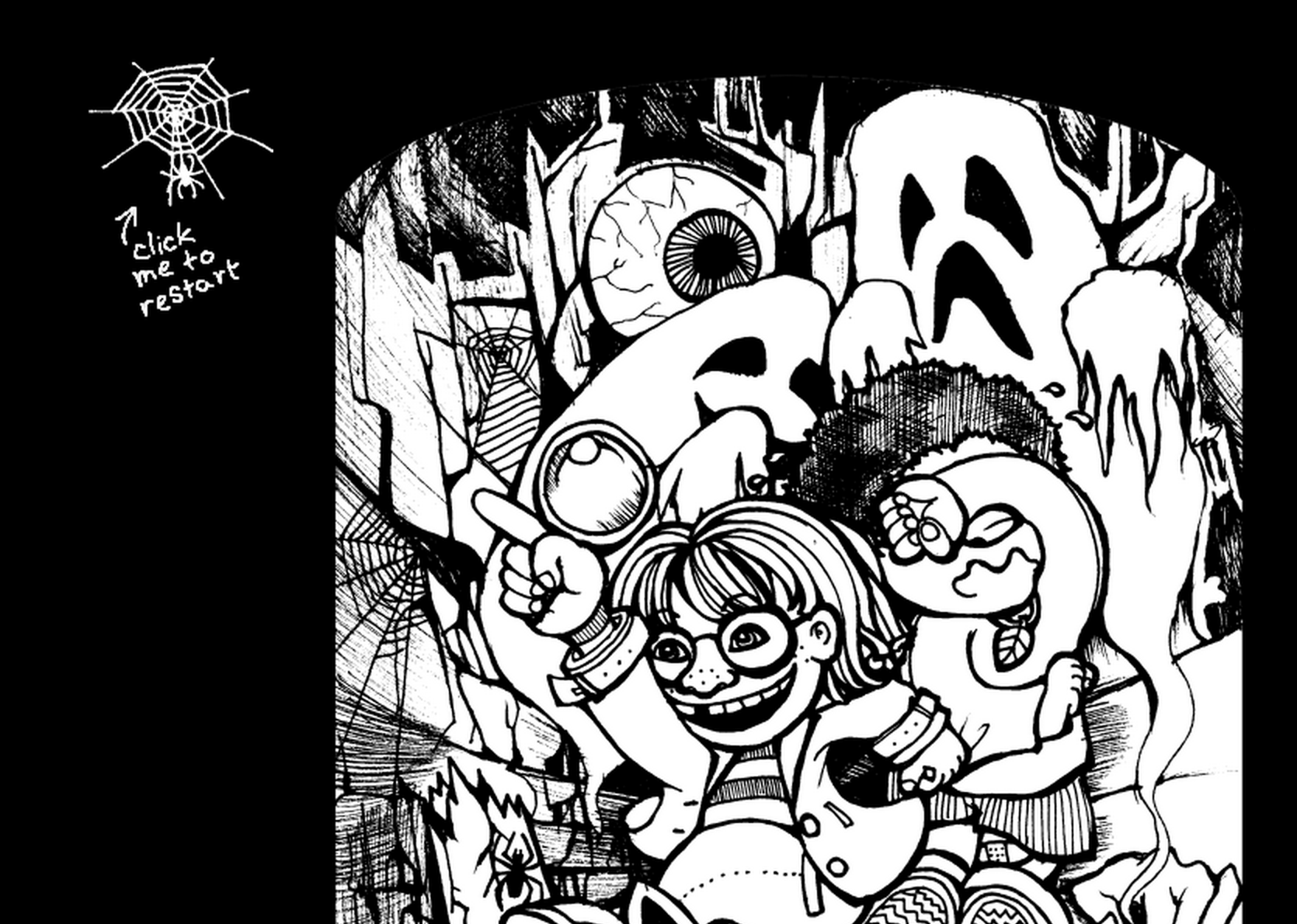
Anna Anthropy has a CYOA out called a very very VERY scary house. It’s highly-branching, low-state stuff, telling the story of a couple of pre-teens breaking into a suspicious mansion, in the spirit of early CYOA haunted house books crossed with Encyclopedia Brown. (Also, as far as I can tell, family-friendly.)

Microdot Reimagined is a parser IF game for sale from Potassium Frog. The starting premise is that your brain has been colonized (sort of) by a professor from the recently destroyed alternate-universe land of Microdot. He needs you to help him reimagine the place in order to bring it back into being, which means exploring a lot of spaces and solving some puzzles.
Stylistically, this is IF of the old school. Microdot Reimagined is executed in Inform 7 and playable with Glulx, and it’s got some nice tweaks, such as stylesheet improvements and cover art. In respect of gameplay, though, it retains the aesthetics of 90s or even 80s IF. There’s a short bit of narrative introduction, but the story such as it is does not seem overly pressing during at least the first part of the game. The map starts with lots and lots (and lots) of rooms accessible at the outset, and a variety of objects to collect from different rooms. I’ve played enough IF that I’m usually able to hold a layout of several dozen rooms in my head, especially if those rooms are introduced (as they usually are in modern IF) in clusters rather than all at once. So I almost never make maps any more. Microdot Reimagined, though, was big enough and thematically varied enough that as I wandered around all its opening space, I soon began to regret not taking notes.
The jokes are wacky-satirical — sort of Douglas Adams lite. Here’s a sample, which will probably give you a pretty good idea of whether the sense of humor matches yours:
>x magazine
It’s Celebrity ROFL Magazine! This is just so amazing. I cannot understand why anyone would not want to feature in this fabulous celebrity catalogue of doom. Let’s take a look at the epic stories in this week’s issue:Lard-packing with the Basingstoke Twins – “Celebrity Twins Elsie and Vera Basingstoke go on a Lard-packing expedition to sun-drenched Spudthorpe!”
Sir Abacus Timmy’s society wedding – “Kneepad Magnate Sir Abacus Timmy weds his Social Media Advisor, Jennifer Twitterbook-Davies!”
Plus there’s a sixteen page photo spread on the Monks of Ecstatic Gloom and their new swimming pool. This is so awesome!
I confess I got stuck after about 60-80 minutes of play, which is one reason this isn’t a full-scale review; but as far as I saw, the puzzles were mostly of a get-X, use-X style, except that the items in question were widely spread all over the map, so this was still nontrivial.
Enrico Colombini — one of the early greats of Italian text adventures — has released a short book about how to create an ebook with puzzles, given that the ebook’s only state is the page number and puzzles often require tracking some variable state.
This is a very specific purpose, but the explanations are clear and detailed, and may be relevant to anyone who is planning such a project. Another approach, of course, might be to use inklewriter’s Kindle conversion software, but that’s only useful if you are using exactly the right platforms; Colombini’s advice applies more broadly. It is published in both English and Italian, and comes with a short sample of a puzzle — a wolf/goat/cabbage cross the river puzzle — executed in ebook form.

Strip ‘Em All is an interactive comic strip puzzle, in which the player can reorder frames of the strip and sometimes alter the content of specific frames. Any change you make in one puzzle frame can have ramifications for the rest of the strip, as well. The puzzles ramp up in difficulty very quickly, and I found some of the later ones very difficult indeed. In several cases it’s not really obvious what order two panels need to follow because the dialogue really makes sense either way; in some, a complex series of panel changes and strip rearrangement is required.
This may sound reminiscent of Dan Benmergui’s Storyteller, but in practice it’s quite different: the text of speech bubbles is written out in advance, and the storylines are much more specific. Where Storyteller is backed by a generalized engine for working out the possible meanings of juxtaposed symbols, Strip ‘Em All is really about hand-rolled puzzles with one right answer.
That said, one of the interesting aspects of this puzzle is that it’s about exploring the interior space of the characters and the way they think as much as it’s about plot events and actions. Often one can hover over characters’ heads in order to see additional thought bubbles, which may be functionally hints about what is really going on. Sometimes a character changes states of consciousness, and all the panels change too as a result. So while I think it could have been better hinted, I found this fairly interesting.
One word of warning: the page includes quite a few ads.
Finally, a couple of interesting things to read: Jon Ingold gives a good interview in Haywire magazine on text gaming and in particular Sorcery!, and Liza Daly recommends some of her favorite interactive fiction from the last year.
 Emily Short's Interactive Storytelling