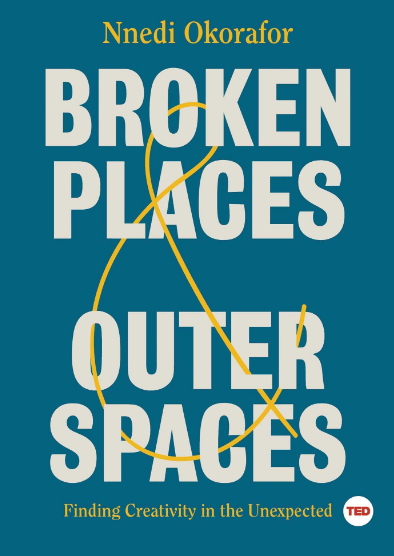
Broken Places & Outer Spaces is a book about creativity and the personal voice that comes from really difficult things in life; from what Okorafor refers to as “the Breaking.”
In it, she talks about an operation that left her partially paralyzed; about the process of learning to walk again, about learning to write as a result of that, and about the changed abilities that she has lived with ever since; about the integration of her Nigerian heritage into her science fiction writing; about her vision of Africanfuturism; about her embrace of the cyborg as a symbol of a potential self that is both less and more than human.
As the TED symbol might suggest, it’s an inspirational piece rather than one dedicated primarily to craft. I’ve come to regard the TED brand a little the way I regard the Papyrus font: it’s not inherently terrible from the outset, but too many exposures have made me wary of the style — polished, digestible, self-consciously heartwarming.
Nonetheless, I very much liked this particular piece. In particular, the idea of the cyborg self resonates: the idea that one is either currently broken, or currently unequal to the tasks ahead, and therefore it’s necessary to become someone else. And not just to grow gently toward the sun, or to undergo some natural process of evolution, but to take responsibility for crafting oneself, to put time and effort, technique and willpower into redesigning oneself.
February 15-16, Rob Sherman is running an interactive fiction masterclass at the British library. This is a paying event; tickets here.
February 29 will be the next meeting of the London IF Meetup. We’ll be doing a shared gameplay session with a curated list of games — I’ll post a link as soon as the session information is up on the website.
March 20-22 in Toronto is Breakout Con, a conference on boardgames and tabletop RPGs. Some great narrative designers are scheduled in as guests.
NarraScope will be May 29-31, in Urbana-Champaign, Illinois.
If you plan to enter Spring Thing 2020, you have until March 1, 2020 to declare your intent to enter. Spring Thing is a long-running competition for interactive fiction that welcomes longer games than IF Comp can accommodate, and features a “back garden” section for games that are unfinished, commercial, experimental, or where the author just wants to opt out of the competitive aspect of the competition. The games themselves will be due March 29.
I gave a talk about storylet design at the London IF Meetup. The session was (atypically) recorded, and we’ll be able to share the recording when it’s been edited, but there is also a tweet thread about the event for those who are curious. The talk included a workshop component where the group brainstormed possible story events, worked out what the prerequisites and effects should be, and then collectively played through the resulting game.
A world-building-via-mechanics look at religious pantheons: how might the realities of ancient religious systems enrich your game design?
Pantheons are naturally alluring objects for systems designers. Designations like “Trickster God” or “God of the Sea” or “God of Combat” naturally align with tech tree branches, player classes, categories of dialogue action, or in-game moral stances.
In practice, ancient pantheons weren’t always that tidy. There certainly were interesting oppositions: indeed, a great deal of structuralist theory has been constructed around finding the ways that Greeks distinguished humans from gods, deities of the indoors from deities of the outdoors, and so on. There were also, however, a lot of complications.
Naturally game design often involves tidying up reality to turn it into something even slightly playable. However, there are a lot of interesting things about the construction of ancient pantheons that could help you enrich your mechanics and tell a more interesting story about your in-game universe. That’s what this article is about.
I’m going to focus on Greek and Roman examples because that’s where my own training lies, but I’d also strongly encourage checking out other traditions for inspiration as well.
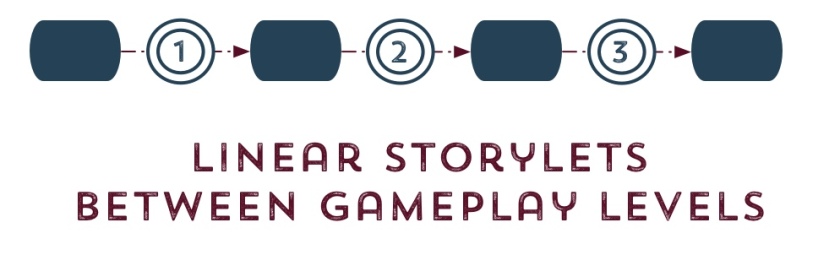
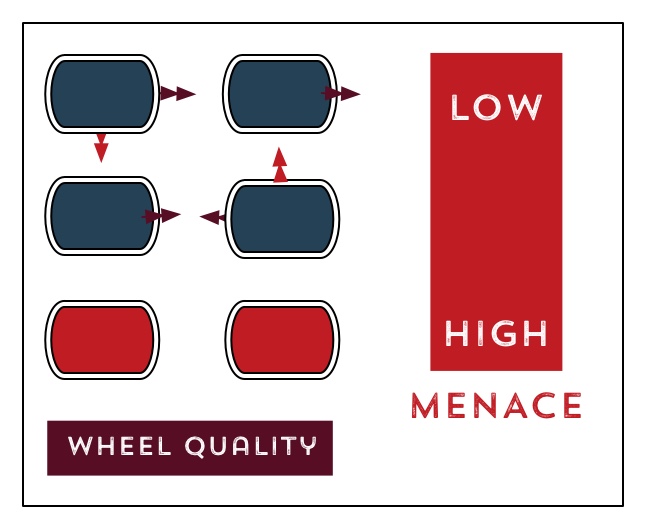
I use similar methods when working out the large-scale design for a storylet project to do the following things:
Represent the story concept from start to finish
Distinguish sections of content that are fairly open and player-controlled from sections that are fairly tight
Distinguish sections that reuse shared parts of the storylet world from sections that are unique to just this narrative arc
Sometimes storylet passages can be very linear indeed — essentially a straight progression from one storylet to the next.
Alternatively, they can be highly freeform, with a bunch of randomly selected story beats that can advance the player’s goals, move them backwards, or cause/alleviate menaces.
The Counterfeit Monkey puzzle chart was one of my major design aids when I was building the thing.
This is a chart of the puzzles in Counterfeit Monkey. It used to be linked from a blog post on the puzzle design, off-site, but it’s no longer at the endpoint of that link.
Instead, let’s put it here. I swear I have a good reason for doing this right now and it is genuinely not just because my blog gets the most traffic if I tweet a colorful diagram.
Don’t look too closely at the fine print if you’re planning to play and haven’t yet.
The Oxford/London IF Meetup next convenes January 29, when I will be talking about (and leading some workshoppy exercises around) storylet-based narrative design.
January 31–Feb 3, Ryan Veeder is running the first of three events in his Exposition for Good Interactive Fiction. This one is a short jam for Inform 7 games. There are a number of rules about how to participate, so please do check out the fine print.
February 15-16, Rob Sherman is running an interactive fiction masterclass at the British library. This is a paying event; tickets here.
March 20-22 in Toronto is Breakout Con, a conference on boardgames and tabletop RPGs. Some great narrative designers are scheduled in as guests.
NarraScope will be May 29-31, in Urbana-Champaign, Illinois.
Competitions
The Gaming Like It’s 1924 jam runs through the end of the month, and celebrates works that recently entered the public domain. There’s a whole list of possibilities in there that you might enjoy.
If you plan to enter Spring Thing 2020, you have until March 1, 2020 to declare your intent to enter. Spring Thing is a long-running competition for interactive fiction that welcomes longer games than IF Comp can accommodate, and features a “back garden” section for games that are unfinished, commercial, experimental, or where the author just wants to opt out of the competitive aspect of the competition. The games themselves will be due March 29.
The finalists for the Independent Games Festival were recently announced, with the awards scheduled to take place at GDC on March 18. Andrew Plotkin has been on the judging panel for a number of years, and shares his thoughts about some of the nominees here.
This video has some interesting design insight about Disco Elysium. I am told. I haven’t actually watched the video all the way through myself, because I haven’t played the game yet, because I need to borrow a Windows machine. That’s all being looked into and taken care of. I hear the video’s interesting, though.
Tools
YarnSpinner is a tool, in line with Twine or ink, that can be used to write and manage branching dialogue for games. It has now had a 1.0 release, and is available for free, though users are encouraged to support its Patreon.
 March 20-22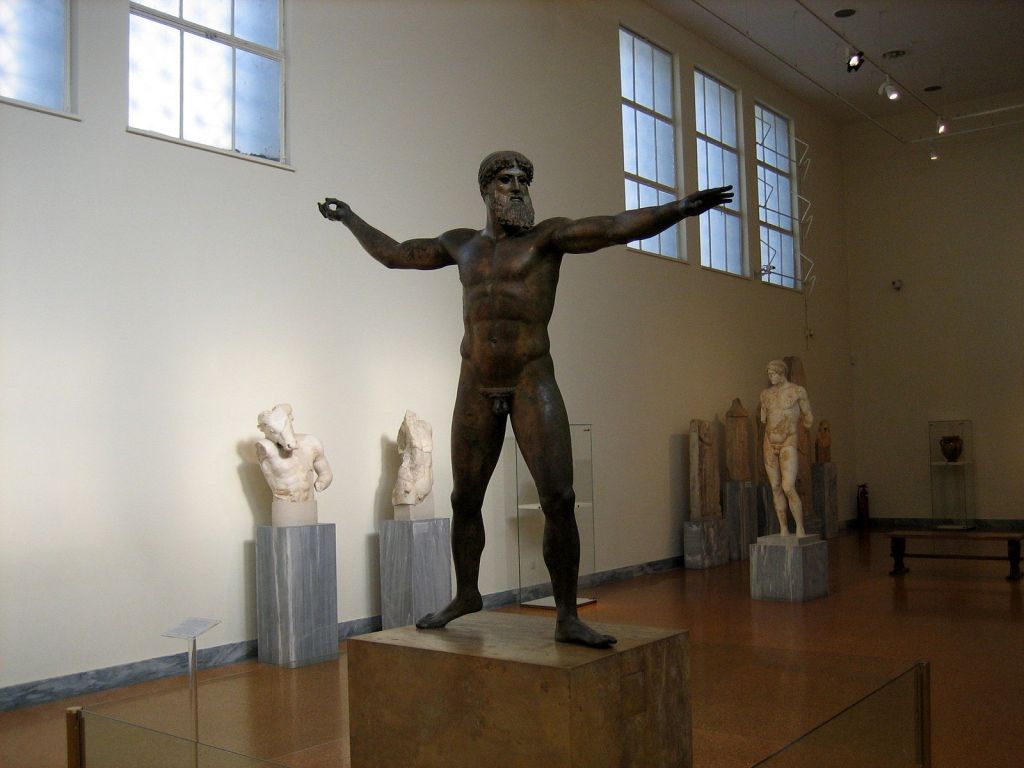

 January 17 is the deadline for proposals for

 The finalists for the Independent Games Festival were
 Emily Short's Interactive Storytelling