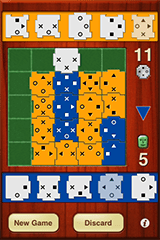
 Jigami is a puzzle game a little bit reminiscent of Reversi. You and your opponent (either the computer or another human) take turns laying down four-sided tiles, which have to fit into the adjacent tiles or they can’t be placed. In addition, each side of the tile bears a symbol — a circle, triangle, square, etc. — and if you place your tile so that it matches the symbol next to it, both the new tile and the old tile turn your color. Furthermore, if that tile also connects with other tiles via the same symbol — such that there is a whole line of squares (say) running through the tiles — you convert the whole set of tiles at once.
That makes for tactically enjoyable puzzle play, since sometimes it’s worth blocking off a particularly valuable vein of symbols just to ensure that your enemy won’t be able to flip them all back to his color in a single move. Then again… sometimes it’s just not possible to play defensively, if you haven’t happened to draw the right tileset or you can’t move fast enough. That means endgame play can be surprisingly volatile, with the apparent winner suddenly losing at the last minute. In some ways it’s more satisfying (and effective, at least for me at this point) to analyze moment-to-moment play rather than craft a long-term play strategy for the whole game.
Jigami allows you always to see your opponent’s pieces as well as your own. I’m not sure whether or not I like that: at first I spent a lot of time trying to think ahead, based on my and my opponent’s pieces. The thing is, though, that you can’t plan completely safely around your opponent’s slate, because it’s always possible to trade in the current slate of pieces for a random new set. So you can’t reliably box your opponent out of making a move, and that makes lookahead thinking based on his tiles a lot less useful — so I’d almost rather not see them at all, because it just complicates my decision-making process.
Still: entertaining, though I will probably like it even more if I come up with play strategies, rather than just short-term tactics. I’m not yet certain whether this will prove possible.
(Disclosure: I received a free review copy of this game.)
 So I ragged on I Dig It in a past review, and someone suggested I give it another try, and I did, whereupon I played the whole thing through. So when I Dig It Expeditions came out, it was more or less guaranteed that I’d try it. Expeditions continues the same excellent production values with new things to find and new digger devices and dangers. I’m not nearly done with it yet, but it’s a worthy addition if you liked the first one.
And they’ve made a tweak that resolves my greatest frustration with the original game: you can roll right over holes at ground level if you want to (as though you were driving around them in three dimensions), so you don’t have to fly around too much once you’ve emerged from your digging.
(Disclosure: I paid full price for this game and have no affiliations with the authors.)


 Emily Short's Interactive Storytelling