Return of the Obra Dinn is probably already familiar to you if you follow indie narrative games at all: winner of both the Grand Prize and Excellence in Narrative at the most recent IGF, the creation of Papers, Please designer Lucas Pope. I’m only getting to it now because I’m seriously behind.
The game puts you in the role an an insurance inspector, trying to work out what happened to everyone who used to be aboard a ghost ship. Thanks to a supernatural pocket watch, you’re able to revisit the time-frozen moment of death for every body you find, allowing you to explore one disturbing tableau after another to figure out who died, in what sequence, and why.
Unsurprisingly, it’s a very good game, one that achieves spectacle, surprise, and even some comedy within its confines. It’s worth playing with as little spoiler information as possible, so I’ve put less than usual above the fold. More design thoughts follow below, but they assume you’ve either played the game or read enough of a synopsis to be able to follow references.
Starting in mid-2017, I’ve used the first Tuesday of the month for reviews of books about game writing, and occasional books about other writing in general.
As of now, I’ve gone through about two dozen — including everything from self-published Kindle ebooks about interactive fiction to acclaimed classics of screenwriting advice — and that doesn’t count the books I read, or started to read, and decided they were just too unhelpful to cover on the blog at all.
I feel like this project is drawing to a natural close.
While there are a handful of good writing books left unreviewed on my shelves or my ebook collection, I’ve talked about pretty much all the ones that had a strong bearing on interactive work; and I’m finding there are diminishing returns on reading more of the same. But it’s been useful for me, seeing what is out there, and I hope it’s been helpful for some of you as well.
So I’m shifting process a little. I’ve started instead to cover academic work that might interest IF authors and narrative designers — trying to make it a little more accessible and curate some of the stuff that might not be easily found. (My article on Max Kreminski’s work is part of that).
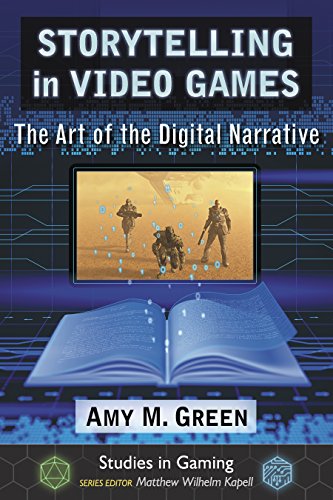
Today’s book, meanwhile, is a piece that straddles the line. The title, Storytelling in Video Games: The Art of Digital Narrative, sounds like it could easily belong to authorial how-to piece. But this is a piece of scholarship in digital narrative, rather than a craft guide, a speculation on experimental narrative creation, or a how-to book about getting on in the industry. The subtitle “Studies in Gaming”, is an important clue here. After a general introduction on why her topic is important, Green goes on to look at concepts of agency, immersion, and worldbuilding; and then to dig into how different long- and short-form games deliver their narrative experiences. She ends with a chapter on games studies in the classroom.
Green is interested in talking about how game narratives work, but from the perspective of a critical reader. She covers Firewatch and Everybody’s Gone to the Rapture, Far Cry Primal and Fallout 4 — and any number of others — via Baudrillard and Benedict Anderson. The rest of the time, much of the text consists of summaries of the various games and their features, and some the critical insight about them as games is pulled in the form of quotes from game critics.
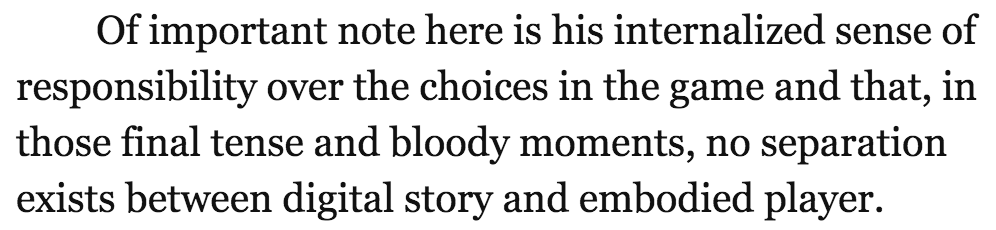
Relatively little of her own critique struck me as new information, and — ironically — in some cases her desire to communicate the emotional impact of things like complicity and immersion produced descriptions that to me felt both hyperbolic and obscure. For instance, she writes about the climax of Last of Us:
I puzzled a little over this — is she claiming that the player is more embodied or more present in the narrative here than at other, less tense moments previously? — but I think she means that at this point in the story the player, enacting the protagonist’s grim choices, cannot escape feeling both complicity and an intimate physical awareness of the acts.
I found myself pulling away from this book, and I think I’m just severely not the target audience. Going via Tzvetan Todorov to conclude that stories need an opening hook and that Last of Us has one — this feels like coming up with an itinerary that includes two hours on the Eurostar but the only destination is my corner shop.
For someone who comes from a humanities academic background but who knows relatively little about games, it might be a different story; though I’m afraid probably few people who meet that description are reading this blog with any regularity.
June 8 and 9, the London IF Meetup has talks (the 8th) and a workshop (the 9th) on interactive fiction designed for audio devices. We’re welcoming some out of town guest speakers for this one, one of our most ambitious events yet.
June 9 is the deadline to apply to exhibit a game or to speak at AdventureX, which is taking place November 2-3 at the British Library.
June 11 is the deadline for submitting Game Industry talk proposals to the IEEE Conference on Games (CoG). The conference itself will be August 20-23 in London.
Narrascope is set for June 14-16 in Boston, MA. This is a new games conference that will support interactive narrative, adventure games, and interactive fiction by bringing together writers, developers, and players. Both Graham Nelson and I will be there and will speak; I’ll be on a panel about Bandersnatch, and Graham will be updating people on the current status of Inform. More information can be found on NarraScope’s home site.
NarraScope will also be the Boston IF Meetup for the month of June. It’s worth noting that if you’re a Boston local and you missed the registration date, you might still be able to attend by volunteering for the event.
July 2-5 will be the ACM IVA Conference, taking place in Paris. IVA 2019’s special topic is “Social Learning with Interactive Agents.”
July 13 will be the next meeting of the Baltimore/DC IF meetup (there is no meeting in June due to NarraScope). The discussion will center around The Missing Ring from the 2019 Spring Thing competition.
“What manner of fool are you: the shrewd knave ever ready with a venomous quip? The renowned artiste at pains to stay above the political fray? The bawdy buffoon known as much for off-stage antics as on-stage mirth? Or the clever counselor whose real audience is the noble ear they whisper into? …The kingdom itself will be shaped by your choices!”
The latest offering to come from Choice of Games, Fool is a 420,000-word interactive novel by Ben Rovik. Play as a talented young court fool, navigating the scheming and treacherous world of the court of Breton.
Oslo-based independent game-developer Red Thread has just released Draugen, an ambitious first-person mystery set in 1920’s Norway. Described as “Fjord Noir,” players take on the role of an American traveler, searching the coastal Norwegian town of Graavik for his lost sister, and accompanied by a young ward.
Announcements, Articles, & Links
Starting on June 1, the IntroComp 2019 contest will be accepting “intent to enter” submissions, through June 30.
IntroComp is an annual contest that aims to give designers feedback on as-of-yet unpublished works that are not completely finished. Entries should be far enough along in the development process that they are playable, and all entries should also be interactive fiction. Cash prizes are available for the top few games (more information can be found on the site.)
On June 2, Fire Hazard Games will be launching The Extraordinary Voyage, a new immersive game at the National Maritime Museum.
The Extraordinary Voyage blends mobile games with interactive theatre, putting the player in the exciting world of seafaring and ocean exploration. Over the course of 90 minutes, players will explore objects in the museum, solve puzzles, and interact with real-life characters to create their own personal narrative.
The game is family-friendly and suitable for children 8 and up. Currently scheduled to run through July 7, although you’ll want to check the schedule for specific dates and times. More info can be found here.
Olivia Wood and Jessica Krause appear on the ScriptLock podcast, talking about topics such as their favorite choices in games and what makes for a good NPC.
This is the third of several posts about James Ryan’s dissertation, Curating Simulated Storyworlds. We are now reading chapters 6 and following, in which Ryan describes his own projects in the curated emergent narrative space.
After the first five chapters, this piece becomes considerably more narrative in its own structure: Ryan is (consciously) telling the story of his own artistic development and practice, and the particular works to which it gave rise.
This is the second of several posts about James Ryan’s dissertation, Curating Simulated Storyworlds. The previous post looked at chapters 1-3, which set out the concept of the dissertation and documented the pleasures of emergent narrative.
Here I read Chapter 4, concerned with the pain of emergent narrative, including critiques from other scholars and projects in emergent narrative that have failed; and Chapter 5, in which he presents his argument for curationist emergent narrative.
The major issues Ryan identifies with simulations are:
Boringness. Some simulations are simulating events that aren’t that engaging, and therefore they will never have the range to compel readers. (Something I was wondering about while reading chapters 1-3.)
Granularity extremes. The system is operating on either too large or too small a scale. As an example, Ryan showcases the system that controls how drinks may be taken in the Saga II story generation system, with an arguably excessive focus on moving objects from hand to hand.
As a side note: this is a granularity of state that most text adventure games wouldn’t bother with. There are some exceptions, though a few of the most granular works I know of were also never finished: for many years NK Guy worked on a game code-named Hamsterworld, which attended to player clothes and body parts (and many other systems) with great precision; of Gunther Schmidl’s And the Waves Choke the Wind, only a first few scenes were ever released. TADS 3’s library supports more in this range than any other text adventure world model I’m aware of, and handles some of the related challenges around making small actions implicit when they aren’t individually very interesting, so that at its best, the granularity of the world model becomes invisible except when there is something down in those details that really does interfere in the player’s intended action, at which point the consequence is reported. Return to Ditch Day remains one of the best examples of this kind of work, and Eric Eve’s work is also exemplary here.
Lack of modularity. The idea here is that elements of the simulation must be small and reusable; otherwise, it isn’t possible to recombine them in interesting ways. To illustrate this issue, Ryan looks at Sheldon Klein’s murder mystery generator, an example I haven’t seen written up particularly often (though perhaps I’ve been looking in the wrong places).
Lack of abstraction. Here, Ryan argues for the value of simulators that can cast different characters in different spaces and situations, rather than retelling (possibly different) stories about the same set of characters and events, since if we have a large number of stories about different characters, the appeal of the vast and the appeal of the ephemeral are preserved. (These are key features of the aesthetic of emergent narrative, as Ryan lays these out in earlier chapters.)
I am not sure what I think about this one. I will grant that the repetition of the same characters can give a kind of sameyness to story generators — though some systems, from Fallen London to Rafael Pérez y Pérez‘ Mexica, refer to characters by title or function in order to avoid the concrete effect of granting them a name.
Modeling gaps. This refers to places where it seems the simulation ought to cover some possibility or set of actions, based on what else is modeled, but for some reason certain elements are omitted.
Causality issues. Here Ryan describes how simulation causality can be too diffuse to make for good storytelling, especially in systems that rely on utility scoring where many different aspects of world state could all be considered to partially explain a particular outcome. (He gives a detailed example based on trying to interpret consequence in Prom Week, which is especially valuable here.) Though I’ve encountered this phenomenon, I haven’t seen the problem labeled or analyzed in depth before.
The solution Ryan proposes — contingent unlocking, where some events explicitly are made possibly by a finite set of prior conditions, and causal bookkeeping, where the system somewhere records how a particular outcome has been made available — will apparently come back in later chapters when he talks about his own work.
It’s a method we also used to some degree in Versu, where characters could record a string that represented why they’d adopted a particular attitude towards the player; and for that matter I use it lightly in my Choice of Games work in progress, which is not a simulation of the kind Ryan is talking about at all, but I still find it useful for the sake of later callbacks to be able to recall, say, the worst thing one character has ever done to another.
*
After these, Ryan next identifies pains of curation, and this is where the gloves come off.
James Ryan recently graduated from UC Santa Cruz, and he was kind enough to make available his dissertation, Curating Simulated Storyworlds, for anyone to read. Of academic work coming out recently, this is one of the more interesting to the interactive fiction crowd, and I’ve already recommended it to quite a few people. I’m going to be writing about it in a few posts, since it’s long enough that I wasn’t able to read it in a single sitting.
As with other posts about academic work, I’m aiming partly to make interesting academic work on interactive narrative visible and accessible to hobbyists and people from the game industry; but I also use the opportunity to record my own thoughts and reactions to the material, and these are often based especially on the history of interactive fiction. So while Ryan’s dissertation is not primarily about text adventures, I will sometimes draw connections from his ideas to work from the text adventure community.
The basic idea: Ryan is interested in the kinds of emergent stories that can be built by Dwarf Fortress-like simulations — large, complex worlds that generate many many events over many simulated years of interaction, often with striking and memorable chains of causality. But from a narrative perspective, experiencing these worlds is not always satisfying. Sometimes they generate fascinating emergent plots. Sometimes they just seem unfocused or dull. Hence: curation. We need either a human being or a second AI system capable of extracting the good stories from the simulator and presenting those to the reader:
To understand the successes, we might ask this essential question: what is the pleasure of emergent narrative? I contend that the form works more like nonfiction than fiction—emergent stories actually happen—and this produces a peculiar aesthetics that undergirds the appeal of its successful works. What then is the pain of emergent narrative? There is a ubiquitous tendency to misconstrue the raw transpiring of a simulation (or a trace of that unfolding) as being a narrative artifact, but such material will almost always lack story structure. (xii)
This is an area that a few others have touched on; Jacob Garbe’s Dwarf Grandpa project is essentially about curating a simulated storyworld.
In essence, Ryan’s assertion at the beginning of the dissertation appears to be that the difference between good and bad emergent narrative generators is simply whether anyone is sufficiently interested to bother curating the output: so Dwarf Fortress and the Sims are good emergent narrative generators because people retell their constructs, while some academic projects are not because no one is moved to retell those. To me this did seem to miss some points about what makes generators effective, including
whether the systems account for the possibility of stakes and motivations, or whether they mostly model less interesting things
whether the components of the systems are polysemous or symbolically rich, thus capable of supporting additional interpretive constructions beyond what the author might have intended
…though it may be that Ryan will come back to those or similar points later in the dissertation.
Ryan’s approach includes an explicit, extensive discussion of the aesthetics of emergent narrative. Why are we even bothering with this, and what experiences are we attempting to achieve? What does emergent narrative make possible, and what are the problems with it?
I was very glad to see this, because I think this kind of discussion is of critical interest for people who approach these systems from an artistic perspective, and they’re often entirely omitted or at best not very thoroughly considered in academic writing on procedural narrative systems.
The dissertation is sizable, so I’m going to be talking about it in a multiple chunks here.

 June 9 is the deadline to apply to exhibit a game or to speak at
  Narrascope is set for June 14-16 in Boston, MA. This is a new games conference that will support interactive narrative, adventure games, and interactive fiction by bringing together writers, developers, and players. Both Graham Nelson and I will be there and will speak; I’ll be on a panel about Bandersnatch, and Graham will be updating people on the current status of Inform.
 “What manner of fool are you: the shrewd knave ever ready with a venomous quip? The renowned artiste at pains to stay above the political fray? The bawdy buffoon known as much for off-stage antics as on-stage mirth? Or the clever counselor whose real audience is the noble ear they whisper into? …The kingdom itself will be shaped by your choices!”
 IntroComp is an annual contest that aims to give designers feedback on as-of-yet unpublished works that are not completely finished. Entries should be far enough along in the development process that they are playable, and all entries should also be interactive fiction. Cash prizes are available for the top few games (more information can be found on the site.)
 On June 2,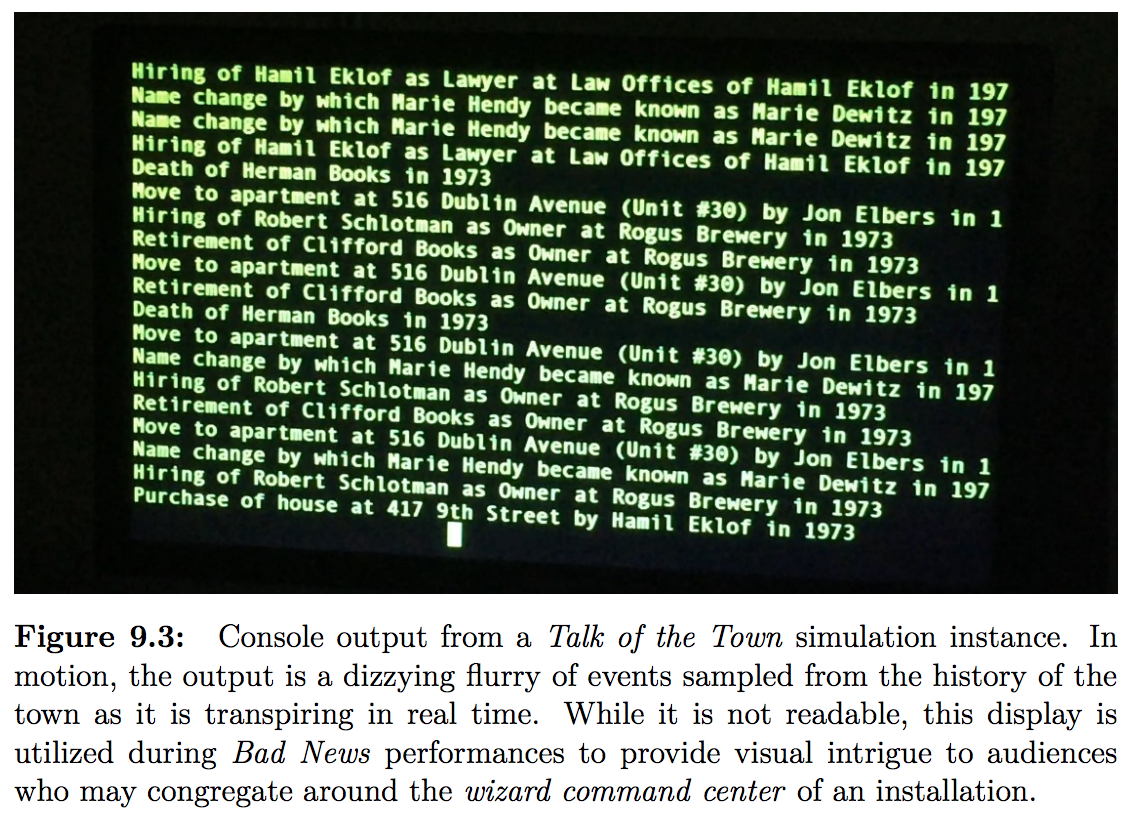
 Emily Short's Interactive Storytelling