Game Over is a radio play I wrote for BBC radio 4, commissioned and script-edited by Judith Kampfner and starring the phenomenal Sarah Elmaleh. It’s a story about trying to write a game about a particular topic, and the tug of different impulses that go into that process, and the ways it’s possible to screw up.
The play is available to listen to online at the moment, though in a few weeks it will become unavailable again.
Upcoming February 17 (a bit more lead-time than usual), the London IF Meetup is doing a Saturday afternoon workshop on using ink and Unity together. This is one of the best methods for creating professional-looking standalone IF applications, and we’ll help you get started with the tools you need.
Let’s Play
OldGamesItalia has put together a video let’s play of the tutorial scene in Versu, for those who never got to play through that.
Announcements
If you released a piece of interactive fiction in 2017, or played a 2017 release that you think deserves recognition, make sure it has an entry on https://t.co/tXxI9u8dY8 – that's where we draw the XYZZY nominees from.
Jason Shiga’s Meanwhile, the interactive comic ported to digital forms by Andrew Plotkin, arrives on Steam January 17.
*
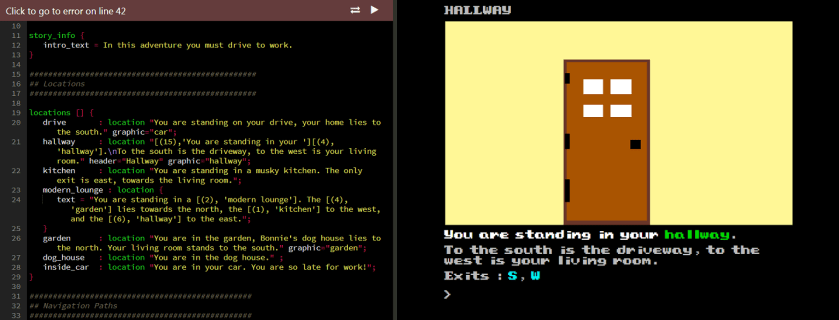
Adventuron is a system for making retro-styled, illustrated text adventures. The creator Chris Ainsley writes:
Adventuron is web hosted, and features a code editor (in which all logic and assets are placed), and has the ability to import maps from Trizbort.
Adventuron features code completion, and a web based game source parser, so the barrier to entry is quite low. I would be fooling myself if I was to claim this is anywhere near the competency of Inform 7, but I hope the code completion and UI features will help it find its audience.
I have a written an introductory article featuring a link to the system itself here.
Articles
Digital Antiquarian has an interview with Judith Pintar, a pioneer of interactive fiction who took a long break from IF but is now working and teaching with it again. The interview covers a wide range of topics, from Pintar’s early days on CompuServe and the nature of the community there, the development of CosmoServe and Shades of Gray, and her current education work focusing on Inform 7.
Digital Humanities Quarterly has an excellent writeup (from researchers at UC Santa Cruz) on crafting systems in games, and how we measure their quality and other parameters.
I reached out to you a while ago to ask about your consultation services / fees and you told me that you weren’t taking on any new clients. I respect that. I was hoping you might “mailbag” my question or maybe have a little advice off the top of your head. Any help would be greatly appreciated! I posted this on the IntFiction forums as well and just hoping to get a little bit of your expertise / feedback.
I am working on a CYOA sandbox visual novel project. My buddy wrote a framework in C# / Unity and I’m currently writing the story in OneNote / Scrivener with articy:draft doing a lot of the node-work / structural organization. I used SimpleMind to do some high-level mapping for the sandbox but it’s been very clunky. I reverted to using Excel so I could bring direct mathematical tests into my work for planning and it’s been really tough to combine the cell-based organizational structure with blocks of text.
Creatively – I don’t write well in little bubbles…at all. I prefer writing in a Word / WordPerfect / Scrivener / Notepad setting. It’s easiest for me to see all the text, re-read what I need to, edit, etc. I’m at a point where the story is getting difficult to test / debug / and translate into Unity. At the end of the day – whatever tools I use – I have to be able to hand my work over to the developer and make sure he understands everything in as neat / concise a manner a possible.
Here’s an example of some of my code:
\INSTRUCTION((ONCLICK.CELLPHONE)(=)(0)) // sets the variable that counts the number of clicks to zero – variable declaration
\EVENT((CELLPHONE)(ONCLICK))
\INSTRUCTION((ONCLICK.CELLPHONE)(+)(1)) // adds 1 to the counter variable
\ITEMDESCRIPTION((CELLPHONE)(ONCLICK)(This is your cell phone)) // cell phone description on the first click
/TRUE
\FALSE
\CONDITIONTEST((ONCLICK.CELLPHONE)(=)(2)) // cell phone description on the second click
\TRUE
\ITEMDESCRIPTION((CELLPHONE)(ONCLICK)(This is STILL your cell phone))
/TRUE
/CONDITIONTEST((ONCLICK.CELLPHONE)(=)(2))
\CONDITIONTEST((ONCLICK.CELLPHONE)(>)(2)) // cell phone description on every click after second
\TRUE
\ITEMDESCRIPTION((CELLPHONE)(ONCLICK)(Why do you keep checking your cell phone?))
/TRUE
/CONDITIONTEST((ONCLICK.CELLPHONE)(>)(2))
/FALSE
/CONDITIONTEST((ONCLICK.CELLPHONE)(=)(1))
/EVENT((CELLPHONE)(ONCLICK))
The bottom line: Some of what I do is creative writing – storytelling, dialogue, and narration / item / entity descriptions, etc. And the other part of what I do is basically writing the instructions to the developer so he knows when to call which functions and how the visual novel is basically supposed to operate. Does that make sense? It’s super time-consuming because I have to partition portions of my mind to work on the tasks separately. My biggest hurdle to overcome is finding a medium in which to do this. I can’t write everything in Unity because I don’t know the C# code and that’s really what my buddy is there for. I’d write everything in Scrivener but I need the math functionality.
The Art of Dramatic Writing is a book from the 1940s about how to write drama, preferably drama with a tragic bent. It’s also a book much referred-to in Lee Sheldon’s Character Development and Storytelling for Games, which is the reason I write about it now.
Egri has one central thesis that animates all his observations about craft, structure, and execution. This is appropriate, because his central thesis… is that a play should have a central thesis.
(Egri uses the word “premise” rather than thesis, but what he means is what we tend to call a thesis statement now, rather than a sitcom-style premise about starting conditions.)
These premises tend to be simple statements about cause and effect, and many of the examples he analyzes are demonstrating those effects in tragic form. For example:
Sacrificial love conquers hopelessness.
Ruthless ambition leads to its own destruction.
Escape from reality leads to a day of reckoning.
He who digs a pit for others falls into it himself.
He adds,
You can arrive at your premise [or thesis] in any of a great many ways. You may start with an idea which you at once convert to a premise, or you may develop a situation first and see that it has potentialities which need only the right premise to give them meaning and suggest an end. (22, in the edition linked above)
Essentially everything else in the book is analysis and application of this idea. Characters should be constructed so as to make them proof-cases for the thesis. The environment of the story must set a stage for a conflict that will show the thesis playing out. Situations, plot, causality must all serve the thesis.
At first blush this might not seem particularly useful grounding for 21st-century interactive storytelling. That’s partly because of the time it comes from: its examples are all stage plays and all old; its ideas about characterization partake of the sexism, racism, and classism of its era. But also there are the structural considerations. Egri’s book emphasizes an idea of inevitability, a story construction in which everything works toward the main character making a decision that executes the thesis. On a naive reading, that might seem to be at odds with the whole concept of interactive story. From another perspective, Egri is describing the underpinnings of procedural rhetoric.
Upcoming February 17 (a bit more lead-time than usual), the London IF Meetup is doing a Saturday afternoon workshop on using ink and Unity together. This is one of the best methods for creating professional-looking standalone IF applications, and we’ll help you get started with the tools you need.
Releases and Updates
Counterfeit Monkey version 7 is the latest CM build, put out by IF community supporters — many thanks to them for their help with that!
Game Over, my BBC radio play about game development, is available to listen to online. (At least, if you’re from certain countries.)
Traditionally I try to do some kind of year-in-review post about trends in IF for the year. There’s always the risk that I’ll be leaving out a lot when I do this. That’s especially true this year, when I’ve had an especially demanding work and travel schedule, and haven’t played nearly all the games I should have played.
But with apologies for many omissions, here are a couple of items I noticed.
Stats-Dominant Systems
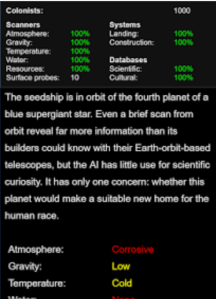
There’s a small genre emerging of games with a barebones front end, highly systemic choices and often a fair amount of randomness, culminating in bunch of different possible outcomes. The amount of story proper varies quite a bit.
This is distinct from, e.g., the genre of Choice of Games, because CoG uses stats heavily but each actual choice is specific to that narrative moment. This stats-y genre, by contrast, tends to present systematic options as well: explore more? refuel? go on to another planet?
The best of these appeal to me because they highlight the narrative consequence of procedural systems, often rigorously supplying a wide range of outcomes. Even when randomization means the player has only moderate control over how the story comes out (and thus perhaps not a load of agency), there is a very tight fit between story and mechanic. I happen to enjoy that as an aesthetic effect.
Seedship (John Ayliff) is possibly my favorite of these, offering loads of possible outcomes for the protagonist’s colonization efforts.


 There’s a small genre emerging of games with a barebones front end, highly systemic choices and often a fair amount of randomness, culminating in bunch of different possible outcomes. The amount of story proper varies quite a bit.
 Emily Short's Interactive Storytelling