Loose Strands (Darned Sock Productions) and Mapped CYOA

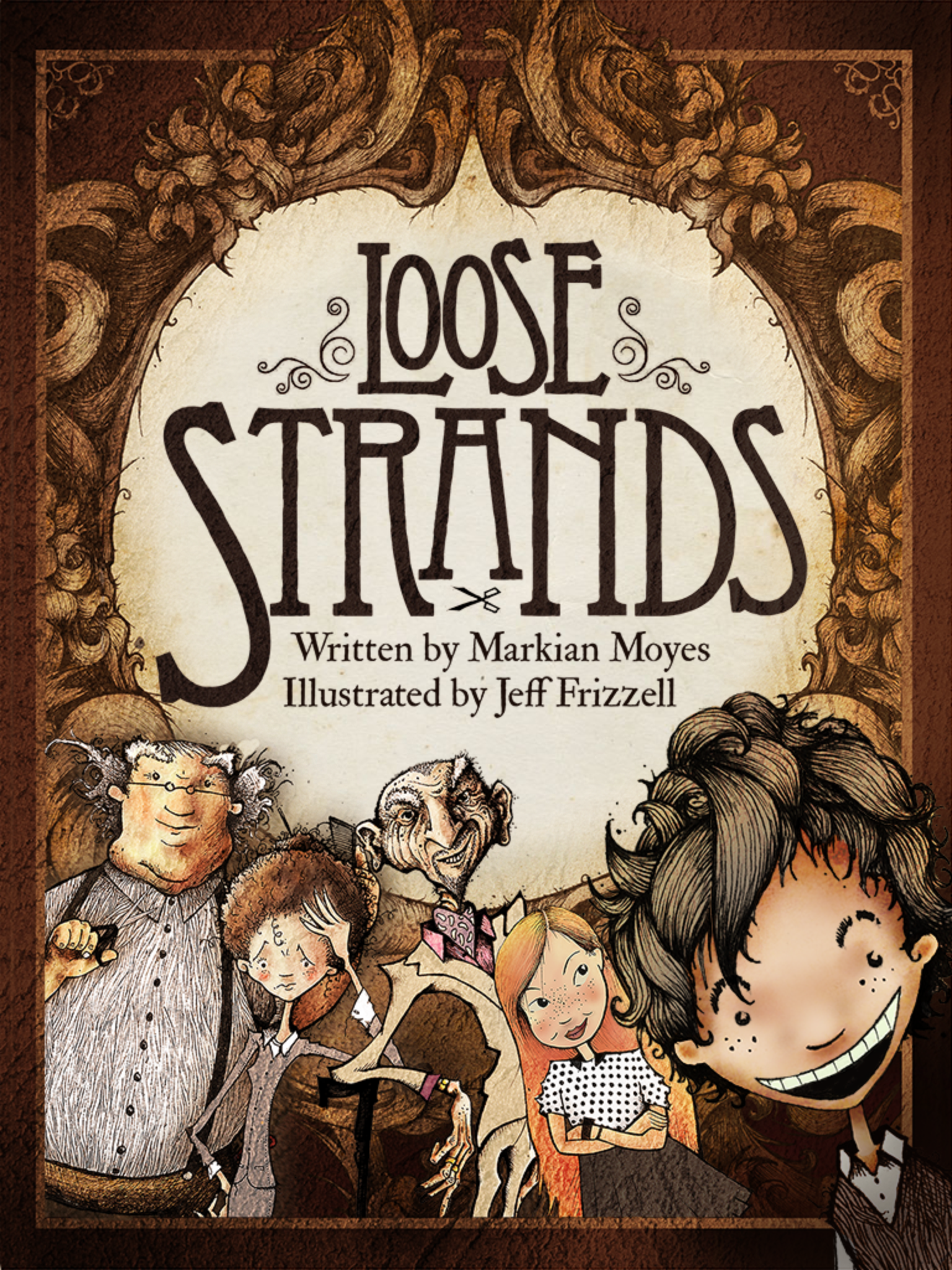
coverphotoLoose Strands is a choice-based interactive story app for kids ages 9+. It tells the story of Roland Bartholomew Dexter the Third, a boy who lives in an impoverished barbershop and is never allowed to go outside. His parents fashion clothes and even food out of hair leavings. Since he can’t go outside to school, he reads books about history and dinosaurs and airplanes, but these books have been so rigorously censored that they aren’t much fun. It never seems to be his birthday.

The only bright spot, if you want to call it that, is that Roland has unusually vivid dreams about the might-have-beens, the things that would have occurred if only he’d made a different decision from the one he did take.

Loose Strands is a story about regret: about being debilitated by the desire to erase the past, or, conversely, plagued by the inability to learn from our mistakes. It handles this with a kind of Lemony Snicket gloss. The villain is cartoonishly evil, the world a fantastic rendition of a totalitarian dystopia. The characters are charming, but not enormously nuanced. Now and then the narrator addresses the reader in a condescending Let Me Tell You About The World fashion, and the pacing around the end of part 1 felt a bit slow to me. Nonetheless, it’s a story about the nature of choices that makes a strong use of the choose-your-path structure.

Whenever you get to a choice point, you can swipe the page in one of two (or occasionally three) directions in order to proceed to the next portion:
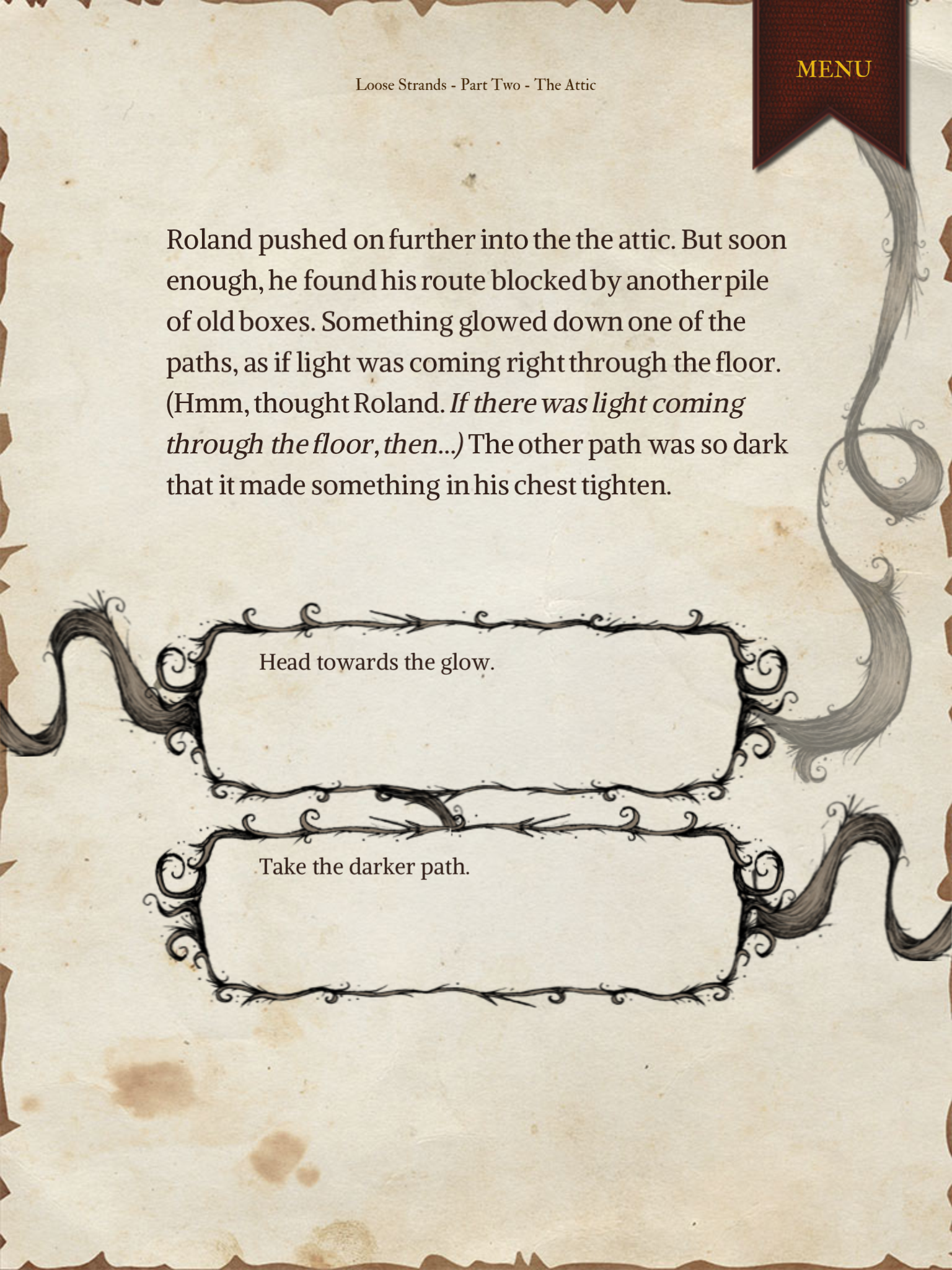
choicephoto

And when you’ve made a choice, the book immediately zooms to the overall story map and blacks out a bunch of spots — showing you how your decision has prevented you from ever seeing certain possible futures. It’s partly a reminder that what you do matters, a “Clementine will remember that” tag — but it’s expressed in an explicitly negative way.

Loose_strands_photo

Likewise, you can sometimes use the map to go to an earlier page, but if you’re trying to rewind too much, you’ll get a message saying you’re not allowed to go back.

Continue reading “Loose Strands (Darned Sock Productions) and Mapped CYOA”
if (Nicholas Bourbaki)

bourbaki“This author sent me a review copy of his CYOA novel.” I took the book out of its wrapper and held it up.

“Nicolas Bourbaki doesn’t exist,” my husband said. “He’s an invention.”

Someone had handwritten the enclosed note. I shrugged. “Maybe this guy really has that name.”

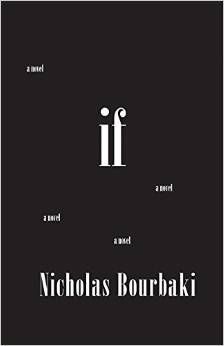
We were both wrong, as it happens; as this interview explains, Bourbaki-the-author assumed, with an extra h in the first name, a shadow of Nicolas Bourbaki the collective of pseudonymous mathematicians. His book, If, is a print choice-based novel — hefty, printed on thick paper, with “a novel” appearing multiple times on the cover as mark of both its multiplicity and its literary seriousness.

If sometimes embraces, sometimes rejects standard CYOA practice. It’s written in the second person, mostly, except when a first-person narrator crops up by surprise and many pages into the story: this first-person character is a bully, and for as long as we remember that he exists, the whole narration feels like a mean-spirited harangue against the protagonist. The main character also floats between characterization and Faceless Protagonism: he has a gender and passes through a specified series of ages, but some characteristics are intentionally withheld. On page 192, a character refers to him by name, though on page 194 we discover that this was a false identity anyway.

But having a name would probably pin the protagonist down in the wrong way. If belongs to that particular subgenre of IF whose overt hook is the opportunity to reach radically different life outcomes from the same starting point: works like Life’s Lottery, Pretty Little Mistakes (Sam Ashwell’s analysis), and Alter Ego (Jimmy Maher’s analysis).

Continue reading “if (Nicholas Bourbaki)”

Scaffolding and Scene-based Design

One of the things I find useful in developing a very plot-oriented piece of IF is to leverage the scenes mechanism as much as possible, designing as follows. I’m not sure this really qualifies as advice so much as some personal experience that may or may not suit others’ writing styles — people tend to approach IF design in different ways. Still, FWIW:

Continue reading “Scaffolding and Scene-based Design”

Plot, scene by scene

When I plan plot-heavy IF, I think of it in terms of a sequence of scenes. This doesn’t mean that the gameplay needs to be rigidly linear: scenes can occur in varying orders, or there can be plot branches, or scenes that can be skipped depending on player action. But I nonetheless do the organization in terms of scenes. A scene has a definite beginning and a definite end. It usually has to take place in a specific area of the game map (which may mean that the player triggers it by entering that area [as in City of Secrets] or that I move the player myself when the scene is scheduled to start). Following some writing advice I got long ago, I try to make most of the scenes end with some kind of clear hook. At the end of the scene, the player should ideally have a new take on what is happening, or a new problem to solve, or a new question about what is going to happen next. Exciting the player’s curiosity about something is especially powerful in getting the player to keep playing.

But the conventional writing advice tends to be insufficient when it comes to the types of scene that IF supports. I find that in interactive fiction my scenes tend to come in several styles, identifiable by the sort of interaction I expect from the player.

In rough order of intensity, they are

Continue reading “Plot, scene by scene”

Inform 7 for the Fiction Author

Jeff Nyman recently raised the idea of having a guide to Inform 7 specifically written for an experienced fiction author without background in IF, and I posted a brainstormed outline for such a project. The formatting was pretty ugly on Usenet, though, and I had a few ideas for revisions, so here is another, longer and better-laid-out version of the same thing, with more links to relevant games and articles.

This still isn’t nearly into the shape I would use if I were actually going to write this book — and I don’t have time to do any such thing right now anyway; I have a bunch of things to do for Inform 7, feelies.org, and the long-neglected theory book before I could take up a project of this magnitude. (And I’d like to have a little time to work on a WIP of my own — IF support work has pretty much wiped out my time for that kind of thing lately.) But possibly people will find the brainstorming interesting, even if it isn’t worked up into a complete document.

Continue reading “Inform 7 for the Fiction Author”