Sims 3 (Mobile version)

imagesLately I’ve been thinking more about emergent narrative — in particular, the idea that a sandbox-style game can produce elements that the player then weaves together into a story that he finds satisfying. The story isn’t really a product of the game, and it’s not necessarily true that anyone else playing the game would perceive the same story. The onus is on the player to determine which of the many otherwise insignificant events contribute to the narrative.

I’m pretty skeptical about this idea. Or rather: I can see that some such thing does happen, in that lots of (say) Sims users construct elaborate stories with their characters, and share movies and narratives. But in general this is not what I would call interactive storytelling; it seems more like handing the user a really complicated dollhouse that happens to have built-in tools for recording and editing the best scenes.

Still, I thought I ought to put a bit more research into this topic before I dismiss the possibilities. It’s been a while since I had (and got tired of the grinding aspects of) the original Sims, so I tried downloading Sims 3 for my iPhone.

Alas, I find it a dead bore.
Continue reading “Sims 3 (Mobile version)”

Alabaster feedback

As Alabaster is in large part an experiment with the underlying conversation system, I would very much welcome feedback about how the system behaves so that I can refine it for future use.

As background: how much the system prompts the player is already an adjustable feature (up to turning off quip prompts entirely, for a standard unprompted ASK/TELL experience). Likewise, it will be possible in the final version of the library, though not demonstrated here, to use a numeric menu to offer the player options.

So what I’m particularly interested in at the moment is how to improve the player experience when the game is using the same library settings as Alabaster. Some things that have come up already:

A common misapprehension seems to be that it’s necessary to retype an entire quip name verbatim, whereas in fact the game parses quip names in the same way that it parses object names: the first few words of the quip, or any unique word, will do. The system does not, perhaps, do a good enough job of teaching new players this fact, especially when the tutorial mode is turned off; so perhaps there should be a mechanism to notice if the player is typing in very long commands and mention (once) that these can be shortened. (Also, perhaps, to point out that the whole ASK INTERLOCUTOR ABOUT structure can be shortened to A.)

I’ve also had a request for tolerance of spare question marks (which some players find themselves typing even after an indirect question such as ASK ABOUT WHETHER SHE IS COLD).

Another point is that Alabaster doesn’t give good feedback when the input is

>SNOW WHITE, [valid quip name here]

In general, I’m not sure I want to encourage players to approach things that way because it encourages them to think there’s actual natural language processing happening — which there isn’t. But there could be better error messages in response.

Anyway, comments are welcome; it would also be useful to have transcripts that demonstrate interaction with the game, since these would provide also some idea of how often commands are failing, and what kinds of commands. If you have one you’d like to send in, I’d appreciate it: emshort@mindspring.com.

Official Release

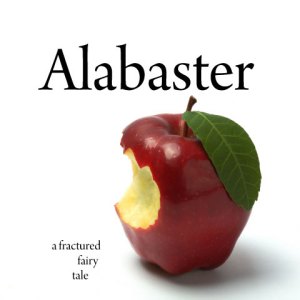
Cover

The Queen has told you to return with her heart in a box. Snow White has made you promise to make other arrangements. Now that you’re alone in the forest, it’s hard to know which of the two women to trust. The Queen is certainly a witch — but her stepdaughter may be something even more horrible…

There are some eighteen possible endings to this fairy tale.

Some of them are even almost happy.

A fractured fairy tale by John Cater, Rob Dubbin, Eric Eve, Elizabeth Heller, Jayzee, Kazuki Mishima, Sarah Morayati, Mark Musante, Emily Short, Adam Thornton, & Ziv Wities.

Illustrated by Daniel Allington-Krzysztofiak.

Available now from

http://www.inform-fiction.org/I7Downloads/Examples/alabaster/

(Changed because the old site went over its traffic allowance.)

Please note — as the site also points out — that you’ll want the latest available Glulx interpreter to play (Git 1.2.4 for Windows, Zoom 1.1.4 for Mac). Alabaster is processing-intensive and makes use of the latest Inform optimizations.

Another warning: some of the comments here get spoilery.

Interactive Storytelling Must-Play List

A few days ago Skye Nathaniel took me to task in comments for “[making] a point of playing Portal when there is science to do elsewhere”. I don’t regret playing Portal — it was awesome. But this makes me wonder about other things that I’m missing. What belongs on the “must play to understand interactive storytelling” list?

Here’s my own list to start with. It is, I know, both woefully incomplete and IF-slanted (and that even though I was fairly sparing about what IF I allowed on the list). I’m probably also forgetting a bunch of things that I’m planning to play myself. But that’s why I’m posting. Input?

Have played and consider relevant

Commercial

  • Planescape: Torment. Didn’t come close to finishing, but played enough to be impressed.
  • Portal. despite Skye’s comments, I did think it was worth playing through, for the characterization of GlaDOS if nothing else. And it’s popular enough that it provides a good example for discussing any of the techniques it does use — because people are likely to know about them.
  • Something in the Myst series, as a milestone of atmosphere and development. I liked Riven best for its overall structure and gameplay. But I’d include it more as source of history to understand than because it’s currently cutting-edge.

Indie but not freeware

  • The Path. I really don’t know whether I liked it or not, but I played to a finish. I thought it was both broken and kind of brilliant, and whatever you think about it, it will really stick with you. I have a Homer in Silicon column on this to come, though probably not for a while.
  • Dangerous High School Girls in Trouble. Very unusual gameplay in many respects, and there are some semi-boring patches in places, but it’s taking on issues and ideas that are worth discussing. (HiS column)

Persuasive

Casual

  • Miss Management. Gamelab’s excellent time management game with memorable characters and a distinct plot arc. (HiS column)
  • Emerald City Confidential. It’s really a graphical adventure, but it puts itself in the casual category via its marketing, sort of. Categories are hazy, did I mention? Anyway, it’s not too formally innovative except in its attempts to make a graphical adventure accessible to a casual audience (and even there, it’s adopting a new set of genre conventions more than inventing); but it does take the story to some places that aren’t completely common in adventure games. (HiS column.)

IF (long more because I know about it than because I’m making some statement about its relative importance)

  • Anchorhead, for the complexity and extent of the plot and the uniformly high quality of writing and atmosphere.
  • Photopia, as an exploration of linearity.
  • Rameses, as a classic example of the value of complicity.
  • Shade, for the changing player/protagonist relationship.
  • The Baron, for adventures in protagonist motivation and the value of choice and philosophical thinking in an interactive story.
  • Varicella, for its development of the accretive protagonist.
  • Slouching Towards Bedlam, for its excellent articulation of the different choices available to the player, and the sense of true freedom within the story.
  • Everybody Dies, for its inventive combination of image and text to accomplish subjective effects, and because it’s an especially strong use of multiple, differently-voiced protagonists (though see also Being Andrew Plotkin).
  • Blue Lacuna, or exploring player reaction and expressiveness as well as player choice; for the experiment in drama management, even though I think said drama management does not always work to keep the pacing tight.
  • For historical reasons, probably Trinity and AMFV; possibly also Deadline, Plundered Hearts, and Wishbringer. Maybe The Hobbit, though honestly it drove me insane when I tried to play it. I don’t get the impression it was a terribly successful adaptation as narrative, but that people really enjoyed getting the NPCs to do weird things.

Ren’Py… I don’t know. I have no specific recommendations here about works that were too awesome to miss, and yet I think a knowledge of the form doesn’t hurt. I’ve played a few of these, especially by Tycoon Games and Hanako Games, but I’d be interested in any suggestions if there are Ren’Py games with really fabulous stories that I’ve missed.

Various games in the newly emergent retro/art genre

  • Passage. Because it gets talked about so much. I wasn’t a huge fan, but I feel like it’s kind of necessary to know about.
  • Don’t Look Back. Terry Cavanagh’s platformer version of the Orpheus and Eurydice story, for its use of the challenge and frustration of gaming in service of the story.
  • Cavanagh also collaborated on Judith, which rediscovers some of Photopia’s techniques — temporal reordering, inevitability, narrowing of interactivity — but in a different medium. So, from my point of view, most of what this game does with interactive storytelling techniques has actually been done better and earlier in IF, but it may have introduced the ideas to a new audience, which is good.
  • (I Fell in Love With) The Majesty of Colors. My favorite, I think, in this game line: it’s intuitive and moving and unique.
  • I Wish I Were the Moon and perhaps also Storyteller (same place) for the way that they allow the player to select elements that should go into a story, rather than controlling any of the characters.

Other/unclassifiable

  • Façade. Unique and entirely obligatory, though far from perfect.
  • Ruben and Lullaby. Uses touch and gesture on the iPhone as a way to communicate feelings to the protagonist. For my taste the actual story aspect is a bit vague, but it’s a fascinating attempt and worth a look. (HiS column.)

Want to play (some of them rather old)

  • The Blackwell Legacy. While I have a dual-booting Mac laptop, I don’t have a two-button mouse for it, which makes some games unplayable. I know, I could fix that for about $20, but I haven’t gotten around to it yet.
  • Neverwinter Nights. Again, I just need a $20 two-button mouse to make this go on my Windows boot partition, so it’s probably going to happen sooner than the others; I know it’s old, but I’m particularly interested in exploring the player-designed content aspect, and I’ve just never gotten around to playing with it. (I know there’s also a Mac version, but as far as I could tell it didn’t come with the editor, which makes it vastly less interesting to me.)
  • Half-Life 2. I don’t have anything up to running this.
  • Bioshock. Ditto.
  • The Mighty Jill-Off.
  • Braid. Planning to play it when it’s available for the Mac.
  • Ico.
  • Shadow of the Colossus.
  • The Longest Journey.
  • Fable. I have the impression that people were disappointed, but I’m still curious about what it attempted, perhaps unsuccessfully, to do.
  • The Witcher.

Playing “Inside Woman”

So I’m playing Andy Phillips’ just-released Inside Woman, and it’s reminding me of all the stuff I have liked and disliked about Phillips’ past work.

The good: a lot is happening. Phillips writes in a slightly different genre than the average IF — there’s a lot less generic exploration and uncovering of backstory, a lot more sneaking around and playing clever tricks in the present. He goes for plots about jewel thefts, espionage, corporate surveillance. Action-movie stuff. This gives his games a kind of gonzo energy. You can tell he’s working from a big concept.

The bad: Sometimes the execution doesn’t work so well. He doesn’t always do this in a way that works for IF — Heroine’s Mantle contains some sequences that feel like they were imagined for a movie screen and then only grudgingly and reluctantly transferred to interactive format. In particular, scenes are sometimes a bit infodumpy and don’t provide enough else for the player to do while they’re going on.

Also, sometimes the puzzles are just weirdly unfair, and sometimes in ways that don’t make sense within the story. Spoilers on a couple of particular things right at the start of the game (I only have 32/400 points so far):

Continue reading “Playing “Inside Woman””

Partway through “Make It Good”

What follows is totally spoilery commentary on a partial playing of Jon Ingold’s “Make It Good”, with some speculations based on the game state I’m currently in. So I strongly recommend not looking unless you’ve played the game (it’s enough fun not to want spoiling) or have at least put in a few hours’ playtime (in which case you may be more or less where I am).

La la la la la etc…

Continue reading “Partway through “Make It Good””