Procedural Text Generation in IF

In the Missing Tools discussion some time ago, one of the things people mentioned wanting more of in IF was procedural text generation, which here is meant specifically as the ability to have the computer describe complex world model states or story events without having to hand-author every possible variation.

This is an area where there’s a lot to learn from work going on in academic research, but as far as I’m aware there’s relatively little communication. As I mentioned in my ICIDS writeup, James Ryan at UCSC and Dr. Boyang Li at Georgia Tech’s Entertainment Intelligence Lab are doing work on a) how to better represent a richly complicated world model and b) how to procedurally alter narrative features such as the tone of narration. One of the things we particularly don’t seem to do in hobbyist IF, perhaps for lack of resources, is experiment with large word databases such as WordNet or crowd-sourced work in particular areas like that used on Scheherazade.

Speaking for myself, I’ve also tended to stumble towards solutions in this space based on trial and error and the needs of my own projects, rather than having a strong grounding in the relevant academic work. Most of what we’ve needed — and most of what we’ve done — is pretty much work in the shallowest end of this pool.

And, of course, text generation for parser IF comes with special additional challenges, in that the player usually expects to be able to refer to any generated noun or noun phrase element; therefore if we generate a description of a thing as “blue”, the system also needs to remember how we described that object and accept the input “blue” to refer to it.

Here are the things I’m currently aware of. Unfortunately, I’m inevitably more aware of the internals of my own libraries and games than I am of other people’s work, so if I left out something cool that you did, please by all means say something in the comments: I am eager to know about it. In particular, there may be a lot I don’t know about under the hood in Kerkerkruip.

Continue reading “Procedural Text Generation in IF”

IF Comp 2014 Results, and upcoming post-mortem discussion

ifcompIF Comp 2014 is over! Congratulations to Sean M. Shore for the winning entry Hunger Daemon, a thoroughly enjoyable piece of work. Full comp results, including the stats breakdown on all the votes, can be found at the IF Comp website. There are also some interesting author post-mortems on various games turning up on the intfiction forum; currently these include background for Hunger Daemon, Krypteia, Raik, Missive, Eidolon,
Transparent, Alethicorp,
The Entropy Cage, Following Me, Fifteen Minutes, Tea Ceremony, Inward Narrow Crooked Lanes and Ugly Oafs. (And my Roundup post is no longer stickied, but if you want it, it’s here.)

For those who’d like to discuss any aspect of the Comp live, we’re having a session of IF Discussion Club on that very topic! It’s 8 PM British time, 3 PM Eastern, noon Pacific, on November 22 on ifMUD (and there’s also an IRC channel set up to access the discussion for those who have trouble with ifMUD for whatever reason). I don’t have a strong planned agenda for this discussion; I feel like I’ve said a lot about this comp already and I’d rather hear about what others think.

But maybe you have something you’d like to see discussed: things that you particularly liked, trends you found exciting, experiments you hope will see some followup, or something else entirely? If there’s something you’d like to get people thinking about prior to the discussion itself, please feel free to post questions/thoughts here, and we’ll take that as a bit of a springboard.

ICIDS: The future of interactive storytelling, plus some Versu thoughts

Hartmut Koenitz submitted a talk for ICIDS that was essentially a manifesto about what needs to happen next in interactive digital narrative, and accompanied this with a workshop on the future of interactive storytelling. The points of the manifesto are as follow:

  • We need a new theory of narrative for interactive digital narrative in order to get rid of accumulated preconceptions.
  • Interoperability is key: tools need to be developed in such a way that they can be hooked together and progress on one hand can be used by others.
  • Sustainability is essential. Lack of archiving has already destroyed a lot of valuable research work.
  • Interactive digital narrative needs to be author-focused. There is a challenge in training new authors in procedurality in order to get useful feedback from them.
  • User experience is crucial. We need to focus on how people actually experience and enjoy this work.

Continue reading “ICIDS: The future of interactive storytelling, plus some Versu thoughts”

ICIDS: Interactive Documentary

I mentioned in my general ICIDS post that William Uricchio spoke about interactive documentaries: interactive story forms designed to convey information, sometimes by journalists to support news articles, sometimes as stand-alone long-form projects. He showed us his team’s project _docubase, a collection of (currently) 172 documentaries: these aren’t hosted at _docubase, but have catalog entries there, allowing the curious to link through and see the originals.

There was quite a lot in his keynote, and what follows isn’t so much a summary of that as a reflection on some of the specific tools and examples that he shared.

Continue reading “ICIDS: Interactive Documentary”

ICIDS, Some Thoughts

ICIDS is an academic conference in interactive storytelling. This year it was held in Singapore, and I was invited as a speaker, which was awesome. I spoke about Versu and Blood & Laurels. Graham Nelson accompanied me, and though he was sightseeing for some portion of the trip, he did come along to one of the workshops, which tackled story modeling and authorship; and we co-guest-taught Alex Mitchell’s class in interactive storytelling at the National University of Singapore.

I found the whole experience pretty fascinating. ICIDS is devoted to a lot of the same things that we discuss in the IF community: how to make interactive stories, how to build tools for authors, how to make use of procedural techniques to do things that stories haven’t mostly tried before, how to gauge player/reader responses to interactive story experiences and learn to make better ones.

Continue reading “ICIDS, Some Thoughts”

Forgetting (Troy Chin)

Screen Shot 2014-11-11 at 1.26.00 PM

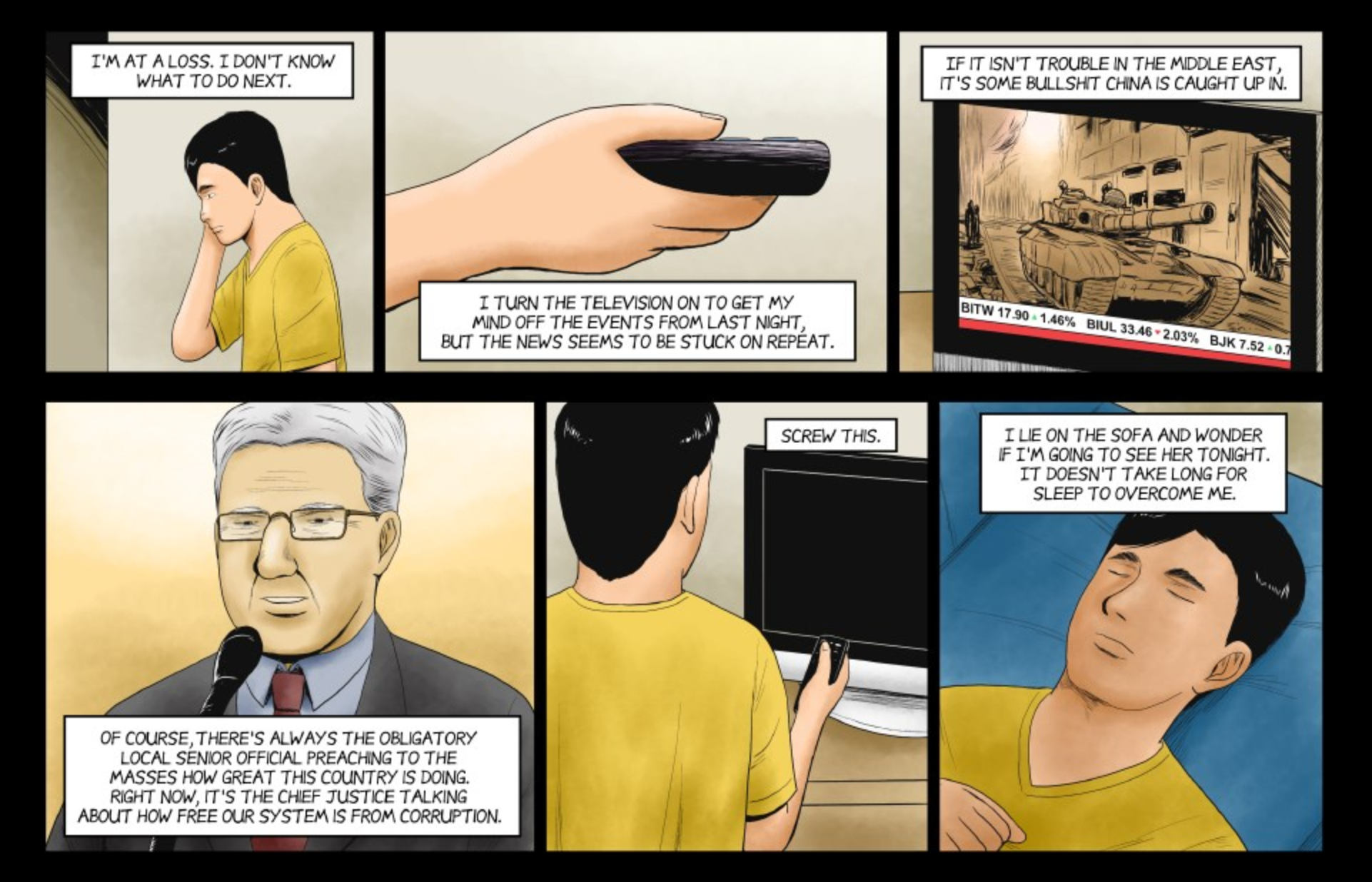
Forgetting is an interactive graphical story by Singaporean artist and author Troy Chin, and was exhibited at the Singapore ArtScience Museum as part of a show that ran concurrently with ICIDS this year (more about ICIDS in a future blog post or two).

The ArtScience Museum. Cool, no?

Forgetting concerns a man who keeps experiencing amnesiac episodes, as well as memories of a relationship with a woman named Julia. It starts out with the hoary “amnesia in a non-descript location” trope, but it soon moves beyond that as the protagonist returns to full memory and starts trying to piece together what’s really going on. The Singapore setting isn’t the main point of the story, but it’s manifest in a number of subtle ways, from the details of the protagonist’s job to his comments on the changing nightlife.

As Chin explained during an introduction to his work, Forgetting is meant to feel linear. Clicking on different panels in a strip, or on different objects in some of the more location-based scenes, can lead to different outcomes, but the system does nothing to indicate that you’ve made a choice, or to tell you where or what the other options are. It’s only at the end, when you are told which ending you reached, that there’s any kind of tracking acknowledgement. Reaching new endings unlocks additional clips of information; conceivably, there may be some grand reward for reaching all of them, as in many visual novels.

I haven’t managed to get that far yet, though, because despite trying to play as thoroughly as I could and going through the story seven or eight times, I’ve only found three conclusions and I haven’t been able to work out what else I could be exploring; and there’s no way of bookmarking or going backward in the story or (a la visual novels) fast-forwarding through already-seen bits, so a complete run-through takes a little while. Ultimately, that’s left me a little dissatisfied: I would like to have gotten far enough to piece together the mystery, whereas all I’ve got at the moment is some hints. I think that might be the experience the author intends — he’s gone to some lengths to conceal the mechanical underpinnings of this work — but it leaves me itching for more information.

Still, this is worth a look. There are moments of exploration, where you’re examining objects in a space and then getting multiple comic panels of exposition about those objects, that felt somewhere on the spectrum between graphical adventure and parser IF. I’d also be curious to know if anyone else gets further than I did. (My endings were Bliss, Instinct, and Cleansed, fwiw.)