End of November Link Assortment

Events

December 2 is the deadline if you’d like to submit a talk proposal or an exhibition piece (interactive fiction might very well be suitable) for the Electronic Literature Organization’s next conference, July 16-19 2020 in Orlando. Details of the call here.

December 7 is the next SF Bay IF Meetup.

December 10 is the next meeting of the People’s Republic of IF in the Boston/Cambridge area.

The Oxford/London IF Meetup does not get together during the festive season, so we’ll not be together again until 2020.

The NarraScope organizers have announced that there will be a NarraScope 2020: specifically, May 29-31, in Urbana-Champaign, Illinois. If you’re interested in speaking there, the call for proposals is now open.

Last year was the inaugural year for this conference, focused on narrative games from classic IF and text adventures through point-and-click adventures to VR games, interactive audio, and mobile story games, TTRPGs and LARP, and quite a bit more. Meanwhile, if you missed this year’s event, or would just like to revisit its glories, there is a new podcast, Through the NarraScope, that discusses some of the talks and content.

New Narrative Games

Tender Claws is the company behind the amazing PRY. They have a new piece out now for Oculus Quest, The Under Presents.

Meanwhile, Choice of Games has a new line of romance IF coming out, under the imprint Heart’s Choice. The first three titles will be available on Steam shortly, and consist of A Pirate’s Pleasure, Dawnfall (science fiction), and Jazz Age.

And this one isn’t a new release, but new accessibility for old releases: David Welbourn continues to release a steady stream of verbose, friendly walkthroughs for parser IF games from the 1990s and 2000s. His walkthroughed games can be found on IFDB via the lists that he publishes each month. Recent walkthroughs include Dr Dumont’s Wild P.A.R.T.I., a formerly commercial game.

Crowdfunding

Aaron Reed’s every-version-is-different novel Subcutanean is funding for a couple more days.

Competitions and Exhibitions
Zozzled

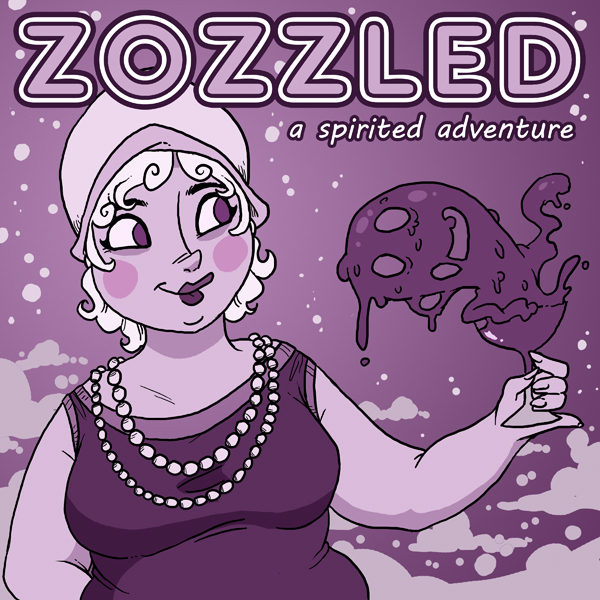
IF Comp 2019 has closed, with Steph Cherrywell winning first place for Zozzled. The full set of rankings and results is available on the competition website.

SubQJam is open now through December 16 for submissions of short interactive fiction, and winners will be featured in SubQ Magazine next year.

Ryan Veeder has announced his Second Quadrennial Exposition for Good Interactive Fiction, an event whose purpose is to create games that are pleasing to Ryan Veeder. Fortunately, Ryan’s IF tastes tend to elicit games that appeal to a lot of other folks as well. Last time around, the winner was the highly entertaining Foo Foo. As a taster of the sort of thing to expect, here is how Ryan describes his preferences:

Entrants should be advised that I like games that are funny, cute, elegant, spooky, friendly, dumb, and/or sincere. Entrants should be advised that I dislike games that are cynical, depressing, gory, horrifying, serious, and/or important.

Entries to the Second Quadrennial Exposition are due… well, at potentially several different times in early 2020. Rather than confuse matters by trying to summarize here, I refer interested parties to Ryan’s own site.

If you’re hankering to write a long game, or a game you don’t think is going to appeal to Ryan Veeder, or a game that is just going to take a bit longer to complete, Spring Thing 2020 is accepting intents from authors now, and through March of next year.

Finally, Green Stories is a competition for stories about building a sustainable future. The competition includes an interactive fiction division.

Articles and Videos

Jon Ingold talks to Meghna Jayanth about her work, the upcoming project Sable, and her presence in the game industry at AdventureX 2019.


Ed Fear talks about challenges around representation in games, and about writing gay characters in particular. Also from AdventureX. (Several other videos from AdventureX are now available as well.)


Jimmy Maher on Digital Antiquarian writes about the Z-Machine and the early days of Inform and Curses, with quite a bit of input from Graham Nelson. (Introductory thoughts about the Z-Machine, Graham’s personal account, Jimmy’s take on the IF Renaissance)


Those interested in the problems of teaching an ML agent to play interactive fiction may like these articles courtesy of Prithviraj Ammanabrolu:

https://arxiv.org/abs/1909.05398 Interactive Fiction Games: A Colossal Adventure – formalizing the task of playing text games with reinforcement learning agents, a software platform (https://github.com/microsoft/jericho) and series of baseline agents designed to play a wide variety of text based games.

https://arxiv.org/abs/1908.06556 Transfer in Deep Reinforcement Learning using Knowledge Graphs – answering the question of how well an agent can play a text adventure by learning to play other text adventures within a genre.

https://arxiv.org/abs/1909.06283 Toward Automated Quest Generation in Text-Adventure Games – looking at the other side of the problem, instead of playing a game, how can we use AI to help generate content for a game (here in the form of a quest within a given world).
Storylets: You Want Them

Storylet systems are a way of organizing narrative content with more flexibility than the typical branching narrative.

Very frequently, when I’m called in to suggest a narrative delivery system that will work for a particular game, I find myself sketching out some form of storylet-based solution. Storylets are simple, atomic, robust, and recombinable.

Here’s my basic definition of a storylet (though many systems may call them other things: events, snippets, etc):

  • there is a piece of content. It might be a line or a whole section of dialogue, it might be narration, it might be an animation or scrap of film
  • there are prerequisites that determine when the content can play
  • there are effects on the world state that result after the content has played

I’ve written some before about how this structure lets one get beyond standard branching narrative, with quality-based and salience-based structures. It is the concept underlying StoryNexus. It also underlies Threaded Conversation, the conversation library I wrote for Inform (eventually released, and now maintained, by Chris Conley).

You could even understand conversation elements in Versu and in Character Engine as a type of storylet. In those cases, there is quite a lot of other procedural work determining what content should be presented next and how it should vary. Quite a few procedural narrative systems work by defining some kind of model for stringing storylets together — so this can be an approach that will support an ambitious AI-driven concept.

At the same time, this design method isn’t only for the procedurally ambitious. You can make and explore the affordances of a rudimentary storylet system by writing your storylet content and quality rules on a set of index cards. And in fact I do sometimes do exactly that as a paper prototyping exercise.

This definition leaves a lot else out. It doesn’t say how much content is inside a given storylet, how that content is structured, or how it’s selected. Max Kreminski’s overview work explores a lot of the nuances here.

But for the present article, I’m looking chiefly at how many standard ways of structuring game narrative content can be rendered in storylets.

Common Branching Structures and Storylets

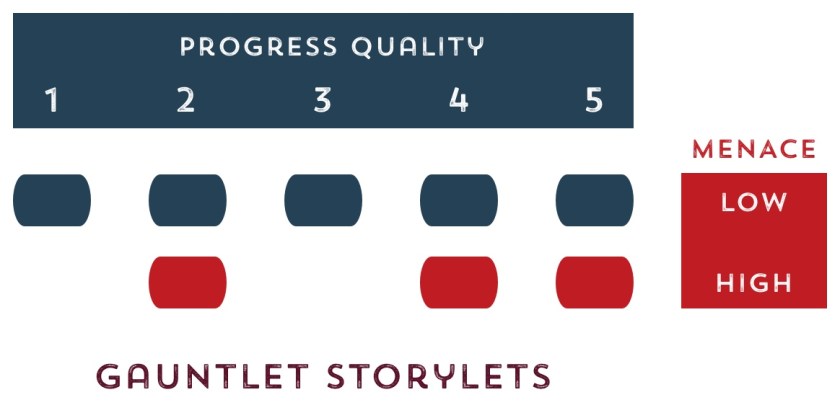
Storylets can be used to replicate a lot of classic structures from branching, Twine, or Choose Your Own Adventure contexts, if you give yourself a progress stat or quality to count how far you are through the story, and perhaps also allow for a menace stat to represent how much trouble the player is in.

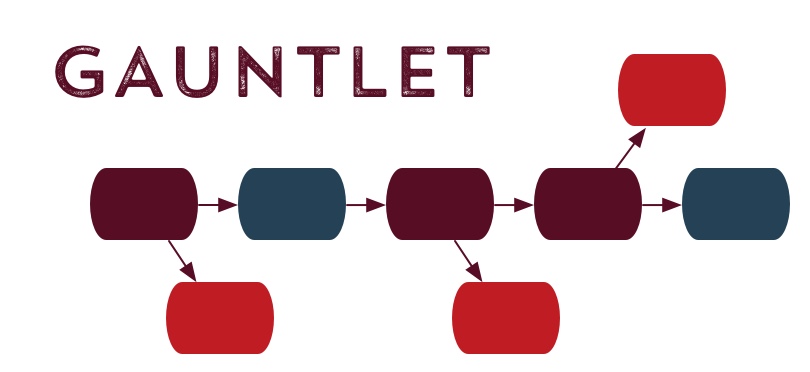
For instance, here’s a gauntlet storyline, linear except where the player makes a mistake, as it might be represented in Twine and then as it might be represented in storylets:

Continue reading “Storylets: You Want Them”

Neo Cab (Chance Agency)

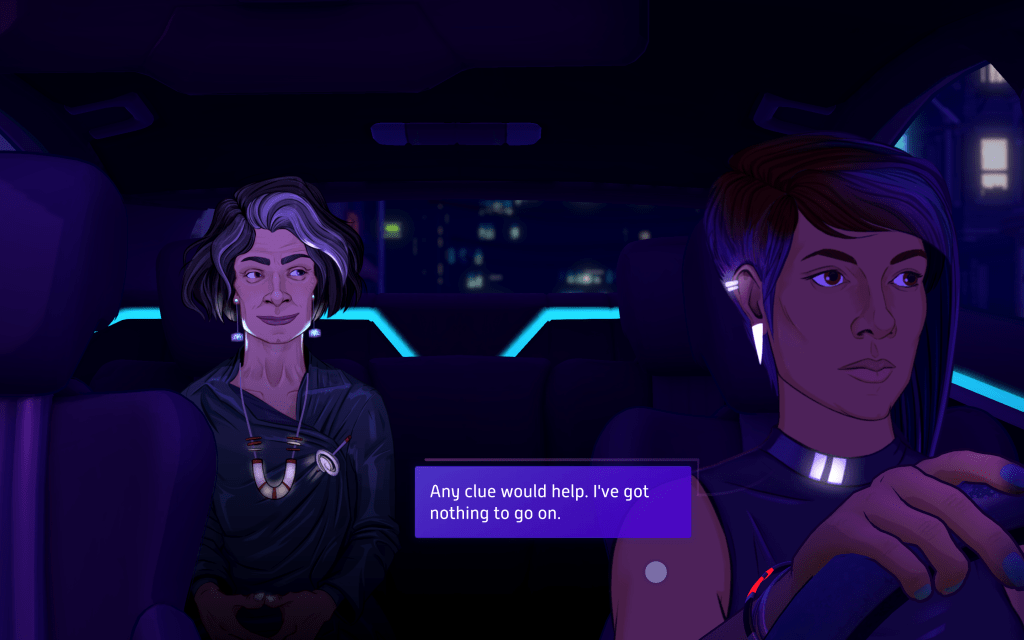
Neo Cab tells the story of Lina, a gig economy driver about ten years in our future and in a slightly-alternate reality. In that world, a company called Capra — part Uber, part Teslahas rolled out a fleet of self-driving cars that make human drivers largely obsolete. Lina can just about make ends meet, barely, but she’s been invited to Los Ojos to live with her old friend Savy, and that seems like a very welcome life change.

Surprise surprise, though: when she gets there, Savy’s situation is not quite as straightforward as she’d hoped.

The story plays out passenger by passenger: the loop consists of deciding what passenger to pick up next, having a conversation with them in the car, and dropping them off. There’s some light gameplay around trying to keep your passengers happy enough that your driver star rating remains above 4, and not spending so much money that you can’t afford to recharge your car or get a bed for yourself at night.

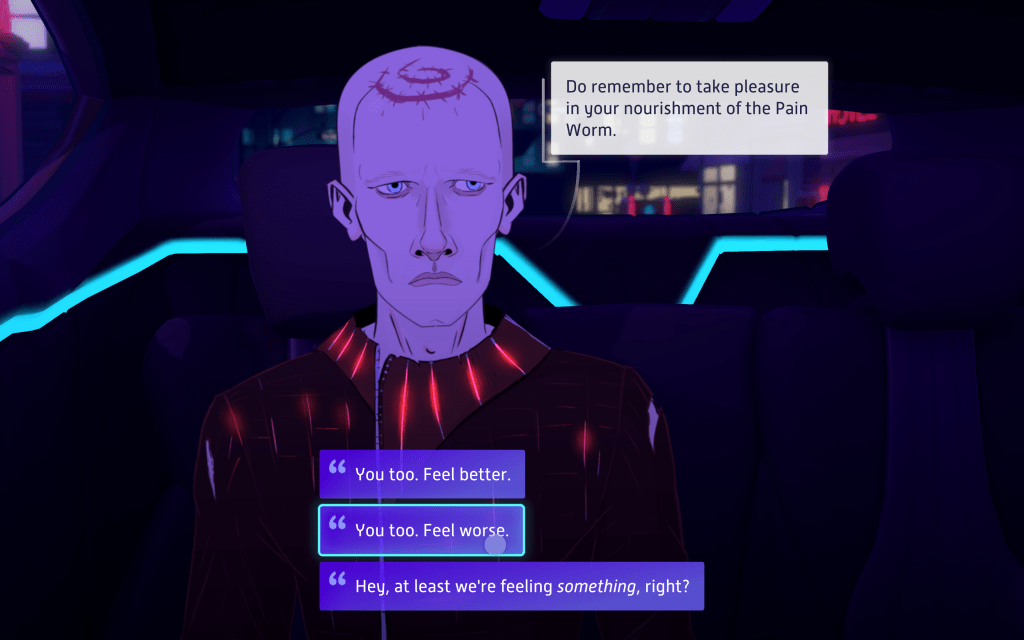
Some of the passengers are a little more out there than others. Agonon here runs a cult worshipping the Pain Worm that lives beneath the city.

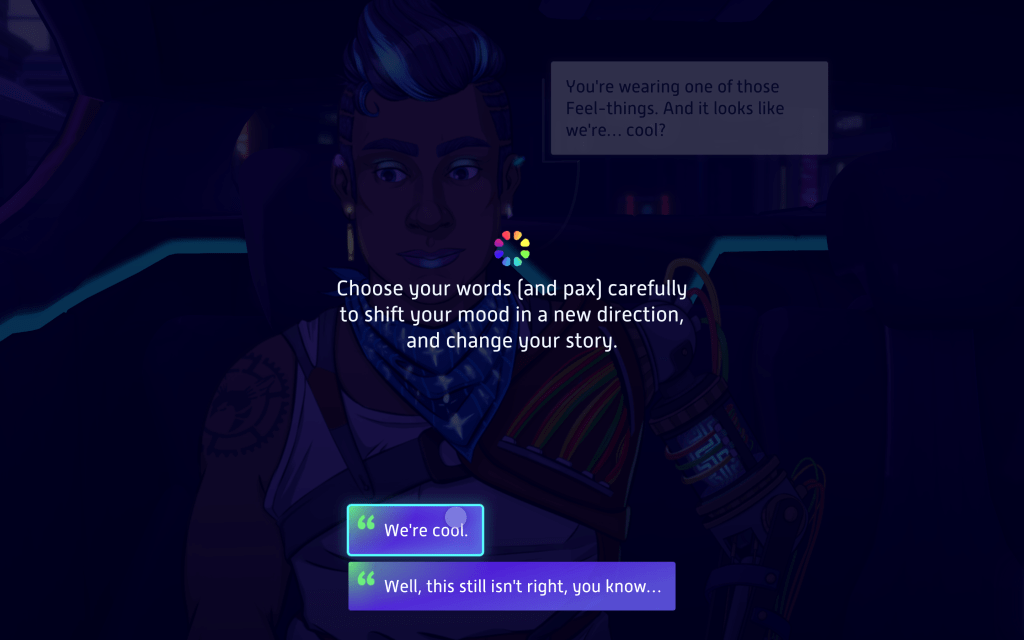
But mostly, the substance of the game is conversation, very lightly animated. The things you’re allowed to say depend partly on the mood you’re in, with conversation options tinted different colors if they happen to be unlocked by your current frame of mind:

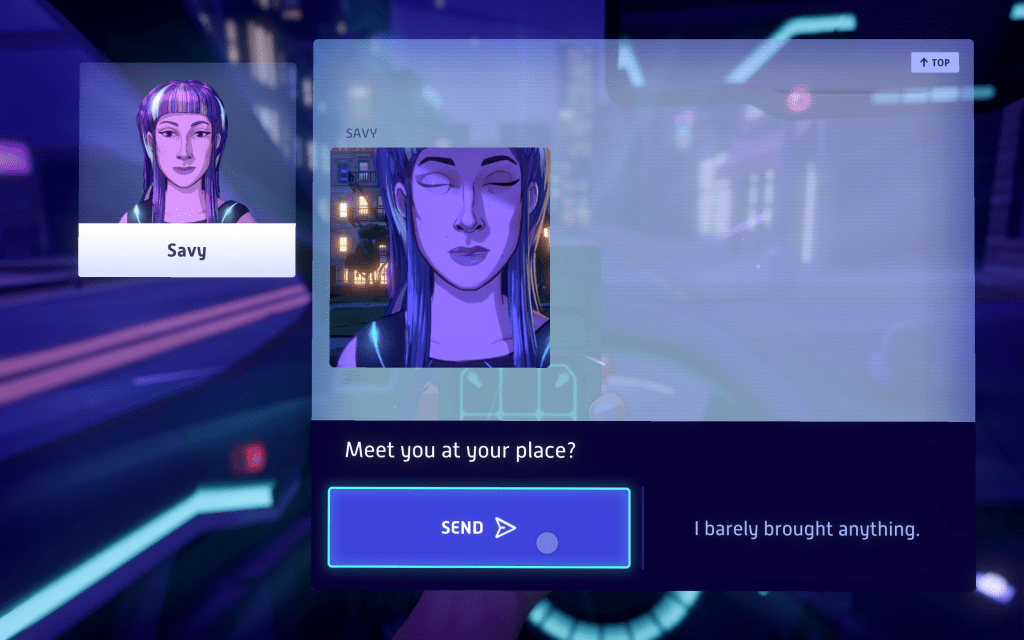
…and on the rare occasions when you’re not talking to a passenger in your car, then you’re probably talking to someone by chat.

It’s not always obvious how your conversation choices are going to drive your mood, and occasionally my passengers reacted to me with less than a 5-star rating when I thought I’d treated them just fine. But the system is forgiving enough that I didn’t find that aspect too frustrating; it felt more like it was representing the reality of a gig economy situation, namely that you don’t always know or control exactly how someone is going to respond to you, and there’s a little bit of arbitrariness in the experience.

Continue reading “Neo Cab (Chance Agency)”

Narrative States

Understanding how player stats map to story outcomes can be a challenge. This article looks at some strategies for simplifying and visualizing complex state spaces, including the use of ternary plots.

Last week I tweeted about the concept of narrative states and how to plot and think about them. This post is a bit of an expansion on that tweet thread. Thanks to everyone who responded there. I’ve answered some of the questions I received, and added some extra resources and images.


Suppose we have a dating sim where outcome is decided by the player’s relationship stats to three characters, and the player has loads of chances to increase relationship with any/all of them. It can be tricky to reason about the design of this.

However, we might choose to make the outcome of our story depend on which suitor we currently like best. Now we can collect a score every time we do something that indicates liking a particular character, and then calculate percentage of interest in each character, thus:

darcy_percentage = darcy_likes / (darcy_likes + wickham_likes + collins_likes)

Needless to say, this value is undefined until the player has expressed an interest in at least one character. Do not divide by zero.

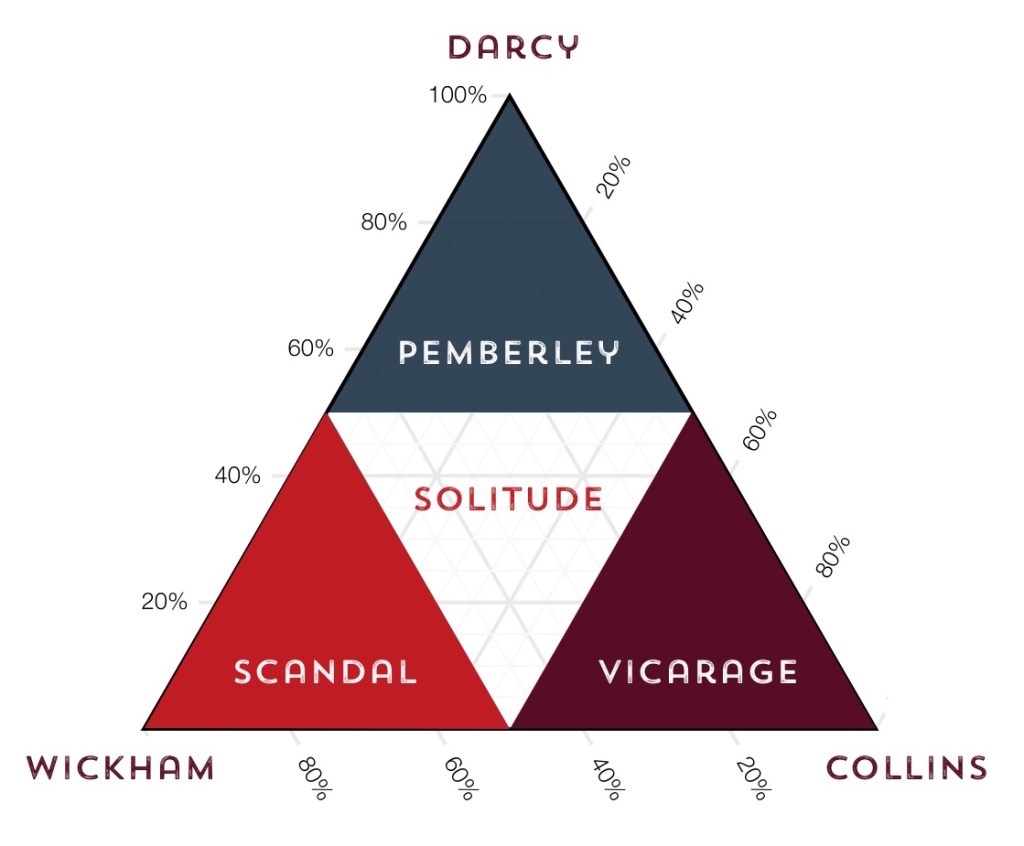
Darcy’s percentage, Wickham’s percentage, and Collins’ percentage have to add up to 100%, which means that we can plot these three variables in two dimensions, with a ternary plot. Three suitors, four story outcomes.

We have four outcomes — one for if the player is more than 50% invested in each suitor, and a fourth outcome if they’ve not given a majority preference to anyone.

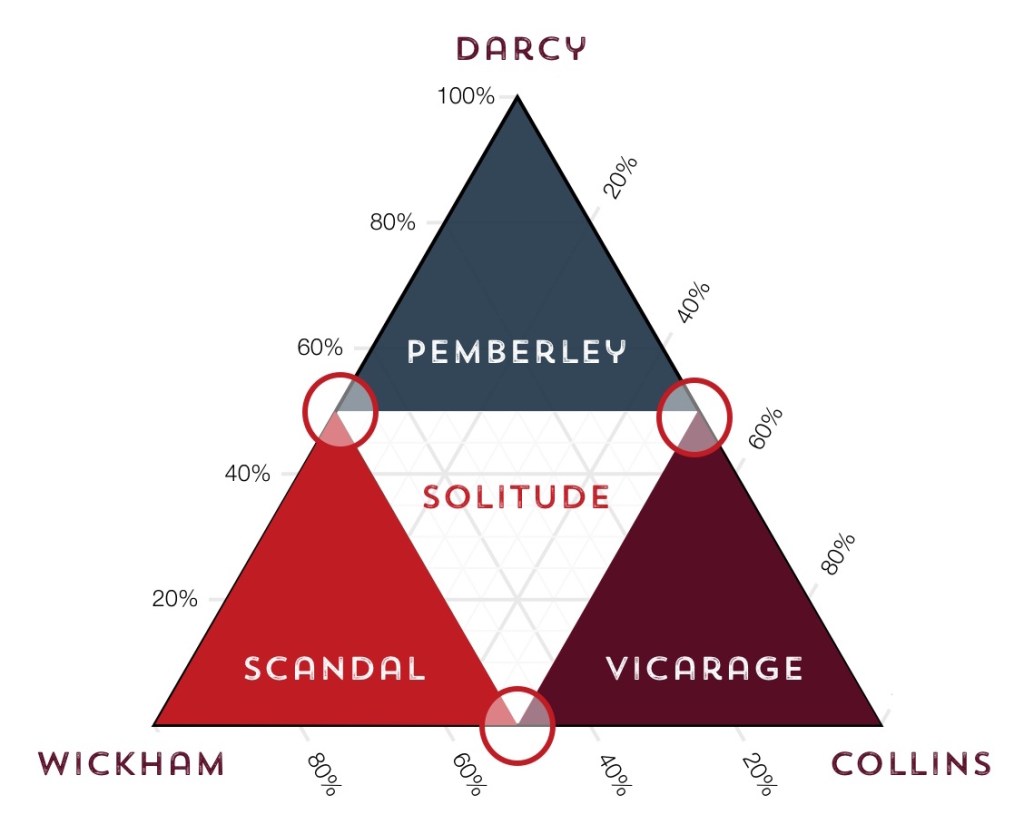
Immediately this chart shows us where the player might get confused or frustrated about why they got the outcome they did — because there are some points of really abrupt state transition.

At the corners between states, a single player action could flip the outcome to another suitor or to the solitude action. This can feel abrupt and confusing.

We can tweak this a couple of ways.

Continue reading “Narrative States”

Mid-November Link Assortment

Events

November 23 is the next Baltimore/DC meetup.

Dec 7 is the next SF Bay IF Meetup.

The Oxford/London IF Meetup does not get together during the festive season, so we’ll not be together again until 2020.

Crowdfunding

Aaron Reed’s horror novel Subcutanean, where each copy is unique, is now available for backing on IndieGoGo.  This is a cool procedural text project, and Aaron has also created a number of making-of posts that explain what he’s doing and why.

Competitions

IF Comp has just ended, and the winners should be announced shortly. (In fact, if you click that link, they may already have been announced — though they have not been at the time of this writing.) Meanwhile, there’s a huge spreadsheet tracking the various reviews written for the Comp, if you’re feeling like you’d read about some of the games.

Ectocomp, the Halloween-themed IF jam, received 22 entries this year. Voting is open through the end of the month, if you’d like to participate and rate the games.

ProcJam, the jam for making things that make things, is also recently over, having brought together 134 entries.

If the thought of all these competitions makes you want to write and share some IF, SubQJam is open now through December 16 for submissions of short interactive fiction, and winners will be featured in SubQ Magazine next year.

If you’d rather compete with something a bit more long-form, or just need more time to put it together, Spring Thing 2020 is accepting intents from authors now, and through March of next year.

Finally, Green Stories is a competition for stories about building a sustainable future. The competition includes an interactive fiction division, which has been described to me thus:

The Interactive Fiction competition is looking for entries from both individuals and creative teams, consisting of a complete story or demo of a longer piece, no longer than 30 minutes worth of gameplay in total. It may be the whole piece, the opening section, or a subsequent chapter or scene.

Winners will receive cash prizes and editorial feedback. Entries are due February 3, 2020.

Mailbag: IF and game writers

As you studied IF for a long time, would you think IF writers are videogame professional writers, or those are 2 separated groups of people ? And would you be able to estimate the number of IF writers ? 

[I’ve edited out a number of side points, but the longer letter also made clear that the writer is interesting in building a tool and/or platform, and is curious about the possible market for this tool and the ways people might use it. — Ed.]

Headcount is a very hard question to answer, because there is no longer one single “IF Community” — I mean, really there never was, but lately there has been much more of a diaspora. The Twine space or the Choice of Games space don’t always overlap and aren’t even always that visible to people working with the parser interactive fiction tradition (and vice versa); and then you’ve got huge, huge numbers of people who are doing interactive story of some kind but only within an app like Episode.

As for the skills you might find among IF writers, that’s again a spectrum. If you went back to 1998 and looked at who was writing IF then, you’d have found a community that was somewhat-to-very technically skilled, since writing code was necessary for almost all the projects that called themselves IF; but also pretty much entirely amateur, since almost no one had ever done any IF writing for pay. 

Now by contrast you would find that there are

  • gig-economy creators who have created technically simple projects and sold them on platforms (like Episodes or Kindle ebooks) that are designed for low barriers to entry; or who have built up some following on Patreon
  • technical inventors and academics who have built very complex and ambitious projects but never worked in the game industry at all; 
  • successful authors in linear media like Cassandra Khaw and Max Gladstone who have made a crossover to working with interactivity;
  • grant-funded interactive media artists who are often experimenting with form or subject matter features that wouldn’t necessarily work as for-market projects
  • well-known professional game writers and/or designers like Liz England, Meghna Jayanth, Jon Ingold, Brendan Hennessy, or Leigh Alexander; these may have background experience with interactive fiction or might still create some text-focused projects at times

So some of those people might be drawn to a new platform. Others, though, already have plenty of venues to publish, or on the other hand are engaged in IF precisely because it gives them a space where they can experiment, build weird science projects, or create personally meaningful art.

Then the question becomes: what could a new platform offer that would appeal to the largest possible subset of the above?

  • the ability easily to deliver experiences that people currently want to build but for some reason cannot — but then you have to figure out what there’s the most thirst to do — I haven’t done this in a few years so the answers are no doubt very out of date, but in the past I’ve run some informal interviews and surveys to find out what people found most vexingly absent from current platforms. Those surveys come from 2014, so there’s definitely room for new research here
  • an audience
  • money — but money typically follows from the audience, and if you had a space were new works got thousands or tens of thousands of readers, you’d definitely find at least some IF authors bringing their work there even if no cash were exchanged.