The Anatomy of Story (John Truby)

Screen Shot 2018-09-02 at 12.02.08 PM.pngThe Anatomy of Story is another book about writing for cinema, and it more or less begins by arguing against everything taught by Save the Cat. The three act structure is wrong. Thinking in terms of inciting incident and rising action will get you nowhere because these ideas are generic. Relying on genre is the way to produce a predictable and formulaic result. The truth comes from within.

Truby encourages the writer to start by identifying topics that matter to them. “Write a story that will change your life,” he says, and then suggests some ways you might identify what topics and themes are particularly important to you. In this respect, it feels like a less dogmatic and more personal approach to some of Egri’s advice.

Once the writer has identified what sort of story she finds most compelling, Truby suggests looking (among other things) for the main character’s “basic action,” the thing that character does most consistently or most importantly in the story — Michael Corleone’s act of revenge, Luke Skywalker’s hand-to-hand combat against evil — as well as a design principle that will help structure the story, and important end-of-story choices that will be finely balanced between two almost-equally-desirable (or undesirable) outcomes.

All of this thinking could equally well be the preparation to find a good mechanic for your narrative design. Elizabeth Smyth’s Bogeyman is a horror story about abuse in which every choice the player makes is about obeying or defying the abuser. Papers, Please is about whether to comply or quietly disobey orders, in a host of ambiguous circumstances.

Continue reading “The Anatomy of Story (John Truby)”

Mailbag: Getting Beta-Testers for Parser IF

I know you’re busy, and hopefully you didn’t delete this as spam ;-)

I’m writing my first interactive fiction game. Although it’s not finished, I’m already looking ahead to finding beta testers – beyond the few friends I have who once way back when played the original Infocom games.

I imagine it takes time to establish the relationships necessary to get people to the point they’re actually willing to take a look. Do you have any advice?

An aside: I’m a computer programmer and using Inform 7. It’s a nice system, and I get it. But I am not familiar with the culture of IF users. (For example, the authors of the Inform manual mention how disabling the UNDO function when the story ends is anathema to many players.) Also, just understanding how to make beta-testers’ jobs easier in general would be nice.

A first step would be to hang out a bit at the intfiction forum or possibly euphoria (I haven’t been to the latter for a while, so I don’t know how active it is, but it’s more of a chat space). Introduce yourself, participate in a few conversations.

It sometimes helps to offer to beta-test for other people, for two reasons: one, it builds those social connections, and two, it familiarizes you with how other people typically do this. If you’re planning to enter a competition, sometimes there are threads in the weeks before the competition deadline where authors are offering to swap beta-testing, and that can also be a useful way to pick up help.

Alternatively, if you live near Baltimore, Seattle, San Francisco, Boston, or London, there is a live meetup that meets pretty regularly near you, and those can be a great place to cultivate connections more quickly. My link roundups twice a month list all the events I know of that are coming up in the near future, but you may already have seen these.

As for expectations and norms: it’s a good idea to read some reviews of recently released games, especially ones that might be similar to yours; they may help you work out what people are expecting and what goes over well or badly. You don’t have to take this as gospel, of course, and sometimes you just really want to do something with your work that isn’t in the expected range. That’s fine. But it can be helpful to know what people are looking for so that you’re not too surprised. One way to look for that information is to check out IFDB and find games in your genre/style and see what people wrote about those. You could also read through reviews from the latest IF Comp to get more of a cross-section view.

Suggestions for Testing is a fairly old article of mine, but as it’s about parser IF, a lot of the recommendations still hold. It talks about what testers might expect to do, and what authors might expect from testers.

Preparing a Game for Testing is about figuring out where your game is likely to present problems so that you can look at those yourself before you ship it off.

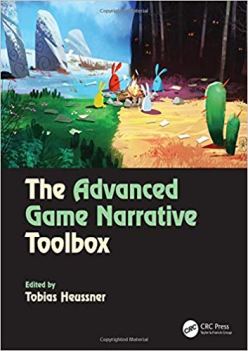
The Advanced Game Narrative Toolbox (ed. Tobias Heussner)

advancedgamenarrativeThe Advanced Game Narrative Toolbox is a brand-new followup to The Game Narrative Toolbox, which I covered previously. The “advanced” bit means that the book doesn’t re-cover all the same ground already found in game writing books. The authors suggest that if you are entirely new to game literacy and writing advice, you should go to the first book in the series, to Skolnick’s Video Game Storytelling, and/or to McKee’s Story.

Where the first book walked the reader through steps for building a basic portfolio of game design documents and related materials, The Advanced Game Narrative Toolbox is more topic-driven, each chapter written by a different author (with just a couple of repeats).

The topics cover a range of craft, commercial, and cultural considerations. Many (but not all) of the chapters end with a suggested exercise for the reader, as they did in the first book; but the feel here is less of a core syllabus and more of a set of electives you might pick to round out your understanding.

Many of the chapters approach their subject by defining process: what are the steps that you would take to go about a given task, what considerations should you apply, who else needs to be involved, what could go wrong, and how will you know when you’re done? So, for instance, a chapter is more likely to say (I paraphrase) “next, make a map that shows where each step of the quest will occur in the game world,” and less likely to dive into deep analysis of different possible map designs and how they will affect player experience. Typically, that process guidance is really useful, especially as it comes paired with lists of references if you need more technique training, but you should be aware which you’re getting.

The book is expensive. I bought it as soon as I heard of it, and I’m glad I did, but I flinched at checkout. Price is not typically something the authors can control, but it means I talk later in the review about how to tell whether you’re likely to get enough value from it to justify the price. That’s not meant to reflect on the book’s quality: it’s good, no question. If you get a chance to pick up a used copy for $15, just buy it.

Continue reading “The Advanced Game Narrative Toolbox (ed. Tobias Heussner)”

Emotional Mechanics

[Most months, I devote the second Tuesday of the month to a mailbag post that answers a question someone’s sent to me. I’m still doing one of those in March, but it will come out in two weeks’ time.

Instead, this post is part of a short series on Character Engine and what we’re doing at Spirit AI. I’m writing these posts with IF and interactive narrative folks in mind, but more general-audience versions of the same content are also appearing on Spirit’s Medium account. Follow us there if you’re interested in hearing regularly about what Spirit is up to.]

restless2

In January, I published a talk about conversation as gameplay, and in particular my ECTOCOMP game jam piece Restless. There, I talked about using Character Engine to give the player more expressive ability. They can tune their dialogue to be open, scary, vulnerable, aggressive, playful; they can pick input topics that they want to focus on.

I’m now revisiting Restless to address some of the flaws I identified in that piece, to give it a better tutorial introduction, polish its use of dynamic text, and add some depth to the content. Tea-Powered has created some additional art, so we can better signal gradations of character emotion. And I’m also refining some of the mechanics under the hood, particularly those that deal with gradual changes in character emotion.

What I’m going for in terms of the design:

  • perceivable consequence:
    • all of the player’s actions should have some effect on the outcome of the story, even if just by moving stats in one direction or another
    • the NPC’s emotional state should be apparent to the player, communicated through art, words, and actions
    • some areas of the NPC’s emotional state space should trigger narrative progression, by having the character get angry, leave, reveal new information, go back to sleep, etc
  • intentionality:
    • the NPC’s reactions should be consistent and predictable enough that the player can choose what to do and be rewarded by an expected outcome, even if there is an additional unexpected consequence
    • the player should have some warning when the NPC is approaching a state that will trigger a significant reaction
  • hysteresis:
    • the NPC should not rapidly cycle back and forth between two emotional states in response to opposed actions from the player; the history of interactions should matter
  • varied narrative intensity and pacing
    • not all player actions should be of equivalent efficacy; some actions should be more important, memorable, or high-stakes
    • it should not be possible to achieve an important result by grinding repetition of an unimportant action

That last point possibly deserves a little bit of expansion. One of the issues with stat-based relationship tracking in games is that it can mean that you could do a lot of banal minor services for a character, and work your way to a point where you’ve maxed out your affinity and now they want to marry you.

This is bad for multiple reasons. One, it’s unrealistic; humans don’t work like that. Two, it’s boring gameplay and boring story. Doing minor favors over and over feels like a chore, from a gameplay perspective. And narratively, there’s no sense of rising stakes, or risk, or the thrill of the relationship becoming more intense.

One way to resolve this would be to throw away the consequences of player action after a certain point. If you’re already at 50% affinity, paying one more compliment to the character does nothing at all. Now you can’t grind your way to romance through compliments: problem solved! Except that this goes against the earlier design principle that all player actions should have consequences of some kind.

So, instead, what we have to do is turn off the player’s ability to do minor actions when we’re in major consequence territory. Compliment away… while your relationship is still in trivial flirt zone. But work your way up to where things are getting serious, and the available affinity moves also get more serious, more freighted. And just having those “bigger” moves popping up in the choice menu should communicate to the player, along with the character art, that we’re in a more important situation.

Fortunately, all of that is pretty doable, by restricting dialogue lines to particular ranges of the emotional space.

This work is still in progress — I’ll post when the new version of Restless is generally available.

Natural Language Understanding for Characters

[This post is part of a short series on Character Engine and what we’re doing at Spirit AI. I’m writing these posts with IF and interactive narrative folks in mind, but more general-audience versions of the same content are also appearing on Spirit’s Medium account. Follow us there if you’re interested in hearing regularly about what Spirit is up to.]

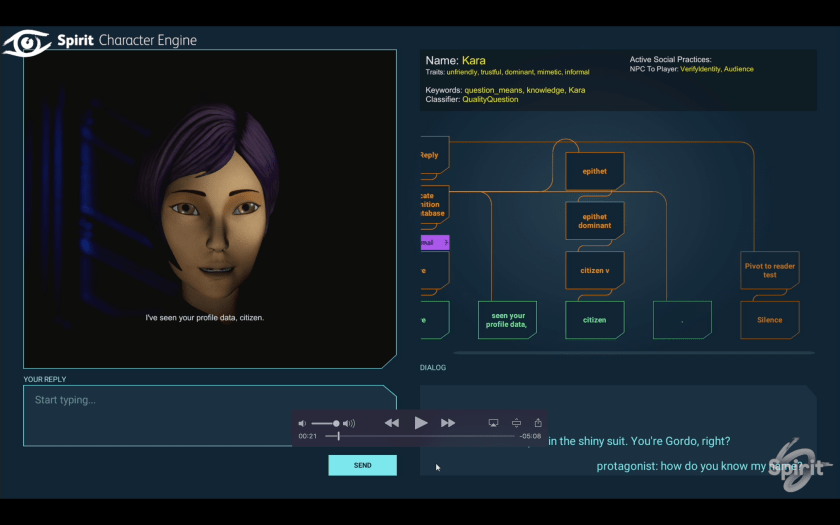
Character Engine is designed for two kinds of interaction: it can either generate input options for the player (as seen in Restless), or it can take natural language input, where the user is typing or using a speech-to-text system.

screen shot 2019-01-20 at 1.02.02 pm

That natural language approach becomes useful for games in AR or VR where more conventional controls would really get in the way. It’s also good for games that are using a chatbot style of interaction, as though you were chatting to a friend on Facebook; and a lot of interactive audio projects deployed on platforms like Alexa use spoken input.

There are plenty of business applications for natural language understanding, and a lot of the big tech players — IBM, Google, Amazon, Microsoft, Facebook — offer some sort of API that will take a sentence or two of user input (like “book a plane to Geneva on March 1”) and return a breakdown of recognized intents (like “book air travel”) and entities (“March 1”, “Geneva”). If you prefer an open source approach over going to one of those companies, RASA is worth a look.

For people who are used to parser interactive fiction, there’s some conceptual overlap with how you might set up parsing for an action: we’re still essentially identifying what the command might be and which in-scope nouns plug into that system. In contrast with a parser, though, these systems typically use machine learning and pre-trained language models to allow them to guess what the user means, rather than requiring the user to say exactly the right string of words. There are trade-offs to this. Parsers are frustrating for a lot of users. Intent recognition systems sometimes produce unexpected answers if they think they’ve understood the player, but really haven’t. In both cases, there’s an art to refining the system to make it as friendly as it can be, detect and guide the user when they say something that doesn’t make sense, and so on.

Some natural language services also let the developer design entire dialogue flows to collect information from the user and feed it into responses — usually interchanges of a few tens of sentences, designed to serve a repetitive, predictable transaction, and lighten the load on human customer service agents.

Those approaches can struggle a bit more when it comes to building a character who is part of an ongoing story, who has a developing relationship with the player or user, and who uses vocabulary differently each time.

That’s exactly where Character Engine can naturally provide a bit more support. We’re tracking character knowledge and personality traits. We’re doing text generation to build output that varies both randomly and in response to lots of details of the simulated world. And because dialogue in Character Engine is expressed in terms of scenes of interaction, making it easier to maintain large and complex flows where the same input should be understood differently at different times.

We don’t want to be in a race with the providers of existing NLU solutions, though. What we want to do is facilitate author-friendly, narrative-rich writing options that tie into whatever happens to be the current state of the art in language understanding. So here’s a bit about how we do that:

Continue reading “Natural Language Understanding for Characters”

Memory and Knowledge for Characters

[For a couple of years now, I’ve reserved the first Tuesday of the month for a review of a book on writing or game design that might be of interest to IF folks. I’m still doing one of those in March, but it will come out the 19th, while I’m at GDC.

Instead, this post is part of a short series on Character Engine and what we’re doing at Spirit AI. I’m writing these posts with IF and interactive narrative folks in mind, but more general-audience versions of the same content are also appearing on Spirit’s Medium account. Follow us there if you’re interested in hearing regularly about what Spirit is up to.]

Knowledge and memory are a somewhat vexed area for game characters. It’s easy to think of characters who don’t remember the last fifty times you asked them the same exact lore question, or are strangely forgetful about the ways you’ve harmed them, or who aren’t equipped to answer common-sense questions about the world they live in.

So why is this a problem? Simply recalling that something has happened is not the main challenge. We can set flags; we can assign variables; we can check on quest journals to see what the player has already done. We can refer back to whatever data store is otherwise tracking world state in this game.

The hard part is building a system where

  • everything important to remember is stored in a reasonably systematic way
  • differences between world truth and character knowledge are handled as much as (and no more than) useful
  • there’s a way to track and author for the combinations of possible state so that the NPCs always have something to say about what they remember and know

There are quite a few technical, design, and writing challenges packed into those three bullet points.

Continue reading “Memory and Knowledge for Characters”