Nothing for Dinner (Nicolas Szilas et al, IDtension)

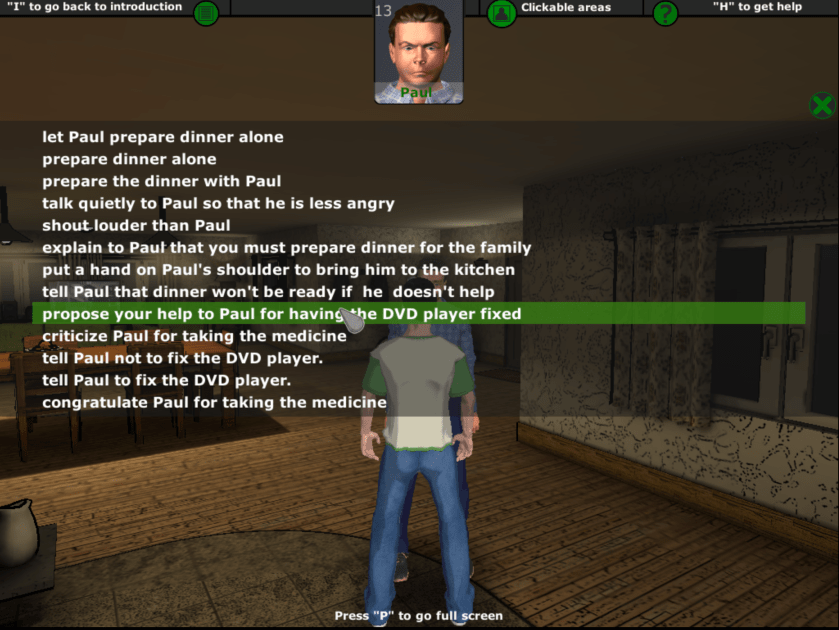
IDtension_conversation_menu.png

“Nothing for Dinner” is an interactive drama released last fall by Nicolas Szilas and collaborators, using a tool called IDtension. Szilas works out of the TECFA Lab at the University of Geneva. If you read my writeup on the book Interactive Digital Narrative, you’ll have seen a mention of Szilas’ article there. Though it would have been out of place in the book overview, I wanted to come back and look more closely at what “Nothing for Dinner” accomplishes.

The premise of the story is that you’re a young man whose father has suffered a stroke that affects his behavior and memory. You need to get something ready for dinner, but your father keeps getting in the way, and other events spontaneously happen — a school friend coming over to get back a textbook she left at your house, your sister’s DVD player breaking, a phone call from your mother with extra chores — to add blocks to your progress.

The system is clearly quite dynamic: I played three times, and the sequence of events was very different each time, with some blockers appearing only in one of the playthroughs. Also, the conversation menus are dynamically generated to let you try various approaches to any of the currently-active problems, or to give emotional feedback to the other characters about what they’ve just done.
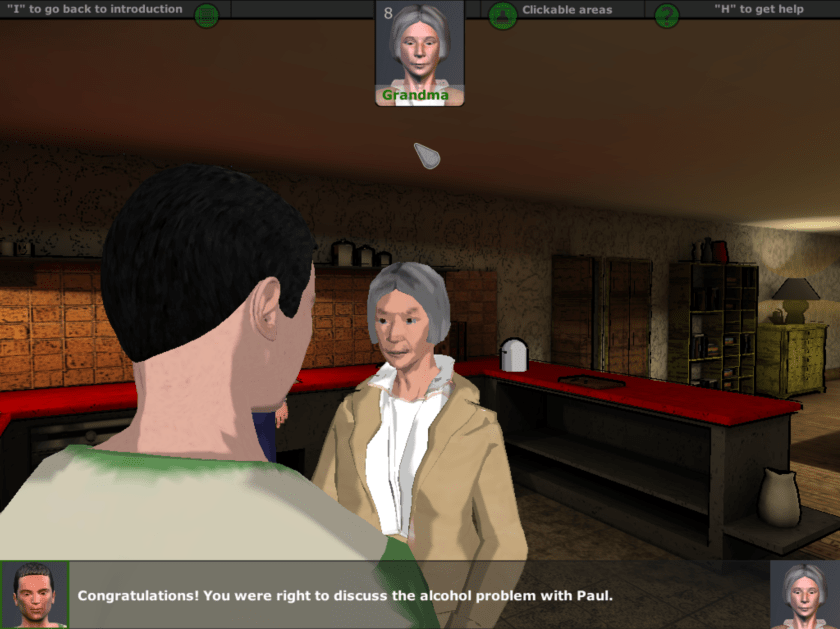
IDtension_grandma.png

If you try to cook dinner alone, your father resentfully complains that you never want to do anything with him; if you try to involve him, he may get annoyed and refuse to help you; if you let him cook by himself, he’ll break things and make a mess. And whenever your father gets upset, your grandmother comes over to chide you for not looking after him.

It’s a very effective mechanism for making me rapidly resent my entire family for offloading all the emotional and practical labor onto me: like a time management game, but with more passive-aggressive commentary, and less opportunity to get anything done.

Continue reading “Nothing for Dinner (Nicolas Szilas et al, IDtension)”

Interactive Digital Narrative: Practice

Screen Shot 2016-08-31 at 1.12.24 PM.pngThis is part three of an overview of Interactive Digital Narrative: History, Theory, and Practice. See my earlier post for coverage of the book’s history section and this post covering the theory section.

The last section of the book gets into questions of practice, though the articles vary: some verge on being historical surveys through the lens of a particular method or technique, while others delve more deeply into detailed design questions. I have already talked about Scott Rettberg’s “Posthyperfiction” article, though it appears in this section.

The introduction to this section is titled “Beyond the Holodeck: A Speculative Perspective on Future Practices,” and suggests three areas for future growth: the story/video game connection; location-based apps and experiences such as Whaiwhai and Zombies, Run! (a game I respect in theory but avoid in practice thanks to my dislike of (a) zombies and (b) running); and interactive documentary and news projects. MIT’s docubase is my go-to resource to find out about new interactive documentaries.

Continue reading “Interactive Digital Narrative: Practice”

Interactive Digital Narrative: Theory

Screen Shot 2016-08-31 at 1.12.24 PM.pngThis is part two of an overview of Interactive Digital Narrative: History, Theory, and Practice. See my earlier post for coverage of the book’s history section (and one practice chapter that I took out of order because it felt like it fit better that way).

This time we’re looking at the theory section, which addresses academic approaches to interactive narrative (including the question of what interactive narrative even is).

Again, the section begins with a brief overview from the volume editors, and this provides a fair sketch of the academic debates of the last couple of decades, together with a bibliography of a number of foundational pieces in this space. I might also have listed Jesper Juul’s half-real here, as it provides a readable and persuasive cap to the narratology vs ludology debate.

Continue reading “Interactive Digital Narrative: Theory”

Interactive Digital Narrative: History

Screen Shot 2016-08-31 at 1.12.24 PM.pngInteractive Digital Narrative: History, Theory, and Practice is an academic publication from Routledge that retails for £90/$123 on Amazon, which is why even though it is completely relevant to me and my work, it took me a little while to get around to buying it. I would guess that most people who write IF as a hobby won’t buy it either, which is in some ways a shame, because improving communication between the hobbyist and academic communities would be beneficial in both directions. But a book priced for academic libraries is not the most accessible way to accomplish that.

Consequently, this is not a conventional academic book review. Instead, it’s partly meant as a high-level overview of the contents for people in the IF community who cannot afford to read the book, or who might want to know what sort of thing is in it before plunking down more than $100 for their own copy. Much of the rest is an attempt to join up what is in the book with what I know about historical and contemporary interactive fiction and narrative games.

That I spend a lot of time pointing out related IF work is not meant as a criticism or complaint about the book’s scope of coverage — which is in fact quite broad — but as an attempt to help bridge community divides and suggest points of contact between hobbyist IF and academic digital narrative.

Finally, there’s a lot of content, so I’m going to take this in chunks. This post starts with the history section.

Continue reading “Interactive Digital Narrative: History”

End of August Link Assortment

Upcoming Events

September 4, the Oxford/London IF meetup has an open problems session in Oxford. Join us if you’d like to discuss something that’s stumping you in a WIP (or give advice to people who are in that situation).

September 10, Australian IF folks are having a meetup in Melbourne. (Link is to a Facebook page that organizes the group, which might be of use even if you aren’t able to attend this specific event.)

If you are instead in the Bay Area on Sept 10, the SF Bay IF Meetup has an event that day as well.

September 10 is also the voting deadline for IntroComp, if you were considering participating. That’s a good chance to give authors feedback on their work in progress. (And if you’re up for it, reviews are great too — IntroComp hasn’t had a huge number of reviews this year so far, and it would be cool to see more.)

September 28, Boston area, PR-IF is holding its next meetup.

Finally, September 28 is also the deadline to submit games to be shown at WordPlay London, a November event centered on interactive text and held at the British Library. You may submit your own works or nominate works by other people.

IF Comp launches at the beginning of October. We’re just about at the deadline for submitting an intent to enter, but if you’d like to donate prizes, that option is still open to you.

*

Speaking of IF Comp, that is going to be the theme of our London October IF Meetup. Last year we played a bunch of comp games together and it was a blast, and we only wished we had a little more time available. This year, I’ve got a more central (Shoreditch rather than Maritime Greenwich), wheelchair-accessible venue in London on October 16. It’s a weekend slot rather than our usual weekday evening, so that we can afford to run for most of the afternoon rather than just a couple of hours. If you’d like to join but can’t make it right at the start, there will still be stuff going on if you arrive later.

If you’re a comp game author this year, you’re going to be in London at that time, and you’d like to see a group play your work live, let me know in advance and we’ll make sure we include your game in the mix.

Please also let me know if you’d like to volunteer as a reader (reading aloud on-screen text so that we’re all on the same page as we play) or to bring snacks (mm, snacks).

Also, please feel free to invite people! The meetup is free and public, and we always welcome new members, but especially here: this is meant to be a fun and festive intro to some of the best of what’s going on in IF right now.

Continue reading “End of August Link Assortment”

Minkette on Escape Room design; Secret Studio

Screen Shot 2016-08-28 at 4.56.38 PM.png

This post is a two-parter. Recently I went to Secret Studio, my third experience with room escapes; and Minkette, one of the creators of Oubliette, came to the Oxford/London IF Meetup to talk about the design and creation process.

I’d asked Minkette to come talk about the kind of storytelling she does: often location-based, often using physical props to communicate backstory or the flavor of the world you’re in.

She started us off with an overview of related projects, including Sleep No More, Wiretapper (reviewed here), and 2.8 Hours Later, a zombie chase game that runs through London. She also spoke about her own Train of Thought, an experience designed for the Underground, in which participants were able to listen to pre-recorded tracks that were meant to be the thoughts of one of the other passengers in their coach. (Here’s an audience member’s description of that experience.)

Next, Minkette took us through the process of constructing the Oubliette escape room, with lots of pictures of the various props in construction. It was fascinating to see what went into these: Oubliette featured a vacuum tube setup that (seemed to) let you pneumatically send messages to other characters, but that was actually just operated by someone pulling a magnet on a string.

But the parts of her talk that were newest to me were the ones where she talked about the psychological purpose of their design choices.

Continue reading “Minkette on Escape Room design; Secret Studio”