I mentioned Richard Goodness’s Fear of Twine exhibition and some of the works in it earlier. Here are some capsule responses to Zombies and Elephants, Workers in Progress, Saturday Night, Truth is Ghost, When Acting As A Wave, and The Girl in the Haunted House.
Category: CYOA
A (Mostly Recentish) IF List, For Breadth
At the London IF Meetup this week, several people mentioned that they’d like to get a better sense of the range of what IF can do. This is a list I’ve put together to suggest the variety of what is out there — different types of play, different ideas about how interactive storytelling could possibly work. Notice that this list includes fiction and nonfiction, many different genres, and many different target audiences.
I’ve also leaned especially toward work that is by people who are part of the meetup group — starred pieces are by people you might run into at one of our meetings.
18 Cadence, by Aaron Reed. Play with snippets of story, construct your own, share with other people. A physically beautiful work that touches on themes of oppression and civil rights, grief and change, love and growth, without being particularly heavy-handed about any of it. Instead, it leaves a space for you to discover your own strands of meaning — and it also happens to include some cool procedural text reworking.
howling dogs, by Porpentine. A sometimes disorienting but powerful sequence of vignettes; it is difficult to explain this one in advance, but this is one of the pieces that really got people paying attention to Twine.
* Aisle, by Sam Barlow. A one-move parser-based game that allows you to type any of many, many different commands in order to discover what to do next. This is one of the older pieces on the list here, but Aisle functions so well as an introduction to what’s fun about parser IF that I’m including it anyway.
* Fallen London, Failbetter Games. A massive sprawling browser-based exploration of a world in which Victorian London has been stolen and taken underground by space bats. (Sort of.) Free to play; lots of lovely prose; many small plot arcs within a very long ongoing world exploration.
Solarium, Alan deNiro. A gripping Twine piece about the madness of the Cold War.
maybe make some change, Aaron Reed. IF augmented with video and audio effects, about a true war-time event. It uses the mechanic of player-typed commands to express fundamental points about the actions that we’ve learned and the terminology with which we think about people and situation.
My Father’s Long Long Legs, by Michael Lutz. A very linear, tightly focused piece of Twine horror that explores how effective it can be to make the player responsible for moving forward through the story, even when there are very few choices.
* Black Crown, Rob Sherman. Uses similar underlying mechanics to Fallen London, but to tell a more focused and darker story. Body horror and strange smells abound.
Choice of the Deathless, from the long-running Choice of Games line. This one is about a magic-using, demon-contract-making law firm. In general, games in this series do a lot with player character customization, providing lots of ways to experience similar issues and problems. Choice of the Deathless has an especially strong premise and setting. Choice of the Deathless is for pay; Choice of Games also offers some freebie experiences, though in my opinion they are a bit less good.
Conversations with My Mother, Merritt Kopas. A reflection on interpersonal relationships in the context of a trans experience, with links outward to actual tweets and real-world documents.
Analogue: A Hate Story, Christine Love. An illustrated science fiction puzzle-story about piecing together what happened aboard a damaged generation ship.
* First Draft of the Revolution, Emily Short, Liza Daly, and inkle. An interactive epistolary story where you play in the juncture between what people want to say to one another, and what they actually dare to say. The player’s role is to revise the letters being sent between characters.
* Moquette, Alex Warren. A somewhat melancholy slice of life story about a dissatisfied man riding the Underground. Features some neat procedural effects for creating the stops on the journey and the characters who get on and off the train.
Lost Pig, by Admiral Jota. A light-hearted, deeply implemented parser game about a lost orc called Grunk.
* Sorcery!, Steve Jackson and inkle. An old-style gamebook updated as a modern app, and one that has gotten very widespread appreciation.
* Bee, Emily Short. A real-life story about a homeschooled girl training for a national spelling bee. It’s built on the Varytale system, which means that the player gets to select which snippets of the story to read next, then make choices within each subchapter.
* Frankenstein, Dave Morris and inkle. A modern retelling of the Frankenstein story that explores what was going through the minds of all the major characters.
Kerkerkruip, Victor Gijsbers et al. A highly randomized dungeon-crawl story with rogue-like mechanics, but textual descriptions of events. Illustrated with a map and other colorful features.
Edited to add: in case it’s of interest, here is an old post, with screenshots, listing text-based games of various kinds. Some are interactive stories; some are interactive poems or other types of games that happen to use text.
Some Links
Illya Szilak reviews TOC, a multimedia novel by Steve Tomasula about (among other things) the passage of time.
Richard Goodness is running Fear of Twine, an online exhibit of sixteen Twine games distributed in four groups of four. Morgan Rille’s The Conversation I Can’t Have is a bravely frank exploration of the experience of a submissive in the kink scene. Jonas Kyratzes’ The Matter of the Great Red Dragon is (or at least was the time I played it) an illustrated, fairy-tale-like parable about moral clarity. Tony Perriello’s Debt is a highly linear vision of a dystopian future, enhanced by music and sound. I haven’t yet gotten to all of them, but they’re worth checking out.
And speaking of Twine, if you haven’t yet tried Tom McHenry’s Horse Master, you’re missing out on an extremely creepy and compelling experience, a horrific sim about raising a horse for competition. It is also about poverty and willingness to go to dreadful extremes. I’m hoping for a XYZZY nomination or two for it.
Choice of the Deathless (Choice of Games)
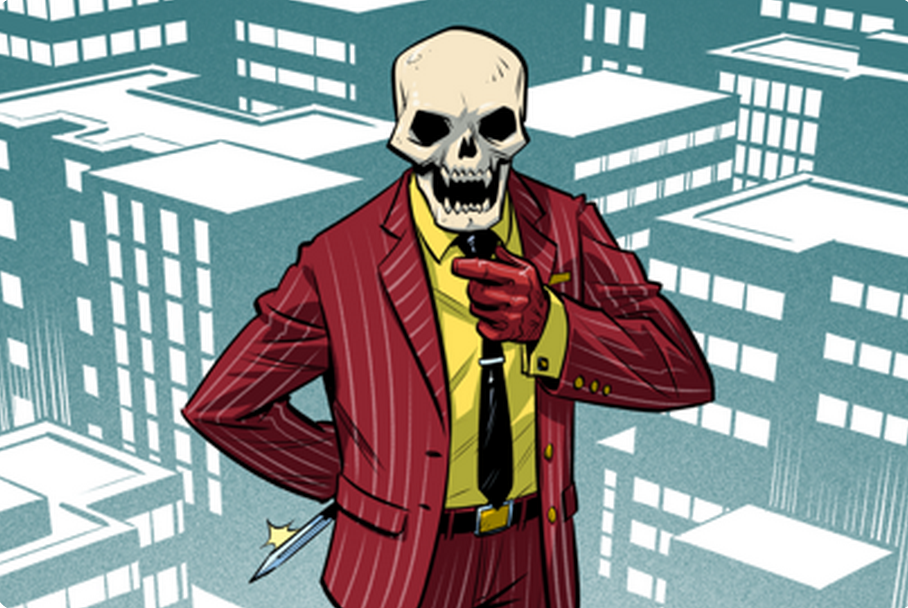
Choice of the Deathless is the latest piece from Choice of Games. Written by Max Gladstone, it’s billed on the Apple app store as “a necromantic legal thriller,” and it moves well away from the Choice of [Generic Trope] format of some of CoG’s earlier releases. Gladstone is writing within the same universe that he used for his two novels, Three Parts Dead and Two Serpents Rise: a world where high-powered law firms are engaged in the partially legal, partially magical exercise of managing the contracts that bind gods and demons. The Craft is a technical and brutal magic, done with blood and shards and entrails and a great deal of legalese.
The result is the most solidly written Choice of Games piece I’ve yet played. Gladstone’s descriptions sometimes run a bit wild for my taste: strange settings are extremely strange; painful experiences are bloodily painful. As a reader I find it hard to invest in a story that is kicked up to eleven that way on every single page. Nonetheless, his prose is confident, and he spends enough time with the various characters to develop them in detail.
Choices are often about the internal politics of the firm: whom to trust, whom to betray, whom to ask for a favor. The plot is fairly linear, in the sense that the major cases you encounter will tend to be the same over again on multiple playings — but the motivations you choose for yourself, and the relationships you have with other characters, do change substantially. One character was a minor enemy in one of my playthroughs, only to become my lover in the next. It’s a less branchy structure than some of CoG’s past stories, and I’m not sure I’d replay it as many times, but I enjoyed and cared about the individual playthroughs more. And those midgame choices about motive and affiliation do pay off in the endgame, when your range of options is very clearly tied to what you’ve done up to that point.
Indeed, in general I felt as though Choice of the Deathless was making less use of stats than the average CoG game, and more use of important narrative decisions that are remembered later. It’s the difference between having story gated on whether you’ve selected at least 5 “bold” actions so far, and story gated on whether you once did a single, memorable brave thing. Choice of the Deathless is tracking a range of stats for you, which you can go and look at, but the big outcomes seemed to involve callbacks to specific moments.
There were a few flaws.
Just occasionally I was offered a choice that seemed reasonable to me as the reader, but turned out to have been a mistake for some unanticipated reason — for instance, revealing my character’s ignorance about something she should have known. That was a bit frustrating, and I would have preferred the choices to be rephrased to reflect what my character knew about those options.
There is also a thread of decisions tracking how you’re spending money during the course of play, and you’re repeatedly invited to adjust where you live and how much you’re saving to pay down student loans. This is the case whether you come from a poor family or a wealthy one. The emphasis on this aspect made me think it must be an important part of the gameplay, but in fact it remained fairly peripheral to the actual story. I felt the piece would probably have done better just to jettison this; it felt to me like something introduced because the author thought this sort of stat challenge was necessary, but then underdeveloped. At no point in the body of the story did I notice my economy-management choices having a significant effect on outcomes. In all of my playthroughs I managed to pay down part but not all of my debt, but what exactly the numbers came to didn’t seem to matter.
Those quibbles aside, Choice of the Deathless is a pretty sizable piece, set in a detailed universe and confidently written.
(Disclosure: I received a review copy of this game.)
Halloween IF

Fallen London has some new content for Halloween, and as I haven’t been back in a while, I headed over to check this out.
Fallen London has changed a good bit since I last spent significant amounts of time there. Some of the more grindy bits now let you just pay a larger number of actions all at once (5, often) in order to get an immediate effect. The Bazaar has new goodies in it that I haven’t seen before. The game of Knife and Candle has been completely redesigned.
What really excites me about “Hallowmas”, though, is that they’re trailing some of their end-of-story content, and also some in-game tie-ins to their forthcoming, much-anticipated Sunless Sea. I’ve been curious for a long time to see how they wrap up some of the strands of this story, especially since what I do know about it is pretty awesome.
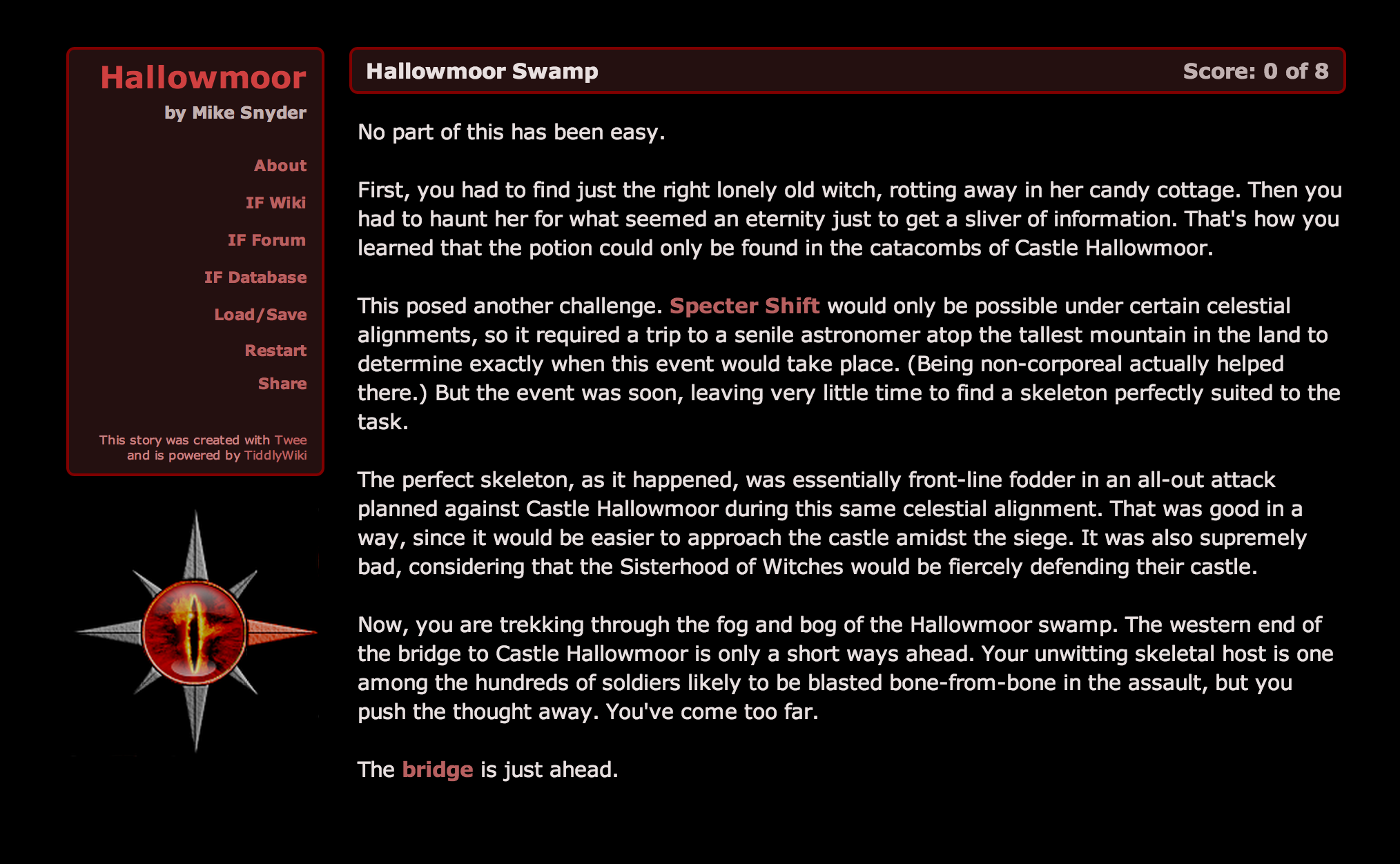
Mike Snyder released a Twine game for Halloween, Hallowmoor, about an epic battle between witches and skeletons in a fantasy kingdom. I haven’t finished it myself, but it’s substantial and highly polished. It’s also an interesting one for people who care about the formal relationship between Twine and parser games, since it’s got a bunch of features — a dynamic, updating map; a compass rose that shows exits; an inventory with usable objects; state that tracks the location of NPCs — that I associate more with parser pieces. There are also definitely puzzles, including a clever body-swapping mechanic.
(Full disclosure: I’m stuck about halfway in, at the moment.)
Ectocomp is a yearly IF competition with games written about a Halloween theme, with three hours or less allowed for development time. This year there are a startling twenty-four entries, many from authors you may already have heard of.
So far I’ve only had a chance to try a small handful of them, but there are some entertaining bits here, and most will only take a few minutes to play.
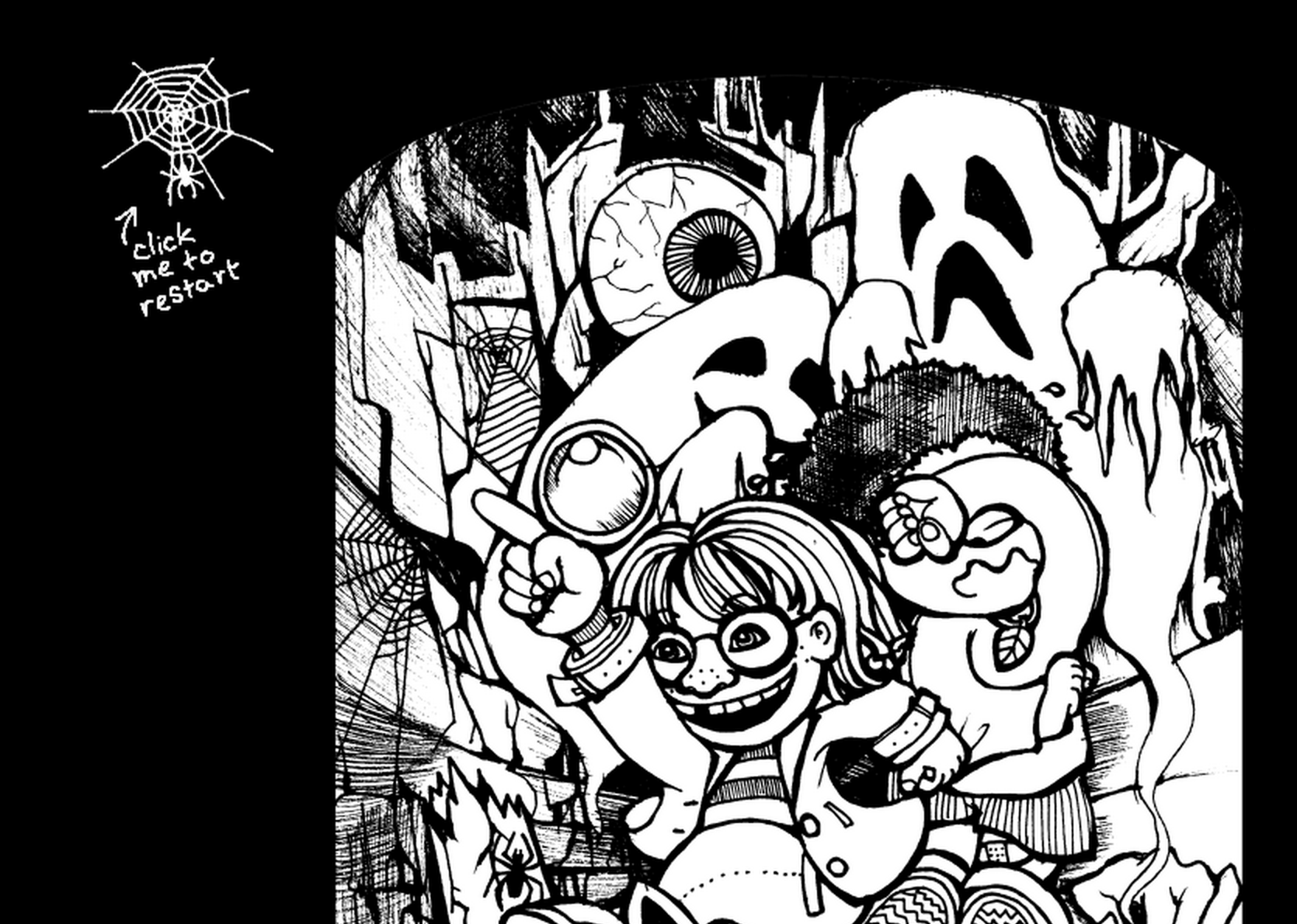
Anna Anthropy has a CYOA out called a very very VERY scary house. It’s highly-branching, low-state stuff, telling the story of a couple of pre-teens breaking into a suspicious mansion, in the spirit of early CYOA haunted house books crossed with Encyclopedia Brown. (Also, as far as I can tell, family-friendly.)
Various Projects

Microdot Reimagined is a parser IF game for sale from Potassium Frog. The starting premise is that your brain has been colonized (sort of) by a professor from the recently destroyed alternate-universe land of Microdot. He needs you to help him reimagine the place in order to bring it back into being, which means exploring a lot of spaces and solving some puzzles.
Stylistically, this is IF of the old school. Microdot Reimagined is executed in Inform 7 and playable with Glulx, and it’s got some nice tweaks, such as stylesheet improvements and cover art. In respect of gameplay, though, it retains the aesthetics of 90s or even 80s IF. There’s a short bit of narrative introduction, but the story such as it is does not seem overly pressing during at least the first part of the game. The map starts with lots and lots (and lots) of rooms accessible at the outset, and a variety of objects to collect from different rooms. I’ve played enough IF that I’m usually able to hold a layout of several dozen rooms in my head, especially if those rooms are introduced (as they usually are in modern IF) in clusters rather than all at once. So I almost never make maps any more. Microdot Reimagined, though, was big enough and thematically varied enough that as I wandered around all its opening space, I soon began to regret not taking notes.
The jokes are wacky-satirical — sort of Douglas Adams lite. Here’s a sample, which will probably give you a pretty good idea of whether the sense of humor matches yours:
>x magazine
It’s Celebrity ROFL Magazine! This is just so amazing. I cannot understand why anyone would not want to feature in this fabulous celebrity catalogue of doom. Let’s take a look at the epic stories in this week’s issue:Lard-packing with the Basingstoke Twins – “Celebrity Twins Elsie and Vera Basingstoke go on a Lard-packing expedition to sun-drenched Spudthorpe!”
Sir Abacus Timmy’s society wedding – “Kneepad Magnate Sir Abacus Timmy weds his Social Media Advisor, Jennifer Twitterbook-Davies!”
Plus there’s a sixteen page photo spread on the Monks of Ecstatic Gloom and their new swimming pool. This is so awesome!
I confess I got stuck after about 60-80 minutes of play, which is one reason this isn’t a full-scale review; but as far as I saw, the puzzles were mostly of a get-X, use-X style, except that the items in question were widely spread all over the map, so this was still nontrivial.
Enrico Colombini — one of the early greats of Italian text adventures — has released a short book about how to create an ebook with puzzles, given that the ebook’s only state is the page number and puzzles often require tracking some variable state.
This is a very specific purpose, but the explanations are clear and detailed, and may be relevant to anyone who is planning such a project. Another approach, of course, might be to use inklewriter’s Kindle conversion software, but that’s only useful if you are using exactly the right platforms; Colombini’s advice applies more broadly. It is published in both English and Italian, and comes with a short sample of a puzzle — a wolf/goat/cabbage cross the river puzzle — executed in ebook form.

Strip ‘Em All is an interactive comic strip puzzle, in which the player can reorder frames of the strip and sometimes alter the content of specific frames. Any change you make in one puzzle frame can have ramifications for the rest of the strip, as well. The puzzles ramp up in difficulty very quickly, and I found some of the later ones very difficult indeed. In several cases it’s not really obvious what order two panels need to follow because the dialogue really makes sense either way; in some, a complex series of panel changes and strip rearrangement is required.
This may sound reminiscent of Dan Benmergui’s Storyteller, but in practice it’s quite different: the text of speech bubbles is written out in advance, and the storylines are much more specific. Where Storyteller is backed by a generalized engine for working out the possible meanings of juxtaposed symbols, Strip ‘Em All is really about hand-rolled puzzles with one right answer.
That said, one of the interesting aspects of this puzzle is that it’s about exploring the interior space of the characters and the way they think as much as it’s about plot events and actions. Often one can hover over characters’ heads in order to see additional thought bubbles, which may be functionally hints about what is really going on. Sometimes a character changes states of consciousness, and all the panels change too as a result. So while I think it could have been better hinted, I found this fairly interesting.
One word of warning: the page includes quite a few ads.
Finally, a couple of interesting things to read: Jon Ingold gives a good interview in Haywire magazine on text gaming and in particular Sorcery!, and Liza Daly recommends some of her favorite interactive fiction from the last year.
 Emily Short's Interactive Storytelling