End of June Link Assortment

Events

July 2-5 will be the ACM IVA Conference, taking place in Paris.  IVA 2019’s special topic is “Social Learning with Interactive Agents”.

July 6, the SF Bay Area IF Meetup is meeting in the usual spot in the Museum of Art and Digital Entertainment.

July 13, the Oxford/London IF Meetup has a talk on Content Selection Architectures. If that title sounds a bit opaque to you, let me clarify: it’s about how we choose what pieces of content to show the player next, one of the fundamental questions of interactive literature. The talk comes to us from Michael Mateas, one of the creators of Façade and Prom Week, who through his own work and through his teaching and program development at UC Santa Cruz is one of the most prolific and influential academic thinkers on how we use procedural systems to create memorable player experiences. I am more than slightly smug that he’s agreed to speak to the group about his most recent work.

July 13, the Baltimore/DC IF Meetup is also getting together, resuming its monthly schedule to discuss The Missing Ring.

evt-655.jpgThe SIGIR Conference is taking place in Paris from July 21-25.

July 25 is the next Boston Area IF Meetup.

The 57th Annual Meeting of the Association for Computational Linguistics (ACL) will take place in Florence (Italy) at the ‘Fortezza da Basso‘ from July 28-August 2.

Logo_DiGRA_Kyoto-V3-300x288.pngDiGRA 2019 is being held August 6-10 in Kyoto.

The IEEE Conference on Games (CoG) will be August 20-23 in London.

The Foundations of Digital Games Conference (FDG) is happening August 26-30 in San Luis Obispo.

Games

Time What Day is a piece about memory that includes both Twine elements and (if you pay for it) a box containing scents and other sensory cues. I am sorry to say I missed the chance to check this out when it was demonstrated at NarraScope, but I’m glad someone did make an interactive narrative with scent tie-ins.

fUPDrH.pngHeretical Geese is a tiny tabletop RPG by Yoon Ha Lee and Ursula Whitcher, available from itch.

Victor Gijsbers has made a huge archive available containing his past games with source code (in many cases the games were previously free but the source was not); some unfinished projects; and writings and posts about interactive fiction.

Articles and Talks

Polygon on the Episodes platform and the people who write content for it.

Lynda Clark offers some interesting stats on the IF on the British Library’s interactive fiction archive, and calls out a few specific games available there.

Long time readers of this blog may remember Ian Thomas’ fascinating LARP write-ups from God Rest Ye Merry, an amazing Christmas murder mystery roleplay scenario held in a historic house with all kinds of jaw-dropping special effects. He’s done another project, All for One, a LARP based on cinematic renditions of the Three Musketeers, and you can read all about it in his Medium post on the making of. (Warning: that GRYM link can eat hours of your life. Pleasurably. But wow there’s a lot there and you will not want to stop once you start. The Medium post on All for One is a much shorter but still really fun and fascinating read.)

I’ve already posted elsewhere, but once more for people who might not have caught it, Graham Nelson did a talk about where Inform is going next, at NarraScope, and the slides and notes are available.

Jon Ingold did a talk on designing a lost language for Heaven’s Vault. This is from a couple of months ago, but I don’t think I’ve posted it here before, and it’s cool:

And here’s Dragan Jerosimovic in a talk from Reboot Develop Blue about what is necessary to build compelling digital characters.
The Fellow Who Caught Fire (Mark Bernstein)

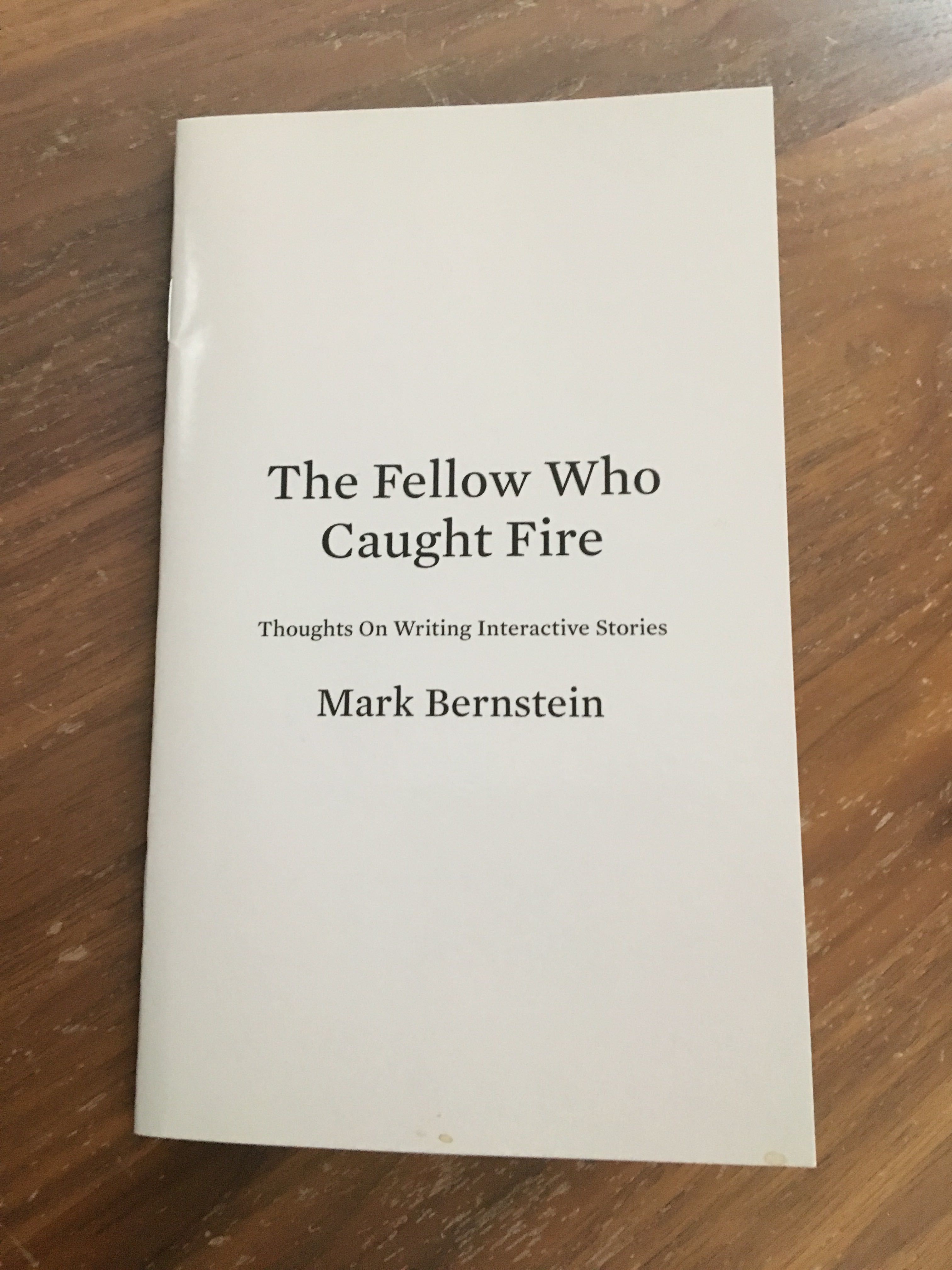
At NarraScope last weekend, Mark Bernstein (“Those Trojan Girls”, previous observations on hypertext narrative) was passing out a booklet entitled “The Fellow Who Caught Fire.” On the left-side pages are sections of a story; on the right-side pages, commentary about how stories are presented. Some of the areas for discussion are familiar from non-interactive literature, such as framing, tense, and person. Others dig into topics like explicit choice and link placement in hypertext narrative.

Since not everyone will have access to these, I thought I’d talk a little about what it contains, and some thoughts I had in response to Bernstein’s questions and provocations.

Continue reading “The Fellow Who Caught Fire (Mark Bernstein)”

Blogs on Narrative Design and Game Writing

I’ve covered many books on game writing here over the years, and I’ve collected and linked a lot of online resources on narrative design and on the history of IF design in particular.

This time, I’m recommending some blogs by other people who post about game writing or narrative design. Originally this post was going to be about blogs and podcasts, but there were enough of both that I have broken it out, and the podcasts section will appear later.

I’ve also intentionally not clustered these blogs by topics, since a lot of bloggers write about different things on the same blog. So instead I’ve mentioned some key posts, if there’s something on the site I consider especially characteristic of that person.

Continue reading “Blogs on Narrative Design and Game Writing”

Mid-June Link Assortment

Events

download.jpgThe Narrascope games conference is currently taking place in Boston, MA, June 14-16.  Both Graham Nelson and I are there and speaking; I’m on a panel about Bandersnatch, and Graham is updating people on the current status of Inform.

NarraScope is also the Boston IF Meetup for the month of June.

ICCC 2019 takes place on June 17-21 in Charlotte, NC.  The event is in its tenth year and is organized by the Association for Computational Creativity.

logo_CIS_front.pngFor those interested in the IEEE Conference on Games (CoG), June 30 is the deadline for early bird registration.  The conference itself will be August 20-23 in London.

July 2-5 will be the ACM IVA Conference, taking place in Paris.  IVA 2019’s special topic is “Social Learning with Interactive Agents”.

July 13 will be the next meeting of the Baltimore/DC IF meetup (there is no meeting in June due to NarraScope). The discussion will center around The Missing Ring from the 2019 Spring Thing competition.

July 16-17 is set for the symposium Ludic Literature: The Converging Interests of Writing, Games, and Play. The two-day event is funded by the Scottish Graduate School and takes place in Glasgow, UK.

icon.pngThe SIGIR Conference is taking place in Paris from July 21-25.

DiGRA 2019 is being held August 6-10 in Kyoto.

New Releases

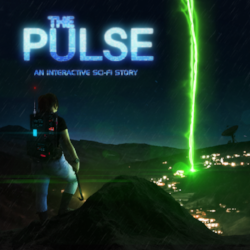
Final_Export_Text_01_Square.pngBack in October, I mentioned that the folks at StoryFix Media were working on a project called The Pulse. That game now has a release date right around the corner, and will be available on June 25 on Google Play.
The Pulse was written by Christopher Webster, developed by Gareth Higgins and Arthur Lee, with original score by Auto/Reflex. Check out the trailers here and here.

Electric Sleep, a recent release from a small team including artist Matthew Weekes (Kynseed, Freedom Planet) and Jack Sanderson-Thwaite (theatre writer with Bristol Old Vic) is currently available on Steam.

Rock Paper Shotgun gave it a very positive review in April, and GameGrin followed suit with a 9/10 rating.

Announcements, Articles, & Links

This interview with Hannah Powell Smith, on plotting, Choice of Games, and writing about ghosts.

A little more backstory on the development of Return of the Obra Dinn (and how it nearly didn’t happen.)

The possibility of further Black Mirror episodes Ă  la Bandersnatch.

The IF Technology Foundation has published its report on accessibility in IF tools and games, with recommendations for how to make IF experiences work better for more people.

Playing Text-adventure Games with an AI by Prithviraj Ammanabrolu records some new experiments with TextWorld.

Crowdfunding

Ninepin Press is publishing a story told on those folded fortune-teller toys, funded via Kickstarter. This is the same press that did The Family Arcana, a story told on a deck of cards.

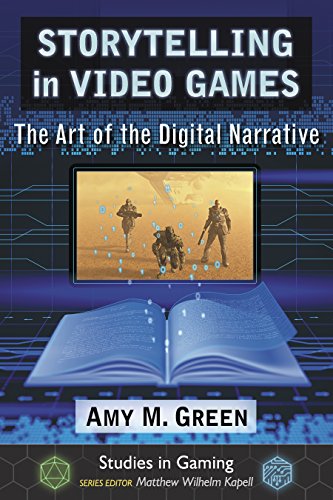
Storytelling in Video Games: The Art of Digital Narrative (Amy Green)

Starting in mid-2017, I’ve used the first Tuesday of the month for reviews of books about game writing, and occasional books about other writing in general.

As of now, I’ve gone through about two dozen — including everything from self-published Kindle ebooks about interactive fiction to acclaimed classics of screenwriting advice — and that doesn’t count the books I read, or started to read, and decided they were just too unhelpful to cover on the blog at all.

I feel like this project is drawing to a natural close.

While there are a handful of good writing books left unreviewed on my shelves or my ebook collection, I’ve talked about pretty much all the ones that had a strong bearing on interactive work; and I’m finding there are diminishing returns on reading more of the same. But it’s been useful for me, seeing what is out there, and I hope it’s been helpful for some of you as well.

So I’m shifting process a little. I’ve started instead to cover academic work that might interest IF authors and narrative designers — trying to make it a little more accessible and curate some of the stuff that might not be easily found. (My article on Max Kreminski’s work is part of that).

StorytellingInVideo

Today’s book, meanwhile, is a piece that straddles the line. The title, Storytelling in Video Games: The Art of Digital Narrative, sounds like it could easily belong to authorial how-to piece. But this is a piece of scholarship in digital narrative, rather than a craft guide, a speculation on experimental narrative creation, or a how-to book about getting on in the industry. The subtitle “Studies in Gaming”, is an important clue here. After a general introduction on why her topic is important, Green goes on to look at concepts of agency, immersion, and worldbuilding; and then to dig into how different long- and short-form games deliver their narrative experiences. She ends with a chapter on games studies in the classroom.

Green is interested in talking about how game narratives work, but from the perspective of a critical reader. She covers Firewatch and Everybody’s Gone to the Rapture, Far Cry Primal and Fallout 4 — and any number of others — via Baudrillard and Benedict Anderson. The rest of the time, much of the text consists of summaries of the various games and their features, and some the critical insight about them as games is pulled in the form of quotes from game critics.

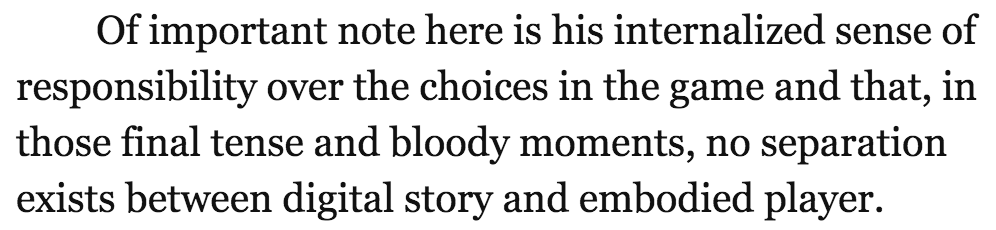
Relatively little of her own critique struck me as new information, and — ironically — in some cases her desire to communicate the emotional impact of things like complicity and immersion produced descriptions that to me felt both hyperbolic and obscure. For instance, she writes about the climax of Last of Us:

Screen Shot 2019-01-27 at 10.05.11 PM.png

I puzzled a little over this — is she claiming that the player is more embodied or more present in the narrative here than at other, less tense moments previously? — but I think she means that at this point in the story the player, enacting the protagonist’s grim choices, cannot escape feeling both complicity and an intimate physical awareness of the acts.

I found myself pulling away from this book, and I think I’m just severely not the target audience. Going via Tzvetan Todorov to conclude that stories need an opening hook and that Last of Us has one — this feels like coming up with an itinerary that includes two hours on the Eurostar but the only destination is my corner shop.

For someone who comes from a humanities academic background but who knows relatively little about games, it might be a different story; though I’m afraid probably few people who meet that description are reading this blog with any regularity.

End of May Link Assortment

Events

June 1 will be the next San Francisco Bay Area IF Meetup, exploring games from this year’s Spring Thing competition.

June 8 and 9, the London IF Meetup has talks (the 8th) and a workshop (the 9th) on interactive fiction designed for audio devices. We’re welcoming some out of town guest speakers for this one, one of our most ambitious events yet.

download.pngJune 9 is the deadline to apply to exhibit a game or to speak at AdventureX, which is taking place November 2-3 at the British Library.
June 11 is the deadline for submitting Game Industry talk proposals to the IEEE Conference on Games (CoG).  The conference itself will be August 20-23 in London.

June 10-12 in London is the CogX Festival of AI and Emerging Technology, where I will be speaking about the work we’re doing at Spirit.

https___cdn.evbuc.com_images_57512733_293295238101_1_original.jpgNarrascope is set for June 14-16 in Boston, MA.  This is a new games conference that will support interactive narrative, adventure games, and interactive fiction by bringing together writers, developers, and players. Both Graham Nelson and I will be there and will speak; I’ll be on a panel about Bandersnatch, and Graham will be updating people on the current status of Inform. More information can be found on NarraScope’s home site.

NarraScope will also be the Boston IF Meetup for the month of June. It’s worth noting that if you’re a Boston local and you missed the registration date, you might still be able to attend by volunteering for the event.

logo_0.pngICCC 2019 takes place on June 17-21 in Charlotte, NC.  The event is in its tenth year and is organized by the Association for Computational Creativity.

July 2-5 will be the ACM IVA Conference, taking place in Paris.  IVA 2019’s special topic is “Social Learning with Interactive Agents.”

July 13 will be the next meeting of the Baltimore/DC IF meetup (there is no meeting in June due to NarraScope). The discussion will center around The Missing Ring from the 2019 Spring Thing competition.

July 16-17 is set for the symposium Ludic Literature: The Converging Interests of Writing, Games, and Play. The two-day event is funded by the Scottish Graduate School and takes place in Glasgow, UK.

New Releases

web408.png“What manner of fool are you: the shrewd knave ever ready with a venomous quip? The renowned artiste at pains to stay above the political fray? The bawdy buffoon known as much for off-stage antics as on-stage mirth? Or the clever counselor whose real audience is the noble ear they whisper into? …The kingdom itself will be shaped by your choices!”

The latest offering to come from Choice of Games, Fool is a 420,000-word interactive novel by Ben Rovik. Play as a talented young court fool, navigating the scheming and treacherous world of the court of Breton.

Oslo-based independent game-developer Red Thread has just released Draugen, an ambitious first-person mystery set in 1920’s Norway. Described as “Fjord Noir,” players take on the role of an American traveler, searching the coastal Norwegian town of Graavik for his lost sister, and accompanied by a young ward.

Announcements, Articles, & Links

Starting on June 1, the IntroComp 2019 contest will be accepting “intent to enter” submissions, through June 30.

download.pngIntroComp is an annual contest that aims to give designers feedback on as-of-yet unpublished works that are not completely finished. Entries should be far enough along in the development process that they are playable, and all entries should also be interactive fiction. Cash prizes are available for the top few games (more information can be found on the site.)

raidersmariners_thumb-764d30a47f98a9fc19120f02be0ec454a9d175a39a5de0ec26809ec984022796.pngOn June 2, Fire Hazard Games will be launching The Extraordinary Voyage, a new immersive game at the National Maritime Museum.

The Extraordinary Voyage blends mobile games with interactive theatre, putting the player in the exciting world of seafaring and ocean exploration. Over the course of 90 minutes, players will explore objects in the museum, solve puzzles, and interact with real-life characters to create their own personal narrative.

The game is family-friendly and suitable for children 8 and up. Currently scheduled to run through July 7, although you’ll want to check the schedule for specific dates and times.  More info can be found here.

Failing Forward: Bruno Dias discusses the topic of failure in storytelling, and the forms it can take in interactive narrative.

Olivia Wood and Jessica Krause appear on the ScriptLock podcast, talking about topics such as their favorite choices in games and what makes for a good NPC.

On his blog, Jason Dyer journals his trip into the classic 1979 game Kadath.