Choice Poetics (Peter Mawhorter)

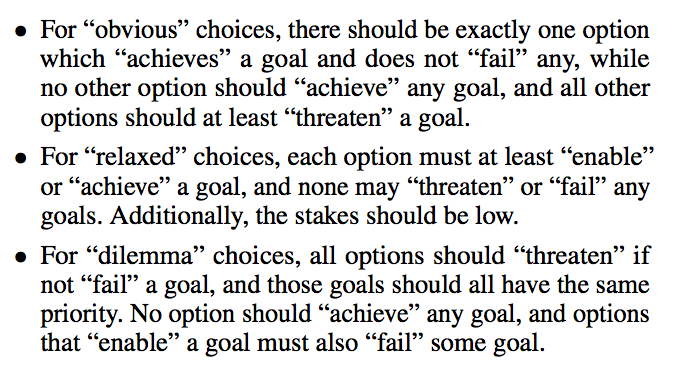
Peter Mawhorter is an academic who looks at how choices work in interactive narrative, elaborating a theory of choice poetics. His articles offer some taxonomies and vocabulary for talking about choice design — with partial, not complete, overlap with IF community terminology for these topics — and he has built a system that procedurally generates new choices from scratch.

In this post, I’m looking at three of his articles and offering some thoughts of my own, but all three are linked and accessible without a paywall, so if you find this interesting you can read the originals. This is part of a series in which I’m looking at academic approaches to interactive fiction and related topics.

Towards a Theory of Choice Poetics (Peter Mawhorter et al) sets the stage for later work and argues that there is a field here worth looking at. As the title would suggest (“Towards…”), he’s not advancing a completed theory himself here, but pointing out some of the factors that would go into such a theory. The article is thus mostly a set of annotated lists: of player motives in choosing options in a game; of play styles; of choice structure styles, as defined by the outcomes of the choice; and “dimensions of player experience”, which I found at once the most interesting and most slippery of his groupings.

He is careful always to point out that these category lists aren’t, and don’t expect to be, complete.

Continue reading “Choice Poetics (Peter Mawhorter)”

Can AI tell a good story?

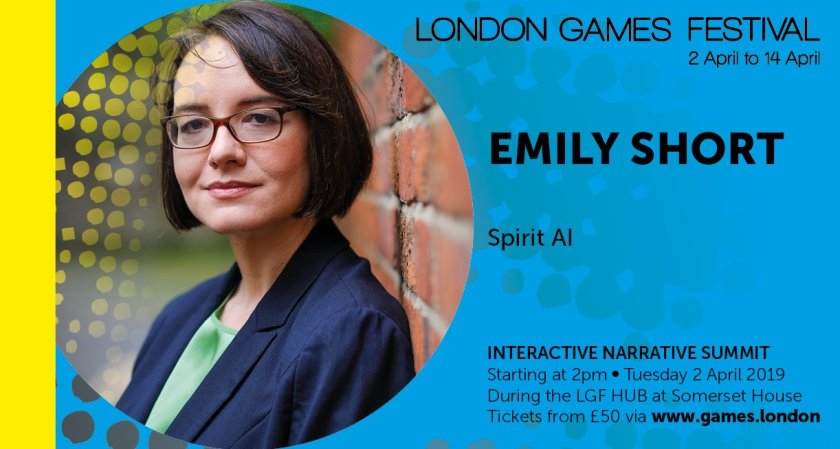
emshortLGF.jpg

Tuesday I was invited to speak at the interactive narratives summit at the London Games Festival, specifically in a debate over whether AI can create a good story.

Perhaps the original scheme was to start a good showdown, but I have somewhat complicated views about what the question even means, and my would-be debater Brenden Gibbons did also, as it happens. So instead we had a more temperate but I think more interesting conversation, moderated by David Tomchak.

This is not a transcript of that conversation, because I can’t do that, but it’s an attempt to recapture some key points, drawing also on notes I made before the event, and expanding some of the ideas with links or examples I didn’t have available in the room.

First, AI can definitely already create stories, by pretty much any definition that a narratologist would establish. Indeed, we can set the bar higher than just “is there a sequence of causally-linked events,” though many scholars would accept that as enough. Some of GPT-2’s output is interesting, funny, and narrative. So are the outputs of other techniques stretching back to the 70s, from generative grammars to the model-and-curate approach used by James Ryan in his recent dissertation Curating Simulated Storyworlds. If AI were an orchard, we would have already plucked many and diverse story fruits there.

Continue reading “Can AI tell a good story?”

The Anatomy of Story (John Truby)

Screen Shot 2018-09-02 at 12.02.08 PM.pngThe Anatomy of Story is another book about writing for cinema, and it more or less begins by arguing against everything taught by Save the Cat. The three act structure is wrong. Thinking in terms of inciting incident and rising action will get you nowhere because these ideas are generic. Relying on genre is the way to produce a predictable and formulaic result. The truth comes from within.

Truby encourages the writer to start by identifying topics that matter to them. “Write a story that will change your life,” he says, and then suggests some ways you might identify what topics and themes are particularly important to you. In this respect, it feels like a less dogmatic and more personal approach to some of Egri’s advice.

Once the writer has identified what sort of story she finds most compelling, Truby suggests looking (among other things) for the main character’s “basic action,” the thing that character does most consistently or most importantly in the story — Michael Corleone’s act of revenge, Luke Skywalker’s hand-to-hand combat against evil — as well as a design principle that will help structure the story, and important end-of-story choices that will be finely balanced between two almost-equally-desirable (or undesirable) outcomes.

All of this thinking could equally well be the preparation to find a good mechanic for your narrative design. Elizabeth Smyth’s Bogeyman is a horror story about abuse in which every choice the player makes is about obeying or defying the abuser. Papers, Please is about whether to comply or quietly disobey orders, in a host of ambiguous circumstances.

Continue reading “The Anatomy of Story (John Truby)”

End of March Link Assortment

Events

April 2, I’m on a session at the London Games Festival interactive narrative summit about whether AI can tell stories. (Preview: the answer is “it depends what you mean by that.” But we can definitely get more into it.)

April 4, the Spring Thing interactive fiction festival opens and games become available to play.

April 4-6, the Playful By Design Spring Symposium at the University of Urbana-Champaign features Chris Klimas speaking about Twine, alongside Allen Turner and Stuart Moulthrop.

April 6, the Oxford/London IF Meetup hears from Tom Kail (inkle) and Xalavier Nelson Jr (freelance) about game design considerations in IF and narrative games.

Also on April 6, the SF/Bay Area IF Meetup will be playing through games from the 2019 Spring Thing competition.

April 13, I’m speaking at the British Library in the Off the Page Chapter 2 event; I’ll be talking about Endure, Blood and Laurels, and Galatea, as work drawing on classical poetry, myth, and literature.

April 15 is the late deadline for designers to submit their work to Indiecade Festival.  The event itself is in October in Santa Monica, CA.header.jpg

April 16 is the release date for Heaven’s Vault, the massive new game from inkle. The archaeological science fiction game has been in development for four years. A video preview is online, as is a review from Eurogamer (as well as several others).

April 27 is the next Baltimore/DC Area IF meetup, discussing Castle, Forest, Island, Sea, as well as Cragne Manor.

The 2nd International Summer School on AI and Games will be held in New York City, May 27-31.  The event is organized by Georgios N. Yannakakis and Julian Togelius, who wrote the Artificial Intelligence and Games book.  More info can be found at the site.

The Oxford/London IF Meetup has an excellent program in process for the weekend of June 8, interactive audio experiences for phones, smart speakers, and similar devices. Saturday, we’re going to be hearing about craft, tools, and commercial considerations, with a couple of speakers coming from out of town. Then Sunday we have a workshop on using Spirit AI’s Character Engine for natural language interactions.

Narrascope is set for June 14-16 in Boston, MA.  This is a new games conference that will support interactive narrative, adventure games, and interactive fiction by bringing together writers, developers, and players.  More information can be found on NarraScope’s home site.

logo_0.pngICCC 2019 takes place on June 17-21 in Charlotte, NC.  The event is in its tenth year and is organized by the Association for Computational Creativity.


Announcements and Crowdfunding

Hugor is an interpreter that allows you to play Hugo games, and there is now a new release available.

Cyan is Kickstarting a new game called Firmament, and Andrew Plotkin has some thoughts about the project.

Articles, Links, & Podcasts

This exploration of level names in video games by Lasse Hämäläinen is fun if you’re intrigued by naming issues in general.
Accessible Games offers guidance on how to build better, more accessible gameplay experiences.


Mailbag: Getting Beta-Testers for Parser IF

I know you’re busy, and hopefully you didn’t delete this as spam ;-)

I’m writing my first interactive fiction game. Although it’s not finished, I’m already looking ahead to finding beta testers – beyond the few friends I have who once way back when played the original Infocom games.

I imagine it takes time to establish the relationships necessary to get people to the point they’re actually willing to take a look. Do you have any advice?

An aside: I’m a computer programmer and using Inform 7. It’s a nice system, and I get it. But I am not familiar with the culture of IF users. (For example, the authors of the Inform manual mention how disabling the UNDO function when the story ends is anathema to many players.) Also, just understanding how to make beta-testers’ jobs easier in general would be nice.

A first step would be to hang out a bit at the intfiction forum or possibly euphoria (I haven’t been to the latter for a while, so I don’t know how active it is, but it’s more of a chat space). Introduce yourself, participate in a few conversations.

It sometimes helps to offer to beta-test for other people, for two reasons: one, it builds those social connections, and two, it familiarizes you with how other people typically do this. If you’re planning to enter a competition, sometimes there are threads in the weeks before the competition deadline where authors are offering to swap beta-testing, and that can also be a useful way to pick up help.

Alternatively, if you live near Baltimore, Seattle, San Francisco, Boston, or London, there is a live meetup that meets pretty regularly near you, and those can be a great place to cultivate connections more quickly. My link roundups twice a month list all the events I know of that are coming up in the near future, but you may already have seen these.

As for expectations and norms: it’s a good idea to read some reviews of recently released games, especially ones that might be similar to yours; they may help you work out what people are expecting and what goes over well or badly. You don’t have to take this as gospel, of course, and sometimes you just really want to do something with your work that isn’t in the expected range. That’s fine. But it can be helpful to know what people are looking for so that you’re not too surprised. One way to look for that information is to check out IFDB and find games in your genre/style and see what people wrote about those. You could also read through reviews from the latest IF Comp to get more of a cross-section view.

Suggestions for Testing is a fairly old article of mine, but as it’s about parser IF, a lot of the recommendations still hold. It talks about what testers might expect to do, and what authors might expect from testers.

Preparing a Game for Testing is about figuring out where your game is likely to present problems so that you can look at those yourself before you ship it off.

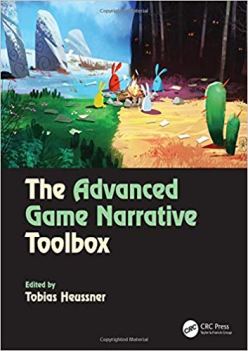
The Advanced Game Narrative Toolbox (ed. Tobias Heussner)

advancedgamenarrativeThe Advanced Game Narrative Toolbox is a brand-new followup to The Game Narrative Toolbox, which I covered previously. The “advanced” bit means that the book doesn’t re-cover all the same ground already found in game writing books. The authors suggest that if you are entirely new to game literacy and writing advice, you should go to the first book in the series, to Skolnick’s Video Game Storytelling, and/or to McKee’s Story.

Where the first book walked the reader through steps for building a basic portfolio of game design documents and related materials, The Advanced Game Narrative Toolbox is more topic-driven, each chapter written by a different author (with just a couple of repeats).

The topics cover a range of craft, commercial, and cultural considerations. Many (but not all) of the chapters end with a suggested exercise for the reader, as they did in the first book; but the feel here is less of a core syllabus and more of a set of electives you might pick to round out your understanding.

Many of the chapters approach their subject by defining process: what are the steps that you would take to go about a given task, what considerations should you apply, who else needs to be involved, what could go wrong, and how will you know when you’re done? So, for instance, a chapter is more likely to say (I paraphrase) “next, make a map that shows where each step of the quest will occur in the game world,” and less likely to dive into deep analysis of different possible map designs and how they will affect player experience. Typically, that process guidance is really useful, especially as it comes paired with lists of references if you need more technique training, but you should be aware which you’re getting.

The book is expensive. I bought it as soon as I heard of it, and I’m glad I did, but I flinched at checkout. Price is not typically something the authors can control, but it means I talk later in the review about how to tell whether you’re likely to get enough value from it to justify the price. That’s not meant to reflect on the book’s quality: it’s good, no question. If you get a chance to pick up a used copy for $15, just buy it.

Continue reading “The Advanced Game Narrative Toolbox (ed. Tobias Heussner)”