Mid-March Link Assortment

March 17, Queer Code London holds a workshop on graphical uses of Twine (co-sponsored by the Oxford/London IF Meetup).

I will be at GDC March 19-23, speaking at the AI Summit and present at the Spirit AI expo floor booth.

March 20, Sunderland Creative Writing Festival offers a workshop on writing choose your own ending stories (looks like it’s focused on craft and choice design, and might be non-digital).

Through March 21, the MIT Rotch Library (77 Mass Ave, 2nd Floor) is running an exhibit about computer-generated books called Author Function.

March 26, the Dublin Interactive Fiction Meetup gets together to look at point and click adventure design and tooling.

April 1 is the date to submit games to Spring Thing 2018, and they’ll become available for people to play on April 5.

April 6-8 is Now Play This in London, a curated show of experimental gameplay that coincides with the London Games Festival.

April 7 is the next meeting of the SF Bay IF Meetup.

April 7 is also the next meeting of the Baltimore/DC Meetup. The topic there will be Papers, Please.

April 18 is the next meeting of the Oxford/London IF Meetup, where inkle studios’ Joseph Humfrey will talk to us about making interactive text look good and flow well — and in my view there’s no one better to learn that from.

And further in the future but worth planning ahead for: Feral Vector is May 31-June 2 this year. This is a joyous, playful indie conference in Yorkshire and has always been delightful when I’ve been able to attend. (I can’t make it this year, alas.)

Continue reading “Mid-March Link Assortment”

Not Exactly Mailbag: Worldbuilding from a Mechanic

Monkey graphicsTwice this year I’ve spoken about matching story and mechanics — once for the Oxford/London IF Meetup, and once as a keynote talk at the Malta Global Game Jam. Both times, I mentioned the idea of using mechanics as the basis of world-building. I’ve done this both with the letter-changing powers of Counterfeit Monkey and the Lavori d’Aracne sympathetic magic of Savoir-Faire and Damnatio Memoriae. (I’ll talk a bit about all of those games below, so beware moderate spoilers, if you care.)

In Malta, one of the questions I got after my talk was “how do I know what questions to ask when world-building?” and I suggested having a look at conventional fiction guides for world-building. It seemed like a fair response at a time, but as I’ve had a look at some of the world-building guides out there, I felt that most of them didn’t necessarily translate directly to the types of strategies I use for this cause. So I’ll belatedly go into a little more depth about that now, in the hope it’s useful to someone (whether or not ever seen by the original questioner).

If you’ve got mechanics, that typically means you’ve got

  • an action/set of actions for the player to perform
  • some kind of world state that is affected by those actions in some way

And that’s all we need to ask world-building questions.

Continue reading “Not Exactly Mailbag: Worldbuilding from a Mechanic”

GDC 2018

Once again, I’ll be at GDC this year, both speaking and presenting our latest Spirit AI work at a booth in the Expo hall.

If you’re new to GDC and are coming to it from the IF community, I’ve written before about the experience and how to get the most out of it.

If you’re going too, here are a few IF-relevant things to look forward to:

Books on Worldbuilding

In this installment of my monthly writing-books review, I’m looking at a few different guides to worldbuilding. Several of these were designed for science fiction and fantasy novel authors, not for games writers, but some are useful in this territory as well.

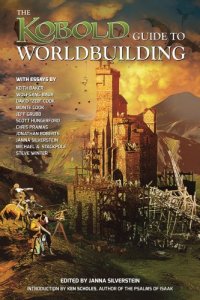
koboldKobold Guide to Worldbuilding (free PDF) is indeed written by and for game designers — though sometimes about tabletop RPG design rather than video game design. Still, the tabletop context is relevant to video games.

As anthologized guides go, it’s more varied and less systematic than some. Some sections are essentially post mortems on past projects that might or might not prove particularly relevant to your own process. Others go into detail about the many different sub-flavors of heroic fantasy.

At some points, the contributors are even philosophically at odds. Contributor Monte Cook argues that game world design is fundamentally different from novel world design because you’re looking for enough setting material to drive dozens or hundreds of stories, not just to support a single one. (“…for an RPG, Middle-Earth doesn’t need Sauron; it needs five or six, all in different locales with different motives and goals…”) Later in the book, Wolfgang Baur disagrees, accusing Cook of Kitchen Sink Design.

Quite a lot of the content here is about why you need world-building — what it can accomplish, and how it contributes to genre and the generation of story possibilities — than the how. Steve Winter’s chapter even gets into the question of why monotheism isn’t a popular choice for RPG backgrounds even when so much of the rest is often loosely western medieval.

But there are how chapters as well. Jonathan Roberts makes a pitch for the value of a good map, but then also takes us through an illustrated step-by-step process for layering in geographical features, biomes, nations and smaller landmarks. Other chapters cover , topics as specific as “How to Design a Guild” and “Designing Mystery Cults.”

Continue reading “Books on Worldbuilding”

End of February Link Assortment

March 1 is the deadline to register if you intend to enter Spring Thing 2018; April 1 is the date to actually submit the games themselves, and they’ll become available for people to play on April 5.

March 3 is the next meetup of the SF Bay IF Meetup group.

March 4, Dublin Interactive Fiction Writing Meetup convenes for an introductory lunch.

March 5, there is a reading of procedural literature at the Harvard Book Store (Cambridge, MA) with Nick Montfort, John Cayley, Liza Daly, and Allison Parrish, at 7pm.

March 7, Oxford/London IF Meetup hears from Greg Buchanan on writing for games from IF and indie to AAA projects.

The Opening Up Digital Fiction competition runs through March 15, 2018. (Previously announced as February.) It offers cash prizes and the possibility of future publication.

March 17, Queer Code London holds a workshop on graphical uses of Twine (co-sponsored by the Oxford/London IF Meetup).

I will be at GDC March 19-23, speaking at the AI Summit and present at the Spirit AI expo floor booth.

March 20, Sunderland Creative Writing Festival offers a workshop on writing choose your own ending stories (looks like it’s focused on craft and choice design, and might be non-digital).

Through March 21, the MIT Rotch Library (77 Mass Ave, 2nd Floor) is running an exhibit about computer-generated books called Author Function.

March 26, the Dublin Interactive Fiction Meetup gets together to look at point and click adventure design and tooling.

And further in the future but worth planning ahead for: Feral Vector is May 31-June 2 this year. This is a joyous, playful indie conference in Yorkshire and has always been delightful when I’ve been able to attend. (I can’t make it this year, alas.)

Releases

Where the Water Tastes Like Wine drops today! This is an amazing project dreamed up and developed by Johnnemann Nordhagen — American lore, and America itself as a construction of stories we tell to each other — written by many many authors. I wrote for it. So did Olivia Wood and Leigh Alexander, Cat Manning and Bruno Dias and Kevin Snow, Jolie Menzel and Austin Walker and Matthew S. Burns and even other people yet. The art is beautiful. The music is haunting. Sting did some of the voice acting. (Yes, that Sting, what, did you think there are two Stings?)

Sub-Q has been going strong again, republishing the IF Comp entry Salt but also several brand new pieces: All Those Parties We Didn’t Cry At, Tripladin Massacre, and This is a Picture Book. (Some of these are now a couple of months old — I fell behind mentioning them here, apologies!)

American Angst (Misha Verollet) is now available on itch.io for free, as well as available on Steam. The description:

You wake up in pitch black darkness. You know not where you are. You know not who you are. And they’re trying to kill you…

Imagine a horror novel where you get to make the choices and decide how the story plays out: Welcome to American Angst, a text-based multiple-choice survival horror interactive fiction, combining RPG elements and turn-based combat with dark humor and satire.

A choice-based game slash novel, you try to escape from an underground prison complex – all the while suffering from amnesia, fighting off guards seeking your death, and slowly unravelling the mystery that brought you to this place, as you traverse the thin line between survival and revenge…

Competitions

The French IF Comp has concluded, and the winner is Hansel et Gretel — La Revanche.

Articles and Other Writing

Liza Daly writes about the utopian fiction that inspired her IF Comp piece Harmonia. Part Two, even more extraordinary, covers one of the least-known authors in depth.

Sub-Q has posted a Q&A with last year’s top five IF Comp winners.

This Gamasutra article on dialogue systems by Pietro Polsinelli and Daniele Giardini is many months old, but I just encountered it recently.

Naomi Clark has a magnificent tweet thread on Black Panther.
A Case of Distrust (Ben Wander)

Screen Shot 2018-02-10 at 8.12.52 PM

I mentioned this game in a previous link assortment, but it deserves its own post: A Case of Distrust is a detective adventure by Ben Wander, set in 1920s San Francisco. You’re a female detective who previously spent time (unusually) on the police force, thanks to a policeman uncle who took you under his wing. But now Uncle Lewis is dead, you’re trying to fend for yourself, and the cases are not coming through the door as quickly as you might like. Happily, one does turn up eventually, and you get involved — only to find that the matter escalates while you’re investigating.

Continue reading “A Case of Distrust (Ben Wander)”