The Island of Doctor Wooby (Ryan Veeder)

Screen Shot 2015-08-17 at 1.44.37 PM

All around you, huge white ribs slice out of the ground like angry grabbing chthonic fingers, and from the center of this ossified ampitheatre a colossal pointed skull looks up at you with toothy indifference. This is a macabre location.

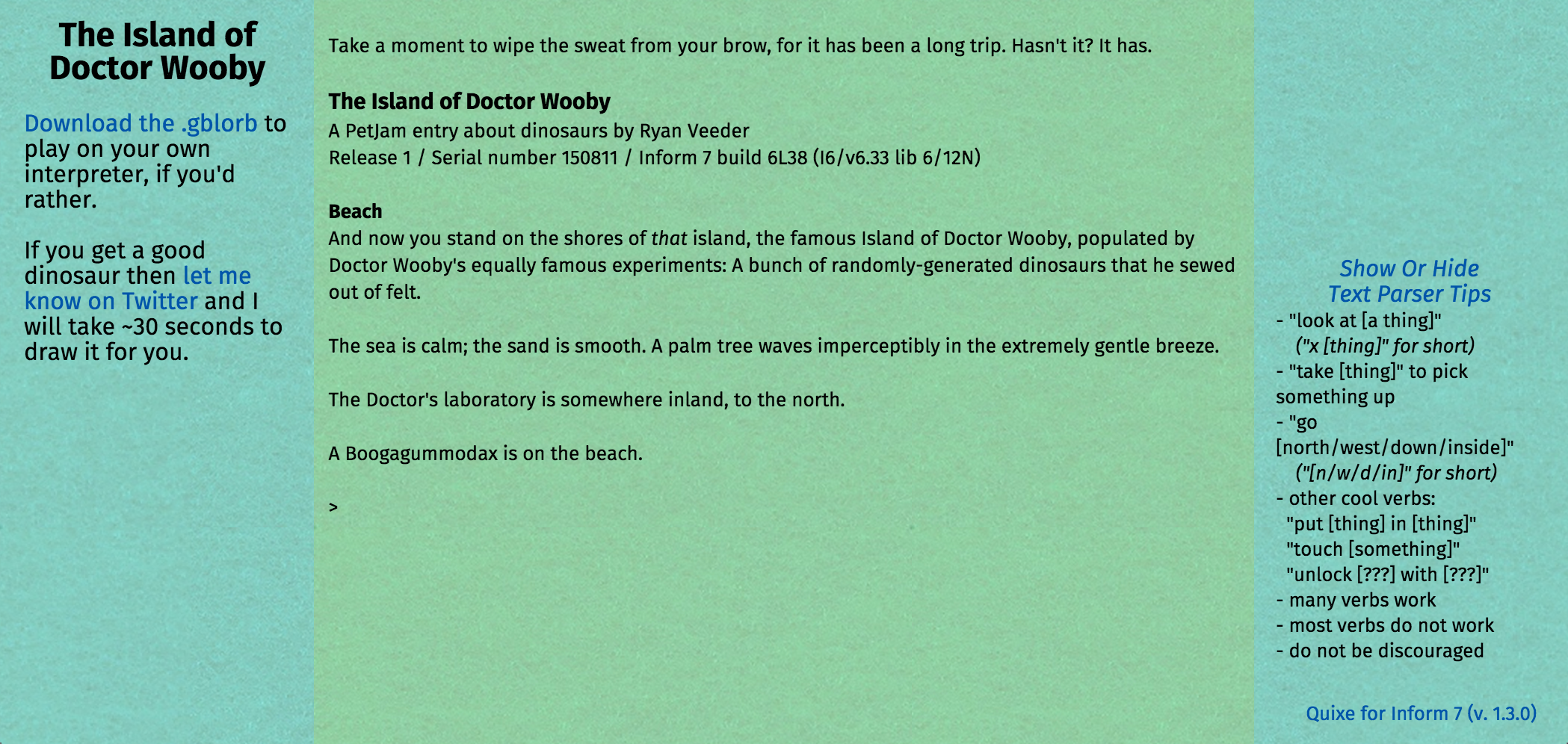
The Island of Doctor Wooby is a short, friendly piece of parser IF, with the chatty narrator, solid parsing, and lightweight puzzles familiar from a lot of Ryan Veeder’s work. It’s somewhat shorter than Dial C for Cupcakes and probably a bit easier than Nautilisia. The premise is that you’re exploring a toy-like island covered with felt dinosaurs sewn by Doctor Wooby.

As for the dinosaurs, their names and characteristics are procedurally generated, giving them different colors of felt and different physical attributes, as well as a range of cute behaviors. You can pet them, feed them, and interact with them in a few other ways — which makes sense considering that Island of Doctor Wooby was an entry in PetJam.

Several of the puzzles turn on recognizing that you’re dealing with artificial things rather than real ones, and therefore you can deal with them differently than you might initially have expected. The game acknowledges its own status as an artificial construct, too:

The sand isn’t diggable in this game. This may be because its components are too securely joined. Maybe it is intended to be a sympathetic character, and digging it would violate the contract of nonviolence implicit in this game’s player-parser relationship. Or perhaps “digging a sand” is just bizarre concept.

In one spot, a river scene is described as “Edenic”; elsewhere, a description of a garden is supplied by a substantial quote from Paradise Lost, though the things described in the quotation are of course not really present, and an attempt to interact with them provokes a disambiguation asking if you’re referring to “the literary flowers”. The setting is thus both childlike and prelapsarian, and yet neither the felt nor the poetry is quite real. In this respect it’s a little reminiscent of Delphina’s House, though DH allows the player to swap between realities rather than making them simultaneously present as Veeder does.

Ultimately the effect of all this remains primarily playful. Gentle, charming, took me about 10-15 minutes to play.

This Book is a Dungeon (Nathan Meunier)

Screen Shot 2015-08-19 at 1.14.01 PM

As indicated in this screenshot, This Book is a Dungeon is a) a Kindle book about game development with Twine and b) the Twine-based dungeon developed as described in the book. The word “Bookumentary” makes my teeth itch a little, so I will pretend I didn’t see that. And I can’t comment on the success of this piece as a self-publishing experiment, so I’ll just talk about the first two aspects.

The book is 81 pages long, which means that the book and game together are definitely far outside the usual “I will play this in 20 minutes in my lunch break” realm occupied by most Twine pieces — though it’s written in a breezy, confident, slightly repetitive style that makes it a pretty fast read:

It’s truly rare to find me doing only ONE thing at a time. Ever. I’ll admit that my rampant ADD is partly to blame. I try to work this incessant need for chaos and spinning plate juggling to my advantage, though it sometimes bites me in the ass. I can’t ignore this one, though. The drive is too great. Plus it’s new and shiny, so off we go!

Continue reading “This Book is a Dungeon (Nathan Meunier)”

Windhammer Prize: ‘Normal Club (Philip Armstrong)

Screen Shot 2015-08-26 at 5.08.12 PM

The Windhammer Prize is a yearly competition for gamebooks, specifically the on-paper, distributed-by-PDF variety. Last year I covered a few of the games, and this year the competition is about to open again, so I thought I would honor the occasion by looking at Philip Armstrong’s ‘Normal Club, the winner of the top prize in 2013. (Past entrants are archived on the competitions site.)

The image I’ve used as the header illustration for this post is a map of the town you’re exploring, and it contains some information (besides the numbers themselves) that you may need to use to solve the adventure. Its cartoony but confident feel is a pretty good introduction to the experience as a whole: lighthearted, accessible, soundly constructed, with the game/puzzle side more prominent than the story side.

‘Normal Club here refers to paranormal research, which in this world is an after-school competitive activity like chess team or debate club. The protagonists are a Buffy-style Scooby gang, and you get to pick three of six prefab characters to include. This choice determines your gang stats and opens up a number of character-specific extra paragraphs throughout the story. For any given situation, one or two of the gang members might have a personal response.

As one might expect, the resulting narrative uses characterization mostly as a spice, and none of the protagonists can afford to have unique motivations that might cause a surprise swerve in the MacGuffin Quest. Likewise, most of the choices you encounter, up until the very end, are tactical rather than moral decisions.

Like many gamebooks, ‘Normal Club starts with some forms to fill out with these stats, and spaces for inventory. Initially I tried to play using the online PDF and just keeping my notes in a notebook, but that was a mistake, for reasons I’ll get into at the moment. If you want to play, you probably need to print this thing off. (It runs to 45 pages, so this isn’t insuperable, but I usually avoid printing longish documents for the sake of the planet.) You will also need a 6-sided die or a reasonable online facsimile.

The discussion below isn’t all that spoilery, but if you want an innocent first experience of this book, you may want to stop here.

Continue reading “Windhammer Prize: ‘Normal Club (Philip Armstrong)”

Conversations We Have In My Head (Squinky)

Screen Shot 2015-08-08 at 10.21.01 PM

Conversations We Have In My Head is a very short, real-time dialogue game by Squinky, describing a conversation between a genderqueer protagonist (Quarky) and their ex (Lex). As the player, you’re choosing responses Lex can make to Quarky’s revelations and questions; new options come and go on the screen. This gives the game a smooth, relaxing quality — this is an odd analogy, perhaps, but it felt a bit like a driving game to me, in which you’re looking at the scenery sliding by and deciding which way you wanted to steer, but didn’t have any brakes.

If you want, you can be totally silent and just listen to Quarky monologue about the changes in their life. Or you can offer lots of feedback, or even more or less wrest the conversation around to yourself on a regular basis, reminding Quarky of the differences between you and of harm done in the past. I like the way this flows, though after about the fifth playing I started to wish I could fast-forward to important junctions in order to try some of the alternatives. Still, the game is so compact that even re-listening to the same opening doesn’t slow things down too much.

Squinky includes the following paragraph in their description of the game:

Many of us have voices in our heads that constantly remind us of our perceived failures and inadequacies. Sometimes, those voices appear to us in the form of a once-important, now-estranged person from our past. This is a game about having one of those conversations with that voice in your head, and the many ways it can go.​​

Despite the conflict implied in this paragraph, I found that the majority of the conversations I generated with Conversations We Have In My Head were net positives, rather than negative reflections on the protagonist or on what happened in the past. Perhaps growing up and coming to know themselves better has opened the possibility that the characters might be kinder to one another and keep things in better perspective than they used to. There are of course some exceptions.

Continue reading “Conversations We Have In My Head (Squinky)”

The Compass Rose (Yoon Ha Lee / Peter Berman)

Screen Shot 2015-08-18 at 2.35.26 PM

The Compass Rose is a spare, impersonal science fiction story by Yoon Ha Lee with tech support by Peter Berman; it’s the third of Sub-Q’s August lineup. It is a hypertext piece, but offers some directional options most of the time as well.

The premise is that a compass rose is a deeply powerful physical object. It is able to show directions and guide you (literally and metaphorically) in your environment, but its abilities go beyond that, terraforming a new world to conform to the values of its colonizers.

The story begins with your rescue of an old compass rose from a damaged planet, and escape. Then you have the opportunity to create your own colony, filling in your own rose-diagram with markers indicating the values you’ve chosen. Is coldness one of your primary directions, or mercy? Openness or paranoia? Each of your major actions affects the type of colony that will result, and orders the constellations in your sky. Once you’ve added to your compass rose, you can click these links for further information.

Continue reading “The Compass Rose (Yoon Ha Lee / Peter Berman)”

Scroll Thief (Daniel Stelzer)

scrollthief

Scroll Thief is a game by Daniel Stelzer, set in the Zork/Enchanter universe, though with significant nods to Colossal Cave as well. It’s a puzzlefest built around the same magical spells that appear in the Enchanter series — gnusto to copy things into your spellbook, frotz to make them glow with magical light, blorb to enclose them safely in a strong box, rezrov to open and untie things — to which Stelzer has added a couple of “metamagic” spells, including the lleps reversal-spell from Balances and another spell that strengthens the effect of a given casting. Stelzer released Act One of the game in IntroComp 2014. (My review at the time.)

Meanwhile, though the spells may be ones we’ve mostly seen before, they’re generally being used on situations that we haven’t. The resulting puzzles do well (or at least, did for me) on the originality and explorability axes. Some take longer than others to work out, and for one or two I needed the hints; on the other hand, others are made easier because they have multiple solutions involving different spell combinations.

To make the exploration more fun, Stelzer provides a number of good easter egg responses for using the spells in unusual places or unexpected ways. There are also a lot of nods to IF community figures and institutions, including what I take to be a reference to ClubFloyd and NightFloyd. In keeping with the Infocom originals, the author has provided invisiclues-style hints which you can highlight to view solutions; these are of course themselves full of misdirections and red herrings.

At the same time, Scroll Thief sets itself apart from its predecessors and inspirations with an expanded role for NPCs, especially the Adventurer from Colossal Cave whom you can summon into your world. Your initial interactions with him are quite manipulative (and you really have no opportunity to make them otherwise), but later in the game it becomes possible to treat him more as an equal, someone you can talk to and do favors for. The bird and the snake from Colossal Cave get cameo appearances, and with judicious use of spells, you can get the bird’s insights into its situation. Then, too, the game’s setting gives more time and attention to the training of novices and the organization of the community of spellcasters, making it less a world of lone heroes and more a world of collaborative effort — a point that becomes particularly clear at the transition to Act II.

The result is less lonely and more focused on interpersonal (or inter-creature) connection than the original games — in a lightweight way reminding me of the transition in Endless, Nameless from a puzzle-oriented model to one where NPC conversation is possible.

The game’s story is not complete in itself. Scroll Thief contains two acts of a longer story, which promises to be a trilogy. The end of Act II introduces a mechanic from Spellbreaker which I would enjoy seeing explored further, so I look forward to the next chapter.

Scroll Thief is certainly possible to play with only moderate knowledge of the source material, but I wouldn’t give it to someone as one of their first encounters with parser IF. Technically, this piece is doing some very challenging things — viewing from one room into another via magical scrying glasses, tying ropes to objects, ordering NPCs around from a distance, and other tasks that justly give parser IF authors pause.

A huge amount of work has gone into making this complicated world model easy for the player to manipulate, and providing hints when some unusual bit of syntax is required. The world model works smoothly most of the time despite the difficulty of what it’s trying to accomplish. But the parsing involved in issuing commands and viewing things from a distance is still sometimes tricky to deal with. When scrying, for instance, LOOK IN SPHERE produces a disambiguation about what you want to look at while LOOK INTO SPHERE actually gives the desired room description of the thing on the other side. In other places, it can be necessary to run through several variant phrasings (ASK ADVENTURER ABOUT HELP vs ASK ADVENTURER FOR HELP, e.g.) in order to land on the one that will work. I ran into a few snags that meant I had to look for hints on puzzles I would otherwise have been able to solve on my own. However, Stelzer is releasing new updates rapidly, so it may be that these issues will be less of a concern in a couple of weeks.

And one more thought on the puzzles, post-spoiler space:

Continue reading “Scroll Thief (Daniel Stelzer)”