Write Worlds Your Readers Won’t Forget (Stant Litore)

51v0a2EYVGL.jpgI’ve written already about some of the world building books I’ve worked with in the past. Stant Litore‘s Write Worlds Your Readers Won’t Forget is relatively new — published late 2017. It’s not a game writing book specifically, but is meant for anyone in the speculative fiction space. It’s also quite compact, about a hundred and fifty pages, and meant to be used, with a sequence of exercises for the reader. More than that, even though it’s a book about world-building, it’s focused on the plot and character implications of what you’re doing:

This book treats worldbuilding as a process for conflict and exerting pressures on your characters. Unforgettable characters live unforgettable stories that are made necessary and possible by unforgettable worlds they are trying to survive and thrive in.

So though this is a book for writers and not for interactivity, it’s bringing in some of the same worldbuilding motives as a tabletop game like Downfall.

In addition, Litore immediately identifies two approaches to worldbuilding: the Tolkien approach, where you start at the ground level in some particular area. And he correctly points out that this is even more difficult than most people give credit for:

It is theoretically possible for you to create an unforgettable imaginary world in the same way that JRR Tolkien did if you have an advanced education or deep training in one particular field relevant to worldbuilding, plus an inquisitive mind that is always asking questions about how your area of expertise informs and is informed by others. For example, if you are a gifted economist, you might begin building a world from the ground up if you start by designing a unique and detailed, though fictional economy…  This kind of deep dive is rare because it requires more than just a “research phase” to inform a novel or screenplay. It relies on committed, dedicated expertise and conversation with other experts in that area of knowledge.

I found that pretty interesting because of my own interest in the idea of research art — but also a strong argument for why not all worldbuilding on all projects needs to go the Tolkien route. And certainly most of mine doesn’t.

Instead, Litore recommends the approach of inserting an importantly different detail in each of three areas: the physical conditions of a world and the requirements of surviving there; the biology and the creatures who live there; and the culture that persists there. He then devotes several chapters to unpacking each of these techniques.

Continue reading “Write Worlds Your Readers Won’t Forget (Stant Litore)”
IF for certain moods, and a couple of IntroComp games

This was originally just going to be a post about IntroComp — I wrote it up a little while ago and scheduled it. But the post as originally written now feels slightly tone-deaf; I’m feeling a bit emotionally drained and stressed by the past week in American politics, and I know a lot of my friends are too. So if you’re in a similar place:

If you could use something warm and fuzzy to play right now:

  • S. Woodson’s Beautiful Dreamer and Magical Makeover are gentle but engaging fantasy.
  • Many of Ryan Veeder’s works are playful in a cozy way, especially Dial C for Cupcakes.
  • Brendan Patrick Hennessy’s work is full of teenagers figuring out how to treat each other better, and is also frequently very funny. If you haven’t played the four-part Known Unknowns, now might be a good time for that.
  • Steph Cherrywell‘s games are full of young women winning out and having adventures.
  • Tentacles Growing Everywhere (Dietrich Squinkifer) is a short-ish game about alien puberty that I found pretty sympathetic.

If you need something smart and funny:

  • Reigns: Her Majesty is all about female negotiations of power, and the accommodations made to deal with it.

If you need something visceral about trauma and survival:

If you need something about the long game of politics and the role of women:

  • Liza Daly’s Harmonia is a story about utopianism and the experience of women, past and present.

Continue reading “IF for certain moods, and a couple of IntroComp games”

The Harbinger’s Head (Kim Berkley / Choice of Games Hosted)

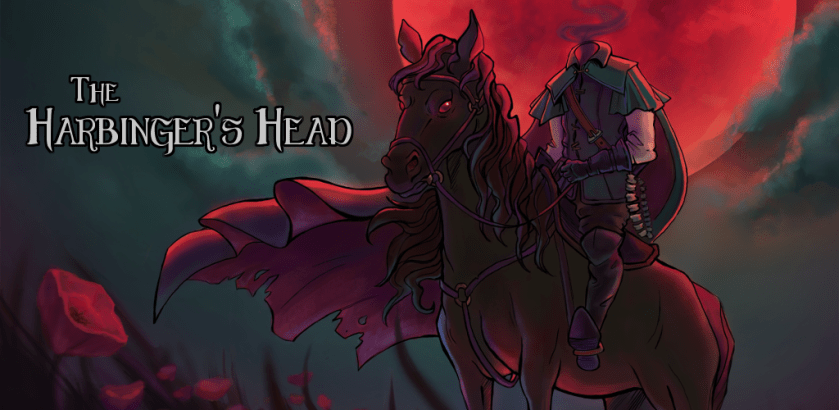
Harbingers Head promo landscape 01 final.png

The Harbinger’s Head is a fantasy horror story from Kim Berkley, in Choice of Games’ Hosted Games category.  It’s set in 1820s Ireland, in which the player encounters a supernatural creature — a kind of headless horseman character — and has to agree to help find his missing head.

The story that follows is focused on action and folklore. You’re partly collecting stories to try to piece together what has really happened in this supernatural situation, but there’s also quite a bit of violence, and one moment where it felt like my protagonist was implicitly under sexual threat, though this passed quickly. Descriptions often focus on the physical, and the game’s text doesn’t hesitate to tell you when you’re supposed to be feeling afraid.

The diction of The Harbinger’s Head sometimes feels substantially more modern than its period — there’s a reference to cutting and pasting something, for instance, and while both concepts individually certainly existed in the past, the paired idiom belongs to the computer age.

But for the most part it does deliver on the folkloric feel. There are several types of faerie creatures, but not your standard vampires and werewolves. Promises are made in desperation and redeemed in less than ideal circumstances. Old bonds of family come into play; so does the conflict between Church and Faerie (though fairly lightly, in the playthrough I experienced).

Continue reading “The Harbinger’s Head (Kim Berkley / Choice of Games Hosted)”

Wonderbook (Jeff Vandermeer)

wonWonderbook is a book about writing — not specific to games, but not unaware of games, either. It takes on many of the standard topics of general-purpose fiction writing guides — plot, character, world-building, revision, the life of the writer, how not to grow to hate yourself in this artform — but with an approach focused on speculative fiction, fantasy, and play. It’s also lavishly, vividly illustrated, with maps and diagrams, portraits and photographs, excerpts of medieval manuscripts, and quite a lot else. There are writing exercises, of several kinds. There are cartoon characters who introduce advice and tips. There are inserted essays and tips from other authors. There are reflections on the history of imaginative literature.

Also, Vandermeer is a good prose stylist, and this is something that cannot be said of all writers of writing books. (You might think…? But no.)

It’s the kind of book that will delight the curious and frustrate the conscientious — since there’s a perennial feeling one might be missing something as one reads. I read it with pleasure, and just a tiny bit of panic that I might be reading it incorrectly and missing things. To be clear, I think this is my problem and not the book’s.

Actually, the book calls me out on precisely this, in its way:

Inherent in this idea of “play” being immature and frivolous is the idea that just like business processes, all creative processes should be efficient, timely, linear, organized, and easily summarized.

Almost certainly there are some diagrams, sidebars, etc., that I did not fully digest before writing this review. I think the book considers that okay, though.
Continue reading “Wonderbook (Jeff Vandermeer)”

Zeppelin Adventure (Robin Johnson, Spring Thing 2018)

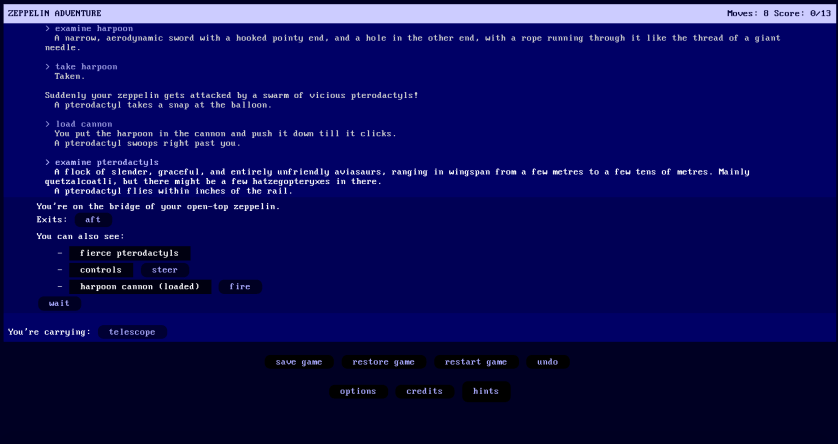
Screen Shot 2018-04-14 at 8.35.32 PM.png

Robin Johnson’s Versificator engine is designed to give the player access to a parser IF-like world model but a choice-based interface, free of verb-guessing. The two previous games in this space, Draculaland and Detectiveland, feature navigation and inventory puzzles that feel quite text adventure-like, but in a more accessible format.

At any given time, the player has quite a few choices available — usually one or several movements between rooms, as well as ways of examining or interacting with environmental objects, and then some things that you can do with your inventory items. But these aren’t listed all in one place; instead, choices associated with something in your inventory become visible only when you’re carrying that inventory item. So there are partially hidden options, and you do generally have to draw some connections yourself before being able to execute a puzzle solution.

zepellincover.jpgFeatured in Spring Thing 2018Zeppelin Adventure continues that tradition, set this time in a wacky-explorer universe where people are plotting out Mars from their giant balloons. Yours, however, suffers an accident and crash-lands on a planet dominated by robots, and you have to go on a quest to find repair parts for your engine.

As the cover art suggests, this is a pulpy kind of story that leans into certain genre conventions both present and historical.

Continue reading “Zeppelin Adventure (Robin Johnson, Spring Thing 2018)”

Life in a Northern Town (People + Places, Spring Thing 2018)

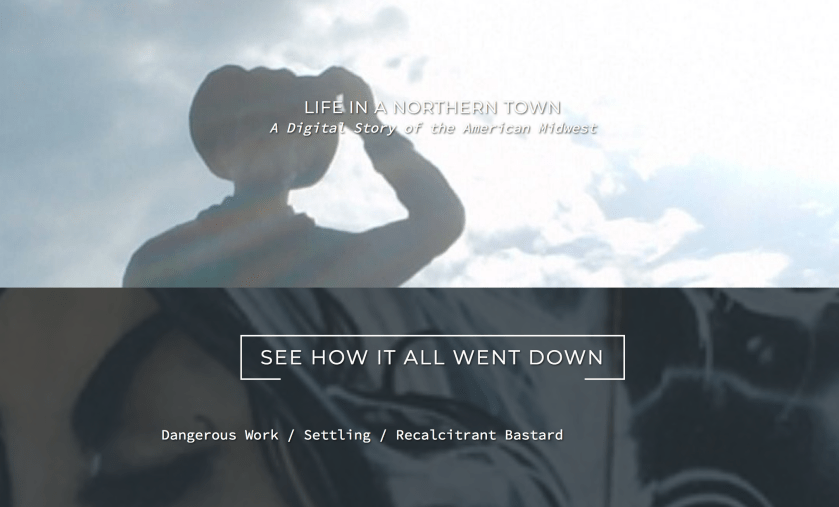
Screen Shot 2018-04-16 at 9.04.33 AM.png

From Spring Thing 2018, Life in a Northern Town is what sometimes gets called dynamic fiction as a subset of interactive fiction: a piece in which, for most characters, you’re never making a single choice that changes an outcome or modifies the shape of a narrative. (Brianna’s chapter, in inklewriter, is an exception: she has actual agency over who she chooses to engage with. But the vast, vast majority of this story is about people making dangerous decisions while the player has no opportunity to intervene or prevent them from doing so.)

For most of the elements, a majority of the clicks are click-to-continue options, and some of the sub-stories in the piece are presented in formats such as groups of images on Instagram, where branching would be very hard to arrange. Other elements are told in Twine or on WordPress, eight different people’s perspectives on the same story — though it’s not really trying for a mimetic effect here. It’s not ARG-ishly pretending to actually be the blogs of all these people. Here and there, images are included, especially on the Instagram segments, but elsewhere it’s almost all text, including the largest chunk of the story which is presented in unstyled Twine.

Still, it’s not the same story it would have been if it had been written into a book. The work of reading it is part of the point, for one thing. This is a story about labor, and the labor is recaptured in the way of reading.

For another, the dynamic-fiction presentation fractures the temporal sequence of scenes, especially in the Twine segments. Often there will be a short scene of dialogue between characters, and then clicking through a link will reveal another beat in the same conversation, another interaction, which might be chronologically before or after the first. It doesn’t really matter how they’re joined up, temporally. I never found this to be confusing. Rather, it gave me a sense that I was getting the overall impression of the interaction and then a couple of other key moments from that interaction, in the same way I might when going over a memory in my head. A handful of times the revealed secondary beat actually overturns the sense of the initial interaction.

So I can see reasons for the way it’s presented, but this is a long piece of work — took me some hours to read, and I’m a pretty fast reader — and by the end I would really have appreciated a more comfortable, less laborious reading experience. Other markers are missing, too: there aren’t chapter breaks, so sometimes the story ratchets forward to a new scene or location without an explicit division. There’s no progress indicator, either, which I really miss when I’ve got a multi-hour work on my hands.

Something like this stands or falls on the quality of its writing. In my initial encounter with the first of its linked stories, “Dangerous Work”, I was a little discouraged by the styling and structure — of course it’s not always the case, but standard, unformatted blue-and-white-on-black Twine sometimes goes with low-effort authoring. But I found myself continuing to read screen after screen, connecting with the luckless protagonist and her precarious life in and around Minneapolis.

Continue reading “Life in a Northern Town (People + Places, Spring Thing 2018)”