Several Interesting Projects

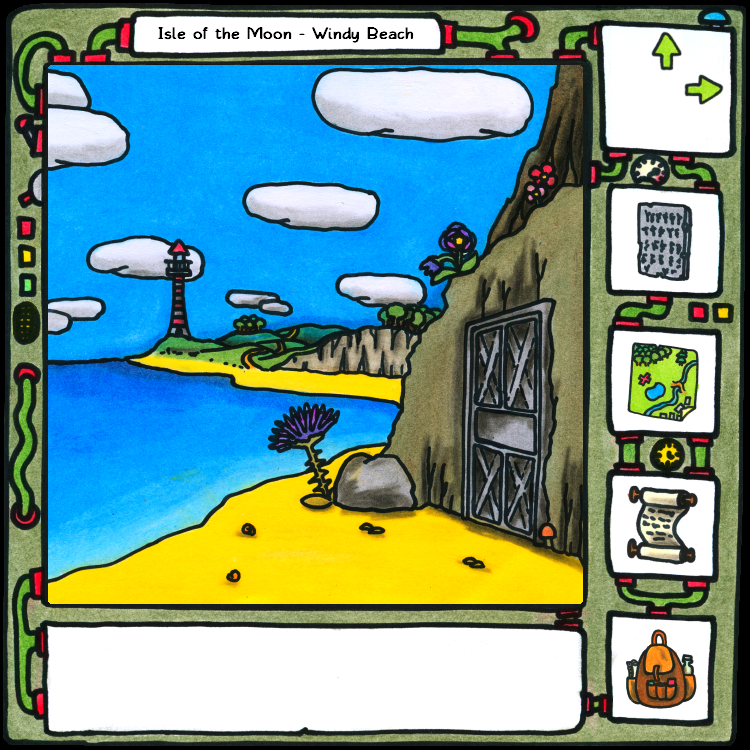
The Silver Tree is a new, Kickstarted project by the Failbetter people: it’s to be short and self-contained, and explore what happened to the 13th century Mongol city of Karakorum in the universe of Fallen London. Since I remain hugely fond of the Fallen London/Echo Bazaar universe and lore, I’m excited about getting a peek in at another piece of it, this time in a slightly more focused gameplay form. The project site has some preview art and an interview with Yazmeen Khan, who is doing the writing.

I not-very-secretly hope this represents a successful approach for Failbetter, as I am not crazy about the way Fallen London generates revenue (make gameplay grindy, then charge players micro-amounts to make it go faster). I would much rather see stories funded through direct purchase and/or prefunding. It’s been a very successful campaign, which is encouraging. Also, they’re offering one of my all time favorite types of backer reward, a deck of custom cards. I am a total sucker for those for some reason.

Dominique Pamplemousse in “It’s All Over Once the Fat Lady Sings!” is a stop-motion musical adventure by Deirdra Kiai (The Play, Life Flashes By, assorted other projects). The whole concept is pleasingly off the beaten path.

Finally, if you’re interested in what Chris Crawford is doing these days, he also has a project on Kickstarter, a Balance of the Planet simulator that asks you to set tax prices for various types of pollution and then calculates a final score based on 58 years of result. It’s a curiously uninteractive experience, in that you set some sliders and then wait to see what happens (or, alternatively, read through the many pages of explanatory articles on different environmental factors).

Chris’ own description suggests that this is meant to be a forensic experience: run the simulator, then stare at the graphs to work out what went wrong, then try again. And you can, indeed, backtrack a bit through the graphs, breaking them down into components and checking out the things that contributed to those components and so on, in a way that is much more in-your-face about numbers than, say, Electrocity or some of the other educational or persuasive energy-policy games I’ve looked at in the past: it’s trying to make the argument quantitatively and crunchily.

And it’s quite hard to get things to balance, so I come away thinking, “hrm, we’re all dooooomed,” not “here’s how to save the planet.” (Except that I also don’t buy some of the game’s premises, such as the baked-in assumption that whatever taxes we set in year 1 we then cannot change at all for the next decades, other than to phase them in gradually.)

All that said, I like the concept of mathematically rigorous simulations to teach these problems; I also like the implication that the player will be able to experiment with different assumptions about the world model. I do wish that there were a more appealing front end and that the challenges were taught gradually, however.

The Act

The Act is a very unusual arcade game I’ve been hearing about for years but until recently had never gotten a chance to play. The player has a single dial, which she can use to move the body language of the main character along a spectrum. Typically (though not always) that spectrum runs from Bashful Dope to Hardened Pickup Artist. The gameplay centers on getting the character to moderate his behavior appropriately in a number of social situations, but especially when flirting: don’t come on too strong at first, but don’t be too slow to pick up cues. Get the interplay just right, and you can complete the scene and move on.

Given that even such supposed interactive narrative stars as Heavy Rain have characters who routinely walk into walls, the idea of a game that was pretty much entirely about reading and responding to body language intrigued me. (L.A. Noire tries that too, of course, but in a very different way.)

And now that The Act is out for iOS, I finally got a chance to play.

Continue reading “The Act”

Bundle In A Box – Adventure Bundle

Out today at bundle-in-a-box.com is a very reasonably-priced bundle of adventure games, both graphical and text, including new work by Jonas Kyratzes (screenshot above). Konstantinos Dimopoulos explains:

We will exclusively debut the whimsical The Sea Will Claim Everything by Jonas Kyratzes and offer six more games: Gemini Rue, Metal Dead, The Shivah, Ben There, Dan That!, Time Gentlemen, Please! and – for the first time ever – the downloadable version of 1893: A World’s Fair Mystery text-adventure (previously only available as a physical product). Yes, we are indeed hoping to further fuel the current Adventure Game Renaissance!

While I haven’t played the graphical games in this collection, I’ve heard great things about The Shivah and Time Gentlemen, Please!. 1893 remains one of the most extensive settings ever offered in text adventure form, a meticulous historical recreation that is engaging to explore whether or not you choose to engage with the plot and puzzles.

Pricing for the Bundle In a Box follows the pay-what-you-want model with a low minimum; proceeds go to establishing an indie dev grant fund and to charity.

A Small Roundup of Interesting Things

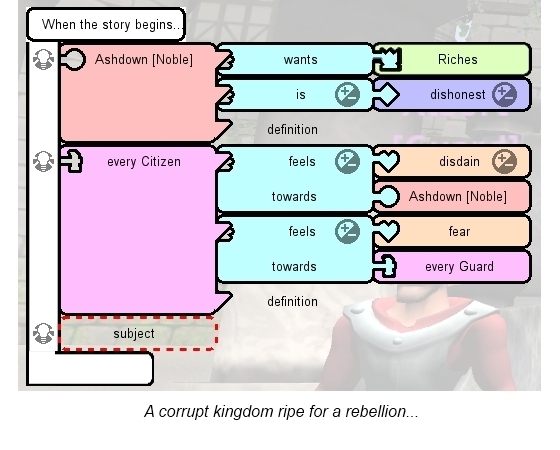
Storybricks, now fundraising on Kickstarter, is an AI project to allow users to create generated stories in an MMO environment. The project provides an authoring tool for establishing characters’ desires, relationships, moods, and basic conversation:

The engine then brings the results to life within a 3D fantasy kingdom. The Storybricks team has posted a public demo that you can try out for yourself.

Playfic, Andy Baio and Cooper McHatton’s website for playing and writing Inform games online, has had a successful three months, with hundreds of new games posted and (collectively) around 85,000 play sessions. Now Playfic has added the ability (crucial, in my opinion) for authors to include extensions from Inform’s extension site, meaning that supported games can be more complex and make use of a wide range of pre-existing tools.

Cover Stories is a minicomp pairing artists and authors of interactive fiction. The first phase (now over) collected dozens of pieces of cover art; during the second phase (now running), authors may select one of the submissions and write a short game suitable for that cover. There are still some cool images unclaimed. Rules and details may be found here.

GDC 2012 Talk on Dynamic Dialogue

One of the more interesting GDC talks I saw was a Friday afternoon presentation by Elan Ruskin, talking about how dialogue snippets are matched to a continually changing world state in Left 4 Dead 2 and other Valve games.

It’s a neat rule-based system, designed to meet a couple of specific important requirements: easy for the writers to author a lot of content, responsive to a wide variety of different situations (what if we want a character to have a special quip if attacked while in the circus environment as opposed to elsewhere?), interruptible (characters should be able to exchange quips, but should sensibly break off if one of them comes under attack). Like Inform, it prioritizes rules and applies the most specific one it can find, using less-specific ones as fall-backs.

The resulting system is very well tuned to the specific case of having NPC dialogue that’s highly reactive. Characters aren’t planning or trying to achieve goals via dialogue, but they present a strong illusion of situational awareness, which is what those games require. (And there’s often a place for purely reactive NPC quips in IF, too.)

The talk also goes over a number of optimization strategies for speeding the lookup on these sorts of tasks, and argues for the importance of making tools that writers find comfortable to use. Solid stuff, both technically and in terms of project planning.

Elan has posted the slides and video here.

(Bonus: there’s a shout-out to Inform in the middle.)

Games from GDC 2012

This year’s GDC brought me in contact with a wide range of really interesting games, demonstrating the incredible spectrum of what games are good at and for: not just frustration, fear, exploration, and adrenal rushes, but many stranger and more nuanced emotional reactions.

Here are some highlights of many different types, several from the IGF Expo floor and others from other encounters:

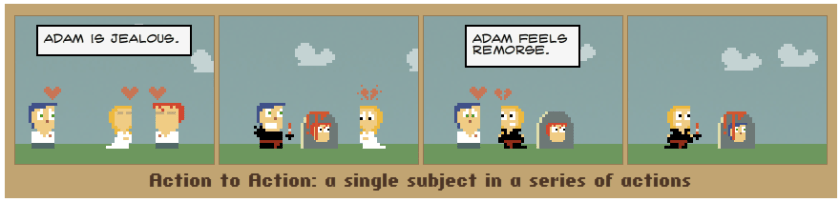
Storyteller by Dan Benmergui is an expansion of an earlier work of the same name (that I actually reviewed long ago). The winner of the 2012 IGF Nuovo award, Storyteller is a puzzle game whose mechanic is essentially about understanding the rules of comics, in good Scott McCloud style.

Continue reading “Games from GDC 2012”