Hi Emily, I appreciate the content you create to further the IF community.
I’m curious what games or platforms stand out to solve some of the issues you listed in your parser article 9 [years] ago.
I’d like to create a text heavy game with detailed world state and want to research the projects that handle these situations the best. Specifically UI driven interaction from the player.
[I then asked for confirmation that the writer would like to see this handled as a mailbag post.]:
I’d love to see a follow up on how you feel things have changed. From the perspective of a “traditional” game developer IF seems stuck in an award state [sic] of being too gamey for readers and not enough mechanics for gamers. It’s a hard problem to solve as most people aren’t writers, programmers and designers , that’s a lot of skill sets to tackle.
I’m not quite sure what “an award state” is, but maybe “an awkward state”? I disagree, though. “Not enough mechanics for gamers” or not, games from 80 Days to Choices and Episode to the works of Choice of Games to Failbetter’s entire oeuvre are making enough money and attracting enough attention to support quite a few small to medium studios. And that doesn’t touch on the audio IF, the visual novels, the interactive film, etc., etc., etc. Interactive fiction, broadly drawn, is doing fine. And I know quite a lot of traditional game developers who think so, too.
But okay, let’s set aside that part of the question. The question is about how to do UI for a game with a lot of world state and a lot of text, but without a parser.
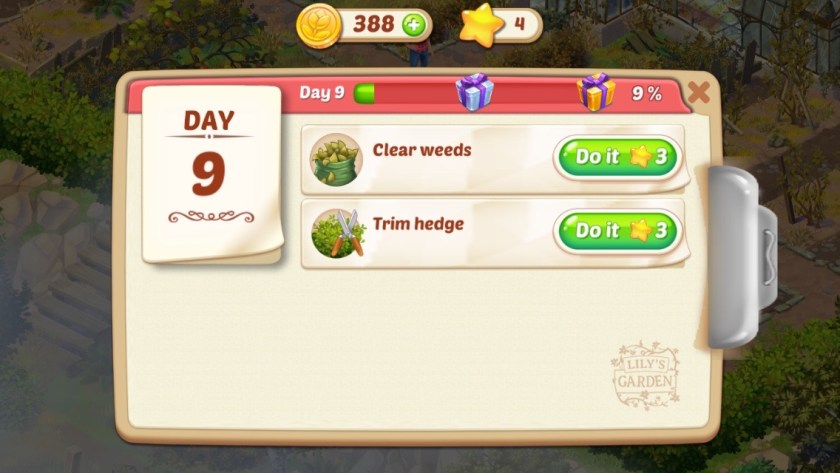
Lily’s Garden is here offering us two storylets: the story about clearing weeds and the story about trimming the hedge. Despite how it might appear, there’s actually some character and narrative advancement associated with each of these options.
A very simple implementation looks like this, interspersing every level with a little bit of story wrapper. This has been a standard method from the days of Diner Dash on:
Gating story with casual game levels
Lily’s Garden does something actually a little different, which is to let you gather “stars” by playing levels and then spend them to open more storylets. The “source” in the image below is the casual gameplay. Often, there are two or three storylets available at a time, which means you can choose which of them to play next, but you do have to finish all of the storylets assigned to a given day before moving on.
This is an effective design choice for mobile free-to-play, for several reasons.
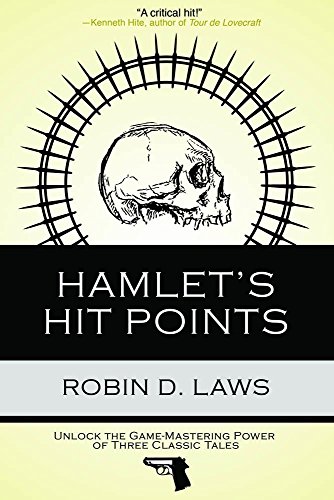
Hamlet’s Hit Points breaks down classic storylines into structures that can be deployed in tabletop (and sometimes digital) RPGs.
Hamlet’s Hit Points has been recommended to me a number of times by people with experience in RPGs, narrative, or systems design. Since I’ve recently been thinking and writing more about the stats-and-point-assignment aspects of narrative design, I came back to the recommendation this month. (It’s available as a physical book from various places including Amazon, but forvariousreasons I’m linking to Amazon less. You can get the book as downloadable content for $8 from DriveThruRPG, so that’s what I’ve linked.)
Hamlet’s Hit Points starts by acknowledging the influence of Hollywood writing guides of the kind I’ve sometimes covered here, and then offers its own kind of structural analysis of story beats, intended to cover both conventional narratives and RPGs. (The book is focused on tabletop RPGs with a human game master.)
Failbetter is a company very close to my heart: I’ve written for them many times as a freelancer over the past decade, and they provided key assistance when I was starting the Oxford/London IF Meetup. I have great respect for their focus on quality prose and storytelling, as well as their pioneering work exploring what storylet-driven narrative design can do.
I have a certain amount of freelance work ongoing from the past couple of months, with FBG’s blessing; and will have some pre-defined bandwidth to keep my hand in consulting. So if you see me out and around doing a few other things, that’s why.
I’m very excited to be on this team, and looking forward to what we build together!
There will be a London IF Meetup in late January, where I will be talking about narrative design with storylets; time and venue are TBD, but I will announce them via the London IF Meetup page when these are settled.
January 31–Feb 3, Ryan Veeder is running the first of three events in his Exposition for Good Interactive Fiction. This one is a short jam for Inform 7 games. There are a number of rules about how to participate, so please do check out the fine print.
February 15-16, Rob Sherman is running an interactive fiction masterclass at the British library. This is a paying event; tickets here.
The NarraScope organizers have announced that there will be a NarraScope 2020: specifically, May 29-31, in Urbana-Champaign, Illinois. Call for talks is here and the deadline for proposals is January 17.
Last year was the inaugural year for this conference, focused on narrative games from classic IF and text adventures through point-and-click adventures to VR games, interactive audio, and mobile story games, TTRPGs and LARP, and quite a bit more. Meanwhile, if you missed this year’s event, or would just like to revisit its glories, there is a new podcast, Through the NarraScope, that discusses some of the talks and content.
Competitions
If you plan to enter Spring Thing 2020, you have until March 1, 2020 to declare your intent to enter. Spring Thing is a long-running competition for interactive fiction that welcomes longer games than IF Comp can accommodate, and features a “back garden” section for games that are unfinished, commercial, experimental, or where the author just wants to opt out of the competitive aspect of the competition.
Meanwhile, Ryan Veeder’s Exposition for Good Interactive Fiction will be taking place in early 2020, in the form of three different events for different formats and lengths of game. The rules for this are fairly complex, so rather than trying to summarize, I will just point you in the direction of Ryan’s pages.
This is an overview of the IF games that worked best or meant most to me in 2019, plus a couple of bonus games that weren’t released this year but that it took me this long to play. There’s a range here — some of these are short, some are long, some choice-based, some not, some commercial and some otherwise.
I didn’t have nearly time to play everything that I might have wished to: it was a very busy year with a few especially wild months. So I didn’t play very many of the IF Comp games, or any of the EctoComp pieces, or many recent releases from Choice of Games.
I played two striking pieces by Porpentine Charity Heartscape this year.
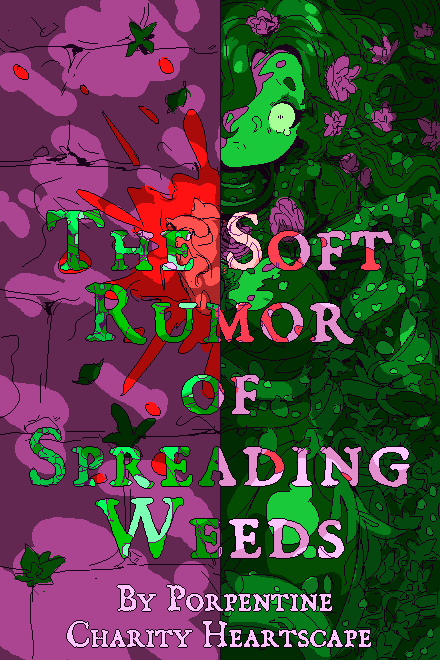
One is available to the general public: The Soft Rumor of Spreading Weeds, a companion piece to With Those We Love Alive, published by Sub-Q. This one explores what it means to be the Empress in this universe; what sort of life she has; what her cruelty tastes like.
The other was a multi-player piece, created specifically to be the keynote of an event: organized by Karlien van den Beukel, and presented to the public at the Victoria & Albert Museum in February. I was in the unique position of presenting the work — a role for which Porpentine had written specific instructions and extra text — and I talked a bit on Twitter about what it was like and how it worked. It would be impossible to capture the experience entirely in another medium or context, but this was one of the more interesting IF experiences in my life, and certainly one of the most interesting multiplayer works.
Storyscape is an app for free-to-play IF on mobile. There are a lot of these out in the world: Choices and Episode have been around for a long time, and have been followed by lots of other apps of varying degrees of quality and imagination, including Fictions, Story, Chapters (Choose Your Romance), Moments, and My High School Summer Party, among others.
In this landscape, substantially the best piece I tried was Titanic in the Storyscape app. I have not yet played all the way to the end of the storyline, but the premise and the first several episodes are by Meghna Jayanth, and they are top-quality work. Expect very non-standard characters; a setting that feels well-researched but never pedantic or onerous; and many many fun choices. Highly recommended.
The Ballroom by Liza Daly tells its story through text that morphs as you change elements of the scenario — becoming by turns a Regency romance, a high school dance scenario, a spy thriller or a police story. It’s an elegant use of textual variation that draws on the legacy of works like Space under the Window. One of the most formally inventive pieces I played this year.
Pray to Your God(s) is a short Twine piece by Vian Nguyen. It describes an act of prayer in the author’s tradition and culture, with autobiographical details that bind it to Vian’s lived experience; but it also provides opportunities for the player to decide how they would engage with this type of ritual themselves, and asks what they might say to the departed.
Dull Grey, by Provodnik Games. Dull Grey presents the story of a young man who is deciding between two possible careers, in a state dominated by Soviet-style centralized planning.
The story presents vignettes, and then, from time to time, offers a choice — the same choice each time — about which career he would like to pursue. It is essentially an entire game that consists of one big Track Switching Choice structure. There is also a little more possibility than the game initially makes obvious.
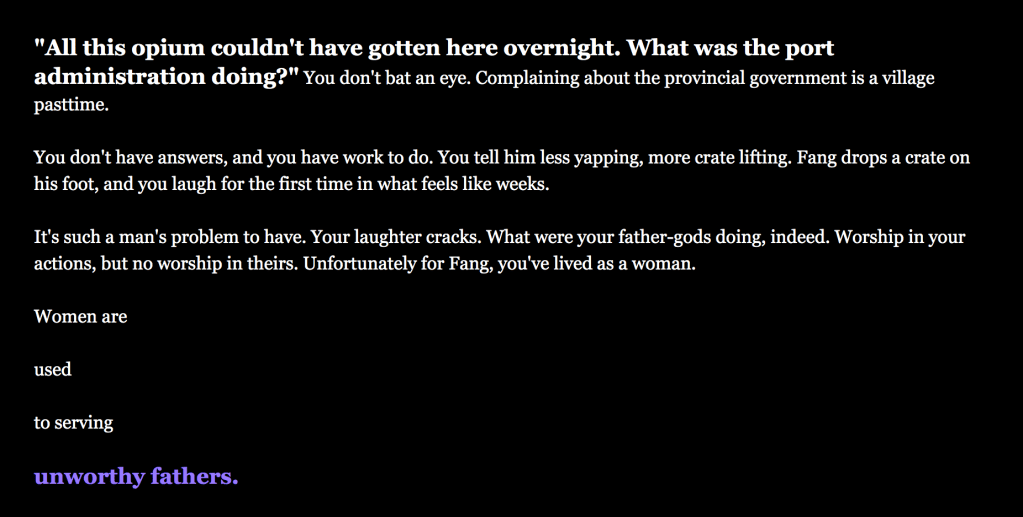
Sisi Jiang’s Lionkiller is set in China during the First Opium War. It tells the story of a woman who disguises herself as a man and becomes a soldier, riffing on the legend of Mulan. The characters are nuanced, the setting rich in detail. There is also a lesbian romance arc, at least in some versions of play.
One of the stronger pieces of IF writing I’ve encountered this year, and very much recommended.
Turandot, Victor Gijsbers. This is a ChoiceScript game but very different from anything that would appear under a Choice of Games branding: largely linear with minimal branches and no visible use of stats, it draws its inspiration loosely from Puccini’s opera of the same name, but entirely revises the plot, so that the titular princess requires Prince Calaf to traverse a death-trap-filled dungeon in the spirit of classic games (a bit as spoofed in Inhumane).
Turandot drops in quite a few references to classic IF and sometimes wanders into gratuitous in-joke territory, but the actual concerns of the piece — about agency and consent, about our responsibility for the situations into which we place other people, about the value of truth and the possibility of atonement from a position of monstrosity — are anything but frivolous, and can be read even by players not familiar with the source materials.
That said, I need to put a warning on this. There are also times when the game’s characters make mean-spirited sexist, racist, and homophobic jokes; and some descriptions of torture and incidents of dubiously consensual sex. Personally I found that the philosophical and moral argument in play made a good case for why I should encounter these objectionable elements. I know other people for whom that wasn’t the case. And I can also understand why one might not want to be exposed to those elements regardless of their reason for existing.
So handle with care.
Bonus game:
I finally got around to playing SPY INTRIGUE (furkle) properly this year. It was an amazing experience and I recommend you check it out if you haven’t gotten to it yet. My review will give you some idea of what to expect from it.






 Emily Short's Interactive Storytelling