Signs of the Sojourner (Alpha, Crowdfunding)

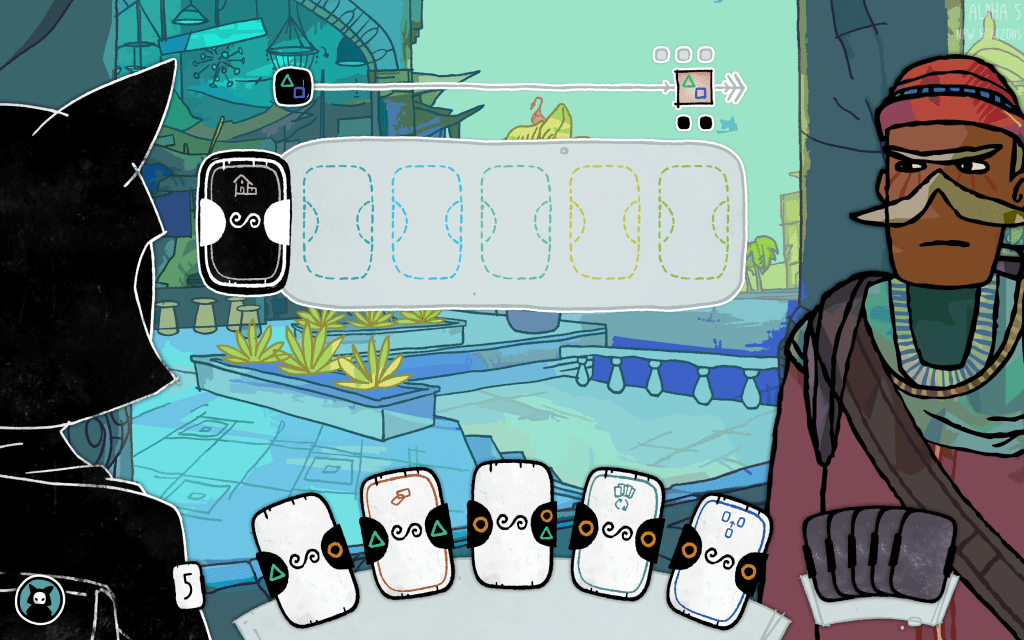
Signs of the Sojourner is an IF-friendly work with a beautifully expressive conversation mechanic that focuses on our resources and style of interaction rather than specifics of dialogue choice.

Play through conversations by deciding how to follow your partner’s lead.

Signs of the Sojourner is a conversational deck-building game by the small indie studio Echodog, currently crowdfunding on Indiegogo and featuring writing by the excellent Kevin Snow. A polished, substantial demo is available on itch.io.

In short: I saw Kevin Snow’s pitch about this game and thought, neat, any game with Kevin’s writing is worth a look. Then I paid a couple dollars to download the demo from itch — you can of course get it for free, but it seemed polite. Then I played the demo through from start to finish, twice, getting significantly different experiences in the two playthroughs.

When I got to the end of the second play, I was having so much fun that I really felt quite sulky about the fact that this was just a demo and that I can’t play the full game until later.

Since I really want the full game to exist in maximum glory, I backed it and then came over here to tell you about why it’s cool. And as I wrote up this post, I needed a few more screenshots and wound up replaying almost all of the alpha for a third time because I was still having fun and discovering some new things about how the mechanics worked.

Continue reading “Signs of the Sojourner (Alpha, Crowdfunding)”
Patchwork Girl (Shelley Jackson) and Spatial Hypertext

Reading Shelley Jackson’s classic 1995 hypertext, from the perspective of the present. Part of a series on literary hypertext.

This is part of an ongoing series of posts looking back at literary hypertext of the 90s and early 2000s, considering both example texts and contemporary scholarship and theory. Here we look at the concept of spatial hypertext.


The move from document-centered hypertext systems to map-based hypertext systems had some unforeseen but far-reaching implications: relationships between nodes could be expressed in more than one way. Maps showed interconnectedness explicitly, usually in the form of a directed graph. But also node proximity came into play; relationships among different nodes or documents could be indicated simply on the basis of their relative location. The use of these map-based hypertext systems to author new information spaces uncovered an interesting phenomenon. Users avoided the explicit linking mechanisms in favor of the more implicit expression of relationships through spatial proximity and visual attributes…

Spatial Hypertext: An Alternative to Navigational and Semantic Links, Frank M. Shipman, III and Catherine C. Marshall, ACM Computing Surveys 31(4), 1999.

“Spatial hypertext,” in this context, does not refer to pieces that map sections of text to a physical geography. There’s a fair amount of that in modern interactive fiction, perhaps because of the cross-pollination of ideas with parser IF. Reed Underwood even wrote an article for Killscreen about spatial hypertext that does use that phrase to mean “hypertext that represents a concrete physical space.”

Here, however, we’re using the older sense: hypertext where the connections between sections are visually represented to the reader in a kind of mindmap construction. Sometimes that mindmap might happen to resemble an object or physical location, but it might just as easily have some entirely different shape, conveying an entirely different kind of relationship between elements. Clicking on different nodes of the map navigates the reader to new contents.

On the screen, spatial hypertext can look a little like a shape poem, except that the blocks themselves contain significant amounts of text, or additional block arrangements of their own. Here is Shelley Jackson’s Patchwork Girl, published in 1995:

The cover of Patchwork Girl, its arrangement of text clusters laid out like an anchor.
Continue reading “Patchwork Girl (Shelley Jackson) and Spatial Hypertext”

Mid-September Link Assortment

Events

September 17 is the next meeting of the People’s Republic of IF at MIT, for those in the Boston/Cambridge area. The website here also features notes from previous meetups.

The 20th annual European GAME-ON® Conference on Simulation and AI in Computer Games is September 18-20 in Breda, The Netherlands.

September 25, the London IF Meetup has a 7 PM talk on interactive and immersive theatre and LARP projects. This will be a densely-packed session with four speakers, talking about work by Fire Hazard Games, Coney and Venice as a Dolphin, and Crooked House.

IF Comp begins properly at the beginning of October, and is still accepting donations to the Colossal Fund as well as donations of prizes of other types.

October 5 is the next meeting of the SF Bay IF Meetup.

October 12, the London IF Meetup gets together to play IF Comp games, starting with contributions created by our own members. We play for much of the afternoon, with someone reading the text and someone else driving interaction, while the audience participates by voting for what we do next. We sometimes get through five games or more in the play time, meaning that participants have played enough to vote in the Comp if they wish.

Indiecade Festival will be in October in Santa Monica, CA.

Ectocomp will be running again this year, with submissions opening October 27, if you’d like to contribute a piece of spooky interactive fiction.

AdventureX runs November 2 and 3 at the British Library — I think it’s already sold out, however, so if you’re attending, you probably already know that.

November 7-8 is Code Mesh 2019 in London.  The conference focuses on promoting useful non-mainstream technologies to the software industry.

Articles

Sam Ashwell on how to write a good blurb for a comp game, which may be relevant to a number of people around now.

Chris Martens and Owais Iqbal on Villanelle, a research language for authoring autonomous characters in IF.

Mailbag: Pedagogical Uses of IF in the Classroom

Pardon, may I ask for some suggestions of resources (articles, short essays) about Interactive Fiction in classrooms? Thank you very much.

And then when I asked whether they were looking for IF taught as the subject or as a means to learning other things:

Surely I’m interested in IF used as a pedagogical tool, as broad as possible (in terms of grades, subjects, case history). An introductory (and inspiring!) blog post would be very useful. Thank you!

Interactive fiction has a long history of classroom use at most levels (a little bit of elementary-level use, but then more in middle school, high school, and university teaching). Several researchers have built syllabus materials that make extensive use of IF; have published about IF-related pedagogy; or have given talks and workshops about how to teach using interactive fiction. At NarraScope, for instance, there were some workshops on this topic as well as a panel on IF and education.

I haven’t done much hands-on work with this myself, but here are some links that may be useful in this area:

Continue reading “Mailbag: Pedagogical Uses of IF in the Classroom”

The Cambridge Introduction to Narrative (H. Porter Abbott) – Chapters 10-14

The Cambridge Introduction to Narrative is a book I’ve been chewing on now for several months, since it raises a number of issues about how to describe and think about narration but doesn’t (except occasionally and briefly) attempt to apply those terms or concepts to interactive literature. So this series has become less anything resembling a review than a set of responses and observations; although I am still trying to summarize the contents just enough that someone who might not want to read the whole book could come away with a clear sense of its subject matter and purpose.

Continue reading “The Cambridge Introduction to Narrative (H. Porter Abbott) – Chapters 10-14”

End of August Link Assortment

Events

September 1 is the deadline if you want to submit an intent to enter IF Comp 2019. (That’s tomorrow!)

PAX West in Seattle features a panel September 2 about building an interactive fiction portfolio and becoming a paid IF author.

September 7 is the next meeting of the SF Bay area IF Meetup.

September 14 is Boston FIG, or festival of indie games, held at Harvard.

Also September 14, the Baltimore/DC IF meetup gets together to discuss Hanon Ondricek’s Cannery Vale.

The 20th annual European GAME-ON® Conference on Simulation and AI in Computer Games is September 18-20 in Breda, The Netherlands.

September 25 is the next meeting of the London IF Meetup, and we will be hearing about live-action interactive narrative experiences including immersive theatre and LARP from several amazing speakers.

Indiecade Festival will be in October in Santa Monica, CA.

New Releases

Greg Boettcher has released an illustrated parser game that debuted in IntroComp 2006. It is now, at last, available from his website, and for a limited time you can also make a charitable donation and receive some feelies as a reward.

Sam Barlow’s Telling Lies is now out, a new FMV/exploration story that is not a sequel but perhaps a conceptual heir to Her Story.

Community and Volunteer Things

Sofia Kitromili is looking to interview IF authors about their experiences creating games and using IF tools. You can contact her any time in the next several months if you would like to speak to her and contribute to her doctoral research.

The Colossal Fundraiser is now raising money for prizes for this year’s IF Comp, as well as to cover the IF Technology Foundation’s other needs and overhead for the year. IFTF supports the IF Archive and other community technology, preserves interactive fiction work and tools that might otherwise be abandoned, and leads accessibility and education initiatives to improve the IF community’s resources.