Postmortems (Raph Koster)

postmortemsRaph Koster’s Postmortems is a series of essays and talks about his work. That work includes online RPGs and MUDs, including some with a story focus perhaps relevant to people on this blog. (Actually, this book is just Volume One, with more volumes to come — but accordingly, it speaks about some of Koster’s earliest work, which is the material that probably dovetails the most with the interests of IF enthusiasts.)

Koster offers an introduction to MUDs that launches from Adventure, but explains the differences about playing such a game with others. There’s a good bit of design narrative and history here about those games — which may well be interesting to readers of this blog, as they’re adjacent to IF. I especially enjoyed reading the (plentiful) examples of MUD scripting, for comparison with how early IF languages worked. There are also detailed descriptions of quests and experiences that would now be difficult or impossible to recapture, such as a “Beowulf” quest from LegendMUD.

I found some of these passages a little dizzying, in a good way: they offered me a glance at an alternate universe of text-based, narrative-studded games, ones that are rarely discussed in the context of the IF canon. By which I mean: I probably should have known about a lot of this all along. (But there are so many things I should have known all along.)

At any rate, I recommend it for people who are interested in the history of games-adjacent-to-IF.

*

Postmortems is also a book about what it’s like to be in a games career, to care about and love games, to think about and with games. The first essay is about Koster’s childhood game writing, as a kid in Peru, and how he grew up from there. It’s illustrated with sketches from the game concepts of his youth. He writes about games he wrote as gifts and as messages to people close to him: another practice I value.

Because the book is drawing from such diverse sources — talks, written work, pieces created as retrospectives and other pieces written at the same time as the games themselves, some articles that include sample code and others meant for very non-technical audiences — it’s quite a varied read. But that is also part of the book’s charm.

*

I’ve written about Raph’s Theory of Fun for Game Design in the past.

Disclosure: I received a free PDF advance review copy of this book for the purposes of coverage.

End of June Link Assortment

The July 4 meeting of the Oxford/London IF Meetup will feature Leigh Alexander presenting on the narrative design process of Reigns: Her Majesty. We will start the session by playing through a bit of the game, so please do feel free to come even if you’re not familiar with it.

(And can I just say how pleased I am with this method of celebrating Independence Day, by hanging out in London with other expats playing a game about being a queen.)

July 6 is the deadline to send your intent to participate in Cragne Manor, an Anchorhead tribute game with rooms written by different authors, and organized by Ryan Veeder and Jenni Polodna. There’s more about this project on the intfiction forum. Contributions are to consist either of Inform 7 code or of detailed specifications for something to be rendered in Inform 7.

Collaboratively authored IF projects have a long history, from Shades of Gray to Coke is It! and the Textfire 12-pack to IF Whispers and Alabaster to the Apollo 18 tribute album. This particular one sounds like it strikes a nice balance of organization and chaos, so I’m looking forward to seeing where it goes.

July 7 is the next Meetup of the SF Bay IF group.

July 19 is the next meeting of the Boston/Cambridge PR-IF.

July 21st, 3-5 p.m. at Mad City Coffee in Columbia, the Baltimore/DC group meets to discuss The Wand.

July 31st in Canterbury (UK) there is a session on how to build escape rooms for libraries.

Gothic Novel Jam is a jam for games or works inspired by the gothic novel in any fashion, and is running throughout July. IF and related narrative games are welcome.

Screen Shot 2018-06-10 at 4.20.43 PM.pngIntroComp is now accepting intents to enter. IntroComp is a competition in which you can submit just an excerpt of an unfinished interactive fiction game, and receive feedback from players about what they liked or didn’t like about it. If you’d like to participate as an author, register with the site immediately (this closes June 30, so today). Games themselves must be submitted by July 31 and judging will occur during August.

Now through August 2, the Future of Storytelling Prize is seeking submissions of interactive storytelling work. The prize is $10,000 and exhibition at the FoST Summit in October. There are two other things I feel I should mention here:

  1. I would not expect this prize to go to something primarily text-based.
  2. One of the categories of prize is for “works that foster empathy” (okay!), funded by the Charles Koch Foundation (…hm.) Considering the Koch brothers’ political involvement, I myself would want to look into that point a little further if I were considering applying for the prize, but your mileage may vary. So, FYI, reader, this is a thing that exists, and those are the connections that go with it.

Screen Shot 2018-06-10 at 4.21.24 PM.png

This is well in advance, but November 10-11, AdventureX will return, this time at the British Library. AdventureX is a conference focused on narrative rich games, whether those are mobile or desktop, text-based or graphical; it’s grown significantly in size and professionalism over the last couple of years, and last year pretty definitively outgrew its previous venue. The way to get tickets in advance is to back the Kickstarter [ETA: The Kickstarter places are all sold, but see the comments on other ways to get in.]

Releases

rentavice.pngRent-a-Vice is a Choice of Games story by Natalia Theodoridou, also known for her shorter interactive fiction published on Sub-Q. Described as “cyberpunk-noir mystery”:

You’re a private investigator with a bad habit, an ex, and mountains of debt–troubles so deep that you stand to lose custody of your kid. When a mysterious client asks for your help finding their missing lover in the seamy world of virtual experience, it’s up to you to gather evidence, experience the technology for yourself, and solve the case.

There’s an author interview here as well.

Continue reading “End of June Link Assortment”

Lonely Men Club (Mike Kleine)

LLMMCC1.jpgLonely Men Club is a book by Mike Kleine (@thefancymike), running to exactly 100,000 words and constructed in a five day period via procedural generation. In that respect, it belongs to the same conceptual category as NaNoGenMo projects, or text-focused works from ProcJAM, or Annals of the Parrigues. He references Cortazar’s Hopscotch and Nick Montfort’s World Clock as influences.

Lonely Men Club represents the thoughts of (a fictionalized version of) the Zodiac Killer. These thoughts concern what he read, bills he received, the color of the sky, his bodily functions, the people he killed. A sentence such as “Killed a foreign woman in Mississippi” sits near “Went to the restroom for seventeen minutes”, and neither of these is more important to the narrator.

This sense of repetition, unpredictability and incoherence, and the lack of discrimination between subjects, are Kleine’s desired and intended outcome, so much so that he’s needed a generator to achieve it. There are typos, I believe intentionally. Sometimes words are jammed together without spaces to create new compounds.

This is a text that is playing with cadence, though individual units of coherent meaning are larger than in Allison Parrish’s Articulations. The latter fixates on a single phrase at a time, often repeating it many times in a single sentence, using that repetition to cluster together all the ideas that might be linked by the word “ever”, for instance:

Forever and amen. And ever. Amen. Every man and every maid never a man and never a maid every woman, every man, every woman, every maid: every morn and every night every morning and every night every night and every morning, in every note and every line for in every line, and in every verse and every limb, and every nerve of every virgin element, — never, never believe never, believe me, and ever believe.

…whereas in Kleine’s grammar the repetitions are less insistent, and individual sentences less impressionistic.

Even the layout of the text on the page, with smudges and imperfections, not to mention variant type sizes, is both an reference to the Zodiac’s ciphers and an accidental (but embraced) result of the process of generating, cutting, and pasting text. Sometimes the text in Lonely Men Club is inverted, white on black. Sometimes it’s scrunched, or in landscape rather than portrait orientation, or falling askew on the page, in a way that reminded me of the dynamic text manipulation of Liza Daly’s A Physical Book project. Sometimes a paragraph simply runs off the page’s edge, losing all the words on the right side.

Continue reading “Lonely Men Club (Mike Kleine)”

Parrigues Tarot (draft)

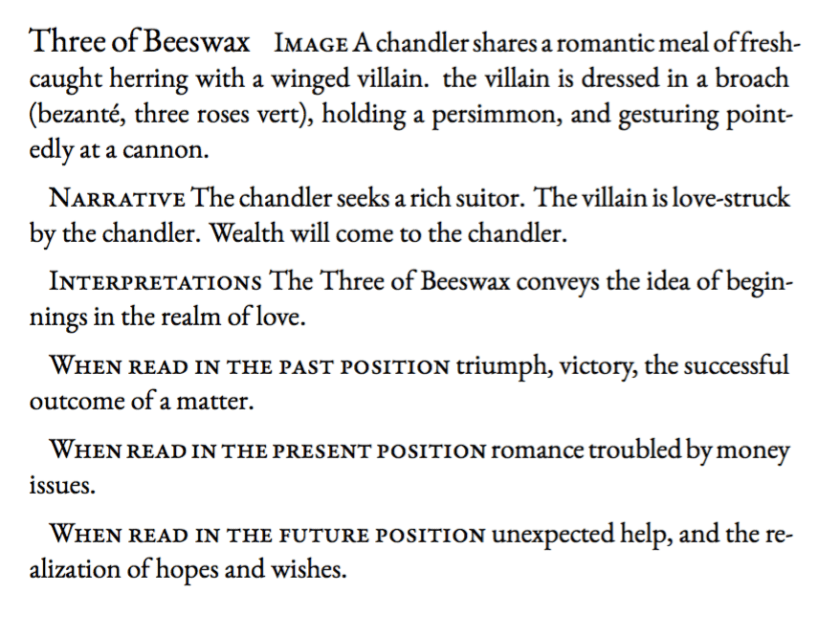
I’ve tweeted a bunch about this project, but talked about it less on my blog: for a while I’ve been working on a followup to Annals of the Parrigues called Parrigues Tarot, a system that generates tarot card descriptions like these:

Screen Shot 2018-06-27 at 12.53.28 AM.png

Though it might seem similar, this was actually a much more difficult and extensive project than Annals of the Parrigues, for several reasons.

First, it’s doing more work with narrative arcs. Many (though not all) cards are built around the idea that the protagonist wants something and takes some action to try to achieve it (or else fears something and takes action to try to avoid it). The chosen action either succeeds or fails, with some results.

Not all of that story has to be represented explicitly in the card description: indeed, the fact that these are nominally descriptions of static images was a little limiting, because I tried to only describe things where an action and its consequence could be pretty clearly implied visually. Meanwhile, sometimes the story can include additional information — why does the protagonist need money in the first place, for instance? But centering the story generation on an action and a desired outcome gave the output more consistent narrative potency than various other constructions I tried.

Finally, the system uses much less random content and requires much more salience of its symbols: if it mentions a lion, or diamonds, or the color blue, there’s usually some underlying tagging that makes those elements relevant to the meaning of the card.

The system is also able to do some quirky variations, like “find a node expansion that matches the current world state except it should be opposed along one axis” — useful for finding an opposite for something already pictured: a thief to go up against a virtuous judge, say.

But maybe the biggest difference is simply down to the nature of the medium. The Annals are, and are expected to be, repetitive, with modest amounts of new information per entry. A tarot card is expected to be compact and evocative with high information density.

Continue reading “Parrigues Tarot (draft)”

Narrative Design Toolkit (Gamisolution)

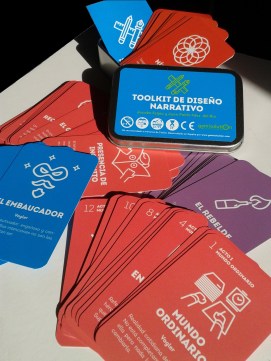
narrativedesignThe Narrative Design Toolkit (available in both English and Spanish) is a deck of cards intended to help the user think through the creation of a new plot, starting with a twelve-card representation of the Hero’s Journey as the basis for elaboration.

As the picture shows, it’s got a simple but stylish design, and includes cards in different colors to represent events and character archetypes, drawing on the writing of Jung and Propp, Campbell, Rodari, and Vogler. Cards include elements such as “the Shadow,” “the Innocent,” “the Grump,” et al. (I think some of the more personality-driven archetypes may have been supplied by the creators of the deck, since they alone don’t have an alternative attribution on them.) Meanwhile, it skips some of Propp’s more specific and startling elements, such as “The hero follows bloody tracks” or “someone pursues the hero, rapidly transforming himself into various animals.” (Though even that’s not as wild as some of the stuff in S. Thompson’s motif index of folk literature, featuring motifs like “Cow drops gold dung” and “Council of fishes decide to get rid of men (who eat fish)” and “Sun and moon born of lizard”. I could page through that stuff all day.)

I myself probably wouldn’t call this a toolkit for narrative design overall so much as a toolkit for plot generation — but that’s still an interesting and useful thing, potentially. Different writers wrestle with different aspects of writing, but “I hate plotting!” is a more common cry than one might think.

Those who’ve been tracking this blog for a while will know that I’m skeptical of the Hero’s Journey and especially of its overwhelming prevalence in game narrative how-to books; also that I’m a total sucker for card decks designed to inspire creativity or to teach IF methods or to tell stories. Likewise tabletop RPGs that offer interesting rules for inventing plots and characters, and the whole challenge of thinking procedurally about the working elements of story. So I went into this unsure whether I’d turn out to like it a lot, or find it very exasperating.

The recommended method for using the Narrative Design Toolkit is perhaps a little underspecified relative to one of those RPGs. It suggests that you:

  1. Lay out cards 1-12 representing the stages of the hero’s journey, then
  2. Swap, remove, and/or replace those cards with other cards in whatever way you wish.

So all in all rather a loose grammar. However, I did sit down and follow these rules.

Continue reading “Narrative Design Toolkit (Gamisolution)”

World Models Rendered in Text

Last month I wrote a bit about text generation and generated narratives overall. This month, I’ve been looking more at parser games — games that typically are distinguished by (among other things) having an expressive (if not very discoverable) mode of input along with a complex world model.

My own first parser IF projects were very interested in that complexity. I liked the sensation of control that came from manipulating a detailed imaginary world, and the richness of describing it. And part of the promise of a complex world model (though not always realized in practice) was the idea that it might let players come up with their own solutions to problems, solutions that weren’t explicitly anticipated by the author.

It might seem like these are two extremes of the IF world: parser games are sometimes seen as niche and old-school, so much so that when I ran June’s London IF Meetup focused on Inform, we had some participants asking if I would start the session by introducing what parser IF is.

Meanwhile, generative text is sometimes not interactive at all. It is used for explorations that may seem high-concept, or else like they’re mostly of technical interest, in that they push on the boundaries of current text-related technology. (See also Andrew Plotkin’s project using machine learning to generate imaginary IF titles. Yes, as an intfiction poster suggested, that’s something you could also do with an older Markov implementation, but that particular exercise was an exercise in applying tech to this goal.)

There’s a tighter alignment between these types of project than might initially appear. Bruno Dias writes about using generative prose over on Sub-Q magazine. And Liza Daly has written about what a world model can do to make generated prose better, more coherent or more compelling.

Continue reading “World Models Rendered in Text”