Kickstarting PROCJAM

Screen Shot 2017-06-02 at 10.29.34 AM.png

Currently on Kickstarter Mike Cook is raising funds towards the 2017 edition of PROCJAM, a yearly 9-day sprint to make things that make things.

I’ve been involved at some level the last couple of years: in 2015, I wrote Annals of the Parrigues sort of because of PROCJAM even if not strictly during the timeframe of the event (so you can decide for yourself if that counts as participating, I suppose). Last year, Mike invited me to Falmouth to the day of kickoff talks for PROCJAM, where I spoke about Annals and was recorded as part of the string of talks there. Falmouth also hosted a workshop adjacent to that, where I had a chance to talk with other researchers in the space about what more and better casual procedural text generation tools might look like.

This year, I’m contributing to the fundraising effort: if you back the Kickstarter at £10 or above, you’ll get a mixtape of procedural toys and gizmos, including some Annals of the Parrigues-related materials from me.

I like PROCJAM for a lot of reasons, and it’s simply gotten better over the years, to the point where I now consider it one of the best projects out there in terms of supporting a creative community. Why?

  • Subject matter. An easy one, perhaps, but PROCJAM defines itself broadly enough to be interesting (“make something that makes something”) but narrowly enough that contributors’ work is likely to be interesting to other contributors.
  • Inspiration. Mike is passionate about this subject and communicates that well — and he brings in other creators to give talks about what inspires them. PROCJAM also features a zine called Seeds covering lots of past procgen projects.
  • Resources. In past years, PROCJAM coordinators have put together elements like art packs for participants to use, and supplied links to potentially useful resources. This year, they’re upping the ante by building tutorials in different areas of procedural generation as well.
  • Accessibility. Mike has thought a lot and collected a lot of feedback about how to make PROCJAM’s resources as open as possible to anyone who wants to partake. Related events occur in accessible buildings. Talks are recorded and made available for free, along with all the other resources. The jam itself is defined to take place over a 9-day period rather than over a weekend, making it a better fit for those of us too busy or too old to commit to staying up for 48 hours intensively working on a project.
  • Cross-community communication. Again, this has taken intentional work, but Mike solicits talks and input from indie creators and artists, academics in PCG and creative computing, and people with game industry experience, getting groups to talk to one another who often do not communicate nearly enough. Last year’s talk sequence also had an excellent gender balance, which I am guessing is also not the result of pure chance. At the same time, PROCJAM is very much framed as being open to all comers.
  • Coverage and feedback. Participating projects actually get video coverage made by Jupiter Hadley as part of the event’s output, along with whatever responses might come in from other PROCJAMmers or bloggers.

So, a good thing. Funds this year will help pay the artists, video makers, and tutorial-creators who contribute their time to building up PROCJAM’s resources, adding yet another bullet point to why this is good:

  • Compensating community-support labor.

On which notes: if you’re interested in the long history of IF-related competitions and jams specifically, here is a survey of them I put together in 2015; and the IFTF is another organization worth knowing about if you’re interested in community support and accessibility drives.
The Frankenstein Wars Released

frankensteinwars

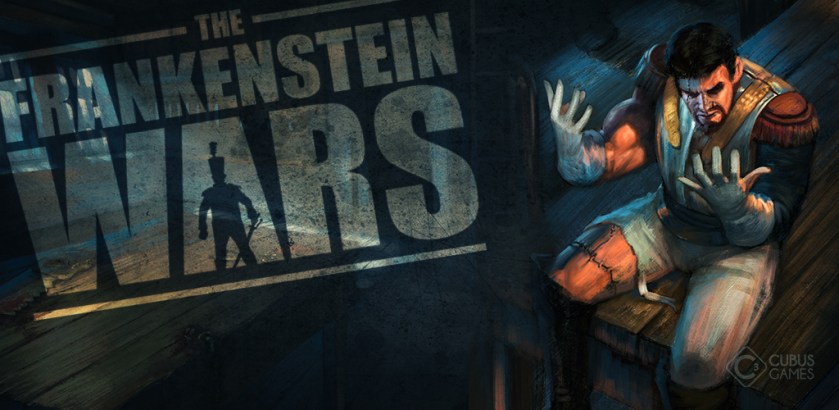
Back in 2015, Cubus Games kickstarted a new gamebook app called The Frankenstein Wars, described as follows:

Tom and Anton Clerval have long guarded the secret to Victor Frankenstein’s resurrection technology. In revolutionary France, in 1827, that secret at last comes to light. The radical Zeroiste movement creates an army of the reanimated dead to seize control of the country, and then to cross the Channel to strike at the heart of the British Empire.

Only Tom and Anton have the power to halt the Zeroistes – or to stoke the flames of all-out war.

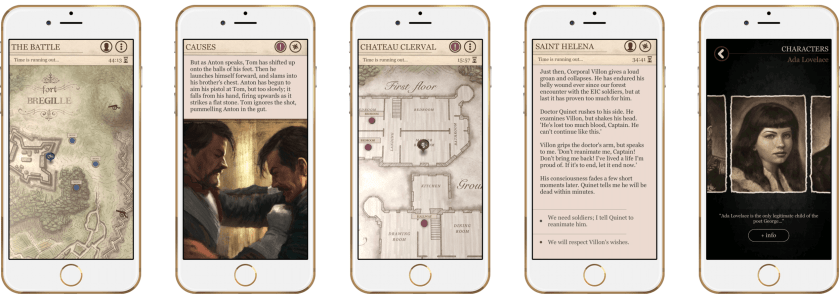
The game is out today for iOS and for Android next week (June 8). Please note that this is not a zombie story, technically. And I do enjoy an epic piece of historical-fantasy IF. And I have to say that the app looks pretty handsome in the screenshots:

frankensteinscreenie.png

End of May Link Assortment

Events

June 1-3 is Feral Vector, a delightful indie games festival in a really beautiful setting in Yorkshire, which usually includes talks, workshops, and hanging around on the grass eating and drinking with fellow devs. Last year there was also a LARP in the woods. I can’t go this year, but I’ve really enjoyed it both times I went. Not specifically IF-focused, but a good time.

Also June 3 is the SF Bay Area IF Meetup; the choice of what they will play there is still to be determined.

June 8 in Nottingham is the next session of Hello Words, which takes a writing club approach to IF development.

June 12 is the next PR-IF meetup in Cambridge, MA.

icoe-cube-min.JPG

June 20, the London IF Meetup is gathering at the Eaton Square Bar to play In Case of Emergency, a mystery storytelling game assembled and run by A Door in a Wall. Atypically for our events, there is a small fee of £5 to participate.

“Smart Oxford” is soliciting applications for a £30,000 grant to put together an interactive, publicly-playable experience in Oxford city center. Applications are due June 20.

June 24 at 3 PM, the Baltimore IF Meetup is getting together to discuss The Weight of a Soul from Spring Thing this year, so if you’re attending, you may want to try the game in advance.

June 28-30, I will be speaking at Gamelab XIII GAMES & INTERACTIVE ENTERTAINMENT CONFERENCE in Barcelona, about artificial intelligence and games.

The British Library is running an Interactive Fiction Summer School as a weeklong course in July, with multiple instructors from a variety of different interactive narrative backgrounds. More information can be found at the British Library’s website.

New Releases

Arc Symphony: Sophia Park and Penelope Evans launched a Twine that had a social ARG component to it as well. It’s about the way 90s internet connections (of both kinds) functioned and made meaning for those who relied on them.

Apology Simulator by Matthew Seiji Burns (of The Writer Will Do Something). You play as both people in the exchange–crafting the best apology you can, and then send it off; you then also have the option to choose whether or not to accept that apology. I frequently found that on a particular screen, there was no way to mutate the message into anything that really felt sincere by my own standards. Often, you have a series of options for things to say, but none of those options involves taking real responsibility for your actions and owning your own mess. And there are options to be extremely passive-aggressive. It’s more experience than story arc, but interesting as a meditation on how apologetic phrasings work in practice.

castellupo.jpgThe Secret of Castel Lupo is an interactive fiction/RPG originally released in Italian and now available in English for Android and iOS. It’s designed for younger readers (8+), but is meant to be entertaining for adults as well.

Causeway is a short IF piece that is only available for PC.  

Richard Goodness has released Hatred, a piece he describes as a “text-based murder simulator.” I have yet to play it, but he describes it as closely tied to Zest.

Narrows is a system for participatory storygames for groups of people, a bit similar to Storium, where the protagonists each submit their actions and then a narrator writes what happens next.

Awards

Reading Digital Fiction has announced its award winners for 2017; among the winners, Mark Marino and family won for best Children’s Digital Fiction with the Tangerine House series.

The Kitschies awards are accepting nominations for work published in the UK during 2017, and they include a reward for “natively digital” work, which goes beyond the ebook: this would include interactive fiction.

Articles

I wrote my last IF Only column for RockPaperShotgun, this time on The Pawn and Magnetic Scrolls games. The Strand initiative is also bringing MS games to mobile and exploring new ways of presenting parser IF in that context.

If you enjoyed what I wrote about high-agency narrative structures like quality and salience-based narrative, you may also like Bruno Dias’ recent post about building a generic QBN system.

Dylan Holmes and Joanna Price discuss plot and character in Night in the Woods.


DINE

Screen Shot 2017-04-23 at 9.26.07 PM.png

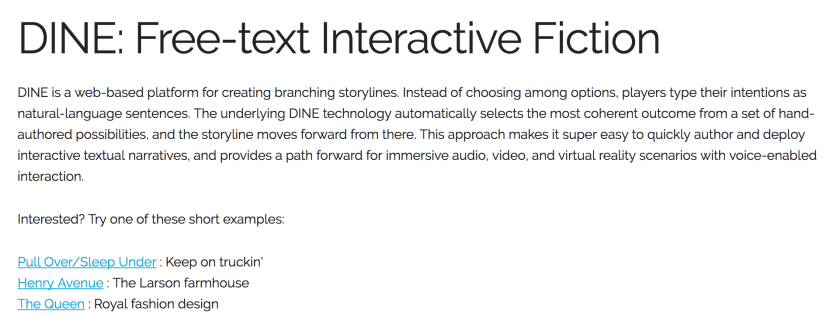
DINE is, as I posted earlier, an unusual interactive fiction system that takes typed input but does not handle it through a parser. Instead, it uses text classification to find a response that is most coherent with the player’s input — a measure that depends heavily on linguistic similarity.

To author content for DINE, the author writes example player inputs (such as “I picked up the photograph”) followed by the response text that the author has in mind. Both the sample input and the actual output are considered when the system chooses a proper response. The system also applies a penalty to any output text the player has already seen.

There’s one final affordance: next to each paragraph of output is a “Huh?” button. Click it to reject the response you were given, and the system will search for the next best fit. It’s not guaranteed to work more with the story than whatever you read last, though.

DINE is not a particularly ideal tool for the kind of experience we associate with parser IF. If you do >INVENTORY twice in a row, you might well get a totally different response the second time — and one that is not especially coherent with the input. Indeed, there’s no way to explicitly author world state, other than as “pages” for the player to land on.

Different DINE pieces handle this in different ways. Olivia Connolly’s “A Quiet Street” offers quite long pages of story between interaction points, and sometimes sets up obvious single tasks for the player to try next, as for instance here, where the game directly tells me what to do:

Screen Shot 2017-04-23 at 10.30.21 PM.png

At its best — for instance, when the circumstances of the narrative made one particular action feel compelling, but didn’t explicitly spell out what that action was — this could achieve a pleasing level of fluidity, as here, where I know that there are strangers approaching the house but that my mother hasn’t seen them yet:

Screen Shot 2017-04-23 at 10.39.00 PM.png

Continue reading “DINE”

Mailbag: High-Agency Narrative Systems

Today’s mailbag entry (at the request of the submitter, anonymized and edited a little) gets into the question of how to create salience and quality-based narratives and other similar games, given that typically one has to build one’s own.

What I keep getting drawn toward on a personal level is your work–and other people’s work too–on procedural narrative generation. I have enough knowledge of coding to understand states and modeling systems and when to move from one to another on a conceptual level, but at this point I could not make one in any language or engine. I think this is something I would like to learn to do more of...

Obviously I’ll need to learn a language from the ground up. That’s fine. I suppose I’m asking what would be most helpful to focus on–not just in terms of C# or Ruby or Python–but other skills as well… most of my questions/interests are about event generation, procedural chains of causality, etc.

Further discussion with the asker indicated they are talking about the kind of quality-based and salience-based narrative systems I wrote about in the article Beyond Branching; this RockPaperShotgun column about Alcyone also gets into some detail about the state of play in this space.

Systems like this can achieve a combination of player freedom and agency that is hard to reach in CYOA or any other node-based system (I would include ChoiceScript here): there are often dozens of viable choices available.

Meanwhile, because you’re not tied to a specific simulation concept (like the standard parser IF world model), you can adjust the qualities of your QBN to the particular needs of this work. Track your protagonist’s health, her interest in opera, her sense of humor, her tolerance for pain; track her relationships with each of a dozen friends, or a dozen aspects of her relationship with one friend.

On the other hand, the tooling and the design abstractions in this space are not nearly as advanced as they are for parser IF or CYOA/hypertext/stats-based IF, so if you want to work with it, you probably have to build your own.

That’s a topic that could take a number of articles, and there isn’t as much writing in this space to point to as in the parser space.

Continue reading “Mailbag: High-Agency Narrative Systems”

Ladykiller in a Bind (Christine Love/Love Conquers All)

Screen Shot 2017-05-20 at 9.52.53 PM.png

Ladykiller in a Bind is an erotic visual novel by Christine Love and co, released last year; it won the IGF Narrative category. Consequently, there’s already quite a lot of commentary about it, especially around its handling of queerness and kink; a late-game scene with dubious consent that bothered some players and that Love ultimately wound up replacing; about mechanics that do not make sex the end goal in itself. Andrew Plotkin wrote up his take on it, and the genre of visual novels in general, as part of his IGF Narrative judging overview.

Plenty of interactive erotica exists — and there’s plenty of demand for it, too, as witness the fact that people searching for interactive sex stories form a sizable portion of my daily blog traffic. They’re probably mostly disappointed, but perhaps this entry will console them a little?

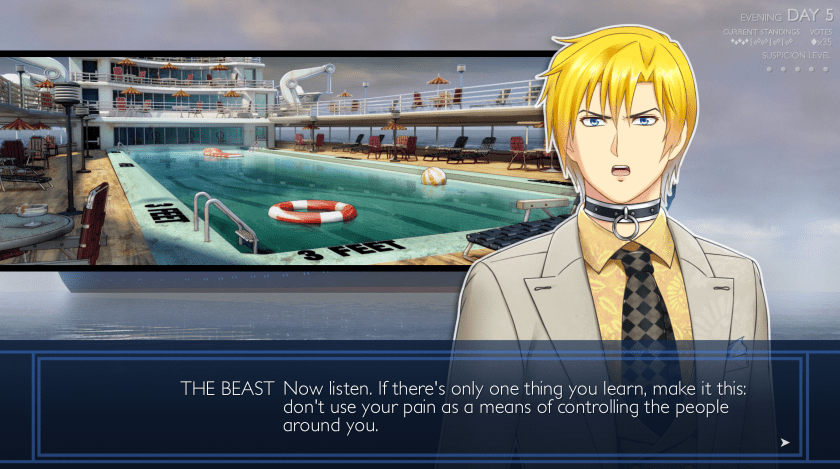
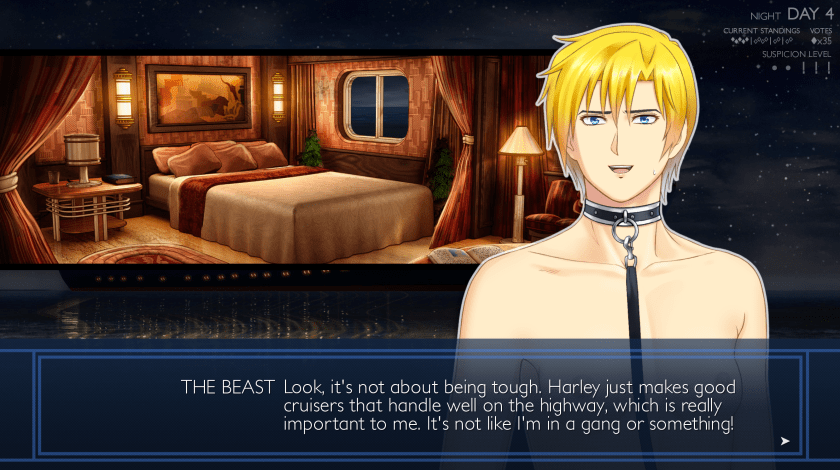
But relatively little of what I’ve encountered is as well-written as Ladykiller in a Bind, particularly when it comes to characterization. As Olivia Wood points out, sex scenes avoid being embarrassing by having something to say beyond “here is a peek at the author’s fantasies.” Ladykiller does that. It uses its sex scenes to communicate who the characters are, and shape their relationships with the protagonist; to talk about honesty, fairness, emotional manipulation, self-image, power exchange, and consent. And sometimes the sex conversation feeds back into dialogue about other things:

Screen Shot 2017-05-20 at 8.08.51 PM

The story is very much a fantasy, with a cast of super-attractive, wealthy, popular just-barely-18-year-olds. And the framing plot is ridiculous: the protagonist is a girl cross-dressing as her twin brother and hoping that none of his friends, enemies, and exes on the ship will notice. Nonetheless, the sex scenes detail emotional states that are relatively rarely shown in media. I don’t just mean the BDSM aspects here, either. There’s a storyline about a character who is relatively inexperienced and also doubts her own attractiveness, who gradually alters what she wants to consent to as she becomes more confident, and this played out quite plausibly.

That’s not to say the game is, or is trying to be, an encyclopedia of all possible sex formats. There are some places it didn’t go, at least during any of my playthroughs: the BDSM scenes I saw delved deeper into the bondage and submission aspects than into the masochism side, for instance. And, unsurprisingly, the scenarios skew towards issues that arise early in a relationship or for relatively inexperienced partners. At one point the older Maid does comment on the comparative immaturity of all the characters — an acknowledgement that would have felt like a lampshade, except that of course these characters are immature. They haven’t had time to become anything else.

But never mind about sex. Let’s talk about conversation mechanics.

Continue reading “Ladykiller in a Bind (Christine Love/Love Conquers All)”