End of July Link Assortment

Events

On August 3, the SF Bay Area IF Meetup will get together at the Museum of Art and Digital Entertainment.

DiGRA 2019 is being held August 6-10 in Kyoto.

The second round of XYZZY voting is open from now til August 9. Anyone who wants to participate is eligible to vote on the best IF of 2018, with the constraint that people should not vote for their own works and may not canvas for votes. Congrats to all the finalists! (Since Cragne Manor with its 80+ authors was nominated, I suspect this year features by far the largest field of XYZZY nominees ever…)

August 10 is the next date for the Baltimore/DC IF Meetup, discussing Omen Exitio: The Plague.

August 11 is the deadline for submitting games to WordPlay 2019 in Toronto (the event itself takes place November 9-10).

Boston Gameloop 2019 will take place on August 17.

The IEEE Conference on Games (CoG) will be August 20-23 in London. I am keynoting.

The Foundations of Digital Games Conference (FDG) is happening August 26-30 in San Luis Obispo.

September 1 is the deadline to register your intent to participate in IFComp 2019.

If you want to submit a speaker application for WordPlay 2019, the cutoff there is also September 1.

The 20th annual European GAME-ON® Conference on Simulation and AI in Computer Games is September 18-20 in Breda, The Netherlands.

Announcements

The folks at Thorny Games have a number of intriguing projects available currently highlighted. Their tabletop RPG Dialect: A Game About Language and How It Dies is up for Game of the Year at the 2019 Gen Con ENnies. The game allows players to make (and potentially destroy) their own languages.

Dialect originally had its Kickstarter campaign in 2016, and the physical copy was shipped to the original backers last year. One of the minds behind the project is David Peterson, who created the Dothraki and High Valyrian conlangs for Game of Thrones.

Dialect is available in both a digital edition and a hard copy (and there are a few reviews out there, as well).

In addition, Thorny has a pair of other projects (also language-focused). Sign, which is based on the 1977 creation of a sign language in Nicaragua, is currently for sale. Meanwhile the upcoming Xenolanguage is currently in playtesting, but is aiming for a 2019 release.

If you’re curious about what Sign and Dialect are like to play, Sam Kabo Ashwell has just posted reviews of both.


Digital activities and classes are taking place through Oxfordshire libraries this summer. Among the offerings are classes on IF.

Texture has added a few recent features, notably: a “private library” option under the New Story button, as well as an “unlisted link” option for publishing games without making them public.


Phoenix Leicester is hosting the experimental game Langoors in the Labyrinth, a new commission by Studio Oleomingus. Designed to be played by two players across two screens, the game is set in post-colonial India, and runs until August 18. Dhruv Jani will lead a workshop on interactive storytelling via Skype on August 10, also at Phoenix. Space is limited, so if you’re interested, book in advance.

Articles & Links

Adam Cadre presents another year’s worth of most excellent prose stylings, with the winners of the 2019 Lyttle Lytton Contest.

Articy is posting video recordings of the talks from Narrascope in June, but Storygames by Aaron A. Reed is excellent and well worth a look. Also in a couple of cool pieces of news from Aaron: the recent release of Downcrawl, a supplementary tabletop RPG book, which is available this month. In addition, Archives of the Sky won a Judges’ Spotlight award at Gen Con this year.


New Releases

Screen Shot 2019-07-31 at 6.16.59 AM.png

In the last Link Assortment, I mentioned the updated version of Nocked! True Tales of Robin Hood, which was originally created for iOS but is newly available on Steam. For additional information, you can see the press release here, which goes into great detail about the snazzy new features.
Books

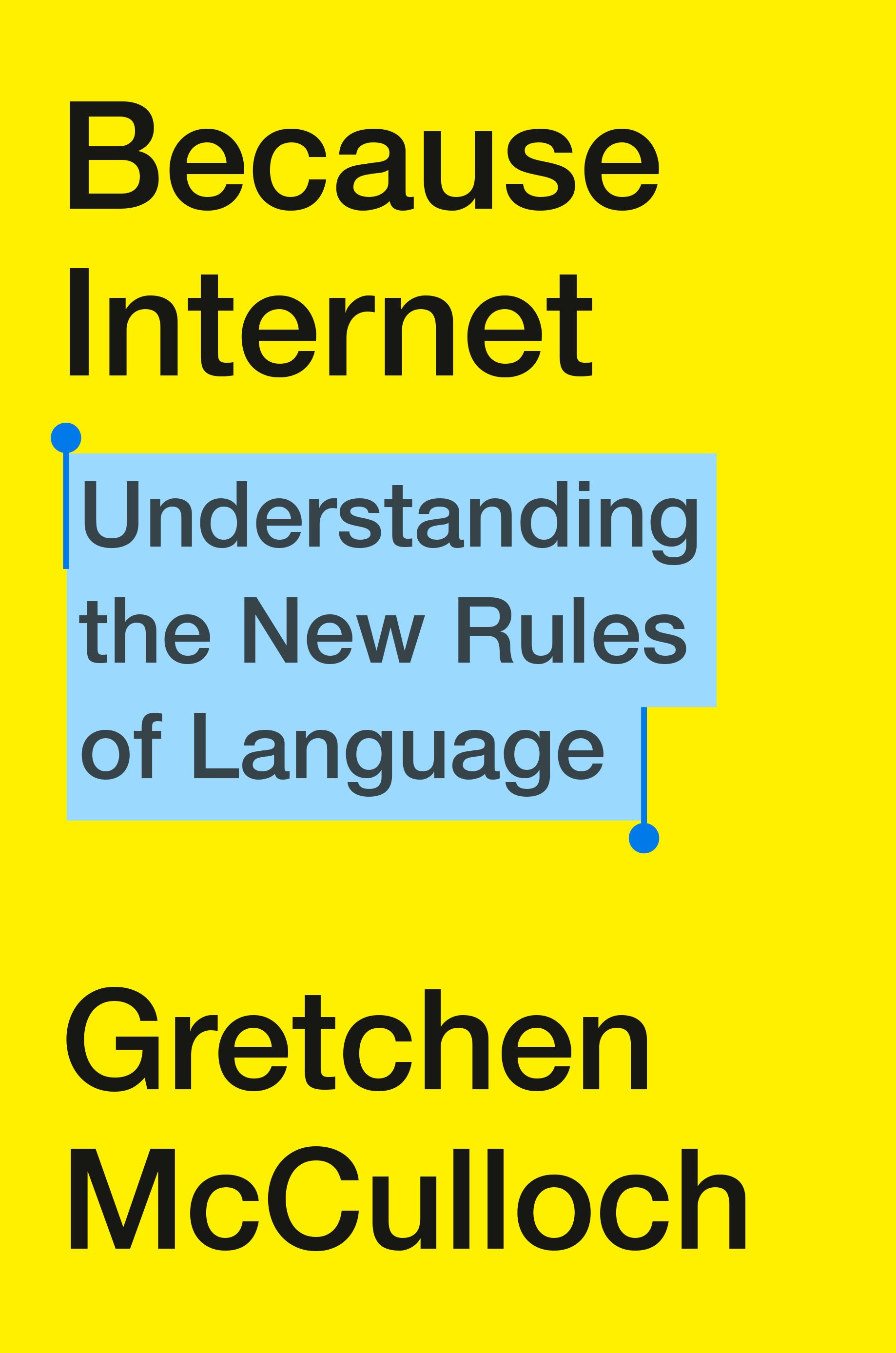
This isn’t IF, but if (continuing what seems to be a theme of this roundup) you’re interested in language use, linguistics, and digital culture, you may like Because Internet, a book by Gretchen McCulloch on how language use has evolved online.

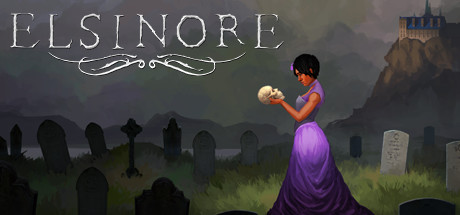
Elsinore (Golden Glitch)

A 3D point-and-click adventure offering a huge amount of narrative agency and NPCs who murder each other. A lot.

Hamlet speaks more colloquially in this game than in the original, but he’s just as emo as ever.

Elsinore casts you as Ophelia living the timeloop of Hamlet over and over, trying to find a route through the story that doesn’t end with everyone dead. Life in the castle is an intricate machine which can be perturbed out of its intended schedule by every intervention you make, so your actions have a cascade of consequences.

You have visions of what is to come; you also have a journal and memories of what’s happened the last times through the story. With that information, you’re free to travel all over the castle, listen to conversations, gather news, and pass that data on to others. Even if you die in a given time loop, the information you’ve learned persists, giving you new options in the next playthrough. Structurally, that’s a bit like Hadean Lands, though the type of puzzle you’re solving and the rest of the narrative is very different.

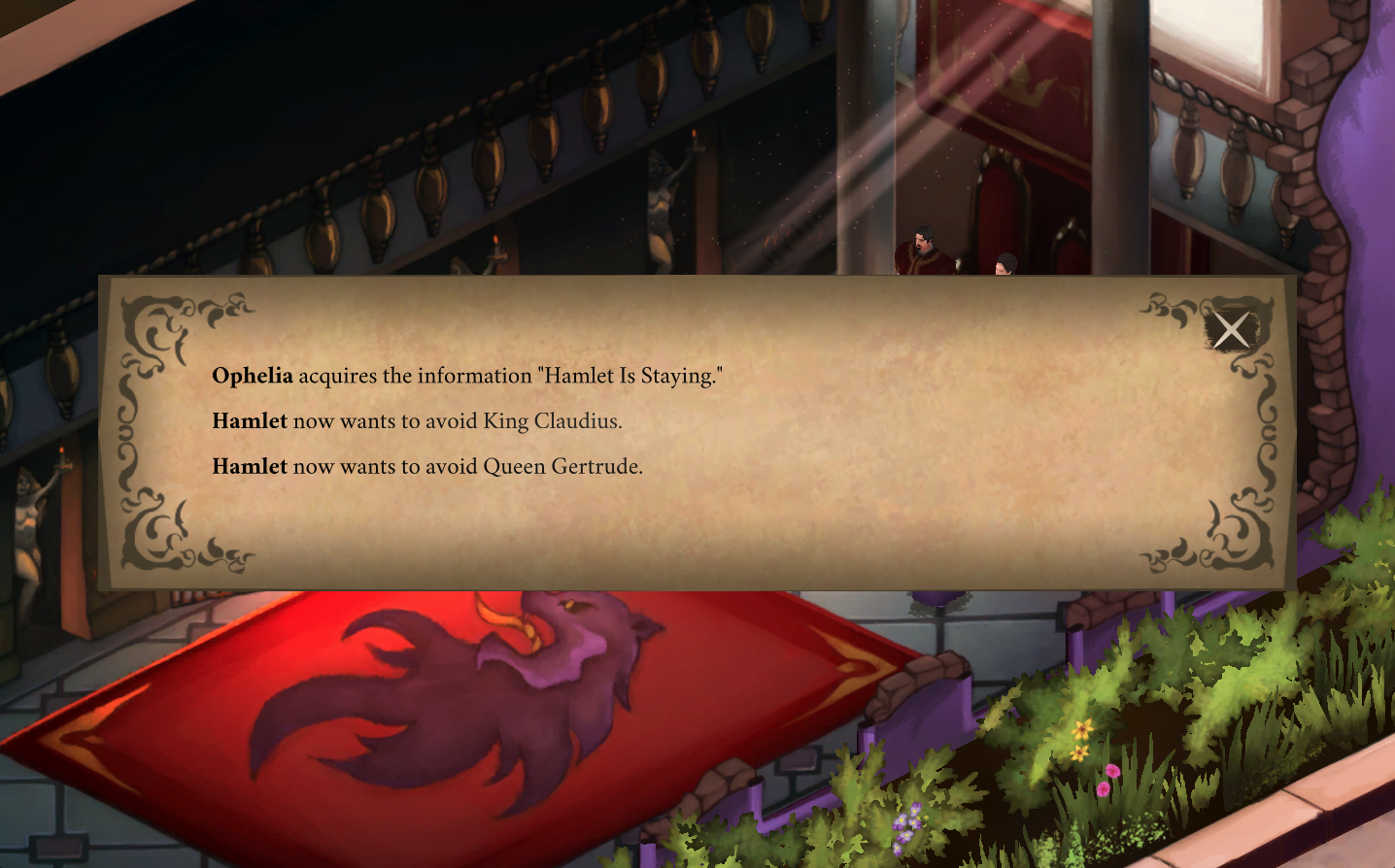
Conversation is organized around events — triggered by time and narrative preconditions, and which allow you to learn things just by being in the right place at the right time — and your inventory of hearsay, provocative things you can tell other characters during the course of play. When you share information with a character, their knowledge and motives are explicitly updated:

In this scene, Ophelia has just listened to an event and learned new information; and Hamlet has updated his own preferences and plans as a result.
Continue reading “Elsinore (Golden Glitch)”

Links and Structures from Michael Joyce to Twine

A look at some articles from the scholarship of literary hypertext, and thoughts about how their concerns and terms relate to current work in Twine and other procedural literature.

Recently I’ve been including some coverage here of academic materials that might be of interest to industry or hobbyist readers. Some of that’s been focused on recent work in story generation or interactive narrative in some way.

Today’s example, by contrast, begins with a reading from a rather older paper: A Nonce Upon Some Times, by Michael Joyce in 1997. (If you want a proper citation: Modern Fiction Studies 43.3 (1997) 579-597.)

This article came to my attention because when I was responding to Mark Bernstein’s piece The Fellow Who Caught Fire, he called out that I was unfamiliar with something he considers to be essential reading in the field of literary hypertext.

“A Nonce Upon Some Times” raises questions about how we categorize hypertext structures, and what we understand from the meaning of these structures. Occasionally this is reminiscent of Sam Kabo Ashwell’s work or perhaps my own on small-scale structures in CYOA: what does it communicate when the author chooses a particular relationship between the available lexia?

Joyce, however, is overtly contemptuous of branching narrative:

The workshop exercise with which I began this essay seeks to isolate a set of primitive choices that both prompt the visual kinetic of rereading in hypertext and, at the same time, isolate the elements of what Douglas calls “a narrative of possibilities.”… It engages working writers with aesthetic and readerly questions about linking rather than encouraging a choose-your-own-adventure sort of drearily branching fiction.

…and what interests him is not the question of how one might project oneself into the role of a protagonist; not how one might experience agency, constraint, or non-agency through this pattern of links.

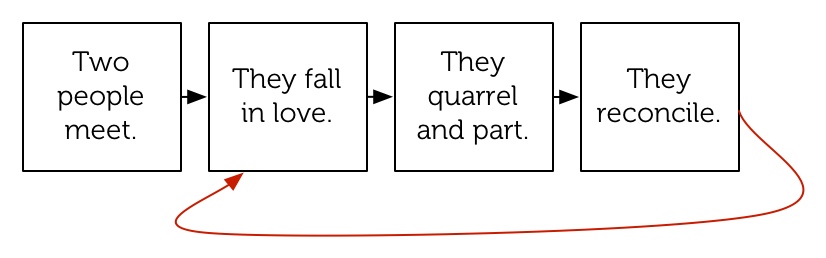
Joyce’s taxonomy is easier to diagram than to explain in words. He proposes that one start with a four part structure, linked linearly, which ends by going back to one of the earlier texts. I would diagram it like this:

Now: what happens next, after we have re-entered the second of the four texts? Where do we go from there, and is it different from where we might have gone the first time around, and what do these different arrangements mean?

Continue reading “Links and Structures from Michael Joyce to Twine”

Heaven’s Vault (inkle)

Heaven’s Vault is a game about piecing together meaning from atom-sized pieces.

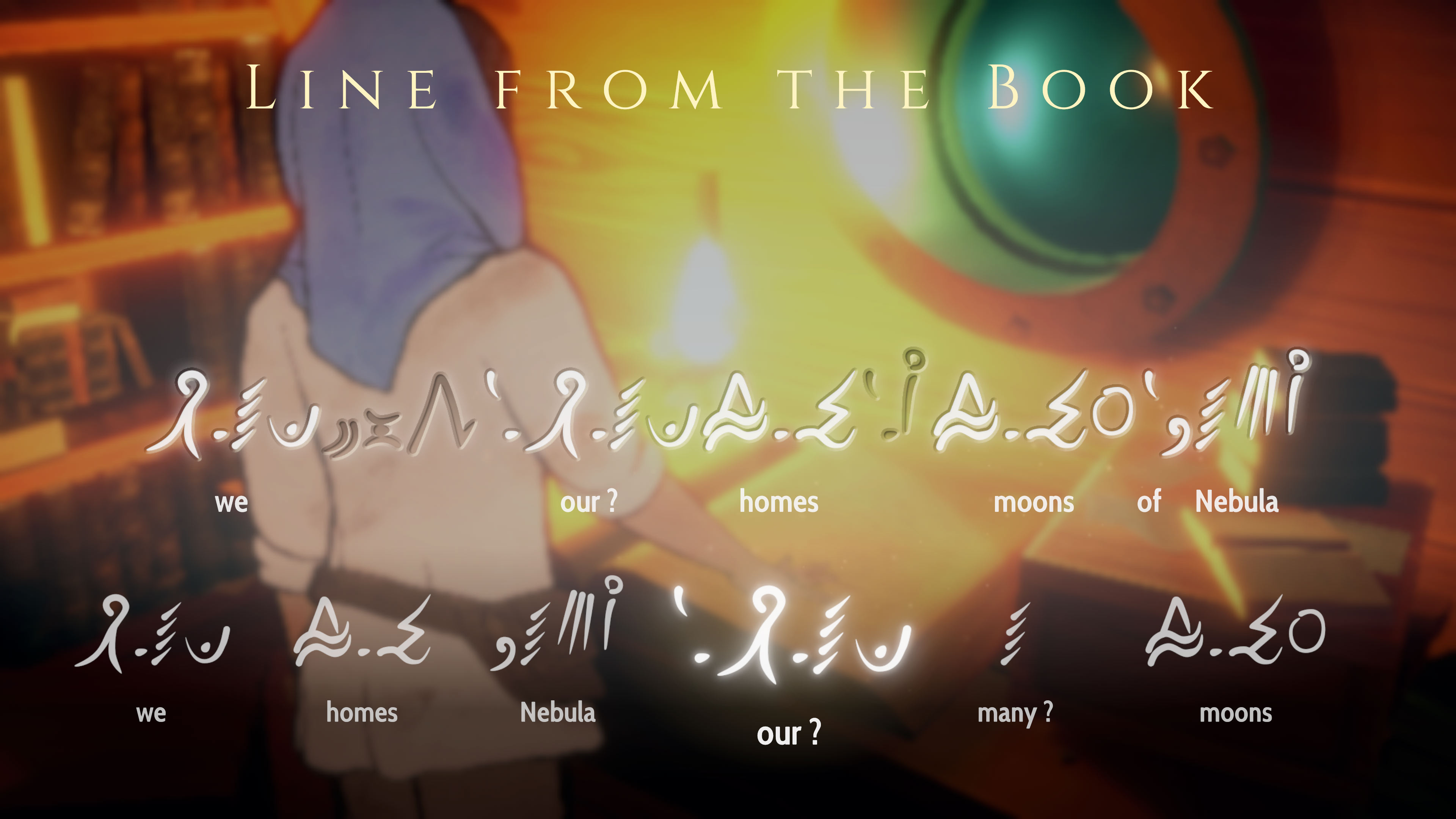
The game’s chief mechanic involves translating inscriptions from Ancient, building a larger and larger personal dictionary until you’re able to interpret entire passages of scripture and significant warnings.

This mechanic is highly satisfying, especially during the early phases of the game. Words in Ancient are made up of a small number of primitives joined together, so as you guess at the meanings of words and sentences, you’re also developing an understanding of what the primitives stand for, what marks stand for nouns or verbs or changes of tense. The more inscriptions you find (and pretty much everything in the Heaven’s Vault universe seems to have a phrase or two of Ancient scratched onto or sewn into it) the more you’re able to decode. Like a crossword, it lets you use leaps of insight in any one area to shed light on others. And because you’re uncovering text, new inscriptions frequently offer new narrative insights.

I really, really enjoyed doing this. While the language of Heaven’s Vault is pretty much encoded English and doesn’t feature the ambiguities and alternative world views embedded in real foreign languages, the process of learning to read Ancient lit up the same parts of my brain as other forms of translation; so much so that I found myself identifying a sequence that meant “voice” and thinking, φωνή.

The game has some pacing issues, noted by other reviewers, and those pacing issues did affect my experience. And by the end of the first play-through, I wished the decoding mechanic would change up and let me make more extensive types of guess on my own, because frequently I “officially” was unable to read something whose meaning was perfectly obvious to me in reality.

Even so, decoding this game kept me onboard for more than 15 hours, at a period in my life where I have relatively little available time for playing anything and have to be extremely picky. And if you replay, you have a new game+ option that starts you over with your existing language learning intact, an accretive PC trick that allows the protagonist at last to feel like she actually is an expert in her chosen field. So if you feel you might also enjoy a translation adventure game, do try it out.

I wish to emphasize this point because I am now going to go into a mass of detail about what I think might have worked better if it had been done differently.

But that’s because this is a really interesting piece of work pioneering comparatively unexplored areas of puzzle design and narrative structure, and it’s at its most instructive when we look at what doesn’t quite work.

Continue reading “Heaven’s Vault (inkle)”

The Twentieth Entry: SPY INTRIGUE (furkle)

In my top 20 list earlier this week, I left a spot blank at the end of my list, because I was pretty sure that I needed to replay this game: furkle’s SPY INTRIGUE, from IF Comp 2015.

2015 is the year the comp broke me. There were 50-odd games to cover in a six week period, and I’d committed to cover on my blog every one I considered recommendation-worthy: a time investment of several hours apiece, though some took longer. I also tried to find ways to send some positive responses back even about the things I couldn’t completely recommend. But I handled that maladroitly and hurt some feelings; and it’s not exactly a challenging feat of empathy to guess that my approach was going to land wrong, so I felt pretty bad about that.

Fitting the equivalent of a new full-time job into my life alongside my other commitments was hard, and it was also an emotionally demanding position to be in. I got email and DMs from authors who wanted me to hurry up and get to their work; to give further information about the contents of my reviews; to reconsider what I’d already written. In one case someone wrote to chew me out for setting the wrong standards for how comp games should be handled by the community at large because I wasn’t giving each game enough attention.

This was the point where (belatedly, you may think) I decided this was an unhealthy situation and I was done reviewing the Comp. I would finish 2015 and then bow out.

But around the same time all this was going on, someone — not the author — pinged me and said could you please post a review of SPY INTRIGUE, it’s gotten so little coverage, hurry it up please. So I assembled and posted what I had to say about it, but that wasn’t very much, relative to what the piece actually is.

What I primarily experienced, trying it out in 2015, were all the ways the game resists the player: the hard to read all-caps text, the staticky backgrounds, the text-shakes and screen-flashes. (I believe the accessibility features at the start of the game do let you turn those off if they’re likely to be bad for you.) Then there’s the way the UI gets a facelift every time you’ve gotten the hang of it, so you have to sort of relearn it; the very long instruction text that only makes things more confusing if you aren’t already acquainted with the game; the absence of markers to help you understand how the story relates to our world.

At the very beginning, it seems like maybe the author just has tremendously bad design sense about what’s going to be comfortable for the average IF reader. Later it becomes clear that the aesthetics are very intentional, but that “maybe it’s incompetence?” look is a really challenging thing to try in the beginning of a comp game, unless that game happens to be attached to the name of someone already well-known. There is, after all, quite a lot of genuinely mishandled work submitted to competitions.

Then, too, it doesn’t align itself to many recognizable tropes of IF. If I think about what might be closest to it, I think of maybe ULTRA BUSINESS TYCOON III for the layering of fantasy and real life; maybe Zest for the inspection of how worldview makes life livable, and the function of supposedly-recreational substances. But even so neither of those is very similar to SPY INTRIGUE. There just isn’t anything very similar to SPY INTRIGUE. This is part of what’s amazing about it, but it’s another challenge to entry.

And in the context in which I originally played, even SPY INTRIGUE’s length was a thing that made it resistant. In a literal sense, I read fast enough — that is, I can get the basic sense of words quickly enough — that I could get to an ending in two hours. But that was nowhere near enough time to understand it, apprehend its themes and structure, and play it sympathetically.

In the intervening years, a couple of things have happened. One, despite a general lack of community discussion about this game, a handful of people whose tastes I trust have told me it was great. Two, I’ve gotten to know furkle personally.

I decided I wanted to replay it; and, at the same time, that I needed to do that at a time when I could approach it completely differently than I did the first time — without the sense of obligation, without the idea that my role vis a vis this work was to be its Designated Reader.

This weekend I replayed. I took a lot more time over it — probably something like eight hours elapsed between start and finish. I wasn’t reading continuously that whole time; on the contrary, I put it aside several times. That’s not because I was bored with it, but there was a sufficient richness that I found I needed a bit of a break at times, to process, before deciding how to re-engage.

I found it hugely easier to get into this time. That’s partly the different reading approach; partly that I’d played it once before, so the UI features were known to me; and partly that knowing more about the author gave me more context for interpreting the game’s ambiguities. This is one of those pieces where knowing the rough plot outline in advance is a significant help in grasping the overall meaning of the work. So I’m going to go into more specifics here than I usually do in a review.

And I really hope more people will play it. Here is a game that placed 29th in its competition, for reasons that I understand completely — but the fact that it was under-played and under-discussed represents a major missed opportunity, especially for people in the community who are interested in the more narrative and writerly possibilities of IF.

SPY INTRIGUE is one of the finest and bravest things ever produced in this medium: personal and true, technically masterful in both code and design, literary in the best sense.

Some people, I’ve seen, refer to it as raw. I wouldn’t call it so; I’d say it has a quality I prefer to rawness, an ability to present the most intense and traumatic experiences with such understanding that it offers others a tool to dismantle their own pain.

Yes, I am still talking about a game in which you can shove banana bread down the front of your spy pants. That game. Yes.

Continue reading “The Twentieth Entry: SPY INTRIGUE (furkle)”

Mid-July Link Assortment

Events

In Cork, the meeting of the Electronic Literature Organization is currently in progress through July 17. The program includes several artist forum sessions in which authors will be talking about their own projects; for instance, Katherine Morayati on Human Errors the 17th.

July 21 is the next Seattle Area IF Meetup, focusing on works in progress.

download-6The SIGIR Conference is taking place in Paris from July 21-25.

July 25 is the next Boston Area IF Meetup.

The 57th Annual Meeting of the Association for Computational Linguistics (ACL) will take place in Florence (Italy) at the ‘Fortezza da Basso‘ from July 28-August 2.

DiGRA 2019 is being held August 6-10 in Kyoto.

Nh4sqhAugust 10 the Oxford/London IF Meetup is doing a workshop on Bitsy, a tool for creating small easy games with some narrative content and also some spatial navigation.

The IEEE Conference on Games (CoG) will be August 20-23 in London; I will be giving a keynote here, looking at some of Spirit’s recent work.

The Foundations of Digital Games Conference (FDG) is happening August 26-30 in San Luis Obispo; I’ll also be speaking here, but only by Skype, so I’ll miss those of you in California. (Sorry! But I’ve been doing too much flying lately.)

September 25, the London IF meetup will be doing a session on immersive theater, LARP, and live-action interactive experiences. The details aren’t yet live on the website, but we’ve got some excellent speakers lined up, so if that’s a topic that interests you, join the group if you haven’t already, and we’ll announce when the venue details are final.

Screen Shot 2019-07-13 at 9.11.44 AMAdditionally: Narrascope 2019 is already in the rear-view mirror, but the folks at Articy are sharing recordings from some of the event’s presentations.

logo-512Starting it off is Natalia Martinsson’s keynote address, with more videos planned. If you weren’t able to attend, this can give you a sense of the event and some of the individual speakers and topics.

And finally: tickets have gone on sale for AdventureX, which is November 2-3 at the British Library. The Narrative Games Convention has also released its lineup with some of the included speakers. As of this post (July 2019) the event seems to be sold out, unless/until they release another block of tickets, which their Twitter account suggests they will.

So: if you were disappointed not to have gotten in on that first round, don’t despair! But do follow the AdventureX Twitter account and/or sign up for the mailing list, if you want to maximize your chances of snagging a ticket for yourself.

Tools & Authoring Systems

Villanelle is an experimental authoring system to let creators build complex character behaviors for interactive fiction. The project is put together by Chris Martens and her team at NCSU. They are actively seeking outside opinions, so if you’re interested, you can first try out the prototype, and then fill out a feedback form to help the team evaluate and refine the project.

Twine-Monogatari is a project to let authors write content in Twine and present it in the Monogatari visual novel system. Monogatari is an open-source tool designed to let authors (among other things) present visual novels in a web browser, and has some other neat features even when used without Twine.

Jams & Contests

ifcomp

The 2019 IF Comp is open for authors to submit intents, now through September 1, if you’d like to contribute a game to the competition.

XYZZY Award voting is currently open, and you’re welcome to participate by nominating up to two games per category.

Articles

In Wing and a Prayer — Stress and Structure, Ian Thomas explores the potential emotional impact of LARP / simulations, via Allied Games’ recreation of a British Ops room in World War II. (More info about the game itself can also be found here.)

This integration allows users to play the original Zork Trilogy through Slack.

Chris Klimas shares his Narrascope presentation on the history of Twine (and its current state).

Forthcoming Releases

headerElsinore, a time-looping adventure from Golden Glitch that explores the story of Hamlet from the point of view of Ophelia, as she relives the same four days and tries to avert the tragic endings of the play.

The game is slated for release on Steam on July 22.

Also coming soon is the rerelease of Nocked!, which originally came out in 2017 for iOS and which I reviewed on this blog at the time. This time around, the game is getting a new-and-improved desktop version, available on July 17.

The Twine-based historical adventure drops players into Medieval England at the start of Robin Hood’s outlaw adventures, and with dozens of potential endings, the choices made will lead to wildly different conclusions.

Author Andrew G. Schneider has added 100,000 words to the branching narrative for the Steam version, so there will be plenty of extra material for those already familiar with the game (and given that the original already had 400,000 words, that leaves plenty for those coming to it for the first time.)