Prospero (Bruno Dias); Writing with Raconteur

Screen Shot 2015-09-15 at 3.02.45 PM

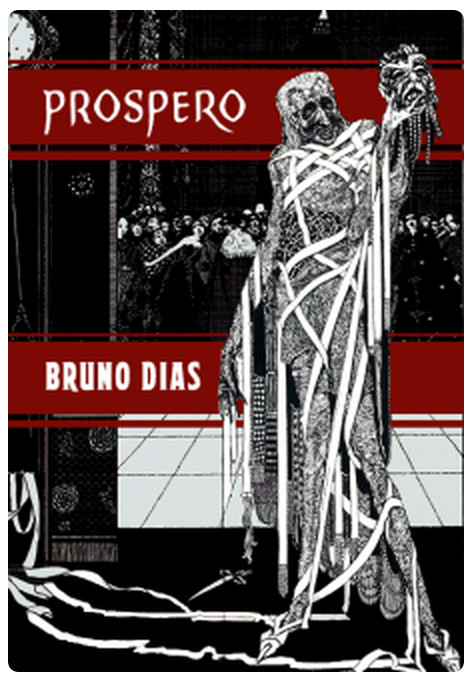
Prospero is Bruno Dias’ retelling of “The Masque of the Red Death”, implemented in Undum/Raconteur and published for Sub-Q Magazine.

As one might expect of both the author and the venue, Prospero is a typographically attractive piece of work, rendered in white text with red progression links. Links that merely expand the existing text appear in bold white, instead. The distinction between stretchtext links and movement links might be old in literary hypertext terms — I’m not certain — but it’s not consistent in the Twine and Undum world. I find it very useful to know whether the link I’m clicking is going to tell me a little more information or whether it’s going to move the whole story forward.

Prospero is also a beautifully textured piece at the level of prose. Dias has a gift for the specific detail — seen in Mere Anarchy in the variety of magical tools available to the protagonist, or here in Prospero in the scenery and the protagonist’s possessions.

The original Poe story goes like this: there’s a plague in the land, but the prince Prospero has a lot of money, so he walls himself up with his favorite courtiers and various resources, and they try to keep the plague at bay. (In contrast with the religious community in Vespers, he seems untroubled by the implications of shutting out the rest of the world.) During an elaborate party Prospero throws, a creepy masked figure attends, who turns out to be the embodiment of the plague. Despite their decadence and indifference to the world outside, the whole party dies. It is possibly a story about the inevitability of death, or possibly about the comeuppance of the wealthy classes.

Dias’ version keeps a great deal of that structure, but moves the action to something closer to the modern day, with cars and modern architecture and electric lighting. He casts the player as the Red Death, with the ability to choose the final outcome. This feels like a surprising choice, given that Poe’s version is so much about inevitability. And I think it would have been fatal to the concept of the original story to give Prospero any choice about whether he lived or died. As the Red Death, we can move among different parts of Prospero’s party, meet different party-goers, and decide whether to spare them all, or one or two favored exceptions, or no one.

Two of Dias’ previous projects, Mere Anarchy and Terminator Chaser, deal with resistance against wealth and power. Prospero raises some of the same issues, particularly the idea of the rich who imagine that they can remove themselves from the rules that apply to everyone else. In contrast with Mere Anarchy, it is comparatively merciful; it allows you to grant forgiveness, if you’re so moved. But I found that I didn’t entirely want to. Perhaps my own favorite ending was to spare one woman who seemed not to belong to the wealthy decadence around her: this suggested a universe with some moral discrimination.

If you like Prospero, you might also enjoy Peter Nepstad’s adaptation of stories by Lord Dunsany, or Caleb Wilson’s anachronistic gothic Six Gray Rats Crawl Up the Pillow.

*

Prospero was built with Raconteur, Dias’ system for creating Undum content. Undum builds beautiful hypertext with elegant typography and link transitions. However, it’s not particularly easy to use out of the box, so Raconteur provides a way to build for it without having to go direct to the javascript; and Dias has released the full source for Prospero as an example case. So in addition to reviewing Prospero, I’d like to take a moment to look at the experience of writing with Raconteur here.

Continue reading “Prospero (Bruno Dias); Writing with Raconteur”
Secret Agent Cinder (Emily Ryan)

Screen Shot 2015-09-11 at 12.24.13 PM

Secret Agent Cinder is a retelling of the Cinderella story, except not: though you dress up and dance with fancy people, it’s really about espionage and sneaking about at Versailles shortly before the French Revolution.

It belongs to that small but growing category of Twine games — with Hallowmoor, Krypteia, and This Book is a Dungeon — that feature a world model and a map you can get to know. There are some light puzzles, and you can reach a sudden bad ending, though the game will then automatically restore you to the last reasonable checkpoint to replay. At the end, you get a rating for your stealthiness, revolutionary violence, and zeal. The result is short, polished, accessible, and quite a lot of fun.

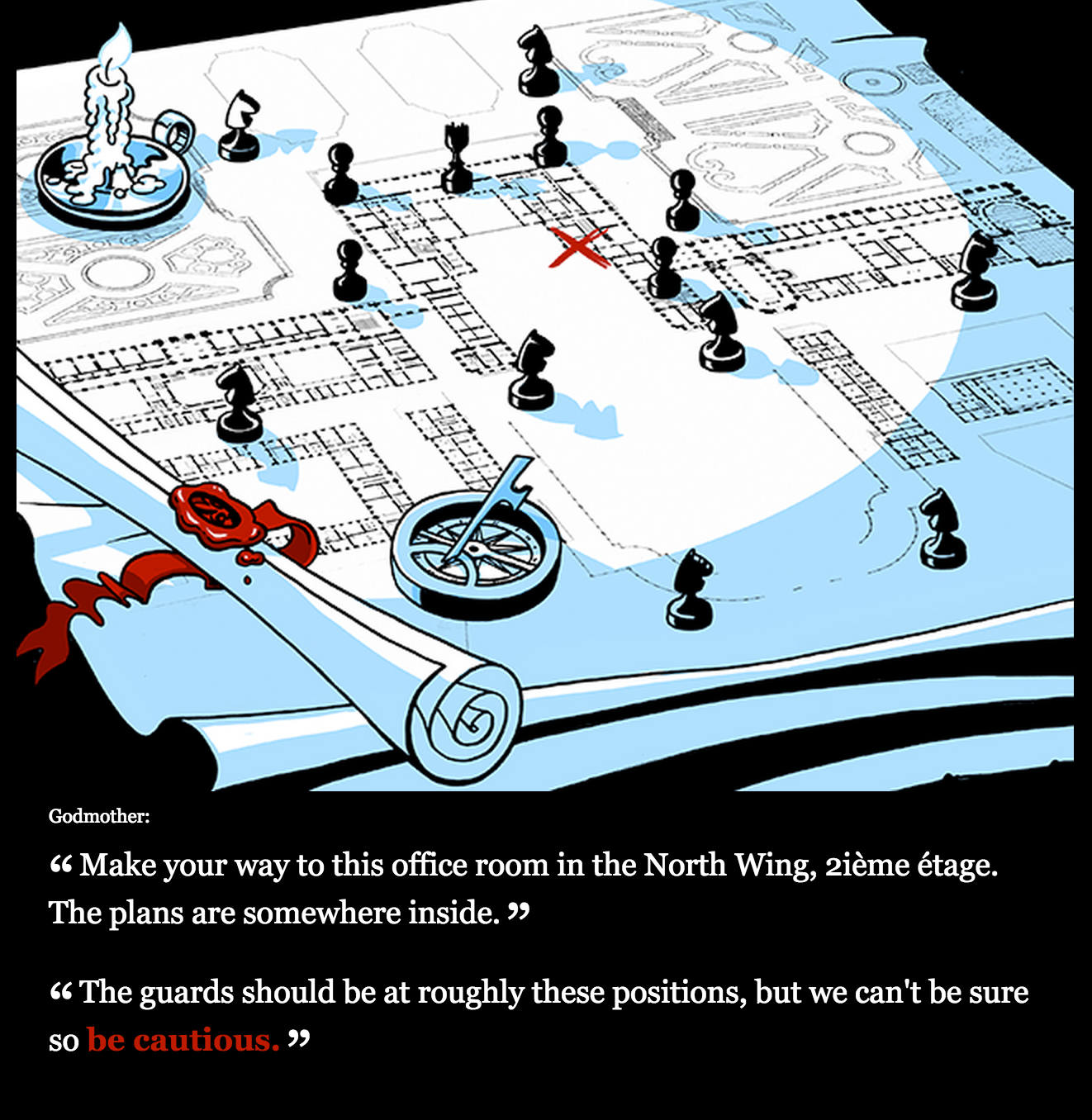
Besides having a map, Secret Agent Cinder uses illustration as a primary channel for storytelling: the pictures aren’t just a gloss on the text, but give key information about, say, the locations of guards. If you don’t pay attention to them, you’re likely to get caught. Many of the jokes are embedded in the imagery as well; it plays more like an interactive web comic than most things I can think of.

Mildly spoilery discussion of the humor follows the break.

Continue reading “Secret Agent Cinder (Emily Ryan)”

Windhammer Prize: ‘Normal Club (Philip Armstrong)

Screen Shot 2015-08-26 at 5.08.12 PM

The Windhammer Prize is a yearly competition for gamebooks, specifically the on-paper, distributed-by-PDF variety. Last year I covered a few of the games, and this year the competition is about to open again, so I thought I would honor the occasion by looking at Philip Armstrong’s ‘Normal Club, the winner of the top prize in 2013. (Past entrants are archived on the competitions site.)

The image I’ve used as the header illustration for this post is a map of the town you’re exploring, and it contains some information (besides the numbers themselves) that you may need to use to solve the adventure. Its cartoony but confident feel is a pretty good introduction to the experience as a whole: lighthearted, accessible, soundly constructed, with the game/puzzle side more prominent than the story side.

‘Normal Club here refers to paranormal research, which in this world is an after-school competitive activity like chess team or debate club. The protagonists are a Buffy-style Scooby gang, and you get to pick three of six prefab characters to include. This choice determines your gang stats and opens up a number of character-specific extra paragraphs throughout the story. For any given situation, one or two of the gang members might have a personal response.

As one might expect, the resulting narrative uses characterization mostly as a spice, and none of the protagonists can afford to have unique motivations that might cause a surprise swerve in the MacGuffin Quest. Likewise, most of the choices you encounter, up until the very end, are tactical rather than moral decisions.

Like many gamebooks, ‘Normal Club starts with some forms to fill out with these stats, and spaces for inventory. Initially I tried to play using the online PDF and just keeping my notes in a notebook, but that was a mistake, for reasons I’ll get into at the moment. If you want to play, you probably need to print this thing off. (It runs to 45 pages, so this isn’t insuperable, but I usually avoid printing longish documents for the sake of the planet.) You will also need a 6-sided die or a reasonable online facsimile.

The discussion below isn’t all that spoilery, but if you want an innocent first experience of this book, you may want to stop here.

Continue reading “Windhammer Prize: ‘Normal Club (Philip Armstrong)”

Conversations We Have In My Head (Squinky)

Screen Shot 2015-08-08 at 10.21.01 PM

Conversations We Have In My Head is a very short, real-time dialogue game by Squinky, describing a conversation between a genderqueer protagonist (Quarky) and their ex (Lex). As the player, you’re choosing responses Lex can make to Quarky’s revelations and questions; new options come and go on the screen. This gives the game a smooth, relaxing quality — this is an odd analogy, perhaps, but it felt a bit like a driving game to me, in which you’re looking at the scenery sliding by and deciding which way you wanted to steer, but didn’t have any brakes.

If you want, you can be totally silent and just listen to Quarky monologue about the changes in their life. Or you can offer lots of feedback, or even more or less wrest the conversation around to yourself on a regular basis, reminding Quarky of the differences between you and of harm done in the past. I like the way this flows, though after about the fifth playing I started to wish I could fast-forward to important junctions in order to try some of the alternatives. Still, the game is so compact that even re-listening to the same opening doesn’t slow things down too much.

Squinky includes the following paragraph in their description of the game:

Many of us have voices in our heads that constantly remind us of our perceived failures and inadequacies. Sometimes, those voices appear to us in the form of a once-important, now-estranged person from our past. This is a game about having one of those conversations with that voice in your head, and the many ways it can go.​​

Despite the conflict implied in this paragraph, I found that the majority of the conversations I generated with Conversations We Have In My Head were net positives, rather than negative reflections on the protagonist or on what happened in the past. Perhaps growing up and coming to know themselves better has opened the possibility that the characters might be kinder to one another and keep things in better perspective than they used to. There are of course some exceptions.

Continue reading “Conversations We Have In My Head (Squinky)”

Neon Haze (Porpentine, Brenda Neotenomie)

Screen Shot 2015-08-11 at 2.12.21 PM

Neon Haze is this week’s release at Sub-Q Magazine.

A side note: If you are interested in IF, especially Twine IF with a speculative fiction focus, you should be paying attention to Sub-Q: it’s an ambitious venture, a website with stories and interviews that pays pro rates for interactive fiction. It provides some resources for matching storytellers with people who can implement content for them, if the author doesn’t already have those skills. The guidelines would allow for parser IF, but possibly they simply haven’t been offered any so far that met the other requirements. Sub-Q is paid for by memberships and donations, but it’s free to read; I’d like to see it continue, though, so I’ve signed up.

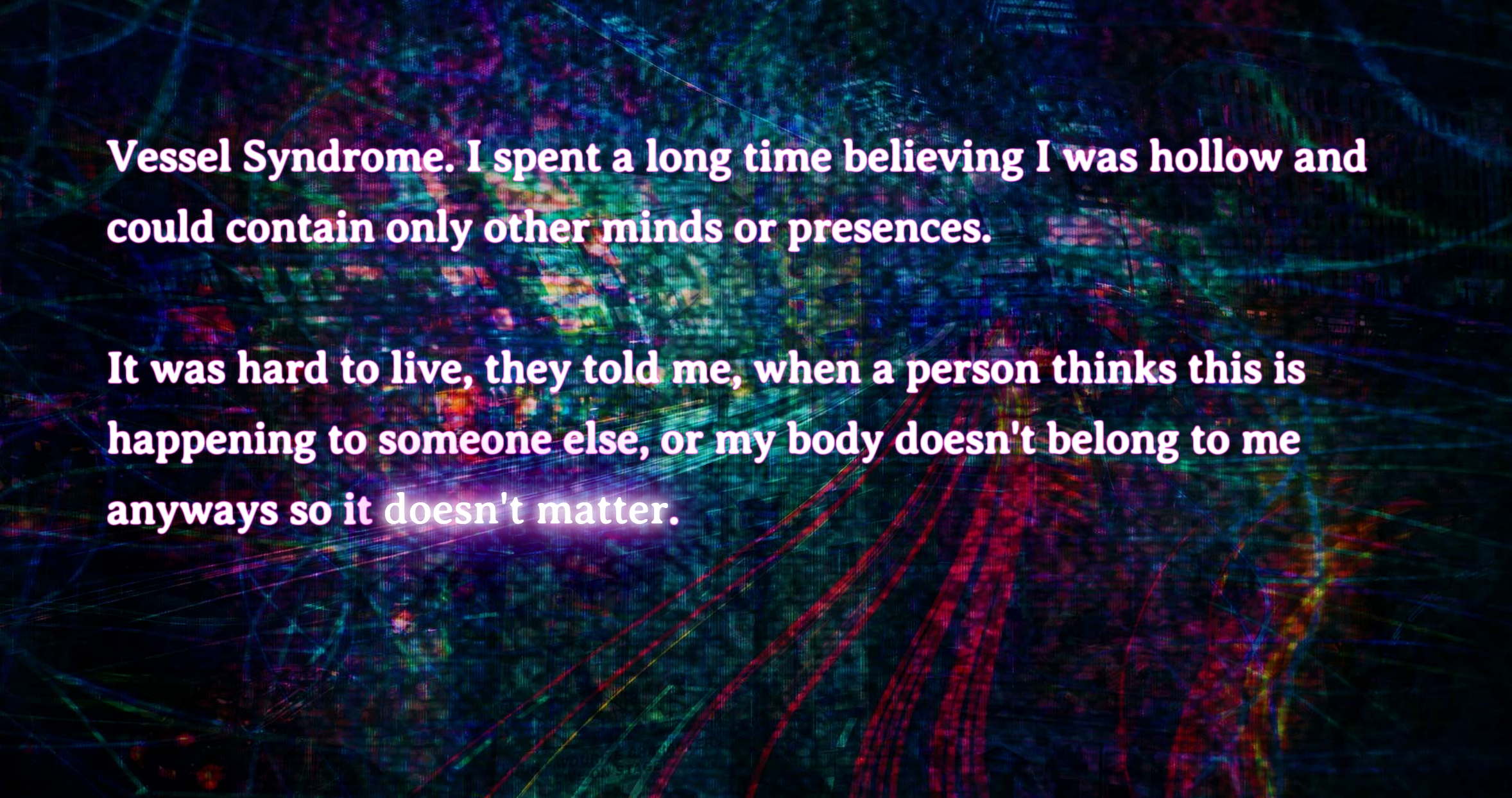
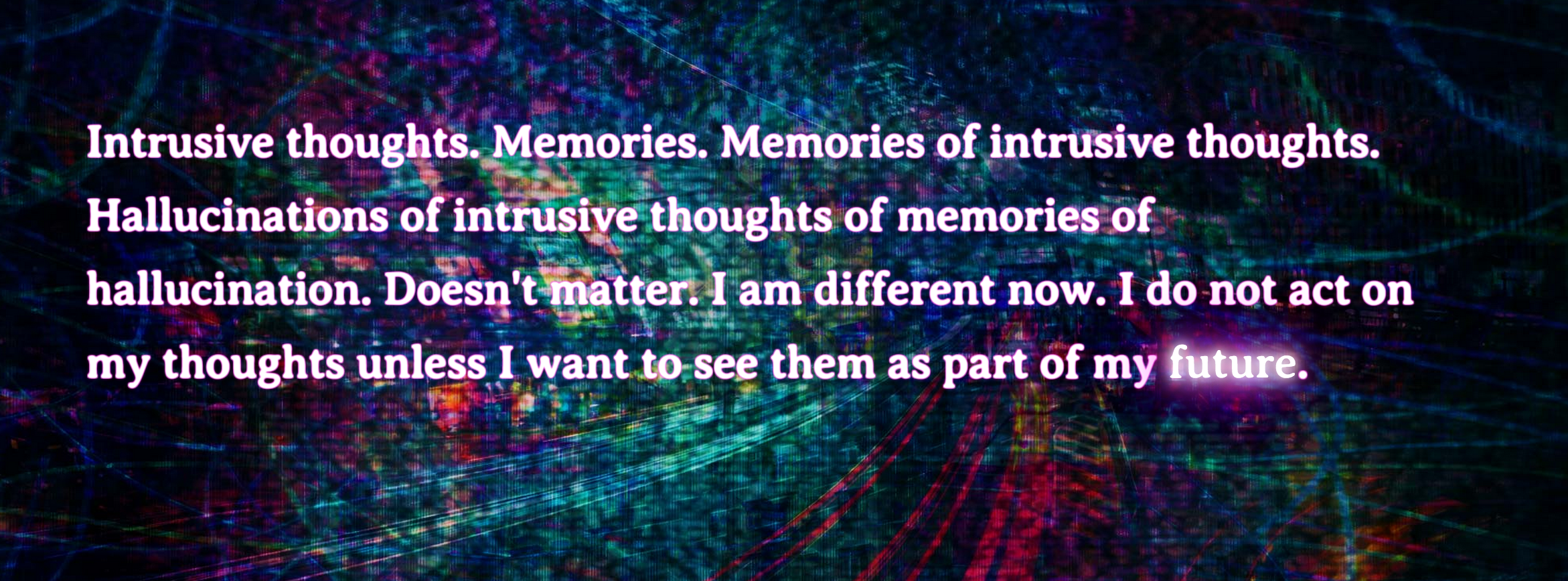
So, Neon Haze. It is the story of someone living in a dark-rainy-night-plus-neon kind of environment. The protagonist suffers from Vessel Syndrome, a condition that produces a sense of not really being oneself, or not being in one’s own body; a sense of being occupied by other spirits. Sometimes they seem to dissociate. Often they use language drawn from therapy sessions to describe their experience.

One of the game’s key moments comes when you’re allowed to choose which of two people you were in a scene: someone safe and surrounded by friends, or an outcast who has gotten into a fight? Whichever you choose, the game does not contradict you, and either way provides an interesting way of understanding the situation. Perhaps the protagonist has always been an outsider and imagining themselves as someone different and safe was a way to escape that experience. Or perhaps the protagonist comes from a background of safety that is now lost, one in which they acted entitled and did not understand how difficult things could be elsewhere, on the outside.

Screen Shot 2015-08-11 at 2.17.38 PM

The story is supported by CSS effects that make the links glow on the page against a dark cityscape, and by Neotenomie’s music, which loops and hums with seductive energy. Sometimes, at least for me, the music was more than a mood-setting device. It communicated hope, or perhaps some not-quite-hope will to live, even when the text itself was describing a bleak situation.

Continue reading “Neon Haze (Porpentine, Brenda Neotenomie)”

IntroComp 2015

IntroComp is a yearly IF competition which invites participants to send in the first part of a game. Judges vote on how much they would be interested in playing the rest of the submitted game, and authors who finish and release their pieces within a year are eligible for a prize based on where they placed. The games for 2015 are currently available, and judging is open through August 21.

Below, thoughts on the pieces I ranked highest.

Continue reading “IntroComp 2015”