Choice of Magics (Kevin Gold / Choice of Games)

choiceofmagics.png

Choice of Magics is work from the author of Choice of Robots, one of Choice of Games’ most successful commercial projects. Choice of Robots was appealing to players for a number of reasons, especially the scope of the possibilities available to you and the sheer size of the project. It delivered a sense of narrative agency that a lot of Choice of Games’ audience really responded to. (Gold also wrote Choice of Alexandria, a smaller and more constrained story.)

Choice of Magics is in a similar mold to Choice of Robots: very large, at over half a million words, with room to customize your style of magic and confront different final challenges depending on how your story has developed so far. The story positions itself at that scale, too — the very first page lays out an absolute mass of background information about the current and previous state of the world, which most fantasy novels would be more likely to introduce gradually over the initial chapter or so.

The game also gives you the option of explicitly noting whenever you’re gaining and losing stats, right inline with the rest of the narration. And the stats page has been enhanced, with some special icons and more content than the average CoG stats page, including a journal of major plot points you’ve encountered — again, to help the reader track the game’s extensive machinery.

This foregrounding of mechanics carries through into the rest of the fiction as well. The story needs to rapidly introduce the five major schools of magic, so it runs you through an adventure scenario that teaches you about each in sequence, surprisingly rapidly.

Several of the world-building choices are quite tropey, which makes them generic but easy to communicate to the player in a hurry: there was a lost ancient civilization, they knew various magics, the magics are currently outlawed but you find your way to the ancient academy where you can recover tools and documents which are written in a muddle of Latin, Greek, and old versions of romance languages — played more for humor than for cultural resonance. At the same time, these ancients were also not so very different from modern people and had magical pseudo-airplanes and microwaves. It’s not quite the Great Underground Empire, but it has something of the same flavor.

Continue reading “Choice of Magics (Kevin Gold / Choice of Games)”

Mid-October Link Assortment

IF Comp judging is currently in progress — if you’d like to judge or review games, now is your chance to check that out and submit your votes.  Voting ends November 15.

The IGDA Foundation is now accepting 2019 GDC scholarship applications for aspiring and current game designers.  The opportunity for IGDA Scholars, IGDA Velocity, and IGDA Next Gen recipients will be open until November 30.

From Now – February 24, 2019, the Victoria and Albert Museum is featuring an exhibit on contemporary video games.

October 19-28 is the submission window for the fifth annual PROCJAM, seeking entries for generative software.

October 20 is the Oxford and London workshop in the Ren’Py tool for building visual novels.

There is a Seattle IF Meetup this month on October 21.   The group will be discussing IF Comp and playing through some games.

October 22 is the deadline for Saugus.net’s 21st Annual Ghost Story Contest.  They accept both traditional prose entries and IF.  Official rules can be found here.


Ectocomp is taking both Spanish and English-language submissions for their competition from October 26-30, but if you want to start work on your game through the site, it is open now.

October 27, the Baltimore/DC Meetup gets together.

November 3 is the next SF Bay IF Meetup.

November 10-11AdventureX will return, this time at the British Library. AdventureX is a conference focused on narrative rich games, whether those are mobile or desktop, text-based or graphical; it’s grown significantly in size and professionalism over the last couple of years. (Incidentally, they’ve published their exhibitor list and it’s pretty sweet.)

December 2 is the deadline for entering the Russian Language IF competition KRIL.

December 5-8 in Dublin is the next ICIDS, the international conference on interactive digital storytelling.

This is long in advance, but NarraScope is a recently-announced conference for IF and narrative games to be held in Cambridge, MA June 14-16 of 2019. Here’s how they describe it:

NarraScope is a new games conference that will support interactive narrative, adventure games, and interactive fiction by bringing together writers, developers, and players.

For users of   ‧ AGS ‧ ChoiceScript ‧ Hypertext ‧ Inform ‧ Ink ‧ Quest ‧ Ren’Py ‧ Storyspace ‧ TADS ‧ Twine ‧ …add yours? ‧

“Interactive fiction” has many meanings. It describes many kinds of games and many diverse communities of practice. It’s time to bring those communities together to hang out and chat exchange ideas!

For fans of   ‧ Zork ‧ The Walking Dead ‧ The Uncle Who Works for Nintendo ‧ Syberia ‧ Sorcery! ‧ Portal ‧ Photopia ‧ Patchwork Girl ‧ Oxenfree ‧ Myst ‧ Meanwhile ‧ Loom ‧ Lifeline ‧ Howling Dogs ‧ Gone Home ‧ 80 Days ‧ Dream Daddy ‧ Device 6 ‧ Counterfeit Monkey ‧ Choice of Broadsides ‧ The Blackwell Legacy ‧ Analogue: A Hate Story ‧ Adventure ‧

We are still finalizing the details of the venue and schedule. We expect to be in Cambridge, in coordination with MIT’s Comparative Media Studies and Writing department. A call for speakers and talk proposals will be posted soon.

*

Continue reading “Mid-October Link Assortment”

The Red Strings Club (Deconstructeam) and Minigame Conversation

Screen Shot 2018-08-29 at 9.58.46 PM.png

The Red Strings Club is a cyberpunk narrative experience about fate and happiness featuring the extensive use of pottery, bartending and impersonating people on the phone to take down a corporate conspiracy.

The Red Strings Club was recommended to me by a reader who explained that this was a game that used mixology as its conversation interface. If you want someone to talk to you, you make them a cocktail.

That does really sound like my kind of thing, I have to admit. I have written multiple prototype games, all of them sadly occupying dusty corners of my hard drive, that were based on some variation of “you have to mix evocatively-described liquids together in order to elicit information.” In one, it was a form of scrying with magical ingredients. In another, you were going to custom mix perfumes for yourself to wear to social events in order to subtly influence the conversation of the nobles around you. In a third, your choice of how to weight components in the mixture was going to drive the probabilities in generated descriptive text, so if you used a lot of one liquid you might become more perceptive about physical qualities, or a lot of another liquid would reveal memories.

None of these projects ever got finished. The perfumes one didn’t get further than an “oh I think I see how I’d do that” level of spec. But what appealed to me was a combination of challenge, physicality, and expressiveness

The challenge would have to do with the mixing rules: you might find that the ideal potion to scry out the murderer was one requiring ingredients that reacted horribly together, and you’d need to find a way to mix them safely.

The expressiveness would arise from the fact that you’re combining several elements into a single choice, and they could carry different axes of information. Imagine a perfume in which the top and heart notes express the noun and verb of action, the “what are you doing” portion of the command, while the base note expresses how you feel about it, a touch of protagonist characterization. Patchouli for the earnest, unguarded, irony-free. Sandalwood if you’re old enough to know better but not quite old enough to be genuinely subtle. Myrrh for bitterness. Vetiver for an inscrutable smirk.

It’s too rare in games that we’re allowed to say whether we take an action eagerly, or joyfully, or with reservations, or because we can think of no alternative.

Anyway. That is a very long preamble to say: that is not how The Red Strings Club works at all.

Continue reading “The Red Strings Club (Deconstructeam) and Minigame Conversation”

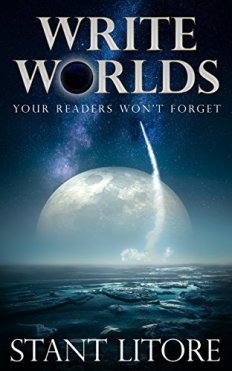
Write Worlds Your Readers Won’t Forget (Stant Litore)

51v0a2EYVGL.jpgI’ve written already about some of the world building books I’ve worked with in the past. Stant Litore‘s Write Worlds Your Readers Won’t Forget is relatively new — published late 2017. It’s not a game writing book specifically, but is meant for anyone in the speculative fiction space. It’s also quite compact, about a hundred and fifty pages, and meant to be used, with a sequence of exercises for the reader. More than that, even though it’s a book about world-building, it’s focused on the plot and character implications of what you’re doing:

This book treats worldbuilding as a process for conflict and exerting pressures on your characters. Unforgettable characters live unforgettable stories that are made necessary and possible by unforgettable worlds they are trying to survive and thrive in.

So though this is a book for writers and not for interactivity, it’s bringing in some of the same worldbuilding motives as a tabletop game like Downfall.

In addition, Litore immediately identifies two approaches to worldbuilding: the Tolkien approach, where you start at the ground level in some particular area. And he correctly points out that this is even more difficult than most people give credit for:

It is theoretically possible for you to create an unforgettable imaginary world in the same way that JRR Tolkien did if you have an advanced education or deep training in one particular field relevant to worldbuilding, plus an inquisitive mind that is always asking questions about how your area of expertise informs and is informed by others. For example, if you are a gifted economist, you might begin building a world from the ground up if you start by designing a unique and detailed, though fictional economy…  This kind of deep dive is rare because it requires more than just a “research phase” to inform a novel or screenplay. It relies on committed, dedicated expertise and conversation with other experts in that area of knowledge.

I found that pretty interesting because of my own interest in the idea of research art — but also a strong argument for why not all worldbuilding on all projects needs to go the Tolkien route. And certainly most of mine doesn’t.

Instead, Litore recommends the approach of inserting an importantly different detail in each of three areas: the physical conditions of a world and the requirements of surviving there; the biology and the creatures who live there; and the culture that persists there. He then devotes several chapters to unpacking each of these techniques.

Continue reading “Write Worlds Your Readers Won’t Forget (Stant Litore)”

End of September Link Assortment

ifcomp.png

IF Comp is here!  As of October 1, games are public and will be available for play and review.  Voting ends November 15.

From Now – February 24, 2019, the Victoria and Albert Museum is featuring an exhibit on contemporary video games.

On October 3, Tellables CEO Amy Stapleton is speaking on conversational storytelling at Digital Book World in Nashville, TN.  Stapleton also writes the Voice First Fiction blog.  The conference runs October 2-4.

October 6 is the next SF Bay IF Meetup.

October 6 is the Oxford and London gathering to play games from IF comp.

Also October 6-7, Roguelike Celebration is coming up in San Francisco — this is obviously a bit different from IF material, but there’s some interesting procedural storytelling work that comes up in this space. This year their speakers include Tarn Adams, Pippin Barr, and Max Kreminski, all people who have turned up on this blog/in IF circles before.

October 11 is the next Boston IF Meetup.

October 12-14, Worcester Polytechnic Institute is hosting the Different Games Collective, focusing on diversity and inclusivity in games.

October 19-28 is the submission window for the fifth annual PROCJAM, seeking entries for generative software.

October 20 is the Oxford and London workshop in the Ren’Py tool for building visual novels.

October 22 is the deadline for Saugus.net’s 21st Annual Ghost Story Contest.  They accept both traditional prose entries and IF.  Official rules can be found here.

Ectocomp is taking both Spanish and English-language submissions for their competition from October 26-30, but if you want to start work on your game through the site, it is open now.

November 10-11AdventureX will return, this time at the British Library. AdventureX is a conference focused on narrative rich games, whether those are mobile or desktop, text-based or graphical; it’s grown significantly in size and professionalism over the last couple of years. (Incidentally, they’ve published their exhibitor list and it’s pretty sweet.)

December 2 is the deadline for entering the Russian Language IF competition KRIL.

December 5-8 in Dublin is the next ICIDS, the international conference on interactive digital storytelling.

This is long in advance, but NarraScope is a recently-announced conference for IF and narrative games to be held in Cambridge, MA June 14-16 of 2019. Here’s how they describe it:

NarraScope is a new games conference that will support interactive narrative, adventure games, and interactive fiction by bringing together writers, developers, and players.

For users of   ‧ AGS ‧ ChoiceScript ‧ Hypertext ‧ Inform ‧ Ink ‧ Quest ‧ Ren’Py ‧ Storyspace ‧ TADS ‧ Twine ‧ …add yours? ‧

“Interactive fiction” has many meanings. It describes many kinds of games and many diverse communities of practice. It’s time to bring those communities together to hang out and chat exchange ideas!

For fans of   ‧ Zork ‧ The Walking Dead ‧ The Uncle Who Works for Nintendo ‧ Syberia ‧ Sorcery! ‧ Portal ‧ Photopia ‧ Patchwork Girl ‧ Oxenfree ‧ Myst ‧ Meanwhile ‧ Loom ‧ Lifeline ‧ Howling Dogs ‧ Gone Home ‧ 80 Days ‧ Dream Daddy ‧ Device 6 ‧ Counterfeit Monkey ‧ Choice of Broadsides ‧ The Blackwell Legacy ‧ Analogue: A Hate Story ‧ Adventure ‧

We are still finalizing the details of the venue and schedule. We expect to be in Cambridge, in coordination with MIT’s Comparative Media Studies and Writing department. A call for speakers and talk proposals will be posted soon.

*

New Releases

baroque408.png

Mad science raised you from the dead!  William Brown’s 200,000-word interactive Gothic horror novel Mysteries of Baroque is the latest title on Choice of Games.

Charles A.F. King has released the underwater adventure Soviet Seafloor Station Ustritsa, a Choose Your Own Fate gamebook set in the Cold War-era Atlantic.

Lamplight City is a point-and-click detective adventure with a steampunk flavor, just recently out.

Google also has made an easter egg text adventure which you can find if you follow the instructions outlined here.

Articles and Podcasts

Bruno Dias talks about writing scenes in IF.


Crowdfunding

The Colossal Fund is raising money for IF Comp prizes this year, and also to support the regular work of the IFTF — including archive support, Twine development, and accessibility improvements for interactive fiction games and tools.

You may also like the look of Nighthawks, the Vampire RPG, featuring the writing of Richard Cobbett (Fallen London, Sunless Sea, et al) and created by Wadjet Eye (numerous point-and-click adventures).

Publishing

Mythaxis is seeking IF to include in its upcoming February 2019 issue; however, it does not pay.

IF for certain moods, and a couple of IntroComp games

This was originally just going to be a post about IntroComp — I wrote it up a little while ago and scheduled it. But the post as originally written now feels slightly tone-deaf; I’m feeling a bit emotionally drained and stressed by the past week in American politics, and I know a lot of my friends are too. So if you’re in a similar place:

If you could use something warm and fuzzy to play right now:

  • S. Woodson’s Beautiful Dreamer and Magical Makeover are gentle but engaging fantasy.
  • Many of Ryan Veeder’s works are playful in a cozy way, especially Dial C for Cupcakes.
  • Brendan Patrick Hennessy’s work is full of teenagers figuring out how to treat each other better, and is also frequently very funny. If you haven’t played the four-part Known Unknowns, now might be a good time for that.
  • Steph Cherrywell‘s games are full of young women winning out and having adventures.
  • Tentacles Growing Everywhere (Dietrich Squinkifer) is a short-ish game about alien puberty that I found pretty sympathetic.

If you need something smart and funny:

  • Reigns: Her Majesty is all about female negotiations of power, and the accommodations made to deal with it.

If you need something visceral about trauma and survival:

If you need something about the long game of politics and the role of women:

  • Liza Daly’s Harmonia is a story about utopianism and the experience of women, past and present.

Continue reading “IF for certain moods, and a couple of IntroComp games”