Fast-Paced Parser Games

Most parser games tend to keep a pretty stately pace, allowing the player to move around and explore, and only ratcheting the plot forward in response to player actions. There are exceptions, though: a handful of pieces describe a world already and continuously in motion, or cut rapidly from one scene to another with just a few moves in each — presenting an experience paced more like a film than like Adventure.

Quite a few of these are by J. Robinson Wheeler, which is unsurprising given that that style is a bit of a specialty of his (perhaps reflecting the fact that he’s also a filmmaker and takes a cinematic approach to his IF stories).

moonbaseMoonbase Indigo, J. Robinson Wheeler. Inspired by Moore-era Bond, with a lot of the tropes you might expect in that context.

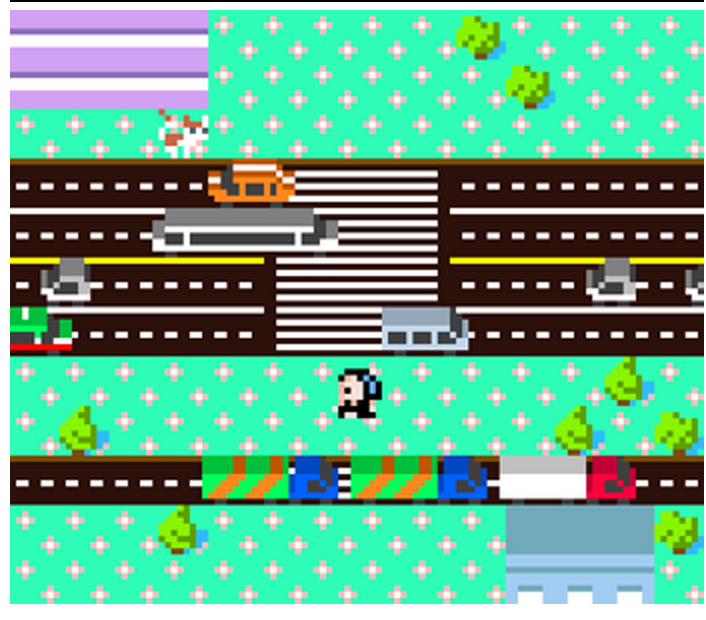
Centipede, J. Robinson Wheeler. A Starship-Troopers-esque reinterpretation of the classic arcade game.

The Tale of the Kissing Bandit, J. Robinson Wheeler. Playful, lightly romantic.

Being Andrew Plotkin, J. Robinson Wheeler. If Being John Malkovich where about zarf, instead. There are a fair number of community and classic IF in-jokes in this one, but also some entertaining riffs on different narrative styles.

Everybody Dies, Jim Munroe. Touches of both realism and mysticism, together with some excellent illustration.

Guilded Youth, Jim Munroe. Told through a series of vignettes that take place both on and off-line.

Dial C for Cupcakes, Ryan Veeder. There are some puzzles in this one, but also a fair amount of scene progression. As is typical for Veeder’s games, the puzzles are not tremendously hard.

Attack of the Yeti Robot Zombies, Øyvind Thorsby. The conceit of this game is that you’re meant to play once and never undo. If you commit to an action, you’re stuck with it.

Andromeda Dreaming, Joey Jones. Most of the games set in Marco Innocenti’s shared Andromeda world are fairly puzzle-based, but this one focuses more on an unfolding story.

If this sort of thing interests you, see also: IFDB poll for Autonomic Narration (where you can also add your own suggestions).

Games about Community: Ohmygod Are You Alright? (Anna Anthropy), Hana Feels (Gavin Inglis), Tusks (Mitch Alexander)

Screen Shot 2015-09-11 at 5.02.00 PMOhmygod Are You Alright? is a flash-augmented Twine piece by Anna Anthropy about the experience of being hit by a car and the recovery process afterward. The details of physical pain and the dehumanization of the hospital are unpleasant enough, though I suppose they could have been even worse.

But the game’s most lasting and unresolved pain pertains to how Anna feels about her community: lonely, cut off from support, no longer enjoying the energy and communal celebration of her earlier time with Twine. She touches on this in the ruleset for A Wish for Something Better, but Ohmygod goes into it more deeply. She mentions feeling surprised by the forlorn hope that being hit by a car will make people pay attention again. There’s wistfulness, too, about having been at the forefront of a movement that now contains a lot of other practitioners.

If games are not great at NPCs and individual relationships, they’re often downright terrible on communal responsibility and community formation, but Ohmygod made me think about two other games I’ve played recently that touch on the function of community in our lives.

Continue reading “Games about Community: Ohmygod Are You Alright? (Anna Anthropy), Hana Feels (Gavin Inglis), Tusks (Mitch Alexander)”

Secret Agent Cinder (Emily Ryan)

Screen Shot 2015-09-11 at 12.24.13 PM

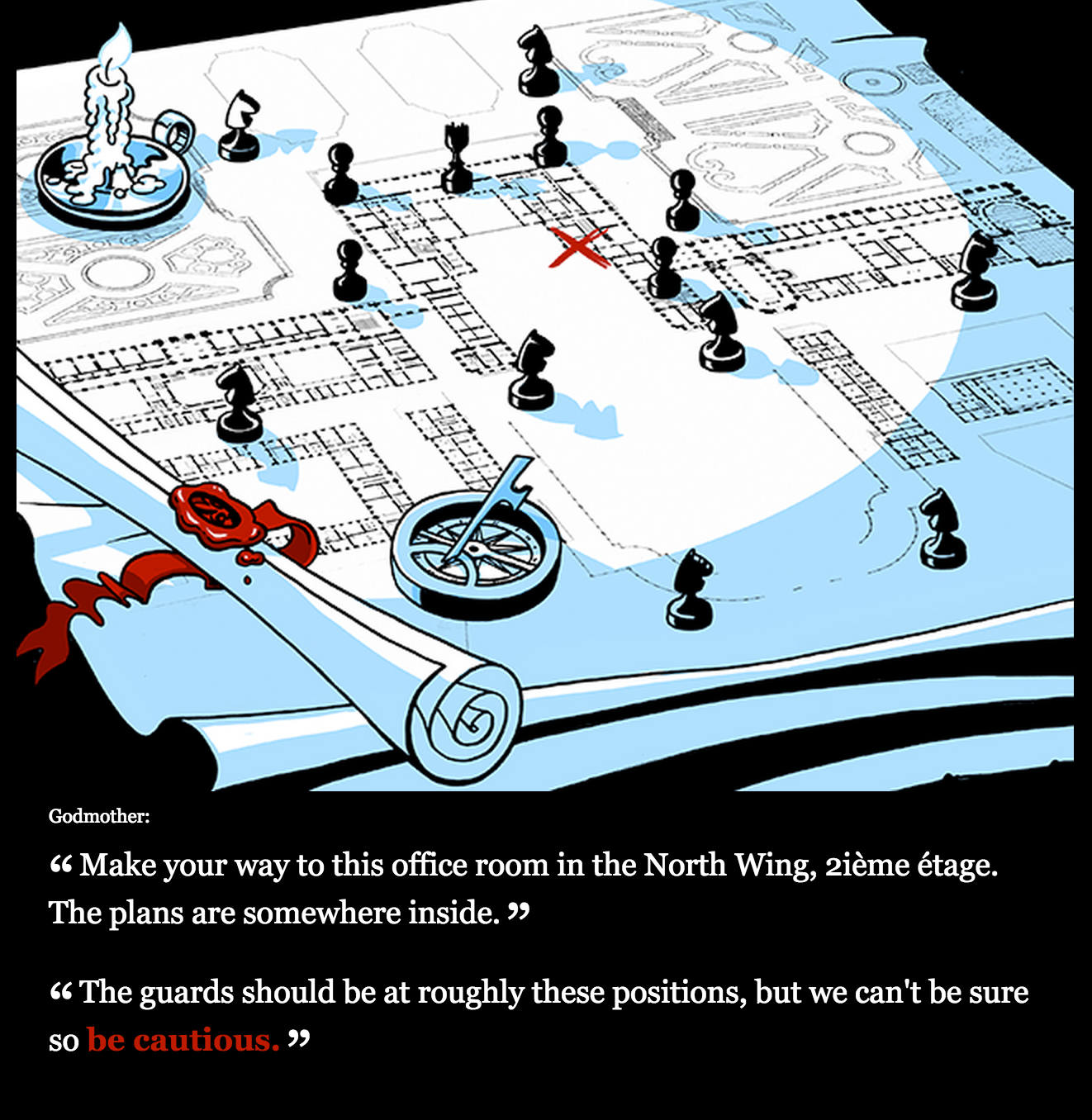
Secret Agent Cinder is a retelling of the Cinderella story, except not: though you dress up and dance with fancy people, it’s really about espionage and sneaking about at Versailles shortly before the French Revolution.

It belongs to that small but growing category of Twine games — with Hallowmoor, Krypteia, and This Book is a Dungeon — that feature a world model and a map you can get to know. There are some light puzzles, and you can reach a sudden bad ending, though the game will then automatically restore you to the last reasonable checkpoint to replay. At the end, you get a rating for your stealthiness, revolutionary violence, and zeal. The result is short, polished, accessible, and quite a lot of fun.

Besides having a map, Secret Agent Cinder uses illustration as a primary channel for storytelling: the pictures aren’t just a gloss on the text, but give key information about, say, the locations of guards. If you don’t pay attention to them, you’re likely to get caught. Many of the jokes are embedded in the imagery as well; it plays more like an interactive web comic than most things I can think of.

Mildly spoilery discussion of the humor follows the break.

Continue reading “Secret Agent Cinder (Emily Ryan)”

Private Games

This is the talk on Games and Intimacy that I gave at Now Play This on Friday.

*

Many of my favorite games to write have been written for specific people.

As indie designers, we talk about writing for the market (which involves a lot of guessing, because who can read the minds of the masses?) or writing for ourselves, to create the game that we most want to play or the game that expresses some deep-held belief or the game that fits our artistic vision. And then a lot of people sink their teeth into one of those approaches and growl at anyone who tries to take it away. Like it’s not realistic to write for yourself, or it’s not honest to write for a large audience.

But there’s a third option, which is to write for a specific recipient or a small group of recipients that you know personally. And that’s actually how a lot of us start, of course. The first computer game I ever completed, I wrote for my little brother because he was bored with math. It was a dungeon where the monsters asked you arithmetic questions as a form of combat. Astonishingly he liked it, which shows you something about the power of personalization.

* For someone else’s friend

Once as part of a charity auction, I auctioned off a small work of custom interactive fiction. The person who bought it asked me to write a game for her brother. She told me about the kinds of games he liked to play and the puzzles he’d enjoyed in the past, and she asked me to set it in a particular fan universe I’m also fond of.

Even though I didn’t know the recipient myself, I really enjoyed working on this project. Game design best practices are often about trying to suit the largest number of people and accommodate different play styles, but when you have one person in mind, when you know what that person likes to do in games, you know what that person is likely to find funny, you can calibrate every aspect so much more tightly. The game rewards are rewards FOR YOU.

* For a collaborator, then the general public

One of my larger on-going projects is providing support for the text adventure tool Inform 7. One of the things I do for that project is provide small — in some cases really tiny — example games, showing off all kinds of code functionality. Over the years I’ve written nearly five hundred of these, and while they were written for the broader Inform community in the long run, their first reader has always been my collaborator on the project, Graham Nelson. So I want to make them amusing and enjoyable in general, but there has always been that additional point of wanting to entertain him personally — especially since he was often reading over the examples I submitted as break from doing some boring or arduous batch of bug-fixing.

And, full disclosure, partway through this project I married him, so we have a lot of shared history.

The result is that those example games are now like a stratified record of shared references, TV shows we were both watching, places we’ve been on vacation, disagreements we were having about game design.

* For a friend

Many years ago some of my friends and I got really into buying and trading perfume oil from Black Phoenix Alchemy Lab. If you’re not familiar with this, it’s an online perfume shop from which you can buy tiny bottles of perfume oil with names like Tezcatlipoca and Severin. Their perfumes are designed after Neil Gaiman characters and voodoo spirits and ancient lost cities; the descriptions of their perfumes are some of the most evocative advertising copy on the internet. And they send samples, but you can never get samples of everything because their product line runs to the hundreds, or maybe even the thousands at this point.

So my friends and I would order these perfume samples, keep the ones we liked, and swap the ones we didn’t like. At one point, I’d decided that when I mailed perfume samples to my IF-loving friends, I would also send along some tiny little IF games that were based on the scents. It felt like a more creative way of doing a review, which had been our custom up to that point.

To a friend who wrote gorgeous surreal IF, I sent a little interactive machine room in which the devices controlled different scent notes. That friend has a really lovely, spare prose style, so I found myself concentrating on my prose, trying to make it worthy of the recipient.

To another friend who was a Harry Potter fan and Snape enthusiast, I sent a small scene set in the Potions classroom, in which the samples I was sending were all Potions ingredients. If you solved its main puzzle and figured out which of the three perfumes I personally liked best, you got an ending that shipped two characters she liked to see together.

One of the things I look for when I’m writing is the moment when a passage rings true. This is so much an intuitive measure that I can’t provide any objective qualifiers for it. It’s different from thinking that something is clever or funny when I write it, though: instead it’s an experience I have when I’m reading it back, and think, “Yeah, that’s right.” What I write for specific people, though, has to ring true in the context of what I know about them.

This is not the kind of game I’d ever write and release for the general public, even if there were some niche audience of Snape-loving BPAL fans who happened to have the exact same three perfume samples that I put in the game, but in the context of this particular friendship it felt really cool.

It was a goofy way to spend a couple of afternoons on vacation. I never would have written those pieces for myself. They were like letters, and had as much to do with the recipient as with me.

Continue reading “Private Games”

Lithomobilus / NonBinary Review / The Strangely-Browne Episode

IMG_0150Lithomobilus is a free reader app that advertises itself as being for non-linear storytelling:

Lithomobilus is the first e-book platform that augments existing narrative forms and makes entirely new nonlinear narratives, without eliminating the things that make books wonderful. Our online writing software gives authors the power to expand upon their existing works, create new works with built-in expansion opportunities, and craft amazing nonlinear works.

Currently the content includes five issues of the NonBinary Review, one issue of Unbound Octavo and a few standalone stories. NonBinary Review takes existing, public domain work and sets it side by side with response material from current authors; so far these include The King in Yellow, Bulfinch’s Mythology: The Age of Fable, The Wonderful Wizard of Oz, Frankenstein, and Grimm’s Fairy Tales. Unbound Octavo contains three short prose pieces that, as far as I could tell, could have been presented in a standard ebook format with no loss of structure.

Meanwhile, the pitch to readers is as follows:

When you are consumed by a story, you can never get enough. You want more characters, more details, more commentary, more of what makes that book addictive. The Lithomobilus e-book platform delivers it all without taking you away from your book.

Which isn’t that far off from the pitch for the Coliloquy novel I covered last month, but Lithomobilus takes a different approach to the same challenge.

Continue reading “Lithomobilus / NonBinary Review / The Strangely-Browne Episode”

A House of Many Doors (PixelTrickery)

City of knives screenshot

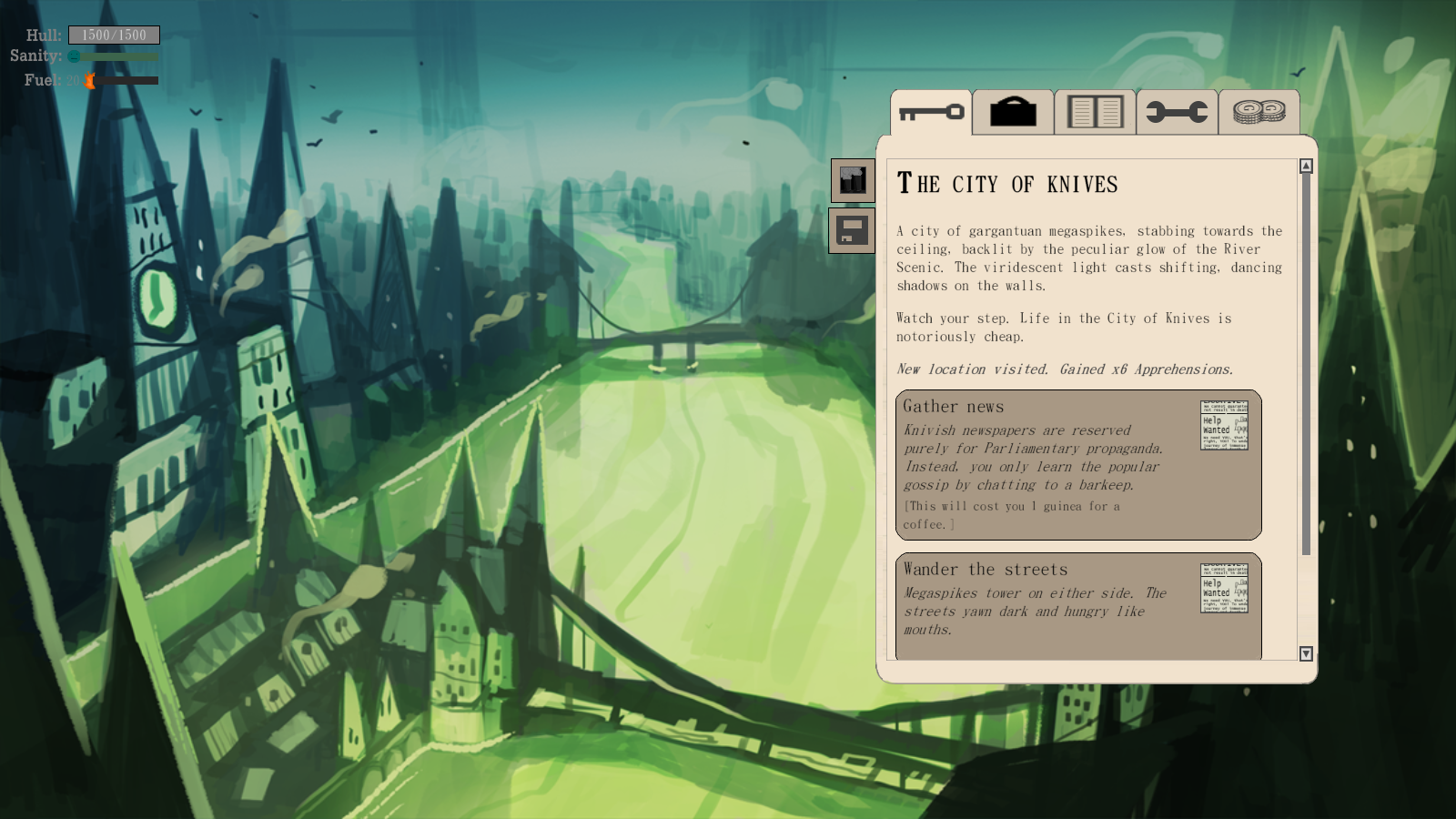
In A House of Many Doors you are an explorer, poet and spy. Mount an expedition to explore a vast dimension of procedurally-generated nightmare architecture. Assemble a dysfunctional crew, build their morale, uncover their secrets, and try desperately to keep them alive. Travel in a train that walks on mechanical legs, and write procedurally-generated poetry about the things you encounter.

The House is a parasite dimension. It steals from other worlds, and can contain almost anything within its endless walls. The player’s journey is a process of constant discovery – there’s always something strange around the next corner.

Kinetopede screenshot

Harry Tuffs is a member of the Oxford/London IF Meetup, and currently using incubation space at Failbetter Games. He’s just launched a Kickstarter for House of Many Doors, an IF + exploration game. The screenshots are a bit (or, in some places, strongly) reminiscent of Sunless Sea, but this is not a roguelike. I asked him for a bit more detail about the game, and he was kind enough to fill me in.

Continue reading “A House of Many Doors (PixelTrickery)”