Mailbag: Getting Beta-Testers for Parser IF

I know you’re busy, and hopefully you didn’t delete this as spam ;-)

I’m writing my first interactive fiction game. Although it’s not finished, I’m already looking ahead to finding beta testers – beyond the few friends I have who once way back when played the original Infocom games.

I imagine it takes time to establish the relationships necessary to get people to the point they’re actually willing to take a look. Do you have any advice?

An aside: I’m a computer programmer and using Inform 7. It’s a nice system, and I get it. But I am not familiar with the culture of IF users. (For example, the authors of the Inform manual mention how disabling the UNDO function when the story ends is anathema to many players.) Also, just understanding how to make beta-testers’ jobs easier in general would be nice.

A first step would be to hang out a bit at the intfiction forum or possibly euphoria (I haven’t been to the latter for a while, so I don’t know how active it is, but it’s more of a chat space). Introduce yourself, participate in a few conversations.

It sometimes helps to offer to beta-test for other people, for two reasons: one, it builds those social connections, and two, it familiarizes you with how other people typically do this. If you’re planning to enter a competition, sometimes there are threads in the weeks before the competition deadline where authors are offering to swap beta-testing, and that can also be a useful way to pick up help.

Alternatively, if you live near Baltimore, Seattle, San Francisco, Boston, or London, there is a live meetup that meets pretty regularly near you, and those can be a great place to cultivate connections more quickly. My link roundups twice a month list all the events I know of that are coming up in the near future, but you may already have seen these.

As for expectations and norms: it’s a good idea to read some reviews of recently released games, especially ones that might be similar to yours; they may help you work out what people are expecting and what goes over well or badly. You don’t have to take this as gospel, of course, and sometimes you just really want to do something with your work that isn’t in the expected range. That’s fine. But it can be helpful to know what people are looking for so that you’re not too surprised. One way to look for that information is to check out IFDB and find games in your genre/style and see what people wrote about those. You could also read through reviews from the latest IF Comp to get more of a cross-section view.

Suggestions for Testing is a fairly old article of mine, but as it’s about parser IF, a lot of the recommendations still hold. It talks about what testers might expect to do, and what authors might expect from testers.

Preparing a Game for Testing is about figuring out where your game is likely to present problems so that you can look at those yourself before you ship it off.

Mailbag: Adapting IF Skills to Adjacent Media

This is a follow-on answer to a previous mailbag post, specifically the part in which the questioner asks,

Would you have any thoughts on how to… improve the adaptive skills needed for bringing IF to newer formats and into audio?

I take this to mean not “how do I port an existing work to an interactive format” (which is also an interesting question), but “how do I do IF-like interactivity in formats other than text, especially audio?”

Key challenges for this, in my experience, center on these areas:

Continue reading “Mailbag: Adapting IF Skills to Adjacent Media”

Mailbag: Self-Training in Narrative Design

Big fan here—of your IF pieces and also of the way you’ve spread interactive fiction outside the IF community. I’m emailing to ask if you have any advice on IF education and bringing it to new platforms/media. 

[Some personally identifying information about the writer’s educational background redacted.]

As I move forward with securing workshop/speaking/consulting gigs, I’m feeling a slight panic that my base skills and knowledge of IF are somewhat lackluster. When it comes to a mastery of interactive thinking, I know that I have a lot of room to grow. 

Would you have any thoughts on how to flex those core IF muscles, and also improve the adaptive skills needed for bringing IF to newer formats and into audio?

Okay, so. This is a two-part question. I’m going to break it across two posts. This post will focus on “how do you flex core IF muscles.” I’ll come back next month to the question of skills for adaptation specifically.

The questioner asks about “a mastery of interactive thinking,” not about writing skills, so I’m going to assume the author feels comfortable on topics like prose and character development, and is more interested in understanding and practicing narrative design across multiple media. It also seems to be a design-focused question rather than a tools- or coding-focused question.

So I’ll try to tackle this from two angles: what are the things you might want to learn, and how might you learn them?

Finally, I should say: even with all the scoping-down I just did, this is a topic that I think would take a book to cover, not a single blog post. So the list of things you might want to know is at once very incomplete and unreasonably scary. No one will master all of it in a couple of months.

What I’d recommend doing, therefore, both to the OP and anyone else who is looking to use this as a guide:

  • Pick one or two areas that seem interesting to you and focus on those for a while; let your interest and enthusiasm be your guide
  • Use a mix of strategies to learn from other people (I list a bunch of approaches below)
  • Alternate between working with other people’s input/insights, and building your own thing. When something you’re reading makes an assertion you think is nonsense, build an experiment to prove the opposite. When something you play inspires you, give that a try. When you read a taxonomy of some kind, question whether it covers all the possibilities, and whether you can imagine categories the article-author didn’t consider (and would the results be any fun to play?)

Continue reading “Mailbag: Self-Training in Narrative Design”

Mailbag: AI Research on Dialogue and Story Generation (Part 3)

This is a continuation of an earlier mailbag answer about AI research that touches on dialogue and story generation. As before, I’m picking a few points of interest, summarizing highlights, and then linking through to the detailed research.

This one is about a couple of areas of natural language processing and generation, as well as sentiment understanding, relevant to how we might realize stories and dialogue with particular surface features and characteristics.

Transferring text style

Screen Shot 2018-08-25 at 2.27.27 PM.png

Style transfer is familiar in image manipulation, and there are loads of consumer-facing applications and websites that let you make style changes to your own photographs. Textual style transfer is a more challenging problem. How might you express the same information, but in different wording, representing a different authorial manner? Alter the sentiment of the text to make it more positive or negative? Translate complex language to something more basic, or vice versa? Capture the distinctive prose characteristics of a well-known author or a specific era? Indeed, looked at the right way, translation from one human language into another can be regarded as a form of style transfer.

Continue reading “Mailbag: AI Research on Dialogue and Story Generation (Part 3)”

Mailbag: Research on Dialogue and Story Generation (Part 2)

This is a continuation of an earlier mailbag answer about research that touches on dialogue and story generation. As before, I’m picking a few points of interest, summarizing highlights, and then linking through to the detailed research. In this section, I’m mostly looking at authoring tools and at academic theoretical work on interactive narrative.

This will not be comprehensive.

Authoring Tools for Dynamic or Procedural Storytelling

Several academic projects focus on building authoring tools for various types of dynamic or procedural storytelling, whether or not those are heavily augmented by AI. Many of these don’t rely on machine learning per se but do explore some other aspect of  the problem; in particular, several attempt to furnish the author with the means to build content for a planner-based storytelling system. But there’s a whole range of functionality here (and this is not a complete list):

Screen Shot 2017-04-23 at 9.26.07 PM

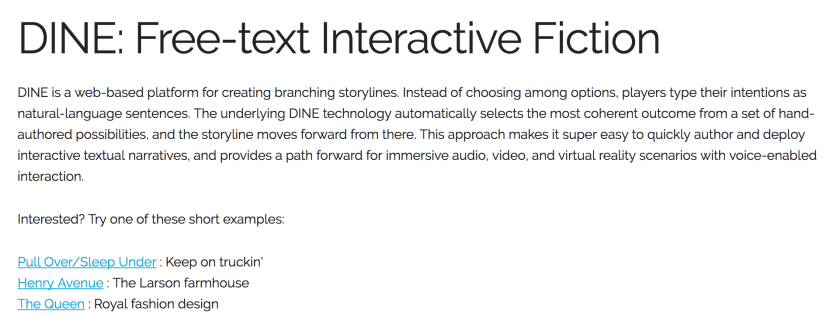
Andrew Gordon has done quite a bit of work around tools designed to assist authors with story creation ideas based on large corpora. I’ve written elsewhere about DINE, his interactive story authoring tool. DINE allows authors to describe the sorts of prompts that they want to understand, but uses its own models of language to determine whether a player’s input qualifies as matching a prompt. The result is less controllable but sometimes more robust than a standard interactive fiction parser. (“Sometimes” is the key word in that sentence.)

Screen Shot 2018-08-26 at 9.39.39 PM.png

Emma’s Journey is a project out of UCSC that combines fragments of choice-based narrative with a planner to create dynamic scenes. Individual pieces feel like they could have been done in Twine, but the selection and ordering of pieces is very dependent on current stats; and there is a distracting minigame for the player that also affects what options are available. This is built with the experimental StoryAssembler tool. There are also several associated research papers.

Continue reading “Mailbag: Research on Dialogue and Story Generation (Part 2)”

Mailbag: AI Research on Dialogue and Story Generation

I’m curious: do you follow much research that happens in stories and dialog these days? In the world of machine learning research, there’s much less in dialog and stories than other areas (e.g. image generation/recognition or translation), but once in a while, you come across some interesting work, e.g. Hierarchical Neural Story Generation (by some folks in Facebook AI).

For some years now I’ve followed work coming out of the UCSC Expressive Intelligence Studio; work done at Georgia Tech around crowdsourced narrative generation; game industry applications introduced or covered at the GDC AI Summit (though it is rarer to see extensive story-generation work here). I’ve also served on the program committees for ICCC and ICIDS and a few FDG workshops; and am an associate editor on IEEE Transactions on Games focused on interactive storytelling applications. Here (1, 2, 3) is my multi-part post covering the book Interactive Digital Narrative in detail.

That’s not to say I see (or could see) everything that’s happening. I tend to focus on things that look most ready to be used in games, entertainment, or chatbot applications — especially those that are designed to support a partially human-authored experience. I also divide my available “research” time between academic work and hands on experiments in areas that interest me.

So with that perspective in mind:

  • I’m not attempting a comprehensive literature review here! That would be huge. This coverage cherrypicks items
  • I will go pretty lightly on the technical detail since the typical readership of this blog may not be that interested, but I’ll try to provide summary and example information that explains why a given item is interesting in my opinion, and then link back to the original research for people who want the deeper dive
  • I’ll actually start by summarizing a bit the paper the questioner linked
  • Even with cherrypicking, there is a lot to say here and I am breaking it out over multiple posts

That Initial Paper

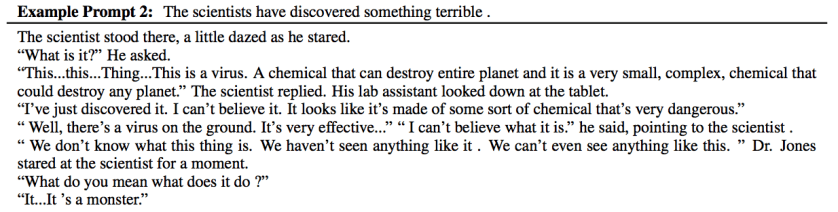
For other readers: the linked article in this question is about using a large dataset pulled from Reddit’s WritingPrompts board and a machine learning model that draws on multiple techniques (convolutional seq2seq, gated self-attention). After training, the system is able to take short prompts and create a paragraph or so of story that relates to the prompt. Several of the sample output sections are quite cool:

Screen Shot 2018-08-25 at 1.41.40 PM.png

But they are generating surface text rather than plot, and the evidence suggests that they would not be able to produce a coherent long-term plot. Just within this dialogue section, we’re talking about a tablet-virus-monster object, and we’ve got a couple of random scientist characters.

Continue reading “Mailbag: AI Research on Dialogue and Story Generation”