IntroComp is a recurring competition featuring game ideas that the creators are considering fleshing out into full games. This year’s crop includes a wide variety of styles.
IntroComp is an annual IF competition that invites authors to contribute partial and unfinished works for feedback. IntroComp 2019 is currently in progress, and if you’d like to check out the work here, you too can judge the entries.
Below the fold, some words on a few of the entries that I had time to play — but you may want to try them out yourself without spoilers.
Erica is an interactive film for the PS4, controlled by a companion app for your smartphone. It bills itself as a thriller: Erica’s father is murdered in a ritualistic way almost at the beginning of the game, and then we pick her story up again when additional murders begin to occur.
The smartphone app lets you control Erica with gestures. Indeed, the first thing you do in the experience is flick a lighter open and start the flame, using swipes of your phone screen. At other moments you might turn a faucet, wipe steam from a mirror, hover over items in a room that you want to interact with, or lead you to shift your focus.
These interactions reminded me of the touch-screen gestures used in Pry, or in The Secret Language of Desire. But I generally found Pry‘s gestural interactivity extremely evocative and focused on communicating a particular feeling or relationship to the events of the story. Erica‘s are a bit more “we’ll have you manipulate this briefcase latch because there just happens to be a briefcase in the story right now.”
At their best, those affective actions are tied into activities where the protagonist might take some time over the activity — opening a box that probably has something awful in it, say — and so, despite the linearity of the structure, the interaction at these moments is contributing something to the viewer’s sense of pace and complicity, in the same way that the forward links in My Father’s Long Long Legs tend to build up apprehension.
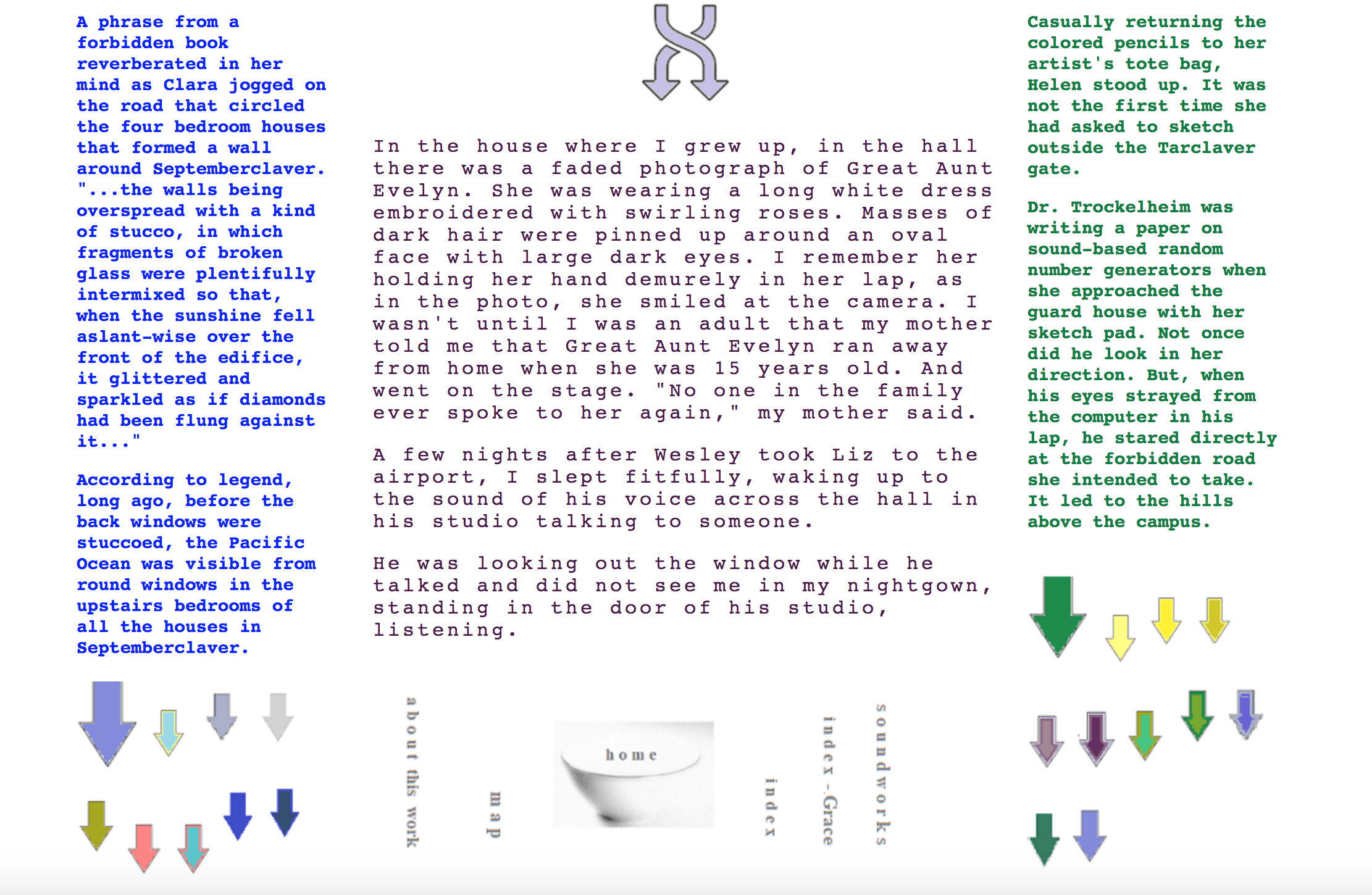
The Yellow Bowl is a piece of 1990s hypertext recently rebuilt for the web. Its paradigm of several narrative tracks that we can pursue simultaneously sets it apart from most (but not all) narrative IF.
Using the arrow at the top center, the reader may advance the central narrative; the many colored arrows, left and right, advance the adjacent narratives in different ways. The reader has information about the relative primacy of the pieces we’re reading, but little about their content or theme.
Judy Malloy’s The Yellow Bowl is a very early hypertext, originally written in BASIC in 1992, and then a few years ago converted to be accessible on the modern web. In her introduction to the new version, she writes
Welcome to the transmediation — from BASIC to JavaScript in an HTML/CSS environment — of The Yellow Bowl. Originally containing approximately 800 lexias, The Yellow Bowl was first presented at “Hypertext, Hypermedia: Defining a Fictional Form”, a 1992 MLA panel, chaired by Terry Harpold, where I said:
“In my narrabase, The Yellow Bowl, the contrast between the narrator’s ‘true’ memories and the ways she distorts them to shape the story places the reader on the uneasy ground between the narrator and the narrative.”
The piece features three narratives: a main storyline about the protagonist Grace, filling the center of the screen, and then two adjacent narratives, which are speculative fiction/fantasy stories that she is making up about two different women who are trying to escape oppressive environments. All three narratives contain a fair amount of domestic detail, of the preparation of meals and the mundane texture of daily life. In the end, the side narratives will end with the two fictional characters meeting.
The reader may advance any of these three narratives at any time, changing which lexia sit next to which; there’s some basic text animation applied to the left and right text streams, so that they flow into place rather than just appearing. There are also a few clips of sound, passages from the text read aloud.
All of these elements feel very much of 1992 — not because it is unfathomable to have animated text effects now, and indeed inkle have been very eloquent about the value of this kind of technique — but because the implementation emphasizes the computer-nature of the text as though that were a novelty, while doing nothing to ease the human process of reading it. The letters dance up the screen, making you lose your place if you try to read before they have finally settled.
Reading this text, I immediately feel a kind of discomfort I’ve come to recognize. When text is presented to me this densely on a page, and there are this many affordances for things to do, it makes me anxious that I will not be able to read it thoroughly.
Even a printed book can have this effect on me, if there are too many sidebars, and especially the parallel texts run together longer than a page or two. S. caused a bit of it, until I came up with a strategy. Curiously, I usually don’t have this same issue with densely-footnoted books, because the footnote enumerations do suggest a clear reading strategy and promise me a way back into the main text when I am done.
In considering ways to read this work, I found myself considering other juxtaposed or parallel-track pieces I might have encountered before.
Earlier in the summer (June 8!) the London IF Meetup had a session on interactive audio storytelling. We aren’t usually able to do this, but in this case thanks to volunteer Julian Weaver we did get audio from these presentations, and Nico was kind enough also to share his slides. So for those who missed it, here are the materials:
Jeferson Valadares (Doppio) speaks about his studio’s project The Vortex ( https://doppio.games/the-vortex ), a game designed to be played by voice and with writing by Greg Buchanan.
Nico Czaja (xm:lab) – Augmented reality, but for your ears: Location based interactive audio stories. Working with cultural institutions, xm:lab brought together Twine, audio files and GPS coordinates to match physical places with reactive stories: A concentration camp memorial, an open air museum, a stretch of primeval forest and Maidan square in Kiev. All these are intended to be experienced phone in pocket and headphones on; Player choice is expressed solely by walking, affordances and story are solely communicated via audio. Nico speaks about the potential and pitfalls discovered in building these projects.
Nicky Birch (BBC R&D, Rosina Sound) and Henry Cooke (BBC R&D) demonstrate and discuss their recent work for smart speakers (The Unfortunates, The Inspection Chamber and Hidden Cities). They share their insights about what works with existing technology, what the market responds to, and where future possibilities might lie.
And as an added bonus resource — this isn’t from the London IF Meetup, but David Kuelz spoke at NarraScope on Designing Games That Listen, and his talk is recorded and available here.
Lily’s Garden begins with the protagonist inheriting a house from an elderly relative. Or perhaps it would be fairer to say “a stately home with attached grounds.”
Not long ago I asked on Twitter whether there was content people wanted to see more or less of on this blog, and one respondent said he missed the reviews of casual games with a narrative bent. (Miss Management remains my gold standard in this field, but there were others that I also really enjoyed.)
I answered that I don’t play as many of those as I used to: partly because my schedule has gotten more demanding, and partly because the time management and casual simulation games went through a phase where they just weren’t that great any more.
However, that conversation reminded me that there was a casual game I’d been meaning to try out — a mobile game called Lily’s Garden that received a warm write-up a while back from Carly Kocurek. And I’d heard a little from narrative designer Stella Sacco about what she was doing with the content, and was intrigued by the promise of a nuanced, grown-up storyline.
IntroComp games are now available for play, and you can vote on your favorites through August 31.
Resources
If you use IF in education, or teach about IF, you might want to connect with IFTF’s Education Committee, which is currently building resources and communication networks.
Articlesand Podcasts
The Short Game podcast covered Counterfeit Monkey (and liked it, yay!). They’re interested in hearing suggestions for more IF to try and play, so worth letting them know about if you’re interested.


 Emily Short's Interactive Storytelling