End of June Link Assortment

Events

July 2-5 will be the ACM IVA Conference, taking place in Paris.  IVA 2019’s special topic is “Social Learning with Interactive Agents”.

July 6, the SF Bay Area IF Meetup is meeting in the usual spot in the Museum of Art and Digital Entertainment.

July 13, the Oxford/London IF Meetup has a talk on Content Selection Architectures. If that title sounds a bit opaque to you, let me clarify: it’s about how we choose what pieces of content to show the player next, one of the fundamental questions of interactive literature. The talk comes to us from Michael Mateas, one of the creators of Façade and Prom Week, who through his own work and through his teaching and program development at UC Santa Cruz is one of the most prolific and influential academic thinkers on how we use procedural systems to create memorable player experiences. I am more than slightly smug that he’s agreed to speak to the group about his most recent work.

July 13, the Baltimore/DC IF Meetup is also getting together, resuming its monthly schedule to discuss The Missing Ring.

evt-655.jpgThe SIGIR Conference is taking place in Paris from July 21-25.

July 25 is the next Boston Area IF Meetup.

The 57th Annual Meeting of the Association for Computational Linguistics (ACL) will take place in Florence (Italy) at the ‘Fortezza da Basso‘ from July 28-August 2.

Logo_DiGRA_Kyoto-V3-300x288.pngDiGRA 2019 is being held August 6-10 in Kyoto.

The IEEE Conference on Games (CoG) will be August 20-23 in London.

The Foundations of Digital Games Conference (FDG) is happening August 26-30 in San Luis Obispo.

Games

Time What Day is a piece about memory that includes both Twine elements and (if you pay for it) a box containing scents and other sensory cues. I am sorry to say I missed the chance to check this out when it was demonstrated at NarraScope, but I’m glad someone did make an interactive narrative with scent tie-ins.

fUPDrH.pngHeretical Geese is a tiny tabletop RPG by Yoon Ha Lee and Ursula Whitcher, available from itch.

Victor Gijsbers has made a huge archive available containing his past games with source code (in many cases the games were previously free but the source was not); some unfinished projects; and writings and posts about interactive fiction.

Articles and Talks

Polygon on the Episodes platform and the people who write content for it.

Lynda Clark offers some interesting stats on the IF on the British Library’s interactive fiction archive, and calls out a few specific games available there.

Long time readers of this blog may remember Ian Thomas’ fascinating LARP write-ups from God Rest Ye Merry, an amazing Christmas murder mystery roleplay scenario held in a historic house with all kinds of jaw-dropping special effects. He’s done another project, All for One, a LARP based on cinematic renditions of the Three Musketeers, and you can read all about it in his Medium post on the making of. (Warning: that GRYM link can eat hours of your life. Pleasurably. But wow there’s a lot there and you will not want to stop once you start. The Medium post on All for One is a much shorter but still really fun and fascinating read.)

I’ve already posted elsewhere, but once more for people who might not have caught it, Graham Nelson did a talk about where Inform is going next, at NarraScope, and the slides and notes are available.

Jon Ingold did a talk on designing a lost language for Heaven’s Vault. This is from a couple of months ago, but I don’t think I’ve posted it here before, and it’s cool:

And here’s Dragan Jerosimovic in a talk from Reboot Develop Blue about what is necessary to build compelling digital characters.
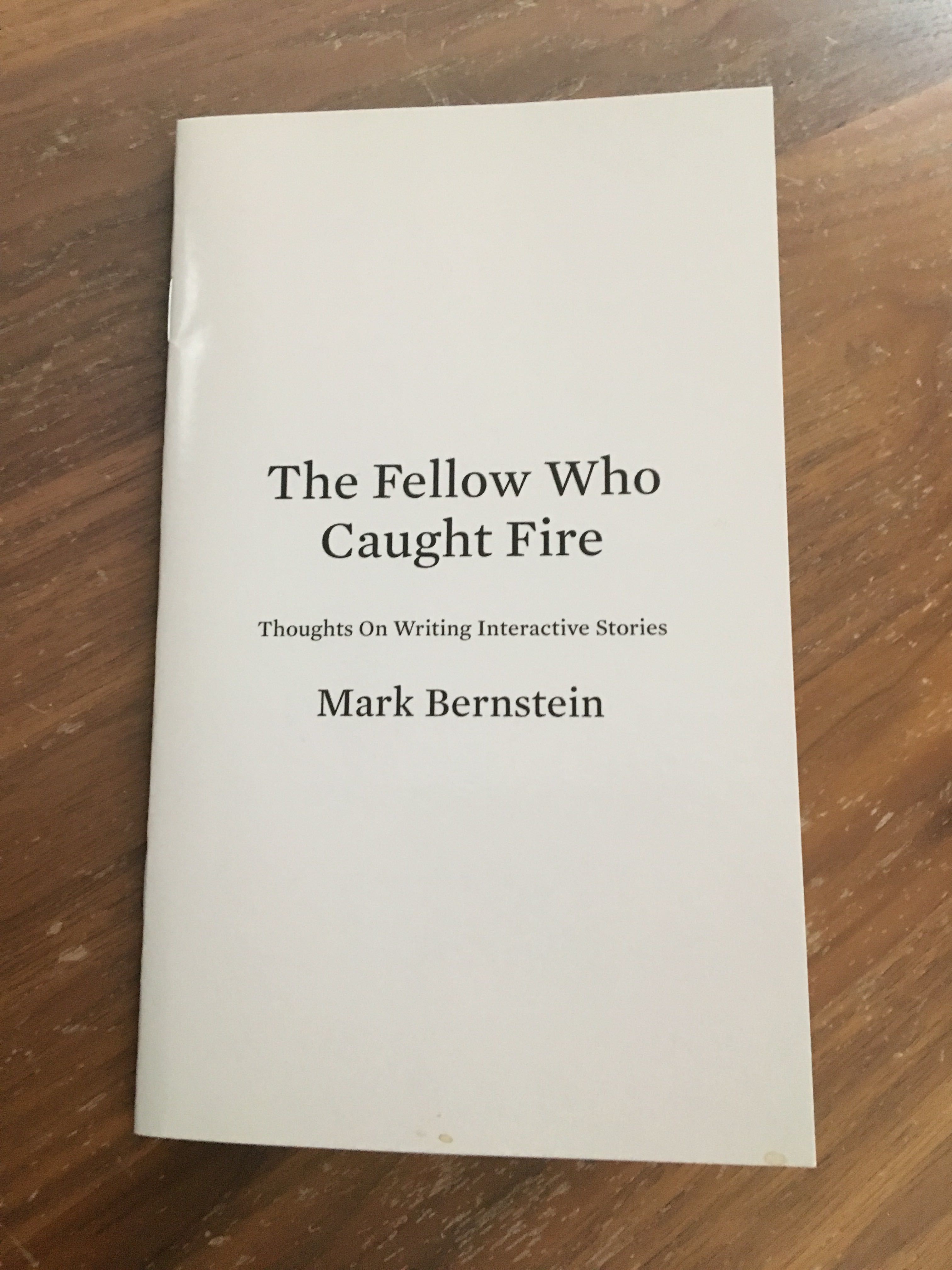

The Fellow Who Caught Fire (Mark Bernstein)

At NarraScope last weekend, Mark Bernstein (“Those Trojan Girls”, previous observations on hypertext narrative) was passing out a booklet entitled “The Fellow Who Caught Fire.” On the left-side pages are sections of a story; on the right-side pages, commentary about how stories are presented. Some of the areas for discussion are familiar from non-interactive literature, such as framing, tense, and person. Others dig into topics like explicit choice and link placement in hypertext narrative.

Since not everyone will have access to these, I thought I’d talk a little about what it contains, and some thoughts I had in response to Bernstein’s questions and provocations.

Continue reading “The Fellow Who Caught Fire (Mark Bernstein)”

Blogs on Narrative Design and Game Writing

I’ve covered many books on game writing here over the years, and I’ve collected and linked a lot of online resources on narrative design and on the history of IF design in particular.

This time, I’m recommending some blogs by other people who post about game writing or narrative design. Originally this post was going to be about blogs and podcasts, but there were enough of both that I have broken it out, and the podcasts section will appear later.

I’ve also intentionally not clustered these blogs by topics, since a lot of bloggers write about different things on the same blog. So instead I’ve mentioned some key posts, if there’s something on the site I consider especially characteristic of that person.

Continue reading “Blogs on Narrative Design and Game Writing”

Graham Nelson on Open-Sourcing Inform 7

This past weekend was NarraScope, a genuinely excellent conference about interactive storytelling in many shapes and forms. It was fantastic, and my one complaint is that there was so much good content that I was forced to miss a lot of things I would have liked to see.

(I livetweeted as much as I could, and I’m grateful to other attendees who did the same from other talks. The #NarraScope stream on Twitter contains a lot of notes about all the things discussed there.)

Graham spoke about Inform 7’s current state of progress, and for those who either weren’t able to attend NarraScope at all, or who chose to do one of the other excellent things going on at the same time, we’ve posted the slides and notes from that talk.

And if you’re curious about the previous time he spoke about I7: https://emshort.blog/2018/06/10/notes-on-the-direction-of-inform/

Mid-June Link Assortment

Events

download.jpgThe Narrascope games conference is currently taking place in Boston, MA, June 14-16.  Both Graham Nelson and I are there and speaking; I’m on a panel about Bandersnatch, and Graham is updating people on the current status of Inform.

NarraScope is also the Boston IF Meetup for the month of June.

ICCC 2019 takes place on June 17-21 in Charlotte, NC.  The event is in its tenth year and is organized by the Association for Computational Creativity.

logo_CIS_front.pngFor those interested in the IEEE Conference on Games (CoG), June 30 is the deadline for early bird registration.  The conference itself will be August 20-23 in London.

July 2-5 will be the ACM IVA Conference, taking place in Paris.  IVA 2019’s special topic is “Social Learning with Interactive Agents”.

July 13 will be the next meeting of the Baltimore/DC IF meetup (there is no meeting in June due to NarraScope). The discussion will center around The Missing Ring from the 2019 Spring Thing competition.

July 16-17 is set for the symposium Ludic Literature: The Converging Interests of Writing, Games, and Play. The two-day event is funded by the Scottish Graduate School and takes place in Glasgow, UK.

icon.pngThe SIGIR Conference is taking place in Paris from July 21-25.

DiGRA 2019 is being held August 6-10 in Kyoto.

New Releases

Final_Export_Text_01_Square.pngBack in October, I mentioned that the folks at StoryFix Media were working on a project called The Pulse. That game now has a release date right around the corner, and will be available on June 25 on Google Play.

The Pulse was written by Christopher Webster, developed by Gareth Higgins and Arthur Lee, with original score by Auto/Reflex. Check out the trailers here and here.

Electric Sleep, a recent release from a small team including artist Matthew Weekes (Kynseed, Freedom Planet) and Jack Sanderson-Thwaite (theatre writer with Bristol Old Vic) is currently available on Steam.

Rock Paper Shotgun gave it a very positive review in April, and GameGrin followed suit with a 9/10 rating.

Announcements, Articles, & Links

This interview with Hannah Powell Smith, on plotting, Choice of Games, and writing about ghosts.

A little more backstory on the development of Return of the Obra Dinn (and how it nearly didn’t happen.)

The possibility of further Black Mirror episodes Ă  la Bandersnatch.

The IF Technology Foundation has published its report on accessibility in IF tools and games, with recommendations for how to make IF experiences work better for more people.

Playing Text-adventure Games with an AI by Prithviraj Ammanabrolu records some new experiments with TextWorld.

Crowdfunding

Ninepin Press is publishing a story told on those folded fortune-teller toys, funded via Kickstarter. This is the same press that did The Family Arcana, a story told on a deck of cards.

Mailbag: Knowledge-driven Dialogue in Inform

I am doing my first steps in Interactive Fiction and your work has helped me a lot. I have been working on an idea, that requires dialogue based on “knowledge”, in other words, the character and the NPCs will initiate dialogue in order to fill out their gaps in knowing the other person. Firstly, I was wondering if Inform7 can do something like that, and if it can which dialogue system would be the best to serve as a basis. Secondly, I was wondering if Inform7 can implement AI, without falling back to Inform6. Thank you in advance and most importantly, for your work in the community! Sorry for the annoyance of my question but I was kind of lost among the many different dialogue systems that are out there…
[and then on confirmation that the asker was okay with a mailbag post]:

First of all let me clarify that I am not asking for mentorship, with this question. More like pointing to the right direction, if there is such a direction. There is a strong chance that there is not something similar implemented, so in this case, don’t let me take your time.

My question is if there is a dialogue system in Inform7 (or in some other framework) , that is based on knowledge of a predefined set of data. For instance the protagonist to be able to query for any one of that data and to store that information in such a way, that the next answer to reveal even more data. Or the knowledge itself to enable the protagonist to make more specific questions. The answer I would like, is not how to implement such a system, of course, but only a reference of the type  “have a look at this extension of Inform7” or “there is no such thing implemented” or “there is no such thing, but you could draw inspiration from this”. Nothing more than that! I have thought of a potential implementation, treating data as things that are visible or not, and the knowledge to be treated as “possession” of those things, but I am not certain it is the right approach.

First of all, re. the Inform 6/7 question: Inform 7 is a full programming language, and you do not need to drop to Inform 6 to code behavior. In the early years there were things that were hard to express in Inform 7, especially mathematical things or elements that accessed files or manipulated on-screen behavior, but most of those elements do now have an Inform 7 wrapper available. Occasionally people still choose to insert Inform 6 chunks inside an Inform 7 program for various reasons, but it isn’t required.

Likewise, when you say “to implement AI,” this is such a big and fuzzy question that it’s hard to answer without more of a breakdown.

Inform 7 is good — and indeed much better than Inform 6 — for handling rule-based decision-making and firing off character interactions within the model world; the main issue here is performance if you’re driving a large number of characters or asking them to plan over complex world state. The rule-based aspects of Inform 7 in fact have influenced other approaches to game AI in larger game applications, as Elan Ruskin discusses in one of his GDC talks.

For other AI approaches, you’d have to do quite a bit more work; for instance, it isn’t really designed to make use of any natural language processing methods outside of its own rich and complex parsing mechanism, and if you wanted to do something that for instance tried to guess what the player meant by words that weren’t in the game’s dictionary but might be similar to ones that were, you’d more likely use some kind of special pre-processing layer or a call out to an external script, because it doesn’t provide ways to e.g. access WordNet or a word2vec model. Likewise, it’s not designed to plug together with SpaCy or Google NLU or any of the external tools that have come into being over the past decade+ to help interpret the semantic structure of a piece of input. It might be interesting to explore how that would work, but that doesn’t exist currently.

Inform plus machine learning is a slightly more interesting point of conversation, because the TextWorld project exists, and there are researchers who are exploring how to use an Inform-based world model as a sandbox environment for training ML agents to solve a text-based game.

That’s different again from the idea of an ML agent designed not to solve an IF game but to be a companion or competitor within an IF game, for the sake of enhancing the player’s experience. There are relatively few IF games in which it would even really be meaningful to talk about a competitor character within a game, because most IF doesn’t have mechanics designed for competitive play (though Kerkerkruip might work). My old game When in Rome 2 also featured an NPC with dynamically selected characteristics who might work counter to the intentions of the player, and it was possible in some cases to be bested or even killed by this creature, if you went up against a clever one and it got resources ready faster than you could.

Now, on to the main question.

Continue reading “Mailbag: Knowledge-driven Dialogue in Inform”