Lethophobia (Olivia Wood and Jess Mersky)

Screen Shot 2016-09-05 at 5.32.35 PM.png

StoryNexus was meant to be revenue stream for Failbetter Games: the tool available for anyone to use, with an option to publish, monetize and split the profits between author and studio. The existence of Fallen London was one of the selling points — players had been asking for years to be allowed to make their own Fallen-London-alike. The system was also one of the few IF tools to offer a quality-based narrative out of the box, where new pieces of story become available as the player’s stats change.

But quality-based narrative is not the easiest kind of interactive narrative to bootstrap. You tend to need a lot of content before the results start feeling like a game. Moreover, a StoryNexus game specifically needs a stock of images as well as a stock of words. SN came with a range of generic icons, but that could just mean that many SN worlds felt rather samey unless the author had put in the extra customization to draw (or have someone else draw) customized card images.

StoryNexus never really took off in the way Failbetter hoped, and the monetization option wasn’t available for long. Officially, StoryNexus is no longer supported. But a small library of sizable or complete SN worlds were written, including Winterstrike, Samsara, Below, Zero Summer, Final Girl, and now Lethophobia. A lot of SN games are loosely structured and have a lot of small anecdotal interactions — sticking with the idea that they’re story worlds, or settings. Lethophobia (like Final Girl) is in a minority: it’s telling one story, and there’s a clear trajectory through that tale. There is also, mercifully, no action limit worth worrying about, so you can play as continuously as you wish without any enforced delays.

Lethophobia is the story of a haunting. The house in question is a very particular one, lovingly described and appealing to every sense. The discoveries you’re assembling about the past are rather looser and less determined: you meet a character, but is he an old friend or your ex-lover? Is this female character your sister, or is she a former piano teacher?

From early on the game communicates that it’s not so much about exactly what happened, but rather about how you orient yourself to those memories, about the process of discovery and reconciliation to trauma.

Lethophobia is also the closest thing to a classic IF puzzle game I’ve seen in StoryNexus form.

Continue reading “Lethophobia (Olivia Wood and Jess Mersky)”
September Mail

Hello Emily,

You don’t know me. I read your blog and I actively use Adrift to experiment with make IF games and have tinkered with Twine also.  I know you are super busy so i will get right down to the point, least i start rambling about IF.  

In a brief summary this is about an idea (that may have already been once given to the IF community) of setting up a crowd funding for a prize pool for a IF Creator/Engine competition.

Some might say the best IF creator out there is Inform, i did try it in the past but couldn’t get into it, i tried Quest and that was confusing to use after getting used to using Adrift. I have been tinkering with Adrift on and off for about six years and it has come along way, but falls short in some areas due to only one Dev who adds new features and fixes bugs in his spare time. Adrift does have the ability to use expressions that are close to programming and it is over the last year or so i have learned quite a bit with expressions. I think Adrift is often overlooked (the ability it has with being able to create custom properties for locations, objects and characters. And the ability to create modules to add to your library or share. It still needs lots of polishing).  

I was thinking to myself today, why hasn’t there been a kickstarter (add in other crowd funding options here) on creating the ultimate IF Creator/Engine (that could handle CYOA style games, point and click, IF or all of the above in one game). But then there would be many opinions of what that might be or look like and how it would be internally structured, visually look etc no one would never agree on things. And of course the parser. So what about the next best option;  crowd fund a prize pool for 1st, 2nd and 3rd place for an Interactive Fiction Creator/Engine competition with defined criteria for judging, such as UI, Parser, multimedia support etc you get the idea. I do not know how big the funding would get to make a decent  prize pool worthy to garner attention from programmers around the world. Obviously the bigger the prize pool the more attention and interest in it. I am not a programmer so i do not know what would be a realistic deadline 12 months? 15 Months? for at least a working prototype. Programmers outside the IF world would be at a disadvantage, but could catch up quick reading a number of articles written about IF its weaknesses and strengths with what is currently available to us as tools as well as free content that can be played to see the best of the current crop of IF games in the last ten years. Maybe fresh eyes (programmers outside of the IF community) on the scene might help?

This approach could see some really ingenious ideas that may not win the prize but spark some new ideas to improve on or the winner might have something few didn’t think of that he/she goes on to finish and releases either for free or profit. People tend to be more interested in being in control of their own project and are motivated to be ambitious or think outside the box more this way. I am sure there would be many failed or unfinished entries, but hopefully there might be a small number of really well implemented ideas… 

Continue reading “September Mail”

Disclosure about disclosures

Because this has come up a couple of times recently:

Sometimes on my blog, and always on Rock Paper Shotgun, I make disclosures about how well I know authors of work I’m reviewing. Doing so feels more like a nod to current expectations of games-journalism propriety than like I’m actually helping the reader much, though.

Continue reading “Disclosure about disclosures”

Nothing for Dinner (Nicolas Szilas et al, IDtension)

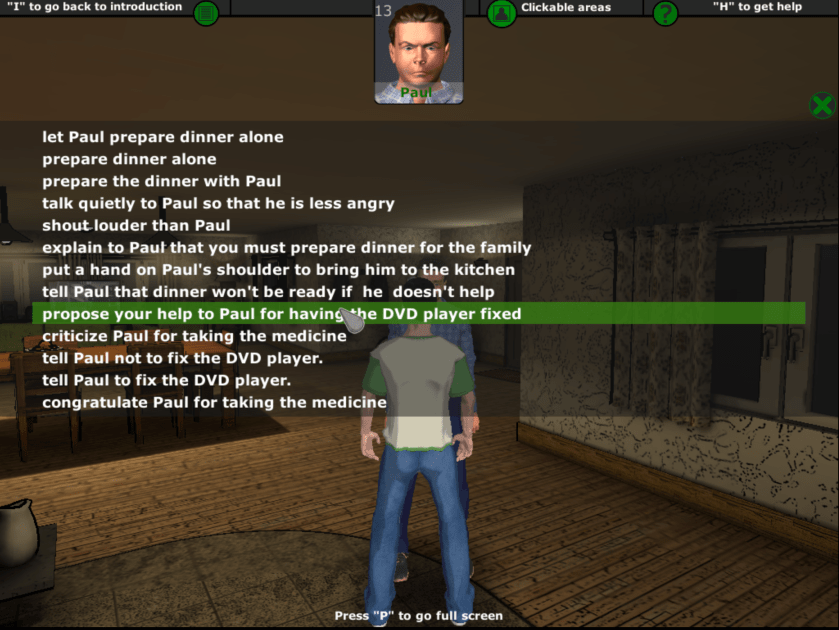
IDtension_conversation_menu.png

“Nothing for Dinner” is an interactive drama released last fall by Nicolas Szilas and collaborators, using a tool called IDtension. Szilas works out of the TECFA Lab at the University of Geneva. If you read my writeup on the book Interactive Digital Narrative, you’ll have seen a mention of Szilas’ article there. Though it would have been out of place in the book overview, I wanted to come back and look more closely at what “Nothing for Dinner” accomplishes.

The premise of the story is that you’re a young man whose father has suffered a stroke that affects his behavior and memory. You need to get something ready for dinner, but your father keeps getting in the way, and other events spontaneously happen — a school friend coming over to get back a textbook she left at your house, your sister’s DVD player breaking, a phone call from your mother with extra chores — to add blocks to your progress.

The system is clearly quite dynamic: I played three times, and the sequence of events was very different each time, with some blockers appearing only in one of the playthroughs. Also, the conversation menus are dynamically generated to let you try various approaches to any of the currently-active problems, or to give emotional feedback to the other characters about what they’ve just done.

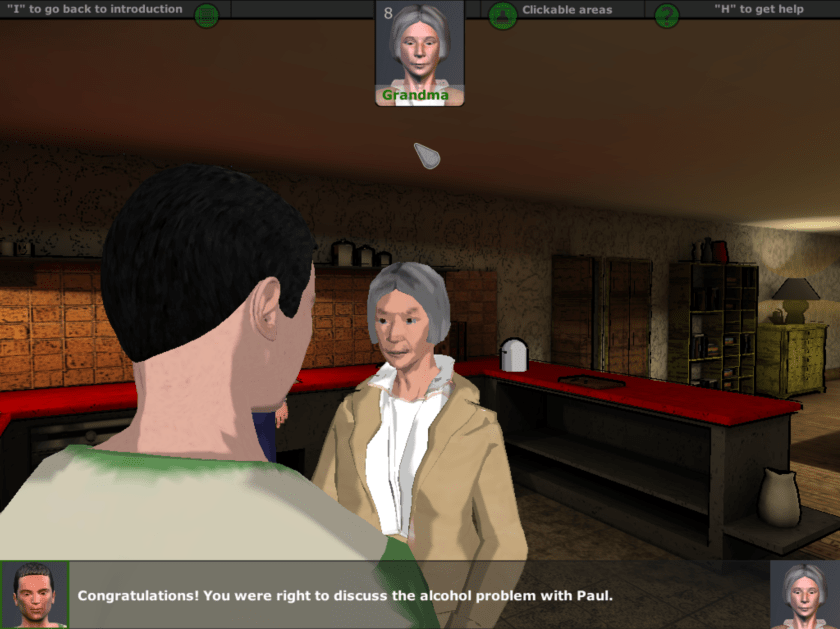
IDtension_grandma.png

If you try to cook dinner alone, your father resentfully complains that you never want to do anything with him; if you try to involve him, he may get annoyed and refuse to help you; if you let him cook by himself, he’ll break things and make a mess. And whenever your father gets upset, your grandmother comes over to chide you for not looking after him.

It’s a very effective mechanism for making me rapidly resent my entire family for offloading all the emotional and practical labor onto me: like a time management game, but with more passive-aggressive commentary, and less opportunity to get anything done.

Continue reading “Nothing for Dinner (Nicolas Szilas et al, IDtension)”

Interactive Digital Narrative: Practice

Screen Shot 2016-08-31 at 1.12.24 PM.pngThis is part three of an overview of Interactive Digital Narrative: History, Theory, and Practice. See my earlier post for coverage of the book’s history section and this post covering the theory section.

The last section of the book gets into questions of practice, though the articles vary: some verge on being historical surveys through the lens of a particular method or technique, while others delve more deeply into detailed design questions. I have already talked about Scott Rettberg’s “Posthyperfiction” article, though it appears in this section.

The introduction to this section is titled “Beyond the Holodeck: A Speculative Perspective on Future Practices,” and suggests three areas for future growth: the story/video game connection; location-based apps and experiences such as Whaiwhai and Zombies, Run! (a game I respect in theory but avoid in practice thanks to my dislike of (a) zombies and (b) running); and interactive documentary and news projects. MIT’s docubase is my go-to resource to find out about new interactive documentaries.

Continue reading “Interactive Digital Narrative: Practice”

Interactive Digital Narrative: Theory

Screen Shot 2016-08-31 at 1.12.24 PM.pngThis is part two of an overview of Interactive Digital Narrative: History, Theory, and Practice. See my earlier post for coverage of the book’s history section (and one practice chapter that I took out of order because it felt like it fit better that way).

This time we’re looking at the theory section, which addresses academic approaches to interactive narrative (including the question of what interactive narrative even is).

Again, the section begins with a brief overview from the volume editors, and this provides a fair sketch of the academic debates of the last couple of decades, together with a bibliography of a number of foundational pieces in this space. I might also have listed Jesper Juul’s half-real here, as it provides a readable and persuasive cap to the narratology vs ludology debate.

Continue reading “Interactive Digital Narrative: Theory”