6Quest is Hungarian interactive fiction based on a gamebook series. The creators are currently running a Kickstarter to have the app translated into English for a wider audience.
I was able to find this list of Hungarian gamebooks by Demian Katz, but I’m not even able to translate the titles, so I don’t have a huge amount to go on. So I asked Paul Muranyi to tell me a little more of the history of gamebooks in Hungary, as well as the current scene and their project.
Z Files: Infection is a project currently being Kickstarted, an interactive comic book set in a zombie universe. I talked with Ruber Eaglenest, aka El Clerigo Urbatain, about the project, and how it works as an interactive comic, as interactive fiction, and in terms of how it portrays its protagonist.
Interactive comic
RUBER: There have been other games that have tried to this fusion, but they are most experiments, or resort to the “infinite canvas”.
EMILY: I think that is an interesting direction. I’ve seen a handful of pieces that do similar things, but I think there is probably a lot of additional room to explore it. IIRC, some of the Tin Man Games pieces do include some comic illustration elements; also a few other things I’ve covered.
RUBER: To be honest, sometimes I’m not at all satisfied about how I try to communicate how interesting is our project compared to other attempts to make interactive comic. I do not want to look as I disregard other attempts, especially when I can climb on his shoulders and improve from there.
We are going to stay inside the pages of a comic, and so, the challenge is to apply the tree structure of CYOA to the finite space of a comic book.
EMILY: What actual constraints do you have in mind here? For instance, are you trying to make all the pages be the same size, or have the same amount of visual space assigned to each node?
RUBER: You see, people and the press likes to praise the infinite canvas because we simply love to see common things applied to new technologies. But when one uses the infinite canvas in a digital or interactive comic, you lose some of the features and inherent properties of the comic format. For example, the ability to close a page narrative, or leave it open with a cliffhanger so that an important revelation occurs at the turn of the page. To play with the structure, with graphic symmetry, among other wonders you can do within the pages of a comic book. For example, in the following conference praising Watchmen, Kieron Gillen explained very well the capacity of traditional structures of comics raised to its maximum capacity of artistic expression.
I just have to grab a few things on my way back to New Tenacity.
Artifacts, you know. Objects of intense mystical power. The usual.
Lifeline 2 is a sequel in form, not in content, to the tremendously successful Lifeline from earlier this year. Lifeline was one of the first games to work on the Apple Watch, which may have helped get it the spotlight, but it did a number of other things well: a clean attractive text interface, a good use of delays and notifications, and a story about a convincingly endangered protagonist.
It also demonstrated a game format that was plainly reusable. Lifeline makes the protagonist a separate character who is reaching out to the player for help — a strategy that deals immediately with gaps between player and protagonist knowledge, and explains occasions when the protagonist won’t do what the player wants. It allows for strongly characterized narrative with a definite voice.
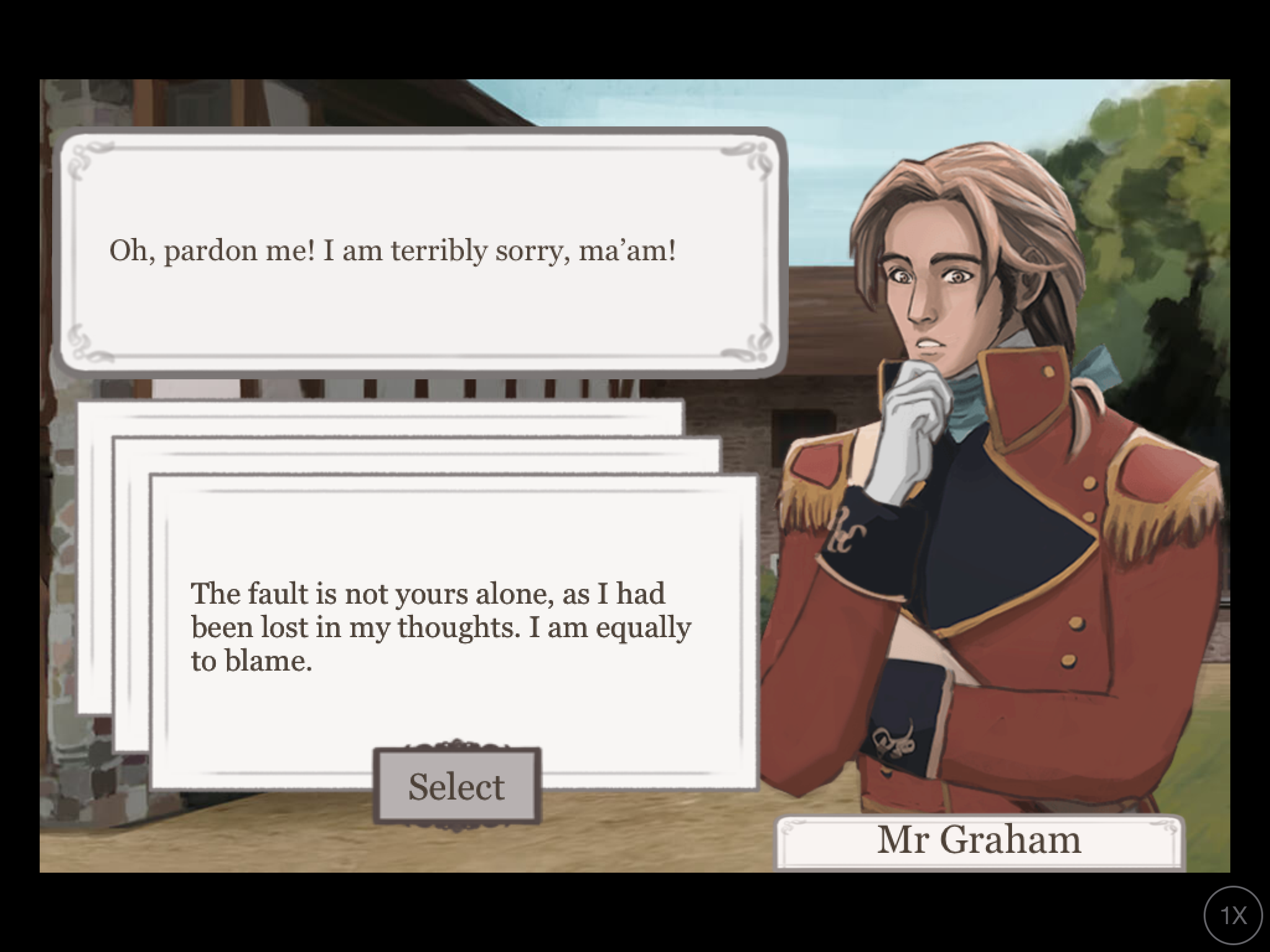
Regency Love is an iOS game set in a pseudo-Austen town; it is in the same general territory as a dating sim or visual novel, but with a structure that also owes something to roleplaying games.
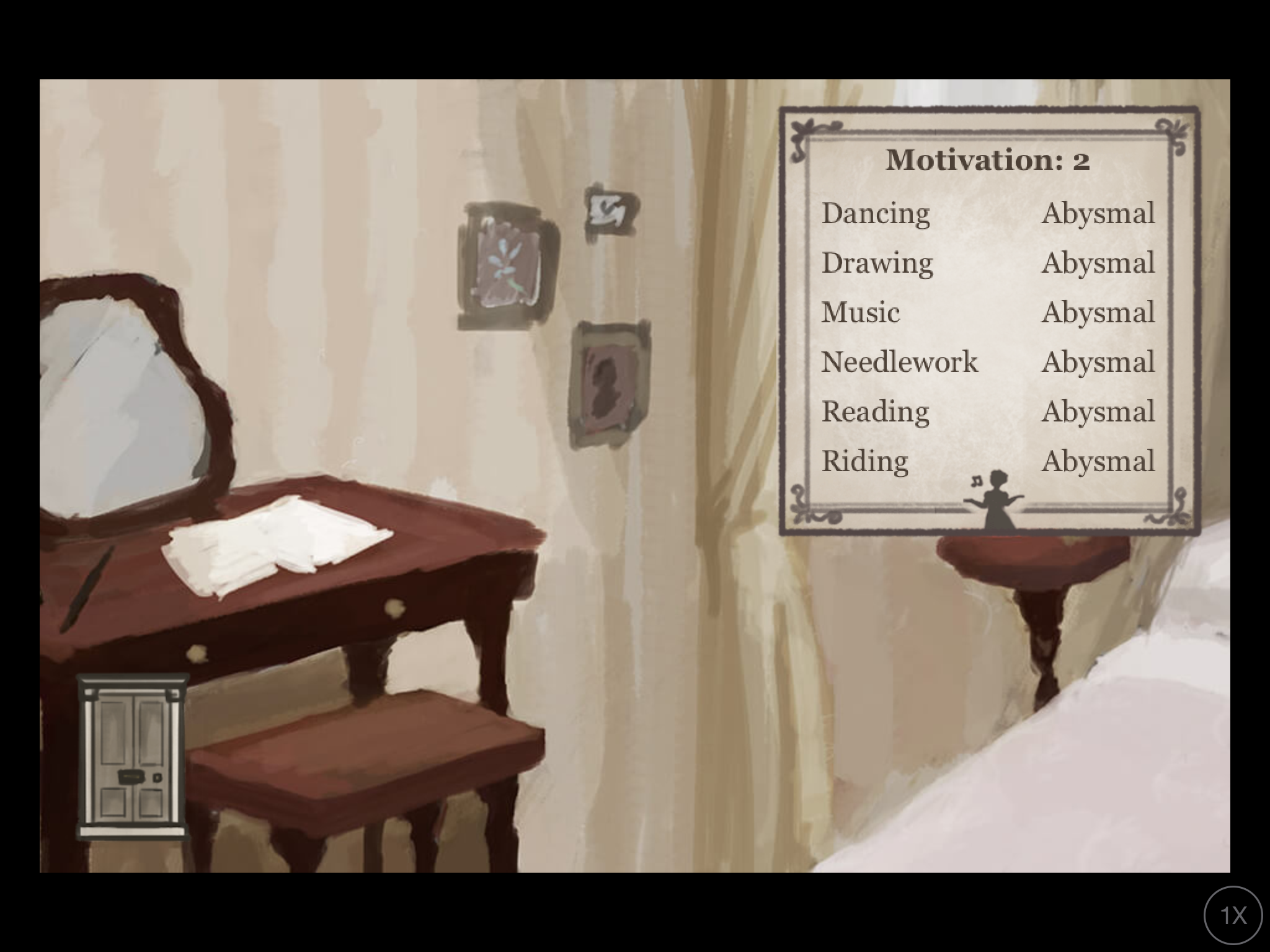
The core interaction loop is that the player can select a place from the map of Darlington, their town; the place may yield one or more possible activities. The activities can either be quizzes about Regency life (how long should you properly mourn a sister? how much did muslin cost?) or social interaction scenes that are primarily dialogue-driven. From time to time, there’s an opportunity to do another quiz-like activity, a game of hangman in which you’re trying to fill in a missing word from a famous quotation, mostly from Austen. Doing quizzes and hangman gains you motivation points which you can spend to raise your skill in one of six “accomplishments” — drawing, needlework, reading, dancing, riding, music (harp and pianoforte and singing are not distinguished). Some of the social activities depend on you having a certain accomplishment level in a certain area before they will unlock. Other social events depend on what has already happened.
Using a map to pick the next little story you want to participate in also reminded me a bit of StoryNexus, though whether the underlying engine relies on anything like quality-based narrative, I have no idea.
Before the game began I evidently paid NO attention to my governess.I was never a great enthusiast for the quizzes and stats part of this game. The questions refer to information from Austen that is not provided internally, so you either already know the answers or you have to guess. There aren’t enough hangman sentences and quizzes to last the whole game, either, so you’ll see the same things repeat over and over again before you’re done. Meanwhile, your accomplishments are necessary enough that you can’t ignore this part of the system, but there’s not enough variety to what the stats do to make it an interesting choice which one you raise next. Somewhere between halfway and three quarters of the way through play I had maxed out all my accomplishments and could now afford to ignore the whole quiz-and-hangman ecosystem, which was a relief.
Based on your behavior, the game also tracks character traits, reflecting whether you’re witty, dutiful, etc. It displays what your traits are, but I never worked out exactly what was moving the dials. What I said in conversation must come into it, but I didn’t know which dialogue did what. Nor did I ever figure out how it mattered. Some events were plainly closed to people with less than 12 Needleworking, but I never saw an explicit flag that excluded people who weren’t witty. So the character trait system may have been doing important things, but it was opaque enough that eventually I started to ignore it.
What does that leave? Talking. Lots and lots of talking. I like talking games! This one made some slightly peculiar choices, though.
In A House of Many Doors you are an explorer, poet and spy. Mount an expedition to explore a vast dimension of procedurally-generated nightmare architecture. Assemble a dysfunctional crew, build their morale, uncover their secrets, and try desperately to keep them alive. Travel in a train that walks on mechanical legs, and write procedurally-generated poetry about the things you encounter.
The House is a parasite dimension. It steals from other worlds, and can contain almost anything within its endless walls. The player’s journey is a process of constant discovery – there’s always something strange around the next corner.
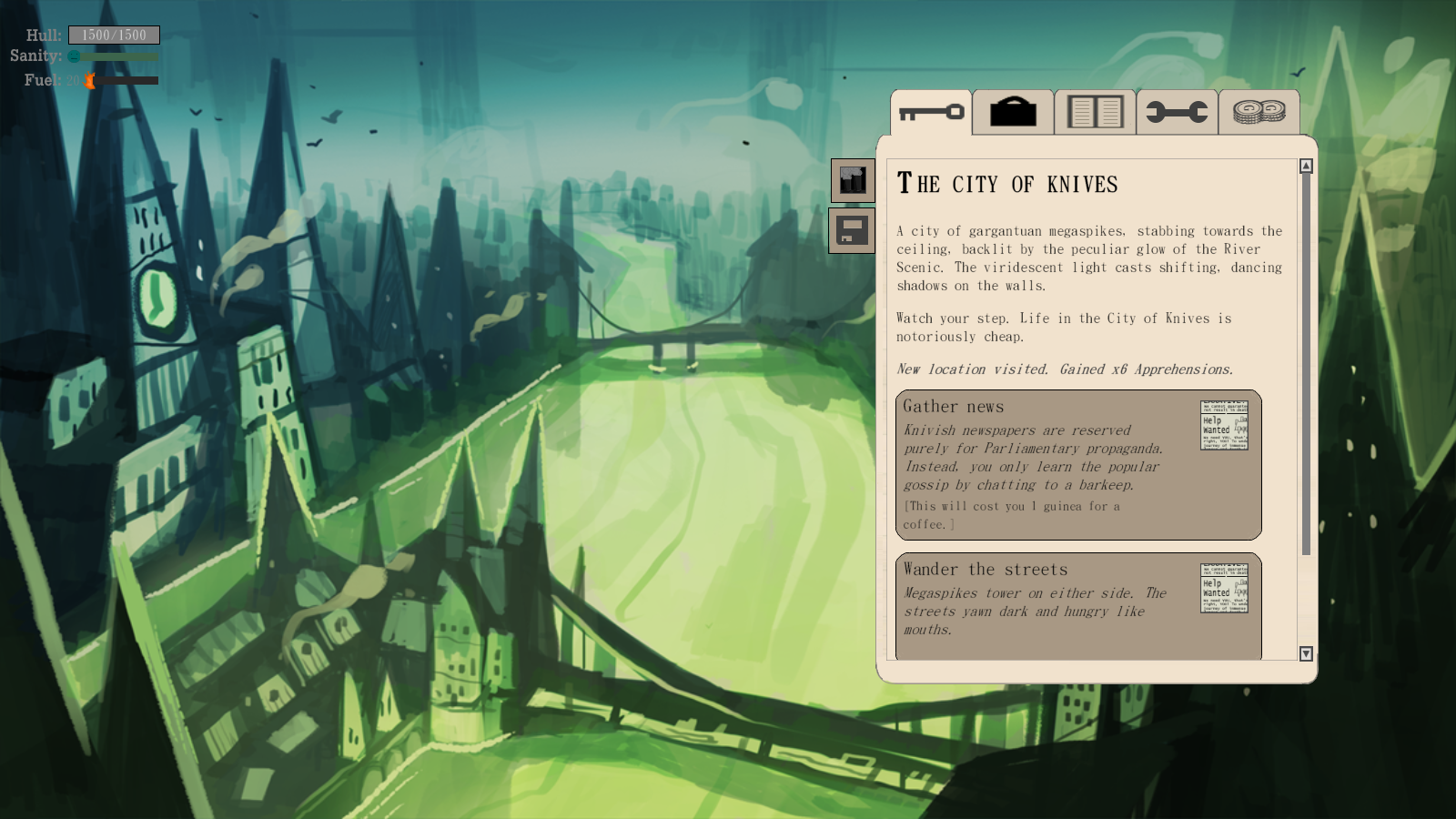
Harry Tuffs is a member of the Oxford/London IF Meetup, and currently using incubation space at Failbetter Games. He’s just launched a Kickstarter for House of Many Doors, an IF + exploration game. The screenshots are a bit (or, in some places, strongly) reminiscent of Sunless Sea, but this is not a roguelike. I asked him for a bit more detail about the game, and he was kind enough to fill me in.
Snake Game is the first new story at Sub-Q Magazine, written by a veteran speculative fiction author turning to IF for the first time. It tells the story of a man who has left the army and returned to his father’s home in the jungle, where the wife he barely knows waits with his young daughter. The story concerns his relationships to all of them, the things we pass down through generations, the way our parents can confuse us about our own identities, and several other things as well. Chandrasekera is Sri Lankan, and I had the impression, though I could be wrong, that the non-fantastical elements of the setting are drawn from his homeland.
Snake Game challenges categorization. It isn’t really choice-based fiction since the player is never making choices for the protagonist, nor does it quite seem like “dynamic fiction”, the term Caelyn Sandel uses for her linear but interactive Bloom. Instead, it is a navigable fiction.
Most of the incidents in the story have three alternate versions, and the reader can choose whether to slither forward through the story or whether to move sideways, considering alternate interpretations and understandings of what is going on. The options — forward, sideways left, sideways right, backward — match the four directions one can take in a game of Snake. Nonetheless, the events are still consistent enough that however much we might turn aside from a moment or an interpretation we dislike, some truth remains truth.




 Emily Short's Interactive Storytelling