Black Closet (Hanako Games)

ss_traitor.jpg

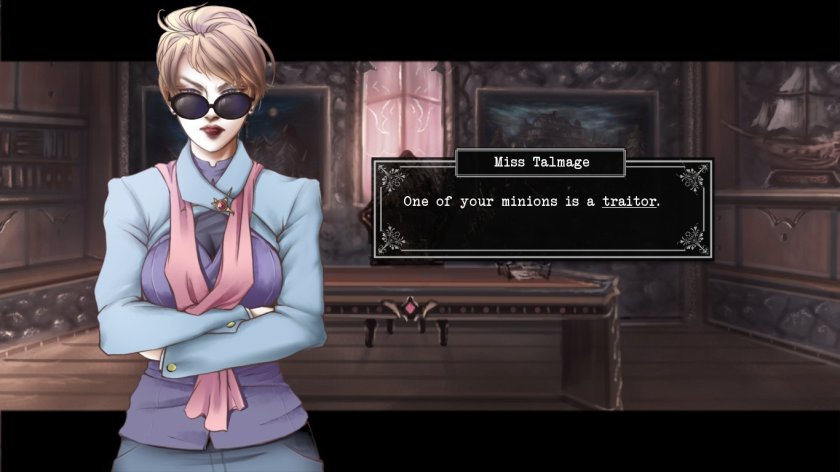
Black Closet is a dating sim/resource-juggling sim from Hanako Games (Long Live the Queen, Date/Warp, and numerous others). In it, you are Elsa Jackson, the student council president at St. Claudine’s, an all-female Catholic boarding school. (I hadn’t heard of St. Claudine before this game, but it was satisfying to look her up and discover that the authors seem to have picked her with some intention. Claudine Thevenet was interested in schooling for girls and also founded an institution to support female authors. It seems she was also, less happily, a sufferer of lifelong PTSD after seeing her two brothers executed in front of her.)

Catholic or not, the school still features quite a bit of romance between its students. Your task is to get through the year and graduate – which will require you to investigate and resolve assorted conspiracies, crises, and personal misunderstandings in the student body.

The other members of the student council are therefore both your dating pool (if you choose to date, which is not mandatory) and your tool for solving problems, as you’re assigning girls to intervene where their skills make them most suitable.

This by itself gives the game quite a different flavor from the lonely and ridiculously hard Long Live the Queen. This time, you are not alone. You don’t have to make yourself into a singular repository of all virtues. Not everything falls to you to deal with. Conversely, there are some paths of action that will alienate one or more of your team members so that they are less available (or, worse, leave entirely).
Continue reading “Black Closet (Hanako Games)”

Imaginary Cities (Darran Anderson)

So this year I’ve been trying (with only partial success) to publish a review of a CYOA book on the 5th of each month. “CYOA book” here may be a paper book or a Kindle ebook with links. This month, though, the CYOA book I originally planned to cover turned out to be enough of a non-starter that I didn’t want to post a whole review just griping about it.

imaginarycoverSo instead we have a non-mapped, non-CYOA print book, but one I think might be of some interest to the kinds of people who like IF.

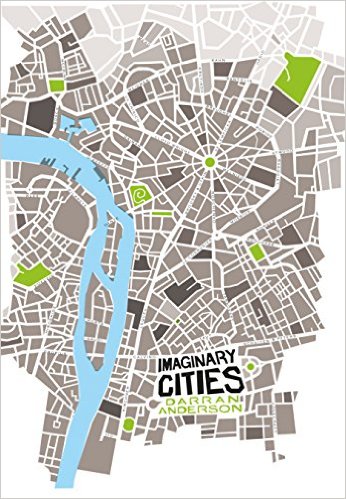
Imaginary Cities is a collection of short chapters about city plans and city concepts. It discusses utopian and dystopian visions, cities imagined for other times and environments than our own, the cities we think other cultures would build and the cities that will suit the culture we hope one day to have. It pulls in the writing of architects and urban planners, historians and fantasists and philosophers. It is, among other things, a vibrant celebration of world-building:

Everything echoes. Inventing the ship and the shipwreck leads to the invention of lighthouses, judas-lights and pirate-plunderers, laws on flotsam and jetsam, the Sirens of Homeric myth, the immrams of Irish verse, Ahab and Prospero. (82)

Imaginary Cities is obviously inspired by Italo Calvino’s Invisible Cities, from which there is a quotation on the first page. I’ve also seen reviews comparing it to W.G. Sebald’s The Rings of Saturn — both books combine a wealth of anecdotal material — but Sebald’s work has a flow and continuity that Imaginary Cities does not always emulate, and his anecdotes (take for instance the business of the the herrings that begin to glow after their death) are selected in service of his greater themes. Imaginary Cities is more of a compendium of curious facts, first collated from a wide range of sources and then organized topically, with quite a lot of the content dedicated to quotation. The result is almost overwhelmingly rich. Individual sentences suggest whole stories and courses of research:

Having adopted the ironic name Filarete (‘lover of virtue’) and designed the bronze doors of St Peter’s Basilica, the architect Antonio di Pietro Averlino fled Rome after trying to steal the desiccated head of John the Baptist. (99)

I enjoyed reading Imaginary Cities. And yet — maybe because so much of the content is about formal experimentation? because my memory for isolated detail is not as good as I’d like and I want to retain more from each page than I do? — I kept wondering if it might have been better in some form other than a book.

Continue reading “Imaginary Cities (Darran Anderson)”

Masques and Murder (James Patton)

Screen Shot 2015-09-11 at 8.59.51 PM

Masques and Murder is a Renaissance revenge fantasy that stands the traditional dating sim visual novel on end. You play a young Italian woman; your family is murdered during the tutorial, and the Prince tells you you must marry one of his three sons. Each son has a taste for particular skills and accomplishments. Impress the sons, and you can get close enough to kill them off.

The bulk of gameplay consists of training your various skills, from hawking to firearms to classics. Periodically new social engagements appear on your calendar, and you have to prepare to meet their demands. If you do well at the skills required, the brothers admire you more and are therefore easier to kill. If not, their admiration drops. There are a couple of small complications that add challenge — you need to keep them from getting too suspicious, and your study abilities are improved if you first reread your Revenge Poem, filling yourself with righteous fury.

This makes it easier and fairer than, say, Long Live the Queen, but also way shorter and less interesting overall. There are few narrative incidents where you can have a unique conversation with anyone; it’s basically all stat-grinding, one stat at a time. There are descriptions for what happens when you train a stat, but these get pretty repetitive, which means that the moment-to-moment gameplay isn’t very juicy: select a stat to work on, reread the same training text as before (often, anyway), select a new stat, … Still, it doesn’t take long to at least get the idea of the game, and I was amused by what it did with the usual tropes of its genre.

Eventually you become close enough to someone to attempt using your skills to kill him — and it’s just as possible to kill someone with verses as with swordplay. Full marks for the description of how to kill a man using your skill at classics.

IF Comp 2015 Guest Post: Janice M. Eisen on Brain Guzzlers from Beyond!

brain_guzzlers_title

As part of the ongoing project to get new reviewers talking about IF Comp games, Janice M. Eisen has written about Brain Guzzlers from Beyond! Janice is a long-time player of parser IF who beta-tested for Infocom.

Continue reading “IF Comp 2015 Guest Post: Janice M. Eisen on Brain Guzzlers from Beyond!”

IF Comp 2015 Guest Post: Susan Patrick on Capsule II

Capsule2_Poster

This post is part of an ongoing project to bring more voices to the IF Comp conversation. I have been reaching out to players and authors who aren’t part of the intfiction community, and also to some veteran intfiction denizens who might not have time to cover the whole comp but who are likely to have especially useful feedback in particular areas.

Reviewing PaperBlurt’s Capsule II is Susan Patrick, a scriptwriter for Ubisoft who hopes to create her own Twine game soon.

Continue reading “IF Comp 2015 Guest Post: Susan Patrick on Capsule II”

IF Comp 2015 Guest Post: JJ Gadd on Crossroads

crossroadscover

This post is part of an ongoing project to bring more voices to the IF Comp conversation. I have been reaching out to players and authors who aren’t part of the intfiction community, and also to some veteran intfiction denizens who might not have time to cover the whole comp but who are likely to have especially useful feedback in particular areas.

Our reviewer this time is J.J. Gadd. Her five-book Lunation Series utilizes hyperlinks to create a choose-your own adventure style experience for readers, allowing them to choose between travelling with one character or another at various points in the narrative. Out now through Harper Voyager. www.lunationseries.com 

Continue reading “IF Comp 2015 Guest Post: JJ Gadd on Crossroads”