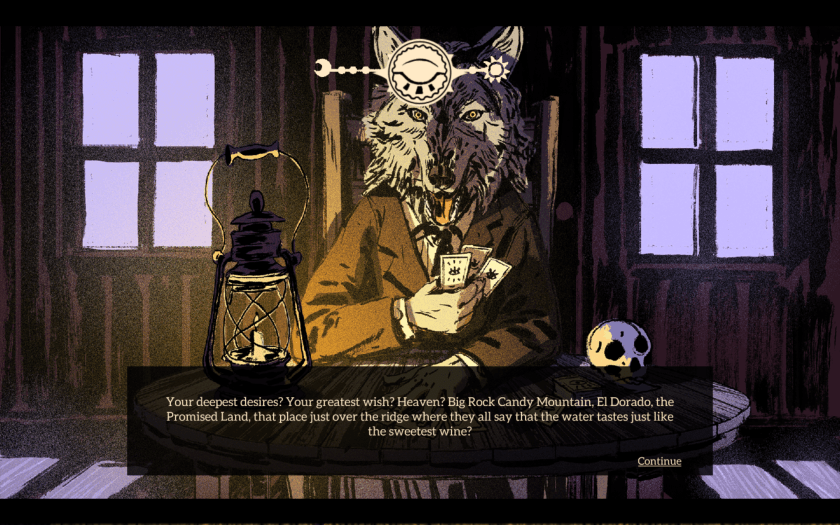
A country made of stories. Where the Water Tastes Like Wine is a game about the shining lie of America: about the dream of freedom and justice and opportunity, and the darker, more tarnished truth. Stories are currency and resource and the means of unlocking connections with other players. And Johnnemann Nordhagen, the creator of the project, decided to collect those stories from many writers of many backgrounds, making it genuinely multi-vocal.
It was delightful to be asked to contribute, and I knew as soon as I played the original trailer that this was something I wanted to be part of.
The request came when I was getting used to being an immigrant outside America, looking back with a mixture of homesickness and anger, sadness and relief. I live now in a country where I don’t fear being SWATted or shot, and where my health care is free. Meanwhile, UK citizens ask about the American health care system the way you might ask to be told a ghost story. Let us hear how you paid a thousand dollars for an unnecessary ambulance ride of one mile; let us shiver pleasantly and then relax knowing that we will not suffer the same fate. It gets darker when we get to “Also, I have friends who died of cancer because they couldn’t afford to see a doctor about their symptoms until it was Stage IV.” I choose how I tell the story of America on a daily basis.
And I listen to the stories of the UK with the same doubts. You say you had a great Empire and relinquished it, and now you look on American imperialism with the smug compassion of a sober alcoholic. You say you’re not so racist and your police aren’t so brutal. You say you have a safety net for your citizens, and that you’d never let your streets be full of homeless people the way they are in San Francisco. There’s some truth in all that, but also a good measure of lie. I can see the rough sleepers in London; I can see them in Oxford. They’re not invisible.
Stories lost. Johnnemann gave me a character prompt: Bertha, a Dust Bowl survivor who leaves Oklahoma for California.
As it happens, I had a grandfather who was born in Oklahoma and moved to California — and I know very little about the circumstances, except that his personal trajectory was inflected more by the war than by weather or crop failures. I never had a single conversation with him about it.
When I was old enough, my mother passed a few things on to me that he’d told her while she was growing up. They were mostly explanatory notes. Your grandfather is like this because. His friends died and he survived and he didn’t understand why either of those things happened. He went into Germany in 1945 and he saw very bad things. Don’t ask him about it. There was a child he met that he tried to save and he couldn’t. Don’t ask about that either. He came back from the war and his sisters were surprised he had lived through it. They weren’t expecting him back and they’d spent the savings he left with them. Definitely do not mention this. Keep it out of your mind when you see or hear about your great-aunts.
The past was a wound fifty years old, still too raw to touch. The stories could not safely be passed on. I only write this now because my grandfather and his sisters and my grandmother are all gone.
Other stories in my family’s history were lost in other ways. I have Native American blood from several parts of the family tree, but I don’t know the languages, the cultures, the religions or histories of any of my Native ancestors. Something of value was stolen from me — by a different set of great-grandparents. What reparation can I, a woman of European appearance and culture, offer myself, a descendant of displaced Native people? There’s no resolving that.
Stories borrowed. For Bertha, I had dots on a map of Oklahoma where my grandfather’s parents and grandparents had lived. I had some vague outlines of how they got there — including the Cherokee ancestors who had walked to that location, in the worst of circumstances. But I needed more specifics, and I also needed to get a sense of the flavor of period speech: this time, place, and character are well outside my personal idiom.
So to find Bertha’s experiences and her voice, I immersed myself in period sources. Reread Grapes of Wrath, of course, but also Whose Names are Unknown, a rather less-read work by Sanora Babb that provided more specific details, and which felt like an especially good inspiration for writing about marginalized and unheard voices:
Sanora Babb’s long-hidden novel Whose Names Are Unknown tells of the High Plains farmers who fled drought and dust storms during the Great Depression. Written with empathy for the farmers’ plight, this powerful narrative is based upon the author’s firsthand experience.
Babb submitted the manuscript for this book to Random House for consideration in 1939. Editor Bennett Cerf planned to publish this “exceptionally fine” novel but when John Steinbeck’s The Grapes of Wrath swept the nation, Cerf explained that the market could not support two books on the subject. — Sanora Babb website
I also read interviews with Oklahomans and song lyrics by Woody Guthrie and a few repositories of stories about the inhabitants of my great-grandparents’ town. It didn’t make it into the final game, I believe, but we were asked to provide a bit of local folklore. The one I wrote up was a story recounted about an ancestor of mine who supposedly fell into what he thought was an open grave during a black-out dust storm.
Continue reading “Worldbuilding America: Where the Water Tastes Like Wine”
 Digital Storytelling: A Creator’s Guide to Interactive Entertainment. This book has gone through several editions, the most recent the third edition from 2014.

 Twice this year I’ve spoken about matching story and mechanics — once for the
  Emily Short's Interactive Storytelling