Set, check, or gate? A problem in personality stats

As I’ve mentioned here before a few times, I’m working on a project for Choice of Games, and it’s once again brought me up against a challenge I’ve run into a few times before when writing for Fallen London and to some extent with Versu. As mental shorthand, I’ve come to think of this as “the check-or-set problem,” though really it should maybe be the check-set-or-gate problem. It is as follows:

When you’re writing in a choice-based medium backed with stats – so ChoiceScript, StoryNexus, Undum, Ren’Py, possibly a hand-rolled Twine system, or inklewriter if you choose to use variables extensively – you have to decide how to treat choices that relate to personality stats.

When I say personality stats, I do not mean “all stats that might make up the protagonist’s profile.” Choices that have to do with resources – how much money you have left, how many classes you have time to take – are comparatively easy to deal with because there are typically obvious narrative contexts where your resources might go up or down, or where your supply of a resource would come into play. I’m not considering that type of stat here.

No, the challenge comes in when dealing with personality traits where we’re trying to collect that data from the player and then reflect it back. In ChoiceScript, I’m especially talking about opposed stats. For instance, in ChoiceScript one might have the opposed stat of Daring/Practicality, where a score of 20% might represent that you are very daring and a score of 80% might represent that you are very practical. Both ends of the spectrum correspond to actual personality characteristics, rather than just the absence of something. And each end might be desirable in a different situation.

So here is the trick about personality stats. Some of the time you might be asking the player to make choices to establish character, in which case choosing to do something Daring should set the player’s Daring stat higher for future reference.

At other times, you might be using stats to determine whether the protagonist has the personality or skills to pull off the approach the protagonist just chose: are they Daring enough to do this skydiving stunt? In that case, you’re checking previously established stats to decide what result to report to the player.

Finally, you might use the player’s stats to determine whether a given choice is available at all. Perhaps a player with low Daring simply isn’t offered the skydiving option. Now you’re gating the option based on stats. At that point you have to make an additional decision about whether to show the player that the option exists but is just greyed out currently (*selectable_if, in ChoiceScript), or whether you want to conceal that option completely from players without the proper stat profile (regular *if).

Greyed out options advertise that alternate possibilities exist, which is useful for communicating to players when past actions are creating consequences in the present moment. On the other hand, secret options that appear only when you have the right knowledge or stats can be fun to discover on replaying.

If you don’t have a consistent strategy around when to check, set, or gate, you’re likely to confuse the player. I find this especially true in ChoiceScript, where the UI does not offer any warning about the mechanical implications of a choice: you just get “Skydive!” and no automatic information about whether that’s going to make you a more daring person or conversely test your previous daring.

For instance, here there are some narrative cues – this is the first move of the game, so we must be setting, and also the use of the past tense tells us that the player is establishing backstory and character aspects rather than taking a risk in the present moment. But nothing about the UI in this scenario distinguishes between setting and checking:

Screen Shot 2016-02-12 at 11.05.02 PM.png
The first move of The Daring Mermaid Expedition by Andrea Phillips

StoryNexus, by contrast, shows the player if a stat is going to be checked to determine chance of success, and gives information about what the current success odds look like. This level of mechanic-surfacing gives the output a more game-y flavor but also (in my opinion) provides the player with a greater level of control:
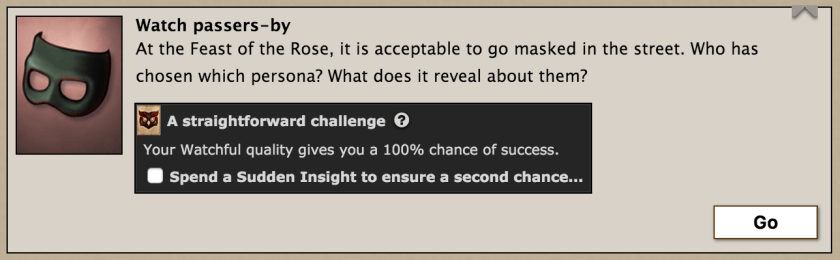
Screen Shot 2016-02-12 at 10.57.53 PM
One branch of the Feast of the Exceptional Rose, Fallen London

Undum sort of splits the difference by keeping the stats table permanently on screen in a sidebar, so while you might not know in advance what a link is going to do, you’re likely to be more aware of what is happening link-wise than in a ChoiceScript game in most UI configurations:

Screen Shot 2016-02-12 at 10.59.31 PM.png
The opening of Mere Anarchy by Bruno Dias

inklewriter, meanwhile, doesn’t automatically surface variables at all. And though there are personality stats underlying 80 Days, and though you sometimes get a message saying that yours have changed, you can never see a chart of all of them, and you don’t know when they’re being checked. You do get a number (see the lower lefthand corner) that describes your relationship to your master Fogg, but there’s quite a lot else happening here, to which the player doesn’t have access:

inklescreen.png
A screen showing limited status information in 80 Days

It largely works, I think, because those personalizing stats aren’t really the most important aspect of the game, and there’s a lot of state – cash flow, location, routes known, etc. – that the player does get to see. So our sense of agency focuses on those.

Below the fold, some thoughts on the different possible strategies for writing personality stats content.

Continue reading “Set, check, or gate? A problem in personality stats”
Firewatch (Campo Santo)

Screen Shot 2016-02-12 at 11.09.37 AM

Firewatch is a new narrative-and-exploration game from Campo Santo, put together by a skilled crew including Sean Vanaman and Jake Rodkin, writers on season one of Telltale’s The Walking Dead.

It took me about five hours to play; people who are more efficient or look at fewer scenery objects might make it through in four. It is effectively a short story, with a single emotional arc and minimal branching. I’ve seen people comparing it to Gone Home, but more happens in the present setting of the game; I also found a few moments that reminded me of Everybody’s Gone to the Rapture, but it is ultimately a very different game from that as well.

Firewatch tells the story of Henry, a guy whose wife Julia is suffering from early-onset dementia. Henry isn’t really equipped to handle that fact. He volunteers for a position watching for fires all summer in Shoshone National Forest. His main – and for a long time really his only – point of contact with other people is through his radio, which allows him to communicate with his supervisor Delilah. He lives in one tower in the woods and Delilah lives in another, far away; Delilah manages other lookouts, but we never communicate with them. Over the course of the summer, Henry spends a lot of time hiking the woods to various spots to do errands at Delilah’s instruction. Gradually, they begin to realize that there are more people out here than they knew about, and that someone is watching Henry and Delilah specifically. There are also, here and there, notes from rangers who used to watch these woods but who have now gone on to other work elsewhere, and hints of the hikers who passed through these woods before.

The game sets up Henry’s backstory through a piece of choice-based text, a passage that could quite plausibly have been prototyped in Twine, interspersed with scenes of his arrival in the woods. The hypertext portion gives you a chance to do a little immediate personalization of Henry. I don’t have the impression your choices there pay into any major story changes, but they do lightly tweak what Henry will say about himself later, and a few props he has. We see the effects of this more or less right away in the game world, in that we pick one of two ways that Julia might have sketched Henry, and then shortly afterwards see the sketch itself: an early promise from the game that there will be perceivable consequences for your choices.

Continue reading “Firewatch (Campo Santo)”

Lifeline: Silent Night (3 Minute Games)

Screen Shot 2016-02-09 at 10.55.29 AMLifeline: Silent Night is a (very lightly) Christmas-themed sequel to the original Lifeline (though, mercifully, it has no important connection with the disappointing Lifeline 2). In it, Taylor, the gender-nonspecific protagonist of the original game, has gotten into trouble aboard the ship home after the events of Lifeline. (I have always thought of Taylor as female, so I refer to Taylor as she below, but your version of Taylor could well be “he” or “they” if you prefer.) There’s less mystery this time around, because we basically know the parameters of the kind of universe we’re inhabiting. Taylor still spouts pop culture references from Futurama and The Simpsons (and the conversation even lampshades this overtly). There are still long pauses where Taylor is “traveling” or “resting” – perhaps somewhat less plausibly now that she is not on a vast moon but are instead poking around what is described as a small spaceship, and during an emergency.

But Silent Night offers a couple of other tweaks on the formula of the original. There are fairly long stretches of non-interactive text in between choice points – sometimes a page or two of text messages on my iPad, more than I remember from the original Lifeline. This text-to-choice ratio wouldn’t seem that odd in, say, a Choice of Games piece, but it’s more noticeable when the text is formatted as text messages (where we’re used to a rapid back-and-forth) and when it’s printing on a delay.

There are structural changes, too. Taylor is no longer completely on her own. The ship is crewed, and Taylor’s connection renders their dialogue in contrasting colors so that you can see the conversation when we’re around them (which is not very often). These other characters are still out of the way for most of the duration of the game, perhaps because otherwise it’s hard to explain why Taylor would be taking our advice to the exclusion of theirs, and it’s also not quite obvious why we can hear them but they can’t hear or see the advice we’re giving back to Taylor. But we just have to accept that that’s how the communication link works.

Second, Silent Night comes with a schematic map of the ship, allowing you to pause during conversation and check out where Taylor is and what she’s doing. This is kind of cool, from a feelie perspective, and helps sell the idea of the ship as a particular place. I wouldn’t ever say that the map becomes necessary, though, and in fact it frequently felt to me as though it had been awkwardly appended to the game after the script was already complete.

For one thing, the game frequently has Taylor making long trips through solitary corridors. Empty corridors are a staple of television and movie spaceships, certainly; but they don’t appear anywhere on the schematic. On the schematic map, all the rooms are directly connected to one another, wasting no time with intervening space. (I couldn’t help thinking of Coloratura here, which also included feelies but felt like the ship had been rigorously researched and planned.)

Continue reading “Lifeline: Silent Night (3 Minute Games)”

January Link Assortment

Upcoming events:

Thanks to a burst of focused planning, we have a bunch of forthcoming meetings scheduled for the Oxford/London Meetup. They are

London, February 16. We will be playing a variant of San Tilapian Studies, along with other short card and boardgames focused on storymaking with other people. I’m psyched about this – San Tilapian Studies takes a fair amount of prep to put together and I don’t run it frequently, so if you want to play, this is an unusual chance. We’re using a different setting and sticker set than in the original.

Oxford, April 3. Sunday afternoon pub meet-up; you may bring WIPs or other items to share if you like, though we’re not set up for actual projection or anything like that. Consider this one a really late March meeting, because SXSW/GDC/Easter weekend use up all of my actual March.

London, April 19. Exact activity TBD, though I have some interesting prospects I’m looking into.

London, June 14. Exact activity TBD, though I have some interesting prospects I’m looking into.

Thanks to Failbetter Games for their on-going willingness to co-host!

*

If you are planning to be at GDC, here’s some IF-related content for you:

I will be talking in a short format about visualization and design, with many examples from interactive narrative contexts (as well as some from elsewhere).

inkle studios folks will be talking about their tool ink that is used for 80 Days and the Sorcery! series, and which they will be open-sourcing. (!)

Meg Jayanth is speaking twice, once about writing NPCs with agency and once about diversity.

Continue reading “January Link Assortment”

IF Comp 2015 Guest Post: Robb Sherwin on Pit of the Condemned

As part of the project to get more reviewers talking about IF Comp games, Robb Sherwin writes for us about Matthew Holland’s Pit of the Condemned. Robb is the author of Cryptozookeeper and Fallacy of Dawn, among other works.

Continue reading “IF Comp 2015 Guest Post: Robb Sherwin on Pit of the Condemned”

Read Only Memories (MidBoss)

ROM_SS_07-1024x576

Read Only Memories is a point-and-click graphical adventure set in “Neo-San Francisco”, in a cyberpunk future full of personal assistant robots; implants that let you experience VR right through your own head-hardware; and massive amounts of genetic engineering. Both the increasingly intelligent robots and “hybrid” humans (those with significant amounts of non-human DNA) are struggling for their rights, while the corporations have largely taken over the responsibilities of government. You are investigating the disappearance of an old friend who is at the forefront of the robotic research.

Continue reading “Read Only Memories (MidBoss)”