Level Up! The Guide to Great Video Game Design (Scott Rogers)

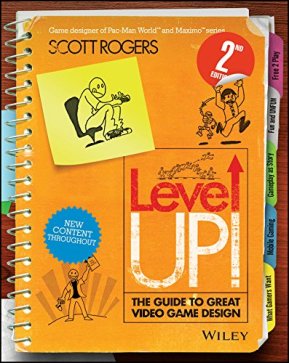
levelupcover.jpgLevel Up! is a book about game design and mechanics for would-be practitioners rather than academics. It’s by no means the only such book out there, but it enjoys pretty excellent reviews and has been recommended to me by a couple of designers I respect.

This won’t be quite a standard review, though, because I’m coming to the book with a particular question in mind. Namely: most of the game writing and narrative design books I’ve reviewed on this website have been somewhat or (in some cases) completely lacking in any discussion of how game mechanics interact with story.

So I’m curious: do I find more about the mechanics aspect of narrative design if I start with a book that’s explicitly into the mechanics? And even if Level Up! doesn’t talk about story-related mechanics as such, can I find general principles of mechanics design that also apply in the story space? For my friends who ask about learning more about the story-mechanics interface, can I point them at this book?

Continue reading “Level Up! The Guide to Great Video Game Design (Scott Rogers)”

S. (J. J. Abrams, Doug Dorst)

sfeelies.jpgS is a puzzle-novel with feelies, imagined by J. J. Abrams and written by Doug Dorst. The premise is that there’s a novel, The Ship of Theseus, written by the mysterious VM Straka and edited by his devoted editor FX Caldeira. This novel is the object of considerable academic debate and political struggle.

There’s also an ambiguity about the true ending of the book: the Chapter 10 printed here is (fictionally) not the original written by the author, and the “true original” ending has been made available online.

The scholarly debate draws in two students, Eric and Jen, who start leaving one another notes in the margins of the book, and then get entangled in the struggle, and also entangled in one another’s lives. Jen and Eric’s story is organized semi-thematically rather than chronologically with the passing pages: they tend to come back to certain bits of the book to talk about certain subjects. Even the early pages of the book contain notes from late in their relationship. Conveniently, they change pen colors at a couple of key points, which at least tells you what era you’re looking at.

Between the pages, there are a number of other very lovingly made artifacts, including postcards, photographs, letters, and in one case a map hand-drawn on a café napkin. The book is also (for various reasons) full of ciphers and clues, some of which Eric and Jen solve themselves, and some of which have been discussed at great length by internet onlookers. The artifacts are amazing, and the whole book shows tremendous production values.

So it’s a piece that feels like a form of analog interactive fiction, or a classic Dennis Wheatley mystery dossier. Or, also/alternatively, a call-out to literary mystery/romance stories like Possession. I didn’t really find it satisfying either as puzzle or as novel, though, because what it communicates is in fact fairly thin relative to the number of pages and amount of work involved.

Continue reading “S. (J. J. Abrams, Doug Dorst)”

Mailbag: Academic literature on modeling conversations

hello :) I was reading some of your stuff about conversation systems, was wondering if you’d have any links/pointers to academic literature on modelling conversations (can be more theoretical/non-game-related), or stuff relevant to people who might be trying to do it?

This one came in via Twitter. I’ve covered some adjacent topics before on mailbag, including

  • Games that do complex conversational mechanics
  • Dialogue and story generation techniques (Parts 1, 2, 3)
  • Dialogue filtering to apply personality and emotion to existing text — this includes links to some academic research into how personality traits affect people’s utterances
  • And back in 2009 I wrote this on conversational analysis and how it applied to my work at the time, including going through a number of dialogue situations recorded in literature and talking about how the conversation model I was using at the time would address or fail to address those

But this question is asking something a little different, specifically about how conversation is modeled in the abstract, not necessarily in games and not necessarily for AI production purposes. What academic literature is out there to help us understand how people talk to one another? What types of approaches exist for modeling conversation in general?

Unsurprisingly, this is a huge field of study, so this is not remotely a literature review; instead, it’s a tour of a few pieces of terminology and resources that might be useful in digging deeper.

Also, I am not approaching it primarily from the perspective of a trained linguist (I’ve taken a few classes, but it’s not my field) and instead from the perspective of a person trying to model things for interactive conversation purposes.

So, with those caveats:

Continue reading “Mailbag: Academic literature on modeling conversations”

Spring Thing 2019

Screen Shot 2019-04-05 at 2.06.35 AM.png

Spring Thing 2019 is now open. The second-biggest regular competition of the interactive fiction calendar, this year it has 20ish games including both choice-based and parser-based work, some experimental and some more classic in style. I haven’t had time to play nearly all of them, but here are a few I’ve had a chance to look at so far:

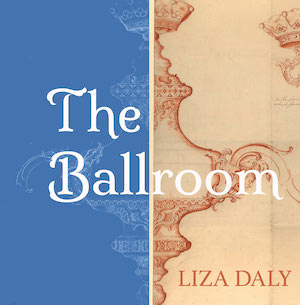
ballroom_cover.jpgLiza Daly has for several years been working with her own custom Windrift system, which produces lovely and typographically pleasing browser stories like Stone Harbor and Harmonia.
The Ballroom is a piece in this system where you can tweak certain details of the story in order to mutate it towards being a different story entirely. What starts as a disappointing anecdote in the life of an impoverished Regency miss can turn in other, rather startling directions as you alter your protagonist’s clothing and social choices, and the rest of the scene changes in consequence. Initially that stays within the Austenesque world, but it soon starts genre-hopping.

There is a logic of world features that persist through significant changes of genre and tone, that reminded me in some ways of Dual Transform or Invisible Parties. And the way you have access to the whole temporal sequence at once and can change the state of things earlier or later in the narrative as you choose, felt a bit Midnight. Swordfight. (though it’s definitely smaller than that work).

Meanwhile the player’s role in the game is not exactly protagonist or co-author — you don’t have enough control to really be responsible for the authorship of the story, but you’re also not straightforwardly a single person in the narrative, either.

Continue reading “Spring Thing 2019”

Choice Poetics (Peter Mawhorter)

Peter Mawhorter is an academic who looks at how choices work in interactive narrative, elaborating a theory of choice poetics. His articles offer some taxonomies and vocabulary for talking about choice design — with partial, not complete, overlap with IF community terminology for these topics — and he has built a system that procedurally generates new choices from scratch.

In this post, I’m looking at three of his articles and offering some thoughts of my own, but all three are linked and accessible without a paywall, so if you find this interesting you can read the originals. This is part of a series in which I’m looking at academic approaches to interactive fiction and related topics.

Towards a Theory of Choice Poetics (Peter Mawhorter et al) sets the stage for later work and argues that there is a field here worth looking at. As the title would suggest (“Towards…”), he’s not advancing a completed theory himself here, but pointing out some of the factors that would go into such a theory. The article is thus mostly a set of annotated lists: of player motives in choosing options in a game; of play styles; of choice structure styles, as defined by the outcomes of the choice; and “dimensions of player experience”, which I found at once the most interesting and most slippery of his groupings.

He is careful always to point out that these category lists aren’t, and don’t expect to be, complete.

Continue reading “Choice Poetics (Peter Mawhorter)”

Can AI tell a good story?

emshortLGF.jpg

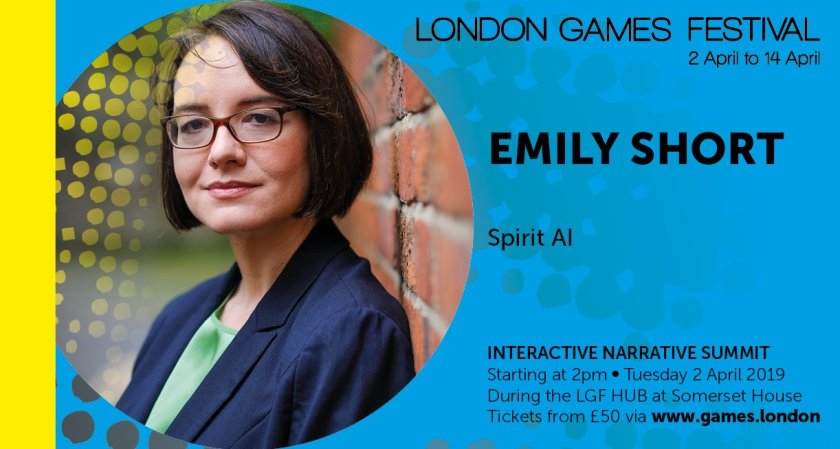
Tuesday I was invited to speak at the interactive narratives summit at the London Games Festival, specifically in a debate over whether AI can create a good story.

Perhaps the original scheme was to start a good showdown, but I have somewhat complicated views about what the question even means, and my would-be debater Brenden Gibbons did also, as it happens. So instead we had a more temperate but I think more interesting conversation, moderated by David Tomchak.

This is not a transcript of that conversation, because I can’t do that, but it’s an attempt to recapture some key points, drawing also on notes I made before the event, and expanding some of the ideas with links or examples I didn’t have available in the room.

First, AI can definitely already create stories, by pretty much any definition that a narratologist would establish. Indeed, we can set the bar higher than just “is there a sequence of causally-linked events,” though many scholars would accept that as enough. Some of GPT-2’s output is interesting, funny, and narrative. So are the outputs of other techniques stretching back to the 70s, from generative grammars to the model-and-curate approach used by James Ryan in his recent dissertation Curating Simulated Storyworlds. If AI were an orchard, we would have already plucked many and diverse story fruits there.

Continue reading “Can AI tell a good story?”