Mailbag: Recommendation requests

I’ve glued together two rather different requests for recommendations here, one about queer representation in IF and the other about classic parser-style work from recent years.

I’m okay with doing this occasionally, but for what it’s worth, IFDB is better than you might think at letting you answer this kind of question for yourself. You can set up polls or search people’s pre-existing curated lists, or use IFDB’s tagging system. I’ve recommended a few related search approaches here as well.

Do you have personally favorite narrative-gaming works among those in which the player character is identifiably queer? (Either incidentally or as part of The Point of the work.)  I imagine you get secondary-research type questions like this with some frequency, but if you have any brief thoughts I would be grateful for thoughts for things in that (very broad) category to especially check out.

These are differently fit for different contexts, but my personal favorite interactive stories of queer protagonists would probably be these:

Birdland by Brendan Patrick Hennessy. Charming lesbian goes to summer camp story. Several of BPH’s games are about queer teenagers (see also Known Unknowns, which gets slightly more seriously into how-this-relationship-can-go-wrong territory, with characters who aren’t out yet or haven’t yet figured out their own sexuality).

With Those We Love Alive, Porpentine. Kind of the other end of the spectrum as far as accessibility. I wouldn’t necessarily recommend this one for kids, and it might need unpacking of its trans themes even for some adult audiences. A lot of Porpentine’s other works would qualify here.

SPY INTRIGUE by furkle. This is definitely not for kids either.

But in picking my favorites here, I have a very large set of works to choose from, since queer-protagonist interactive fiction is pretty abundant.

Several pieces explicitly look at some aspect of queer experience as the main point of the story. Among the ones I’ve found most striking are Coming Out Story by Nicky Case; Bloom and Cis Gaze by Caelyn Sandel; and Tentacles Growing Everywhere by Dietrich Squinkifer. I’m also interested in, but haven’t yet had time to play, A Bathroom Myth by Anya Johanna DeNiro.

There are also several brands and serieses that explicitly permit the player to self-define a character’s gender expression or sexual attraction. Here I’d include Fallen London and all the games in its universe including Sunless Sea and Sunless Skies, as well as the Choice of Games brand. Fallen London and many of the CoG games allow non-binary gender protagonists as well as same-gender relationships, and in some cases allow the protagonist to negotiate poly relationships. The Failbetter blog includes a discussion by Hannah Flynn of how they approached gender in their work.

There are other games in which the protagonist is of fixed gender but can opt into relationships with other characters of various genders in the course of play, without explicitly making that part of protagonist identity. 80 Days includes at least one same-sex romance encounter I know of, and there may be more I didn’t see.

An IFDB search for the tag “queer” will turn up further options. Meanwhile, Queerly Represent Me offers some resources on this general topic and on sensitivity reads.


I’m a fan of old-style text adventures. Is anything like those still being produced?

Yes indeed. It’s not entirely clear what time frame we should consider for “still” here, but I’ll arbitrarily band to the past five or six years, with a couple suggestions that go further back if they might have gone overlooked at the time. And as for “old-style,” I’m pairing with some Infocom games but also some canonical early hobbyist IF.

The Enchanter series in general: for comedy-fantasy, try Oppositely Opal (Buster Hudson, 2015) or Illuminismo Iniziato (Michael J. Coyne, 2018). A little further afield from Enchanter but still in the general vein of light-hearted puzzle game with fantasy approach to reality, consider Thaumistry (Bob Bates, 2017). The Wizard Sniffer (Buster Hudson, 2017) is also highly acclaimed, though I personally haven’t played it.

Zork III and Spellbreaker for their challenging set-piece puzzles: Try Scroll Thief (Daniel Stelzer, 2015). It allows you to get the world model into surprising states, and the solutions often left me with a pleasing sense of having really gotten away with something. And if you really want parser puzzles with a minimum of fiction, try Junior Arithmancer (Mike Spivey, 2018) as well as pretty much the entire oeuvre of Arthur DiBianca, who excels at this style.

Deadline: Make It Good is my favorite answer to Deadline, but that itself is now a decade old. More recently, if you were interested in comparing people’s stories and trying to extract a consistent meaning, you might like Color the Truth (mathbrush, 2016).

Infidel: try Arthur DiBianca’s archaeology puzzler Temple of Shorgil (2018). Or, if you want something a bit more Indiana Jones, there’s Tex Bonaventure and the Temple of the Water of Life (Truthcraze, 2013).

Plundered Hearts: If you liked it for its romance theme, I have to reach back a few years to the work of Kathleen Fischer. But if you liked Plundered Hearts for its self-conscious pulpy use genre, its forward-moving plot, and the opportunities to cause wild reactions in the various NPCs you encounter, I recommend the heist game Alias ‘The Magpie’ (J.J. Guest, 2018), or the alien-invasion adventure Brain Guzzlers from Beyond! (Steph Cherrywell, 2015).

Planetfall: I don’t have any recommendations that will give you a Floyd replacement, precisely, but in the “abandoned SF station with puzzles to solve” zone, here’s Richard Otter’s Word of the Day (2017) or Steph Cherrywell’s Chlorophyll (2015).

Hollywood Hijinx: this is one I didn’t get all the way through myself, but Diddlebucker! (J. Michael, 2018) very explicitly casts itself as an Infocom nostalgia piece, and the reviewers appear to have found it a solid puzzle game.

Suspended: Terminal Interface for Models RCM301-303 (Victor Gijsbers, 2018). Well, maybe. I haven’t actually played Suspended. But both of these games involve control of a distant robot that provides your senses.

Nord and Bert Couldn’t Make Head or Tail of It: Andrew Schultz‘s games do wordplay surrealism in pretty much every configuration you can imagine.

Trinity: A Beauty Cold and Austere (Mike Spivey, 2017), a math-themed, historically-informed puzzle-fest. It has a happier meta-arc than Trinity, but the puzzles are generally excellent.

Frenetic Five series: The Owl Consults series consists of two games by different authors, but both involving teams of superheroes whose skills can variously be activated to get through the game.

So Far: Sub Rosa (Joey Jones and Melvin Rangasamy, 2015) presents an excellent selection of puzzles set in an environment that doesn’t physically resemble our own very much at all.

Tapestry: Map (Ade McT, 2015) is my favorite recent-ish parser puzzle game that reflects on key turning points in the protagonist’s life, and what it would mean if they’d gone differently.

Anchorhead: the obvious recommendation here has to be the multi-author tribute game Cragne Manor (everyone under the sun, 2018).

The Act of Misdirection: Three Card Trick (Chandler Groover, 2016).

Bonus suggestions: I didn’t get nearly all the way through Worldsmith (Ade McTavish, 2016), but it’s huge. If you’re looking for something epic and ambitious, maybe that’s worth a try. Also, at 2014, Hunger Daemon falls just outside the category but it’s solid, funny stuff.

If you search for tag:parser published:2015-, you can find IFDB’s list of titles that might also fall into this category.

Finally, I’d also say that there is a whole genre of parser games written in the past five years or so that retain a lot of the parser’s advantages but work on making the experience more accessible to new users. Since they’re not really “old-style”, I haven’t listed them here, but I discuss the phenomenon in this Rock Paper Shotgun column.

Get Your Gun, Dragonfly (Palimrya)

Get Your Gun, Dragonfly is a medium-short piece about lovers trying to survive outside a society that has become untenably hostile to them. For starters, our protagonists are trans, and any kind of hormonal therapy has been aggressively outlawed. The viewpoint character also has some significant body modifications (such as a powered arm that constantly needs to be topped up on fuel). Her lover is Hispanic, and neither of those things is seen as acceptable, either.

It is not an entirely easy work to start. The language is poetic, the descriptions often metaphorical. At the same time, the setting is just science-fictional enough to contain literal possibilities that could only possibly be metaphors in our world.

So in the early screens it isn’t always obvious whether a reference to chitin means that something merely looks like chitin or whether you’re talking about someone who is actually part insect, or has a bioengineered exoskeleton of some kind, or…

And, in any case, the style of the writing is often lush to the point of overripeness, an effect that is certainly intentional, but that tends to arouse my suspicion as a reader. When writing is so obviously for effect, I often worry that it is going to be only for effect, with less attention to truth and thoughtfulness. In such situations, I tend to read with my empathy in my back pocket, unwilling to commit emotionally yet when I am not sure that commitment has been earned.

But I found that, if I read slowly and didn’t get too impatient to click the next link, it took only a few minutes to get my bearings with this. I could perceive more emotional nuances, and the pace of the work began to come clear. Major narrative passages tend to be more prosaic, but descriptions of important things and people are frequently poems.


At no point does the text become anything you might accuse of restraint, and there are points where the cadence of a line or the choice of a word felt off to me, but this is a matter as much of taste as of substance.

Get Your Gun, Dragonfly takes place in a dystopic, near-future America in which the camps have become even more brutal, the fascism more aggressive and unchecked. For entertainment, middle school students fly Apple- and Google-branded drones around the countryside, hoping to catch footage of a death in progress.

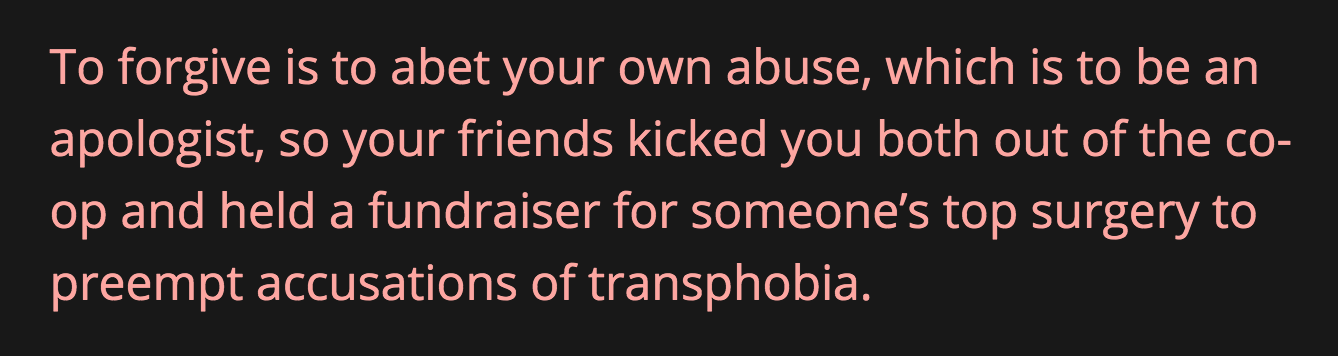
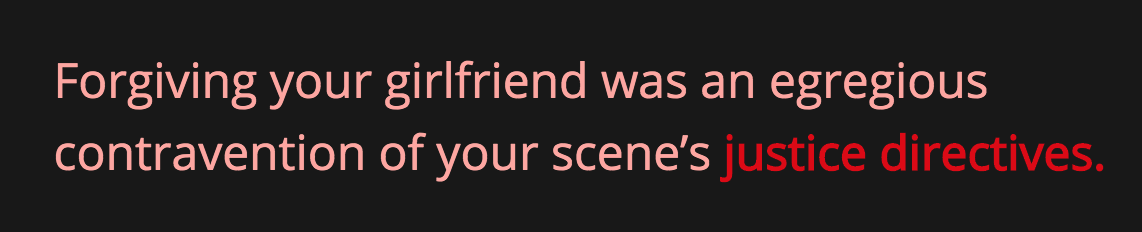
But it’s not all about the more terrifying aspects of the right in America. Several of the most dry and cutting passages are those that describe “your scene” and its reaction to you and your girlfriend, just before they make sure you have nowhere in town to live:

This is not, not at all, a story that excuses abuse, or that argues it shouldn’t receive some kind of communal response. Your girlfriend has had to do a lot of very serious work on herself, work that she has chosen to undertake and that she’s shown struggling through, in the hope of becoming someone better afterward, and some scars of that process are still evident in your interactions when it’s done. Her patience, so different from her past manner, remains a thing to be pointed out and celebrated.

The piece is also, in title and in function, a call to action. There’s a passage on the acknowledgements page about what you can do, now, to help support and protect immigrants.

It may be over-reading what the author intended, but I perceived a parallel between the two stories, the personal story of the abusive girlfriend who becomes a better person and learns to live her beliefs, and the public story, which extends from the fiction into reality, of a country that mistreats the most vulnerable people in its own borders.

The personal story suggests, by analogy, a kind of hope for the latter, though only with hard work and a collective willingness to own responsibility for who we are.

The Cambridge Introduction to Narrative (H. Porter Abbott) – Chapters 7-9

cambridgeIntroToNarrative

The Cambridge Introduction to Narrative approaches stories from a very different perspective than most of the game writing, novel writing, and screenplay writing books I’ve covered here before; instead, it’s an academic approach to describing what narrative is, based in the field of narratology.

Last month I looked at the first six chapters; now I’m returning to it. As before, I generally found myself reading this overview with an eye to how interactive media tend to compare, since Abbott only examines hypertext to a limited degree, and other interactive narrative very little at all.

Continue reading “The Cambridge Introduction to Narrative (H. Porter Abbott) – Chapters 7-9”

End of July Link Assortment

Events

On August 3, the SF Bay Area IF Meetup will get together at the Museum of Art and Digital Entertainment.

DiGRA 2019 is being held August 6-10 in Kyoto.

The second round of XYZZY voting is open from now til August 9. Anyone who wants to participate is eligible to vote on the best IF of 2018, with the constraint that people should not vote for their own works and may not canvas for votes. Congrats to all the finalists! (Since Cragne Manor with its 80+ authors was nominated, I suspect this year features by far the largest field of XYZZY nominees ever…)

August 10 is the next date for the Baltimore/DC IF Meetup, discussing Omen Exitio: The Plague.

August 11 is the deadline for submitting games to WordPlay 2019 in Toronto (the event itself takes place November 9-10).

Boston Gameloop 2019 will take place on August 17.

The IEEE Conference on Games (CoG) will be August 20-23 in London. I am keynoting.

The Foundations of Digital Games Conference (FDG) is happening August 26-30 in San Luis Obispo.

September 1 is the deadline to register your intent to participate in IFComp 2019.

If you want to submit a speaker application for WordPlay 2019, the cutoff there is also September 1.

The 20th annual European GAME-ON® Conference on Simulation and AI in Computer Games is September 18-20 in Breda, The Netherlands.

Announcements

The folks at Thorny Games have a number of intriguing projects available currently highlighted. Their tabletop RPG Dialect: A Game About Language and How It Dies is up for Game of the Year at the 2019 Gen Con ENnies. The game allows players to make (and potentially destroy) their own languages.

Dialect originally had its Kickstarter campaign in 2016, and the physical copy was shipped to the original backers last year. One of the minds behind the project is David Peterson, who created the Dothraki and High Valyrian conlangs for Game of Thrones.

Dialect is available in both a digital edition and a hard copy (and there are a few reviews out there, as well).

In addition, Thorny has a pair of other projects (also language-focused). Sign, which is based on the 1977 creation of a sign language in Nicaragua, is currently for sale. Meanwhile the upcoming Xenolanguage is currently in playtesting, but is aiming for a 2019 release.

If you’re curious about what Sign and Dialect are like to play, Sam Kabo Ashwell has just posted reviews of both.


Digital activities and classes are taking place through Oxfordshire libraries this summer. Among the offerings are classes on IF.

Texture has added a few recent features, notably: a “private library” option under the New Story button, as well as an “unlisted link” option for publishing games without making them public.


Phoenix Leicester is hosting the experimental game Langoors in the Labyrinth, a new commission by Studio Oleomingus. Designed to be played by two players across two screens, the game is set in post-colonial India, and runs until August 18. Dhruv Jani will lead a workshop on interactive storytelling via Skype on August 10, also at Phoenix. Space is limited, so if you’re interested, book in advance.

Articles & Links

Adam Cadre presents another year’s worth of most excellent prose stylings, with the winners of the 2019 Lyttle Lytton Contest.

Articy is posting video recordings of the talks from Narrascope in June, but Storygames by Aaron A. Reed is excellent and well worth a look. Also in a couple of cool pieces of news from Aaron: the recent release of Downcrawl, a supplementary tabletop RPG book, which is available this month. In addition, Archives of the Sky won a Judges’ Spotlight award at Gen Con this year.


New Releases

Screen Shot 2019-07-31 at 6.16.59 AM.png

In the last Link Assortment, I mentioned the updated version of Nocked! True Tales of Robin Hood, which was originally created for iOS but is newly available on Steam. For additional information, you can see the press release here, which goes into great detail about the snazzy new features.

Books

This isn’t IF, but if (continuing what seems to be a theme of this roundup) you’re interested in language use, linguistics, and digital culture, you may like Because Internet, a book by Gretchen McCulloch on how language use has evolved online.

Elsinore (Golden Glitch)

A 3D point-and-click adventure offering a huge amount of narrative agency and NPCs who murder each other. A lot.

Hamlet speaks more colloquially in this game than in the original, but he’s just as emo as ever.

Elsinore casts you as Ophelia living the timeloop of Hamlet over and over, trying to find a route through the story that doesn’t end with everyone dead. Life in the castle is an intricate machine which can be perturbed out of its intended schedule by every intervention you make, so your actions have a cascade of consequences.

You have visions of what is to come; you also have a journal and memories of what’s happened the last times through the story. With that information, you’re free to travel all over the castle, listen to conversations, gather news, and pass that data on to others. Even if you die in a given time loop, the information you’ve learned persists, giving you new options in the next playthrough. Structurally, that’s a bit like Hadean Lands, though the type of puzzle you’re solving and the rest of the narrative is very different.

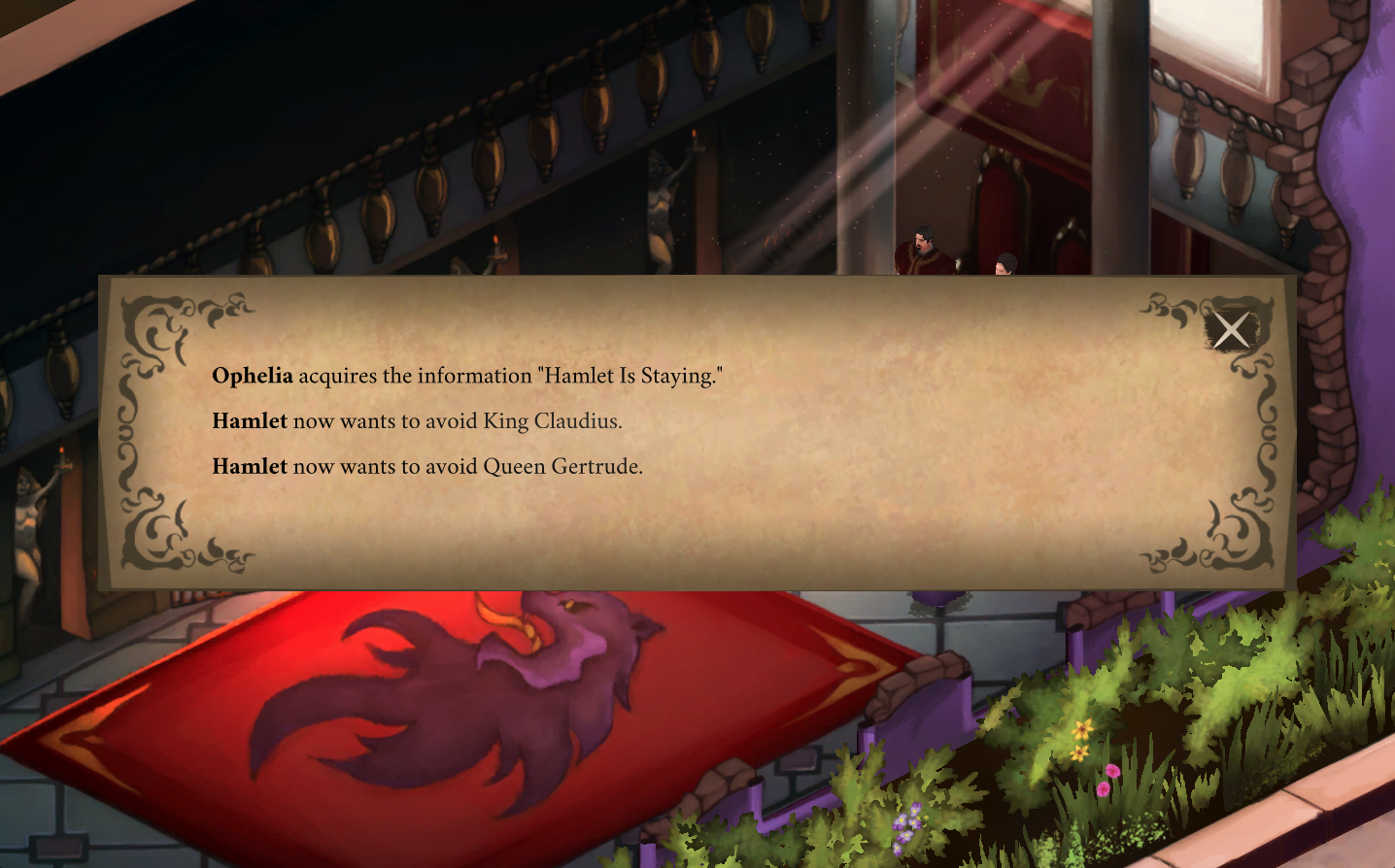
Conversation is organized around events — triggered by time and narrative preconditions, and which allow you to learn things just by being in the right place at the right time — and your inventory of hearsay, provocative things you can tell other characters during the course of play. When you share information with a character, their knowledge and motives are explicitly updated:

In this scene, Ophelia has just listened to an event and learned new information; and Hamlet has updated his own preferences and plans as a result.
Continue reading “Elsinore (Golden Glitch)”

Links and Structures from Michael Joyce to Twine

A look at some articles from the scholarship of literary hypertext, and thoughts about how their concerns and terms relate to current work in Twine and other procedural literature.

Recently I’ve been including some coverage here of academic materials that might be of interest to industry or hobbyist readers. Some of that’s been focused on recent work in story generation or interactive narrative in some way.

Today’s example, by contrast, begins with a reading from a rather older paper: A Nonce Upon Some Times, by Michael Joyce in 1997. (If you want a proper citation: Modern Fiction Studies 43.3 (1997) 579-597.)

This article came to my attention because when I was responding to Mark Bernstein’s piece The Fellow Who Caught Fire, he called out that I was unfamiliar with something he considers to be essential reading in the field of literary hypertext.

“A Nonce Upon Some Times” raises questions about how we categorize hypertext structures, and what we understand from the meaning of these structures. Occasionally this is reminiscent of Sam Kabo Ashwell’s work or perhaps my own on small-scale structures in CYOA: what does it communicate when the author chooses a particular relationship between the available lexia?

Joyce, however, is overtly contemptuous of branching narrative:

The workshop exercise with which I began this essay seeks to isolate a set of primitive choices that both prompt the visual kinetic of rereading in hypertext and, at the same time, isolate the elements of what Douglas calls “a narrative of possibilities.”… It engages working writers with aesthetic and readerly questions about linking rather than encouraging a choose-your-own-adventure sort of drearily branching fiction.

…and what interests him is not the question of how one might project oneself into the role of a protagonist; not how one might experience agency, constraint, or non-agency through this pattern of links.

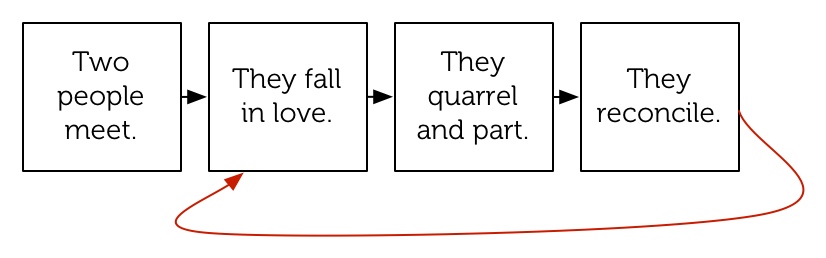
Joyce’s taxonomy is easier to diagram than to explain in words. He proposes that one start with a four part structure, linked linearly, which ends by going back to one of the earlier texts. I would diagram it like this:

Now: what happens next, after we have re-entered the second of the four texts? Where do we go from there, and is it different from where we might have gone the first time around, and what do these different arrangements mean?

Continue reading “Links and Structures from Michael Joyce to Twine”